
For people who struggle with consistency—whether due to fluctuating schedules, shifting priorities, or simply a lack of routine—the right planning system can mean the difference between frustration and progress. Two popular options dominate the personal organization space: bullet journals and pre-printed planners. While both aim to improve productivity and clarity, they serve different needs, especially when used by someone whose habits aren’t set in stone.
Inconsistent users often face unique challenges: missed entries, abandoned layouts, guilt over unused pages, or confusion from too much rigidity. The ideal planner should adapt to their rhythm, not force them into one. This article compares bullet journals and pre-printed planners through the lens of inconsistency, offering practical insights, real-life scenarios, and expert-backed guidance to help you choose the system that supports—not sabotages—your natural workflow.
The Inconsistency Factor: Why It Matters in Planning
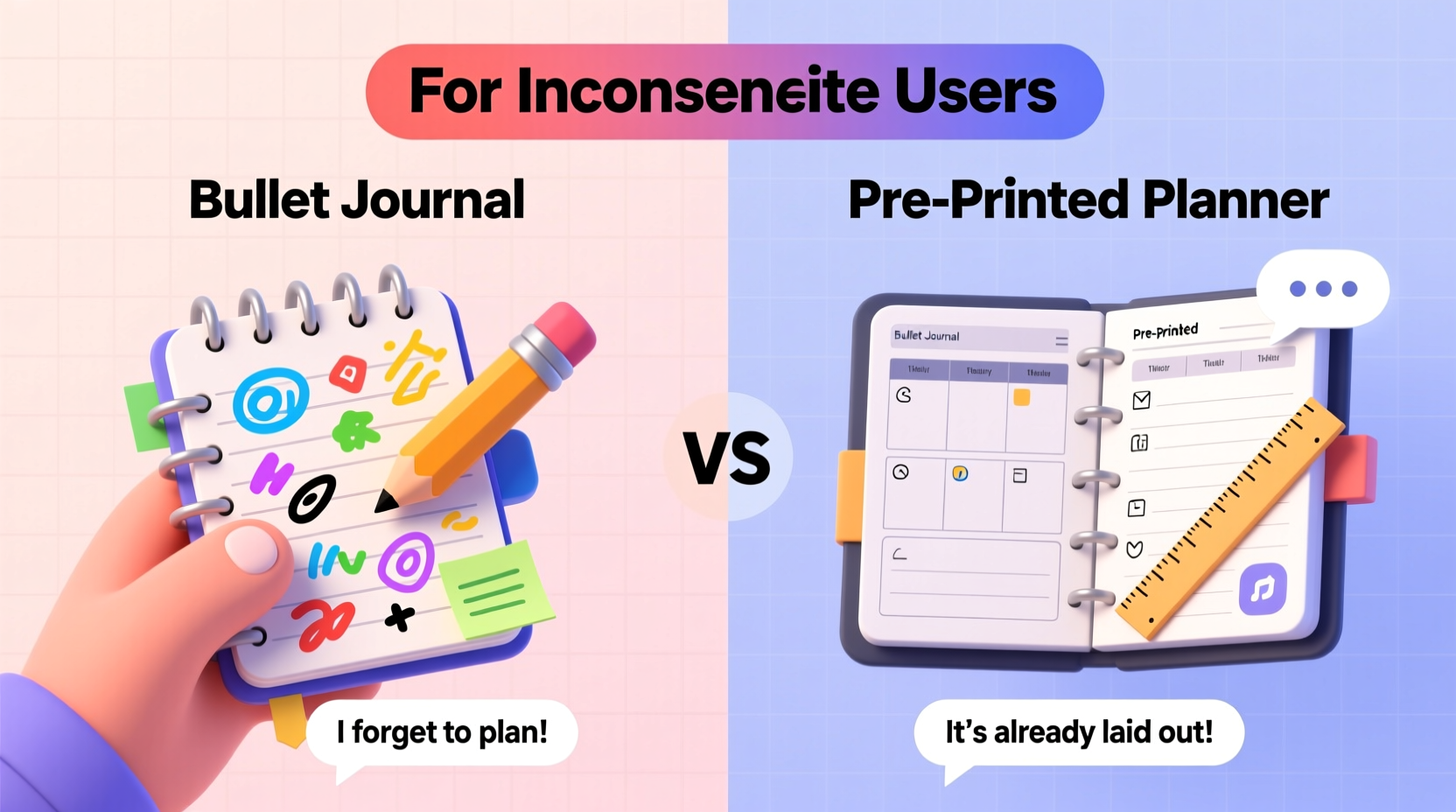
Inconsistency isn't a flaw—it's a reality for many. Life changes: workloads spike, energy levels vary, motivation waxes and wanes. A planning tool must accommodate these fluctuations without triggering discouragement. The problem arises when tools demand more than the user can give at any given moment.
Pre-printed planners offer structure but often come with fixed layouts, dated calendars, and rigid sections. When life gets chaotic, falling behind in such a planner can feel like failure. Bullet journals, on the other hand, are blank canvases—flexible but potentially overwhelming without clear direction.
The key question isn’t which system is “better” overall, but which one handles inconsistency with grace. Does it allow catch-up? Can it be resumed after long gaps? Is there minimal pressure to stay on track?
“Planning systems should reduce mental load, not increase it. For inconsistent users, the best tool is the one that survives interruption.” — Dr. Lena Torres, Cognitive Behavioral Therapist & Productivity Researcher
Bullet Journal: Freedom with Responsibility
Invented by designer Ryder Carroll, the bullet journal (or BuJo) is a customizable organization method built in a notebook using rapid logging, collections, and migration. Its core strength lies in its adaptability. You decide what goes in, how it’s formatted, and when to revise it.
For inconsistent users, this freedom can be liberating. There’s no wrong way to use it. Miss a week? Simply start a new page. Change your goals? Migrate unfinished tasks or create a new collection. No guilt over blank spreads or outdated monthly calendars.
However, this flexibility comes with responsibility. The blank page demands initiative. Without established routines, users may underuse the journal or abandon it entirely during low-motivation periods. Some report spending more time designing spreads than actually planning.
Pros of Bullet Journals for Inconsistent Users
- Adaptable layout: Modify or restart sections anytime.
- No wasted pages: Skip days or months without consequence.
- Migration feature: Carry forward tasks meaningfully instead of letting them expire.
- Creative outlet: Doodling or expressive writing can boost re-engagement.
Cons of Bullet Journals for Inconsistent Users
- Requires self-direction: No built-in prompts or structure.
- Learning curve: Indexing, signifiers, and migration take practice.
- Potential for over-engineering: Fancy spreads may deter actual use.
- No accountability cues: No daily lines or reminders to write.
Pre-Printed Planners: Structure with Constraints
Pre-printed planners come with predetermined layouts—daily, weekly, and monthly spreads, goal-setting pages, habit trackers, and sometimes inspirational quotes. Brands like Passion Planner, Erin Condren, and Panda Planner emphasize guided organization.
This built-in scaffolding benefits users who need cues to engage. Seeing a blank line for “Today’s Top 3 Tasks” prompts action, even on unmotivated days. The physical presence of dated pages creates gentle accountability.
But for inconsistent users, this same structure can backfire. Missing a few days leads to skipped pages. Falling behind in January doesn’t mean you can reset in February—the planner continues forward regardless. Many users report feeling “behind” and eventually abandoning the planner altogether.
Some high-end planners now offer undated versions or flexible layouts, bridging the gap between rigidity and adaptability. Still, most mass-market options remain date-specific, limiting their usefulness for erratic planners.
Pros of Pre-Printed Planners for Inconsistent Users
- Guided design: Built-in prompts reduce decision fatigue.
- Habit tracking: Visual consistency encourages small wins.
- Daily visibility: Seeing a page dedicated to each day increases engagement.
- Professional layouts: Save time on formatting and design.
Cons of Pre-Printed Planners for Inconsistent Users
- Inflexible dates: Hard to catch up after missing days.
- Wasted space: Blank pages can induce guilt or shame.
- One-size-fits-all: May not reflect changing priorities.
- Cost: High-quality planners are expensive and harder to replace mid-year.
Comparative Analysis: Bullet Journal vs Pre-Printed Planner
| Feature | Bullet Journal | Pre-Printed Planner |
|---|---|---|
| Flexibility | High – fully customizable | Low to Medium – fixed layouts |
| Recovery After Gaps | Easy – just start a new page | Difficult – dated pages accumulate |
| Setup Time | Moderate to High – requires initial effort | Low – ready to use out of box |
| Cognitive Load | Higher – demands consistent input | Lower – provides structure |
| Cost Over Time | Low – one notebook lasts months | High – annual purchase required |
| Best For | Users who value creativity and control | Users who thrive on routine and guidance |
Real-World Example: Sarah’s Struggle With Consistency
Sarah, a freelance graphic designer, tried both systems over two years. In 2022, she bought a premium pre-printed planner with monthly goals, weekly spreads, and gratitude prompts. Initially excited, she filled the first month diligently. Then a client project ran late, her sleep schedule collapsed, and she missed three consecutive days. Returning to the planner, she saw blank pages and felt defeated. She didn’t open it again until April—and by then, the dated format made restarting awkward. She eventually switched to a bullet journal.
At first, Sarah was overwhelmed by the blank pages. But she adopted a minimalist approach: one daily log, a habit tracker on the opposite page, and monthly reflections. When she skipped a week, she didn’t panic—she migrated tasks and continued. Over time, her journal became less about perfection and more about awareness. Even on days she wrote only one sentence, she maintained continuity.
“The bullet journal doesn’t judge me for being absent,” Sarah says. “It just waits. The pre-printed planner felt like a teacher marking my absences.”
Step-by-Step Guide: Choosing Your Ideal System
If you're unsure which planner suits your inconsistent habits, follow this five-step process:
- Assess Your Current Rhythm
Track your planning behavior for one week. Note: How often do you open a planner? What triggers use or avoidance? Are you more productive with structure or freedom? - Test Both Systems Briefly
Spend one week with a simple bullet journal (use a cheap notebook). Then try a sample page from a pre-printed planner (many brands offer free downloads). Compare engagement levels. - Evaluate Recovery Ease
Intentionally skip two days. When you return, which system feels easier to resume? Which one causes less stress? - Identify Your Motivators
Do you respond better to visual prompts (pre-printed) or creative ownership (bullet journal)? Are you motivated by aesthetics or functionality? - Commit and Simplify
Choose one system and strip it down. For bullet journals: limit yourself to task logging and one tracker. For pre-printed planners: ignore irrelevant sections and focus on daily use.
Expert Insight: The Psychology of Planner Persistence
Dr. Lena Torres emphasizes that the effectiveness of any planner depends on cognitive accessibility. “Tools that require high initiation effort fail during low-energy phases,” she explains. “Inconsistent users benefit most from systems with low activation energy—those that can be used in five minutes or less.”
She recommends bullet journals for users with variable focus, provided they adopt simplified frameworks. “A complex bullet journal with 20 collections is no better than an ornate planner you never open. Simplicity enables resilience.”
“The most effective planners aren’t the prettiest—they’re the ones you actually use, even when you’re tired, distracted, or overwhelmed.” — Dr. Lena Torres
Frequently Asked Questions
Can I use a bullet journal if I’m not artistic?
Absolutely. Bullet journaling is about function, not artistry. Minimalist designs with clean lists and basic symbols are perfectly valid. Many users prefer plain, utilitarian layouts that prioritize clarity over decoration.
Are undated pre-printed planners a good compromise?
Yes. Undated planners remove the pressure of fixed dates while retaining structured layouts. You can start on any day and progress at your own pace. Brands like Cultivate What Matters and some kikki.K editions offer this format, making them ideal for inconsistent planners seeking guidance without rigidity.
How do I avoid burnout with either system?
Start small. Limit your entries to 2–3 essential elements: daily tasks, mood check-in, and one priority. Avoid elaborate setups. Revisit your system monthly—remove what isn’t working. Remember, maintenance beats perfection.
Final Recommendation: The Verdict for Inconsistent Users
After evaluating flexibility, recovery ease, cognitive load, and real-world usability, the bullet journal emerges as the more forgiving option for inconsistent users—provided it’s used simply. Its ability to pause, pivot, and restart without penalty aligns with the unpredictable nature of modern life.
That said, pre-printed planners win for users who respond well to external structure and need prompts to initiate action. If you find comfort in routine and rarely go more than a few days off-track, a well-chosen planner can sustain momentum.
The truth is, neither system is universally superior. The best choice depends on your psychological relationship with consistency. Ask yourself: Do you need permission to begin again? Or do you need a nudge to keep going?
Take Action Today
Don’t wait for the “perfect” planner or a fresh start. Grab any notebook or print a blank calendar grid and begin with one entry: your top priority for today. Test both methods over two weeks. Notice which one feels lighter, more intuitive, and less burdensome. The right tool won’t fix inconsistency—but it can make navigating it far less stressful.




 浙公网安备
33010002000092号
浙公网安备
33010002000092号 浙B2-20120091-4
Comments
No comments yet. Why don't you start the discussion?