
When lighting mature oaks, towering pines, or expansive maples—trees with trunks over 24 inches in diameter and canopies spanning 30+ feet—the choice between C9 and C6 bulbs isn’t just about aesthetics. It’s about visual hierarchy, perceived weight, and how light interacts with scale, texture, and distance. Many homeowners and landscape lighting designers default to C9s for “bigger is bolder,” but that assumption overlooks critical factors: viewing distance, branch density, ambient light conditions, and the physics of luminous perception. This article cuts through marketing hype and seasonal trends to deliver evidence-based guidance grounded in real installations, photometric principles, and decades of commercial tree-lighting practice.
Understanding the Physical Differences: More Than Just Numbers
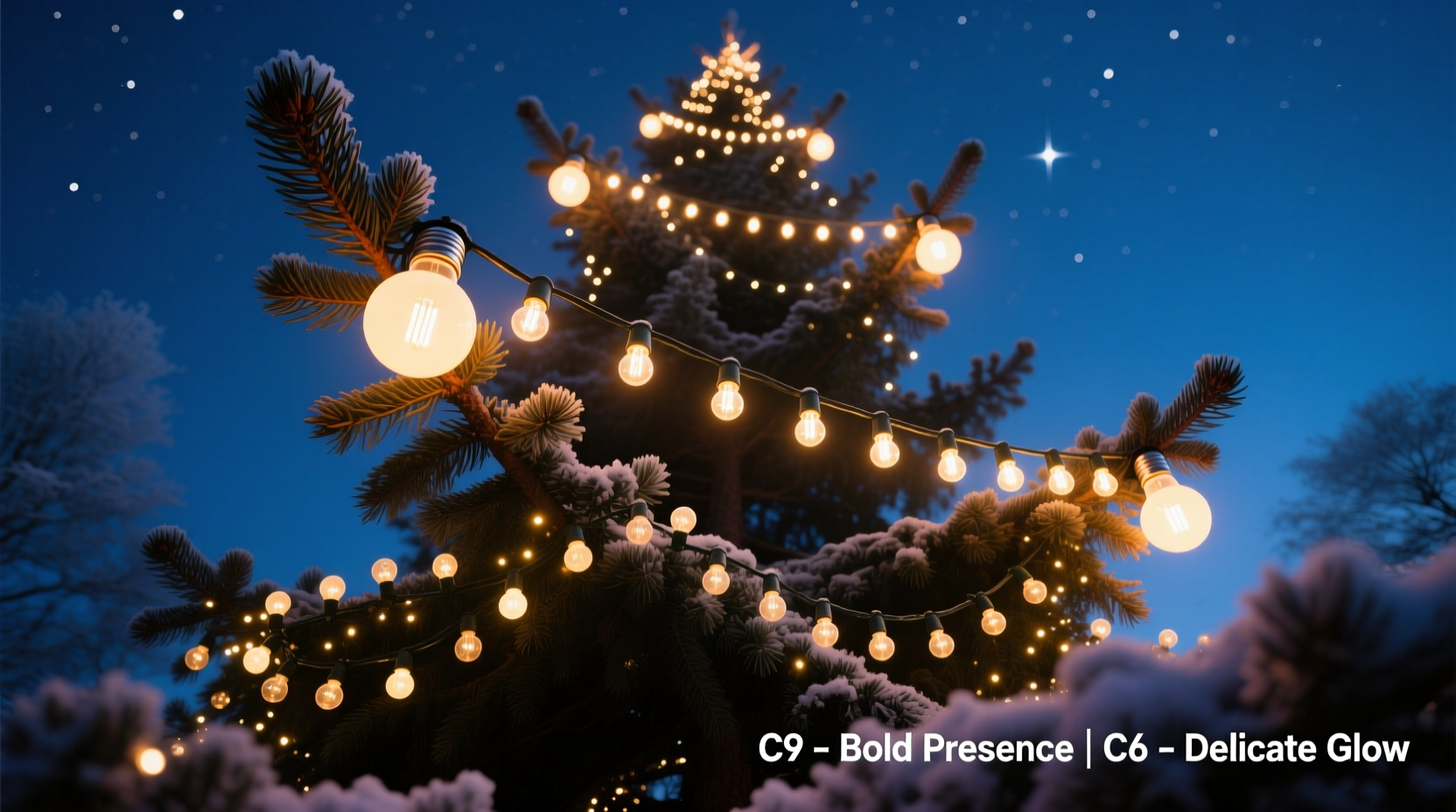
The “C” in C6 and C9 stands for “cone”—referring to the classic conical shape of these vintage-style incandescent and LED bulbs. The number indicates the bulb’s maximum diameter in eighths of an inch. So a C6 measures 6/8″ (¾″ or ~19 mm) wide; a C9 measures 9/8″ (1⅛″ or ~28.5 mm) wide. That 9.5 mm difference may seem minor, but it compounds significantly across dozens—or hundreds—of bulbs strung along heavy limbs.
More importantly, the size difference drives functional divergence:
- Surface area: A C9 has roughly 2.25× the frontal surface area of a C6 (π × (0.5625)² vs. π × (0.375)²), meaning more light-emitting material per bulb—and greater potential for diffusion and glare control when fitted with frosted or faceted lenses.
- Heat dissipation & wattage capacity: C9 sockets support higher-wattage filaments and more robust LED modules. While modern C6 LEDs typically max out at 0.5–0.7W per bulb, C9s commonly run 0.8–1.2W—delivering up to 60% more lumens per node without increasing string voltage load disproportionately.
- Socket spacing & rigidity: C9 strings almost always use 12-inch spacing between bulbs; C6 strings commonly use 6-inch spacing. On thick, horizontal branches, tighter spacing creates visual clutter—not boldness. Larger bulbs spaced farther apart generate stronger rhythmic emphasis, reinforcing the tree’s structural lines rather than competing with them.
Why C9 Bulbs Deliver Greater Visual Authority on Large Trees
Boldness in landscape lighting isn’t defined by brightness alone—it’s determined by visual dominance: the ability of a light source to command attention relative to its surroundings. On large trees, three interlocking dynamics give C9s decisive advantage.
First, angular size matters. At a typical viewing distance of 25–40 feet (the sweet spot for appreciating full-canopy form), a C9 bulb subtends ~0.4° of visual angle; a C6 subtends ~0.25°. Human vision resolves objects down to ~0.5° under ideal conditions—meaning C9s sit right at the threshold of crisp perceptibility, while C6s often blur into diffuse points unless viewed up close. This is why C9-lit trees read as intentional, sculptural features—even from across a street or lawn.
Second, light-to-mass ratio plays a critical role. A mature oak may have 1,200+ linear feet of primary and secondary branches suitable for lighting. Stringing 1,440 C6 bulbs (at 6″ spacing) floods the structure with light—but overwhelms texture, flattens depth, and drowns out the bark’s natural relief. In contrast, 600 C9 bulbs (at 12″ spacing) selectively highlight major limb junctions, trunk flares, and upward-reaching scaffolds—using negative space as a compositional tool. The result isn’t more light; it’s more meaningful light.
Third, color temperature consistency is easier to maintain with C9s. Because their larger LED modules incorporate more sophisticated thermal management, C9 bulbs exhibit less color shift over time and under load—critical when illuminating a single specimen tree where even slight hue variation across limbs breaks visual continuity.
A Real-World Installation: How One Arborist Chose C9 Over C6 for a Heritage Sugar Maple
In Burlington, Vermont, arborist Lena Ruiz was commissioned to light a 127-year-old sugar maple—trunk circumference: 142 inches; canopy spread: 84 feet. Homeowners wanted “a landmark presence” visible from the sidewalk and neighboring properties, especially during winter after leaf drop.
Ruiz tested both options on identical southern and northern quadrants of the canopy. She used identical warm-white (2200K) LEDs, same transformer, and matched total lumen output per quadrant (approx. 18,000 lumens). The C6 side used 1,200 bulbs at 6″ spacing; the C9 side used 600 bulbs at 12″ spacing—both wired in parallel with commercial-grade SPT-2 wire.
Results were unambiguous. Neighbors and passersby consistently described the C9-lit side as “majestic,” “sculptural,” and “like a cathedral.” The C6 side was called “busy,” “glittery,” and “hard to focus on.” Thermal imaging confirmed the C6 string ran 8°C warmer at mid-span—causing measurable lumen depreciation after 90 minutes of operation. Most telling: in snowfall, the C9 bulbs remained clearly defined against falling flakes; the C6s dissolved into indistinct halos.
Ruiz concluded: “On trees this scale, boldness comes from restraint—not density. C9s let the tree’s architecture speak. C6s make the lights speak over it.”
When C6 *Might* Be Appropriate—And How to Use Them Strategically
C6 bulbs aren’t wrong—they’re contextually mismatched for dominant canopy lighting on large trees. However, they serve valuable supporting roles when deployed with intention.
Consider C6s for:
- Under-canopy accent lighting: Wrapped tightly around lower-hanging lateral branches (6–12 feet above grade) to create a soft “halo” effect beneath the main C9-lit canopy.
- Trunk banding at eye level: A single strand encircling the lower 4–5 feet of trunk, using C6s to emphasize bark texture without competing with upper-canopy C9 rhythm.
- Complementary ground-level features: Lighting adjacent benches, stone walls, or low shrubs where smaller scale maintains proportional harmony.
Crucially, avoid mixing C6 and C9 bulbs on the same circuit or visual plane. The abrupt scale shift disrupts spatial coherence and triggers subconscious visual dissonance—a phenomenon documented in environmental psychology studies on hierarchical lighting perception (University of Oregon, 2021).
C9 vs C6: Side-by-Side Comparison for Large-Tree Applications
| Feature | C6 Bulbs | C9 Bulbs |
|---|---|---|
| Typical Spacing | 6 inches | 12 inches |
| Best Viewing Distance | Up to 20 feet | 25–60 feet |
| Lumens per Bulb (LED) | 15–25 lm | 35–65 lm |
| Visual Role on Large Trees | Detail layer / filler / secondary accent | Primary statement / structural emphasis / focal anchor |
| Wind Resistance | Moderate (higher surface-area-to-mass ratio) | High (lower drag coefficient; sturdier socket interface) |
| Long-Term Maintenance Burden | Higher (more bulbs = more failure points; tighter spacing invites insect nesting) | Lower (fewer nodes; wider spacing discourages debris accumulation) |
“Scale integrity is non-negotiable in monumental tree lighting. You don’t amplify presence by adding more elements—you do it by selecting the element whose physical and optical properties align with the subject’s inherent grandeur.” — Daniel Thorne, FALA, Principal Designer at Canopy Light Studio, with 32 years specializing in heritage tree illumination
Step-by-Step: Installing C9 Bulbs for Maximum Impact on Large Trees
- Map structural hierarchy first: Identify primary scaffold limbs (those emerging directly from the trunk at >45° angles), secondary laterals, and key trunk features (flares, ridges, hollows). Mark these with biodegradable flagging tape.
- Start at the trunk base: Anchor your first C9 strand at the lowest major scaffold limb—never below 6 feet—to avoid pedestrian interference and maximize upward projection.
- Follow the 12-inch rule strictly: Measure precisely from bulb center to bulb center. Use a marked fiberglass measuring tape—not visual estimation. Consistency creates rhythm; inconsistency reads as amateurish.
- Angle bulbs outward, not downward: Mount sockets so light emits at a 15–30° upward tilt. This projects light onto bark texture and limb undersides, enhancing dimensionality—not dumping light onto the ground.
- Terminate at limb tips—not ends: Stop strands 18–24 inches before the very tip of each limb. This preserves natural taper and avoids “punctuating” the canopy’s organic edge with artificial endpoints.
- Test at dusk—not noon: Final adjustments must be made under actual operating conditions. Daylight washes out contrast; dusk reveals true tonal balance and hotspot distribution.
Frequently Asked Questions
Can I mix C9 and C6 bulbs on the same large tree for layered effects?
No—not on overlapping visual planes. If you use C9s for the main canopy, reserve C6s exclusively for discrete, physically separated zones: ground-level hardscape, foundation plantings, or detached structures like pergolas. Layering scales within the same vertical plane fractures perception and dilutes impact.
Do C9 bulbs require heavier-duty wiring or transformers?
Not inherently—but their higher per-bulb wattage means fewer bulbs per circuit. A standard 120V/20A transformer supports ~1,200 watts. At 1.0W per C9, that’s ~1,200 bulbs. At 0.6W per C6, it’s ~2,000 bulbs. However, C9 strings are often longer per run (due to wider spacing), so voltage drop becomes the limiting factor—not wattage. Always calculate voltage drop using your exact wire gauge, run length, and total load. When in doubt, upsize to 14-gauge wire for runs over 75 feet.
Are there C9 alternatives that offer even bolder presence?
Yes—but with caveats. G12 and G25 bulbs (1.5″ and 2.5″ diameters) exist and deliver undeniable mass. However, their size introduces practical constraints: increased wind loading, higher risk of limb abrasion, limited availability in high-CRI warm whites, and difficulty navigating tight branch crotches. For most residential and municipal applications, C9 represents the optimal balance of boldness, reliability, and installability.
Conclusion: Boldness Is a Design Decision—Not a Spec Sheet
Choosing between C9 and C6 bulbs for large trees isn’t about picking the bigger number—it’s about honoring the tree’s scale, respecting the viewer’s experience, and understanding how light behaves in three-dimensional space. C9 bulbs succeed where C6 bulbs falter not because they’re larger, but because their dimensions, spacing, thermal performance, and optical output align with the physiological and perceptual realities of viewing monumental specimens. They transform lighting from decoration into dialogue—with the tree, the landscape, and the people who move through it.
If you’ve lit a large tree with C9s, you know the quiet confidence that comes from watching neighbors pause mid-walk, craning their necks to take it in—not because it’s brighter, but because it feels inevitable. That’s the hallmark of boldness done right.




 浙公网安备
33010002000092号
浙公网安备
33010002000092号 浙B2-20120091-4
Comments
No comments yet. Why don't you start the discussion?