
California Polytechnic State University—commonly known as Cal Poly—is one of the most sought-after public universities in the United States, particularly for students pursuing degrees in engineering, architecture, agriculture, and business. Despite its national reputation, many applicants are surprised to learn that Cal Poly does not accept the Common Application (Common App). This divergence from the norm raises an important question: Why doesn’t Cal Poly use the Common App?
The answer lies in a combination of institutional policy, system-wide mandates, and strategic admissions practices designed to maintain academic standards and align with the broader California State University (CSU) system. Understanding this decision not only clarifies the application process but also helps prospective students avoid confusion and prepare more effectively.
Understanding the CSU System’s Centralized Application Platform
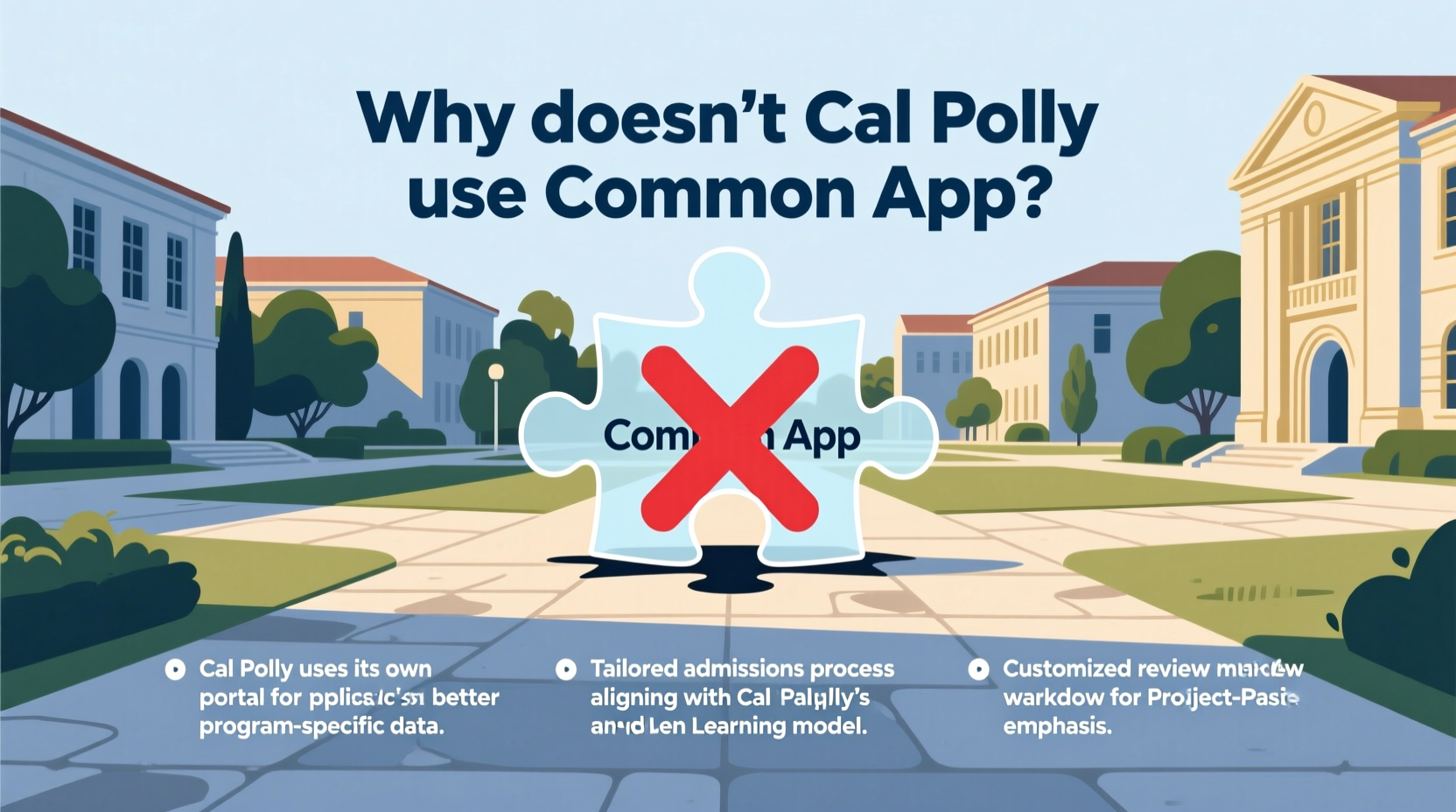
Cal Poly is part of the 23-campus California State University (CSU) system, the largest four-year public university system in the U.S. Unlike the University of California (UC) system or private institutions, the CSU system operates under a unified admissions framework that relies on its own application portal: CalState Apply.
All 23 CSU campuses—including Cal Poly San Luis Obispo and Cal Poly Humboldt—require applicants to submit their materials through CalState Apply. This centralized platform allows the CSU system to standardize data collection, streamline processing, and ensure equity across campuses. It also enables better coordination of residency verification, financial aid applications, and transfer credit evaluation.
The Common App, while widely adopted by private colleges and some public universities, is not integrated into the CSU infrastructure. Adopting it would require significant investment in compatibility, training, and administrative overhaul—without clear benefits to offset the costs.
“Using a single, system-wide application ensures consistency, reduces errors, and supports equitable access across diverse student populations.” — Dr. Maria Gonzalez, Former CSU Associate Vice Chancellor for Student Success
Key Differences Between Common App and CalState Apply
While both platforms serve the same fundamental purpose—collecting student information for admissions review—they differ significantly in structure, scope, and functionality.
| Feature | Common App | CalState Apply |
|---|---|---|
| Used By | Over 1,000 private and public colleges nationwide | All 23 CSU campuses only |
| Essay Requirements | One personal statement used for all schools | One personal insight response per campus (up to 8 prompts) |
| Application Fee | $0–$50 per school (fee waivers available) | $70 total (covers up to 3 campuses) |
| Recommendation Letters | Supported directly in the platform | Not submitted via CalState Apply; handled separately if required |
| Integration with Financial Aid | Separate FAFSA/CSS submission | Linked directly to CA Dream Act or FAFSA upon submission |
These differences highlight why Cal Poly cannot simply “opt in” to the Common App—it would disrupt the alignment with CSU policies, create inefficiencies, and potentially compromise data integrity.
How Cal Poly’s Selective Admissions Influences Its Process
Cal Poly is among the most selective CSU campuses, with an undergraduate acceptance rate hovering around 28% (as of recent cycles). This high demand necessitates a tailored admissions approach focused on academic preparation, major-specific readiness, and demonstrated interest in hands-on learning.
The CalState Apply platform allows Cal Poly to collect detailed information relevant to its Learn by Doing philosophy. For example:
- Applicants must select a primary major and sometimes a second choice, which triggers specific supplemental questions.
- Some programs, like Architecture or Industrial Engineering, may request portfolios or prerequisite coursework summaries outside the main application.
- The personal insight questions emphasize problem-solving, leadership, and real-world experience—values central to Cal Poly’s educational model.
By maintaining control over its application format, Cal Poly ensures that candidates are evaluated based on criteria most predictive of success within its rigorous, project-based curriculum.
Step-by-Step Guide to Applying to Cal Poly Without the Common App
For students accustomed to the Common App, navigating CalState Apply can feel unfamiliar. Here’s a clear timeline to stay on track:
- Research Deadlines: The application window opens October 1 and closes November 30 for fall admission. No extensions are granted.
- Create a CalState Apply Account: Visit calstate.edu/apply and register using your email.
- Select Campuses: Choose Cal Poly SLO (and up to two other CSUs) in one application.
- Enter Academic History: List all high schools, colleges attended, and coursework (including A-G requirements).
- Write Personal Insight Responses: Answer one of eight prompts (max 350 words each). Focus on depth, not breadth.
- Review and Submit: Pay the $70 fee (or request a waiver) and confirm submission before November 30.
- Monitor To-Do Lists: After submission, check your MyCSULearning portal regularly for missing documents.
Note: Standardized test scores (SAT/ACT) are not considered in Cal Poly admissions, consistent with CSU-wide policy.
Mini Case Study: Navigating the Transition from Common App Expectations
Jasmine, a high school senior from Texas, assumed she could apply to Cal Poly using the Common App, as she did for her other target schools. When she discovered Cal Poly wasn’t listed, she felt frustrated and delayed her application until mid-November.
After consulting her counselor, Jasmine created a CalState Apply account and realized she needed to tailor her personal insight response specifically to Cal Poly’s emphasis on experiential learning. She revised her essay to highlight her robotics team leadership and internship at a local engineering firm—experiences that aligned with Cal Poly’s culture.
She was admitted to the Mechanical Engineering program and later said, “I thought the separate app was a hassle, but writing a focused response actually helped me stand out.”
FAQ
Can I use my Common App essay for CalState Apply?
You can adapt your Common App personal statement as inspiration, but CalState Apply requires responses to specific personal insight questions (350 words max). Direct copying isn’t recommended due to differing prompts and audience.
Is CalState Apply secure and reliable?
Yes. CalState Apply is managed by the CSU Chancellor’s Office with enterprise-level security, regular backups, and technical support. Millions of students have successfully applied through the system since its launch.
Why do UC schools use their own app too?
Like the CSU system, the University of California uses its independent application (uc.edu/admissions) to maintain system-wide control, ensure policy compliance, and customize data collection. Neither UC nor CSU uses the Common App.
Checklist: Preparing Your Cal Poly Application
- ☑ Confirm you meet A-G course requirements (history, math, lab science, etc.)
- ☑ Research your intended major and prerequisites
- ☑ Prepare draft responses to all 8 personal insight questions
- ☑ Choose which prompt best reflects your strengths and experiences
- ☑ Gather parent/guardian info for financial and residency sections
- ☑ Request fee waiver if eligible (based on income or participation in college access programs)
- ☑ Submit before November 30—no exceptions
- ☑ Bookmark your MyCSULearning portal for post-submission updates
Conclusion
Cal Poly’s decision not to use the Common App is not arbitrary—it reflects a deliberate alignment with the CSU system’s operational efficiency, equity goals, and academic mission. While it may require extra effort from applicants used to national platforms, the CalState Apply process offers a focused opportunity to present yourself authentically to one of the nation’s top public polytechnic universities.
By understanding the reasons behind this choice and preparing accordingly, you position yourself for success—not just in admission, but in embracing the practical, innovative education Cal Poly is known for.




 浙公网安备
33010002000092号
浙公网安备
33010002000092号 浙B2-20120091-4
Comments
No comments yet. Why don't you start the discussion?