
When the lights go out, having a backup generator can mean the difference between comfort and chaos. But choosing the right generator isn’t just about picking the biggest model on the shelf. It’s about matching your actual power needs. Too small, and it won’t run essential appliances. Too large, and you’re wasting money and fuel. The key is calculating the total watts required to power your home efficiently. This guide walks you through every step—from identifying appliance loads to factoring in startup surges—so you can make an informed decision.
Understanding Generator Power: Running vs. Starting Watts
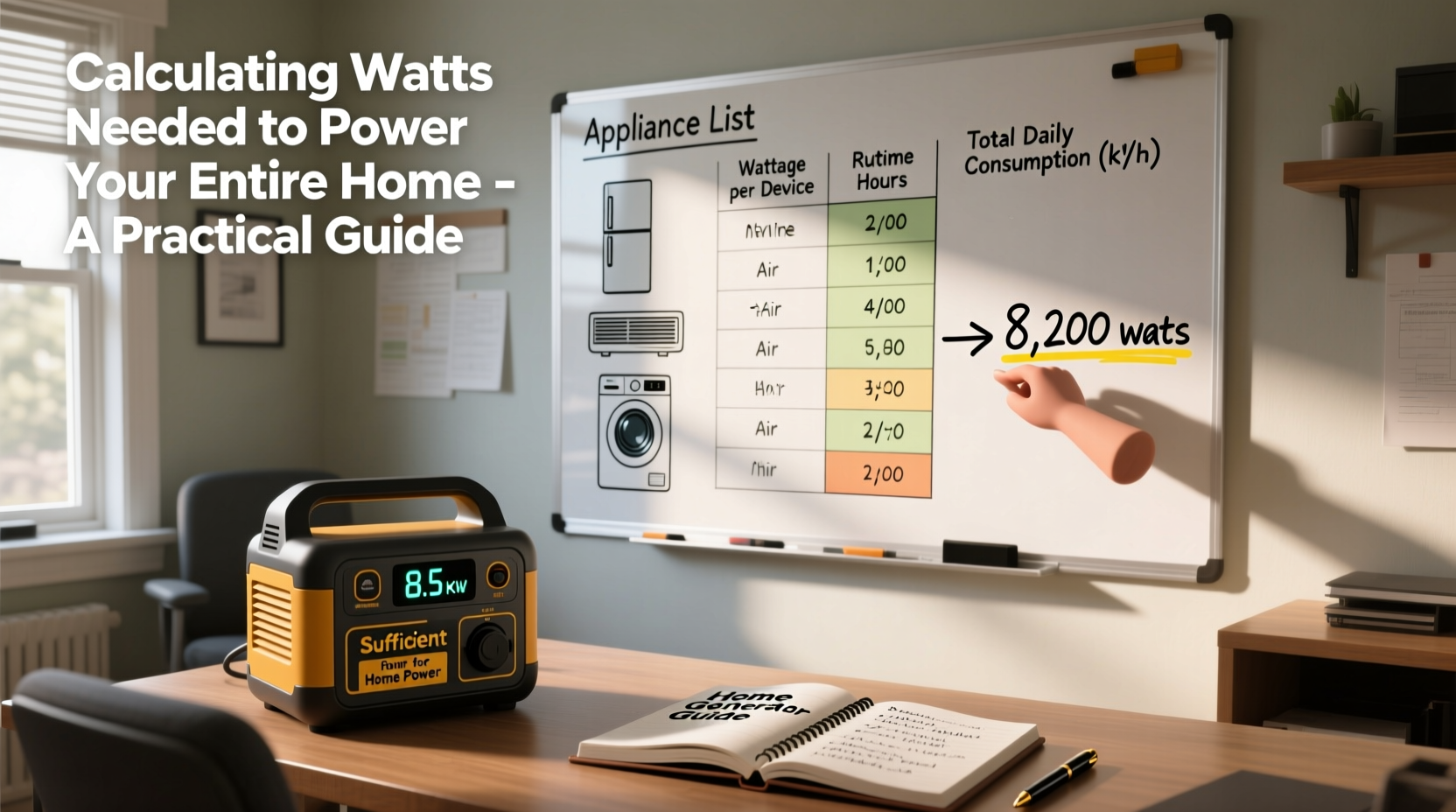
Before adding up your household devices, it’s crucial to understand the two types of electrical demands: running (or continuous) watts and starting (or surge) watts.
Running watts are the amount of power an appliance uses during normal operation. For example, a refrigerator might require 700 watts to keep running. However, when the compressor kicks in, it may briefly need 2,200 watts to start. This spike is known as the starting wattage.
Generators must be able to handle both the continuous load and the momentary surge. If the generator can’t supply enough starting watts, motors in refrigerators, air conditioners, or pumps may fail to start—or worse, damage the generator.
Step-by-Step: How to Calculate Your Home’s Total Wattage
Follow this structured approach to determine exactly how many watts you’ll need from a generator.
- Make a list of essential appliances. Focus on what you need during an outage: refrigerator, furnace fan, sump pump, well pump, lights, freezer, microwave, and perhaps a window AC unit.
- Find the wattage for each device. Check the label on the back or bottom of the appliance. Look for “watts,” “W,” or calculate using volts × amps = watts.
- Distinguish between running and starting watts. Some labels include both; others only list running watts. Use industry averages for motors (e.g., refrigerators often need 3× their running watts at startup).
- Add up the running watts. Sum all the continuous power requirements.
- Identify the largest starting watt demand. Add that surge value only once, since most appliances don’t start simultaneously.
- Total required watts = Sum of all running watts + Largest starting watt surge.
For example:
| Appliance | Running Watts | Starting Watts |
|---|---|---|
| Refrigerator | 700 | 2,200 |
| Well Pump | 1,000 | 2,500 |
| Furnace Fan | 800 | 1,600 |
| Microwave | 1,000 | 1,000 |
| LED Lighting (10 bulbs) | 100 | 100 |
| Wi-Fi Router & Modem | 20 | 20 |
Total running watts: 700 + 1,000 + 800 + 1,000 + 100 + 20 = 3,620 W
Largest starting watt: Well pump at 2,500 W
Total required generator capacity: 3,620 + 2,500 = 6,120 watts
In this scenario, a 7,000-watt generator would provide a safe margin.
Common Appliances and Their Typical Wattage
To help estimate power needs without checking every label, refer to this general reference table:
| Appliance | Running Watts | Starting Watts |
|---|---|---|
| Refrigerator (standard) | 700 | 2,200 |
| Freezer | 750 | 2,000 |
| Window AC (10,000 BTU) | 1,000 | 3,000 |
| Well Pump (1/2 HP) | 1,000 | 2,500 |
| Sump Pump (1/3 HP) | 800 | 2,000 |
| Furnace Fan (blower) | 800 | 1,600 |
| Microwave (1000W) | 1,000 | 1,000 |
| Coffee Maker | 800 | 800 |
| Laptop | 50 | 50 |
| LED Light Bulb (per bulb) | 10 | 10 |
Real-World Example: Powering a Mid-Sized Home During Winter
Consider Sarah, living in a 2,000-square-foot home in upstate New York. When winter storms knock out power, she wants to keep her family safe and warm. Her essentials include:
- Natural gas furnace with electric blower (800 running / 1,600 starting watts)
- Well pump (1,000 / 2,500 W)
- Refrigerator (700 / 2,200 W)
- Freezer (750 / 2,000 W)
- LED lighting (150 W total)
- Wi-Fi and phone chargers (50 W)
Total running watts: 3,450 W
Highest starting watt: 2,500 W (well pump)
Required capacity: 3,450 + 2,500 = 5,950 W
Sarah opts for a 7,500-watt standby generator. This provides headroom for occasional use of a space heater or microwave without overloading the system. She also installs a transfer switch to safely connect the generator and avoid backfeeding the grid.
“Many homeowners underestimate surge power. A generator rated just under the startup demand will stall when critical equipment tries to turn on.” — James Lyle, Certified Electrician and Backup Power Consultant
Generator Sizing Checklist
Use this checklist before purchasing or installing a generator:
- ✅ Identify which appliances are essential during an outage
- ✅ Record running and starting wattage for each device
- ✅ Add all running watts together
- ✅ Identify the highest starting watt requirement
- ✅ Add that surge value to the total running watts
- ✅ Choose a generator with at least 10–20% more capacity than your calculated total
- ✅ Install a transfer switch for safety and code compliance
- ✅ Test the system annually under load
Frequently Asked Questions
Can I power my whole house with a portable generator?
Yes, but only if it’s large enough and connected properly via a transfer switch. Most portable units range from 3,000 to 12,000 watts. Homes over 2,500 sq ft with central AC or electric heating usually require more power than portables can deliver reliably.
What’s the difference between a portable and a standby generator?
Portable generators are manually operated, fueled by gasoline, and plugged into individual circuits or a transfer switch. Standby generators run on natural gas or propane, automatically kick in during outages, and are permanently installed. Standby models typically offer higher wattage and seamless operation.
Do I really need to account for starting watts?
Absolutely. Ignoring surge demands is the most common reason generators fail under load. Motors in refrigerators, pumps, and compressors draw significantly more power at startup. Even if your running load is within limits, a single motor starting can overload an undersized unit.
Final Considerations and Safety Notes
Accuracy matters, but so does safety. Never plug a generator directly into a wall outlet—a practice known as \"backfeeding\"—as it can electrocute utility workers and damage your home’s wiring. Always use a properly installed transfer switch or interlock kit approved by local codes.
Also consider fuel type and runtime. Gasoline-powered portables may run 8–12 hours on a tank, while propane or diesel models can last longer. Standby units tied to natural gas lines can operate indefinitely during prolonged outages.
Take Control of Your Power Future
Knowing exactly how many watts your home needs isn’t just technical prep—it’s peace of mind. By taking the time to assess your real power demands, you avoid guesswork, ensure reliability, and protect your investment. Whether you choose a portable unit for occasional use or a full standby system, accurate calculation is the foundation of smart preparedness. Start today by auditing your appliances, and take the first step toward uninterrupted power when you need it most.




 浙公网安备
33010002000092号
浙公网安备
33010002000092号 浙B2-20120091-4
Comments
No comments yet. Why don't you start the discussion?