
For decades, doodling has been dismissed as a sign of distraction—a mindless scribble made while the brain checks out. In meeting rooms, classrooms, and conference calls, doodlers have often been labeled unfocused or disengaged. But recent research and cognitive science tell a different story. Far from being a distraction, doodling may actually help people retain information, spark creative insights, and solve complex problems more effectively. In fact, some of the world’s most innovative thinkers—from Leonardo da Vinci to Steve Jobs—filled their notebooks with sketches, arrows, and abstract shapes while processing ideas.
In today’s fast-paced work environments, where back-to-back meetings dominate schedules, finding ways to stay mentally engaged is critical. Doodling, it turns out, might be one of the simplest yet most powerful tools for enhancing cognitive performance during group discussions and brainstorming sessions.
The Science Behind Doodling and Cognitive Engagement
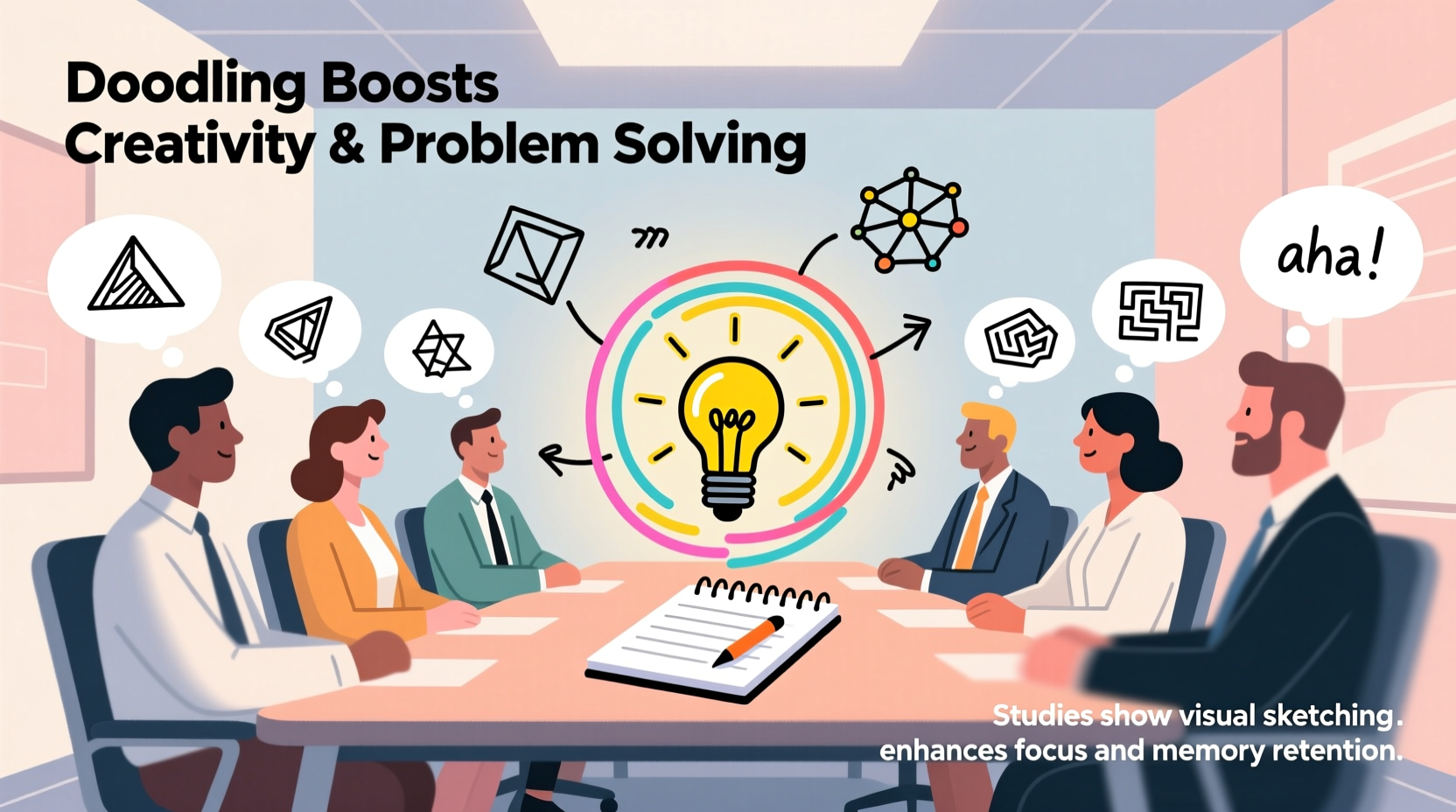
Doodling isn’t just idle drawing—it’s a form of low-level cognitive activation that keeps the brain alert without overloading it. A landmark 2009 study published in Applied Cognitive Psychology found that participants who were allowed to doodle while listening to a monotonous phone message recalled 29% more information than those who didn’t. The researchers concluded that doodling prevents the mind from wandering into more distracting daydreams by occupying just enough mental bandwidth to maintain focus.
This phenomenon is linked to what neuroscientists call “default mode network” (DMN) regulation. When we’re not actively engaged in a task, the DMN activates, leading to mind-wandering and reduced attention. Doodling acts as a mild cognitive anchor, suppressing excessive DMN activity while still allowing the brain to process incoming information subconsciously.
“Doodling helps stabilize attention during passive listening tasks. It’s not a sign of boredom—it’s a self-regulation strategy.” — Dr. Jackie Andrade, Cognitive Psychologist, University of Plymouth
Moreover, visual-spatial engagement through drawing—even simple shapes or patterns—activates areas of the brain associated with memory encoding and creative thinking. This dual-processing ability allows individuals to absorb verbal input while simultaneously exploring visual metaphors, connections, and solutions.
How Doodling Enhances Creativity and Problem Solving
Creativity doesn’t always emerge from intense concentration. Often, breakthrough ideas come during moments of relaxed awareness—like walking, showering, or yes, doodling. When the conscious mind is occupied with a repetitive motor task like sketching lines or shapes, the subconscious mind gains space to make novel associations.
In meetings, especially those involving strategic planning or innovation workshops, doodling can serve as a silent incubator for ideas. Instead of passively absorbing bullet points, a person who doodles might begin mapping relationships between concepts, sketching out flowcharts, or illustrating metaphors that clarify abstract topics.
Consider this: when someone doodles a lightbulb next to a discussion about innovation, they aren’t just copying an icon—they’re reinforcing the concept visually, making it more memorable. If they draw arrows connecting people, ideas, or departments, they may unconsciously identify collaboration gaps or workflow inefficiencies.
Real-World Example: Google’s Design Sprints
At Google Ventures, design sprints rely heavily on visual thinking. During intensive five-day innovation cycles, participants are encouraged to sketch ideas continuously—not just during dedicated brainstorming sessions but also while others are speaking. These sketches aren’t expected to be artistic; they’re tools for rapid ideation.
In one documented sprint, a product team was struggling to define user pain points for a healthcare app. Midway through a discussion, a UX researcher began doodling a patient’s journey as a winding road with potholes labeled “insurance delays” and “confusing forms.” That simple sketch became the foundation for the team’s empathy map and directly influenced the app’s navigation structure.
This example illustrates how doodling transforms abstract dialogue into tangible visuals, enabling teams to see problems from new angles and co-create solutions more effectively.
Doodling vs. Traditional Note-Taking: A Comparative Analysis
While traditional note-taking emphasizes verbatim recording, doodling supports conceptual understanding. Each method has strengths, but they serve different cognitive functions.
| Aspect | Traditional Note-Taking | Doodling / Visual Note-Taking |
|---|---|---|
| Mental Focus | Verbal processing, linear logic | Visual-spatial reasoning, pattern recognition |
| Memory Retention | Moderate (depends on review) | High (dual-coding effect: visual + verbal) |
| Creativity Support | Limited | Strong—encourages metaphorical thinking |
| Meeting Engagement | Active but can lead to transcription fatigue | Sustained attention through motor engagement |
| Problem-Solving Utility | Useful for documenting decisions | Ideal for identifying patterns and generating ideas |
The dual-coding theory in psychology suggests that information presented both verbally and visually is more likely to be remembered. Doodling leverages this principle naturally, embedding key ideas within visual frameworks that are easier to recall later.
Practical Ways to Use Doodling in Meetings
Integrating doodling into professional settings requires a shift in perception—from seeing it as off-task behavior to recognizing it as a legitimate cognitive tool. Here’s how individuals and teams can harness its power constructively.
Step-by-Step Guide: Turning Doodles Into Insights
- Start with intention: Before the meeting begins, set a personal goal—e.g., “I want to understand the core challenge” or “I’m looking for connections between departments.”
- Listen for keywords: As speakers talk, jot down key terms and immediately surround them with simple icons (a gear for process, a person for roles, a cloud for ideas).
- Map relationships: Use arrows, circles, or containers to link related concepts. Don’t worry about neatness—focus on capturing associations.
- Identify patterns: Look for recurring themes in your sketches. Are certain issues appearing in multiple contexts? That could signal a systemic problem.
- Share selectively: After the meeting, review your doodles. If you’ve uncovered a useful insight, share it with the team using your sketch as a conversation starter.
Checklist: Healthy Doodling Habits in Professional Settings
- ✅ Doodle to stay focused, not to escape the conversation
- ✅ Keep sketches loosely connected to the topic (avoid unrelated drawings)
- ✅ Use symbols consistently (e.g., question marks for uncertainties)
- ✅ Review doodles post-meeting for insights or follow-up questions
- ✅ Share visual notes if they add value to team understanding
- ✅ Respect meeting norms—avoid loud pen-clicking or obstructive movements
Overcoming Skepticism and Building a Doodle-Friendly Culture
Despite growing evidence, many managers still view doodling as unprofessional. To normalize it in the workplace, employees and leaders alike need to reframe the narrative around visual thinking.
One effective approach is to introduce “sketch sharing” at the end of meetings. Invite participants to briefly show their notes or doodles and explain one insight they captured. This practice validates diverse thinking styles and demonstrates that non-linear processing contributes to collective intelligence.
Companies like Dropbox and IDEO have incorporated visual facilitation into their meeting culture, employing “live illustrators” who translate discussions into large-scale murals in real time. While not every team needs a professional illustrator, adopting even basic visual habits can elevate communication clarity and engagement.
“People think doodling distracts from listening. But when done purposefully, it deepens comprehension and unlocks lateral thinking.” — Sunni Brown, Author of *The Doodle Revolution*
FAQ: Common Questions About Doodling in Meetings
Isn’t doodling just a way to zone out?
Not necessarily. While aimless drawing can indicate disengagement, structured or semi-structured doodling actually helps sustain attention. The key is whether the doodling relates to the content. When tied to the discussion, it becomes active listening in visual form.
What if I’m not good at drawing?
Doodling isn’t about artistic skill—it’s about visual thinking. Simple shapes, lines, and symbols are all you need. A circle with a face can represent a person; a jagged line can mean conflict. The goal is clarity, not aesthetics.
Can doodling be effective in virtual meetings?
Absolutely. Use digital tools like tablets with styluses, whiteboard apps (Miro, Jamboard), or even paper and camera sharing. The physical act of drawing remains beneficial regardless of the meeting format.
Conclusion: Rethink the Scribble, Unlock New Thinking
Doodling deserves a place at the meeting table—not as a guilty habit, but as a proven cognitive strategy. By engaging both hemispheres of the brain, supporting memory retention, and fostering creative connections, doodling transforms passive listeners into active thinkers. In an era where innovation depends on fresh perspectives, something as simple as a pen and notebook might be the most underrated tool in your professional arsenal.
The next time you find yourself sketching stars, boxes, or abstract swirls during a strategy call, don’t stop. Lean into it. Let your hand guide your mind toward insights that linear notes alone might never reveal. And if someone questions your focus, share the science: sometimes, the deepest thinking happens not in silence, but in the margins.




 浙公网安备
33010002000092号
浙公网安备
33010002000092号 浙B2-20120091-4
Comments
No comments yet. Why don't you start the discussion?