
For many adults living with Attention-Deficit/Hyperactivity Disorder (ADHD), maintaining focus during work, conversations, or even quiet tasks can feel like an uphill battle. Traditional coping mechanisms—timers, lists, and medication—are helpful, but they don’t address the physical restlessness that often accompanies ADHD. Enter fidget toys: small, handheld tools designed to occupy restless hands. While commonly associated with children, their use among adults is growing. But do they actually help improve focus? The answer, supported by emerging research and anecdotal evidence, is increasingly yes—when used intentionally.
The Science Behind Movement and Focus
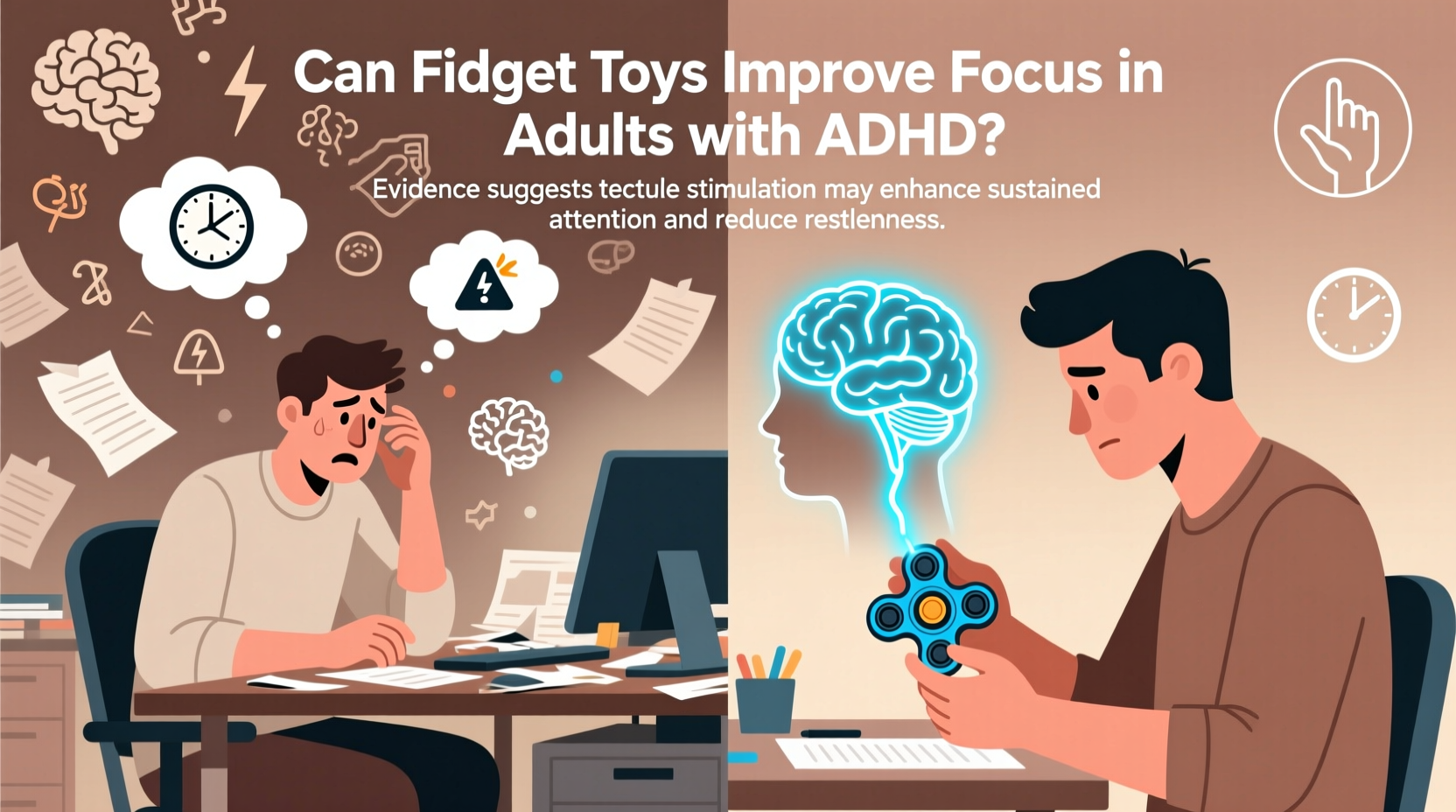
Contrary to outdated assumptions, movement isn’t always a distraction for people with ADHD—it can be a critical component of concentration. Neurological studies suggest that individuals with ADHD have differences in dopamine regulation and executive function. Physical stimulation, such as tapping a pen or squeezing a stress ball, may help modulate arousal levels in the brain, promoting alertness without overstimulation.
A 2015 study published in the Journal of Abnormal Child Psychology found that children with ADHD who were allowed to move more—fidgeting, leg bouncing, etc.—performed better on cognitive tasks requiring attention. While this study focused on children, its implications extend to adults, whose neurobiology remains similar. The act of fidgeting appears to serve as a self-regulatory mechanism, helping the brain reach an optimal state for processing information.
“Movement isn’t the enemy of focus for people with ADHD—it’s often the bridge to it.” — Dr. Russell Barkley, Clinical Neuropsychologist and ADHD Researcher
This insight reframes fidgeting not as a behavior to suppress, but as a potential tool to harness. Fidget toys provide a socially acceptable and controlled outlet for this need to move, reducing disruptive behaviors while supporting mental engagement.
How Fidget Toys Work for Adults with ADHD
Fidget toys operate on the principle of “dual-task processing.” By occupying part of the brain with a simple, repetitive motor task—like spinning a ring or clicking a button—the prefrontal cortex is freed from managing excess sensory input or internal restlessness. This allows cognitive resources to redirect toward the primary task, such as reading, listening in a meeting, or writing.
Common types of fidget toys include:
- Fidget spinners: Smooth rotational motion provides visual and tactile feedback.
- Pop-its: Satisfying bubble-popping action offers rhythmic sensory input.
- Tangle toys: Interlocking, bendable segments allow silent manipulation.
- Stress balls: Compression-based resistance helps release tension.
- Fidget cubes: Multi-sided gadgets with buttons, switches, and sliders.
For adults, discretion matters. A loud click or flashy spinner might draw unwanted attention in a professional setting. That’s why many opt for minimalist designs—such as textured rings, magnetic desk toys, or even smooth stones kept in a pocket—that offer sensory engagement without disruption.
Real-World Impact: A Case Study
Consider Mark, a 38-year-old software developer diagnosed with ADHD in his late twenties. He struggled with long coding sessions, often losing focus after 20 minutes. Despite using productivity apps and time-blocking techniques, he found himself pacing, checking his phone, or doodling excessively. His therapist suggested trying a fidget toy during deep work periods.
Mark started with a quiet tangle toy, twisting it unconsciously while debugging code. Within a week, he noticed fewer interruptions in his workflow. “It’s like my hands had somewhere to go,” he said. “Instead of getting up every few minutes, I stayed seated and actually finished tasks faster.” Over time, he experimented with different tools and settled on a magnetic desktop sculpture that allowed subtle finger movements without drawing attention.
His experience aligns with what clinicians observe: when fidget tools are integrated into a personalized focus strategy, they can significantly reduce off-task behavior and increase task persistence.
Do’s and Don’ts of Using Fidget Toys Effectively
Not all fidgeting leads to improved focus. The key lies in intentional use. Below is a comparison of effective versus counterproductive practices.
| Do’s | Don’ts |
|---|---|
| Use toys purposefully: Engage only during tasks requiring sustained attention. | Mindless overuse: Constantly playing with a toy even when not focusing can become a distraction. |
| Choose low-sensory options: Opt for quiet, non-visual tools in group settings. | Select flashy or noisy tools: These can disrupt others and shift focus away from the task. |
| Pair with other strategies: Combine with timers, task lists, or ambient noise. | Rely solely on the toy: It’s a support tool, not a standalone solution. |
| Experiment mindfully: Try different textures, resistance levels, and forms. | Stick to one type out of habit: What works today may not work tomorrow. |
Step-by-Step Guide to Incorporating Fidget Tools
If you’re new to fidget toys or haven’t found success with them before, follow this structured approach to integrate them effectively into your daily routine.
- Assess your focus challenges: Identify when and where you lose concentration. Is it during meetings? Long reading sessions? Creative work?
- Select a discreet, comfortable toy: Start with something simple—like a soft silicone ring or a smooth worry stone.
- Introduce it during low-stakes tasks: Use it while replying to emails or organizing files to build familiarity.
- Monitor your focus duration: Track how long you stay engaged compared to days without the toy.
- Adjust based on feedback: If the toy distracts, switch to a less stimulating option. If it helps, expand usage to higher-focus tasks.
- Combine with behavioral strategies: Pair fidget use with the Pomodoro Technique (25-minute focus blocks) or mindfulness breathing.
This methodical integration prevents the toy from becoming just another novelty and instead embeds it as part of a broader focus system.
Expert Perspectives and Clinical Support
Occupational therapists have long advocated for sensory tools in managing ADHD symptoms. According to Dr. Sarah Lyon, an occupational therapist specializing in adult neurodiversity, “Fidget tools fall under the umbrella of sensory modulation strategies. They help regulate the nervous system, which in turn supports cognitive performance.”
She emphasizes that effectiveness depends on personal preference: “One person might thrive with a chewable necklace, another with a weighted lap pad. The goal is matching the tool to the individual’s sensory profile.”
Clinical psychologists also recognize their role. In cognitive-behavioral therapy (CBT) for ADHD, fidget toys are sometimes recommended as part of impulse control training. By giving restlessness a constructive outlet, clients report reduced anxiety and improved ability to stay present in conversations or meetings.
“We don’t expect someone with poor vision to squint harder—we give them glasses. Why should we expect someone with ADHD to ‘just focus’ without tools?” — Dr. Ari Tuckman, Psychologist and Author of *More Attention, Less Deficit*
Frequently Asked Questions
Are fidget toys just a placebo effect?
While belief in a tool’s effectiveness can enhance results, research shows measurable improvements in attention and task completion when fidget tools are used appropriately. The physiological impact of sensory input on dopamine and arousal levels suggests real neurological benefits beyond placebo.
Can fidget toys be distracting?
Yes—if misused. A toy that requires constant visual attention (like a spinning top) or produces noise can pull focus away from the main task. The best fidget tools are subtle, tactile, and require minimal cognitive load to operate.
Do I need a diagnosis to benefit from fidget toys?
No. Many neurotypical adults use fidget tools to manage stress or improve concentration. However, those with ADHD often experience more pronounced benefits due to their unique neurological wiring.
Conclusion: Turning Restlessness Into Results
Fidget toys are more than stress relievers or office novelties—they can be powerful allies in the daily management of ADHD-related focus challenges. When selected and used with intention, they help channel excess energy into productive engagement, allowing adults to participate more fully in work, relationships, and personal growth.
The journey to better focus isn’t about eliminating movement, but about redirecting it. Whether it’s a silent tangle toy during a Zoom call or a textured ring worn like jewelry, these small tools can make a meaningful difference. The next time your mind wanders and your fingers twitch, consider reaching not for your phone—but for a fidget tool that keeps you grounded and on track.




 浙公网安备
33010002000092号
浙公网安备
33010002000092号 浙B2-20120091-4
Comments
No comments yet. Why don't you start the discussion?