
Hamsters are among the most popular small pets, cherished for their compact size, curious nature, and endearing behaviors. Many owners notice that their hamsters become active at night, emerging from hiding spots after dusk to explore, run on wheels, or nibble on treats. This nocturnal rhythm raises a common question: can hamsters see in the dark? While they aren’t equipped with true night vision like some animals, their visual capabilities are adapted to low-light environments in ways that support their natural behavior. Understanding how hamsters perceive their surroundings is essential for providing proper care, designing suitable enclosures, and minimizing stress.
Anatomy of a Hamster’s Eye
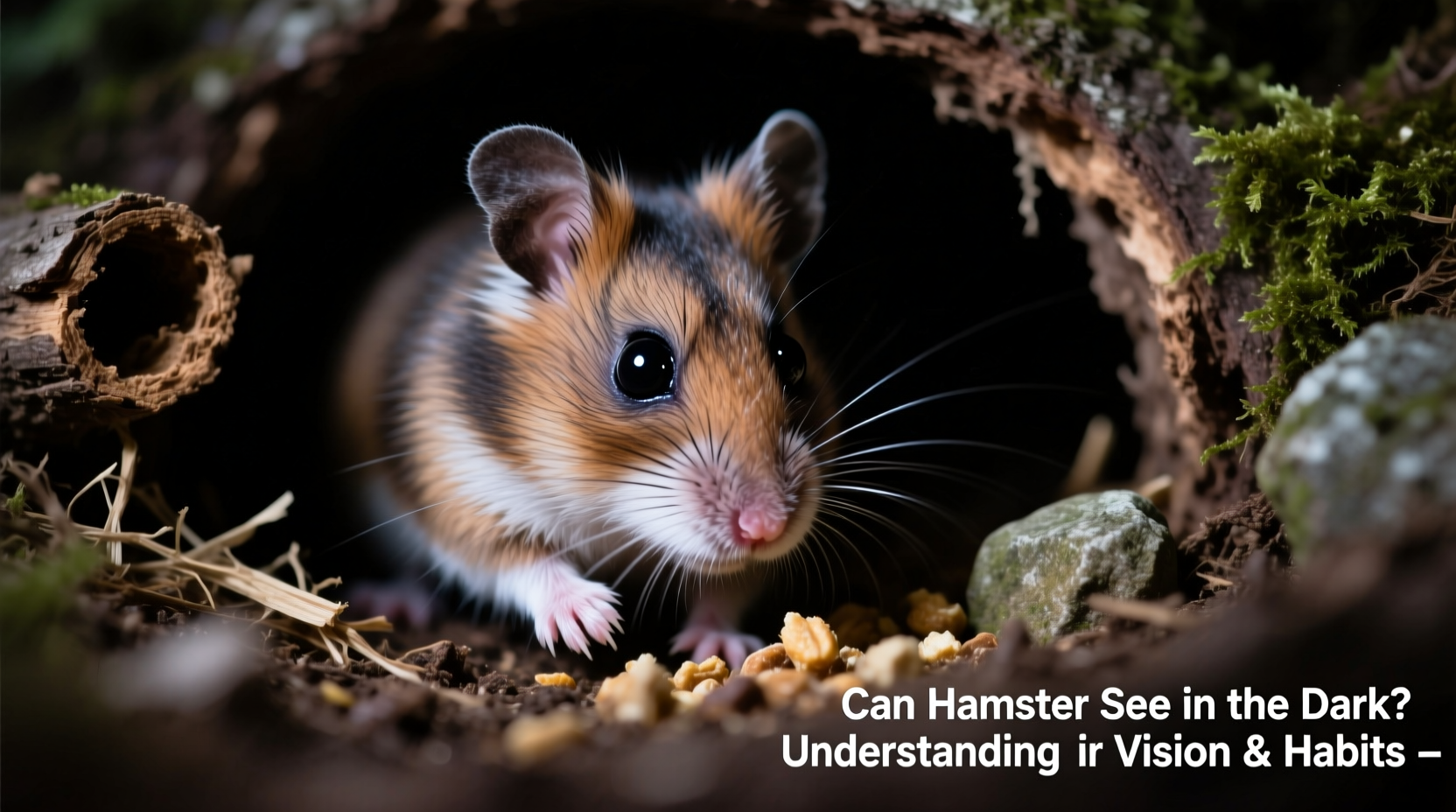
The structure of a hamster’s eye reflects its evolutionary adaptation as a prey animal. Unlike humans, whose eyes are positioned at the front of the head for depth perception, hamsters have eyes located more toward the sides. This lateral placement gives them a wider field of view—nearly 360 degrees—which helps detect movement from predators approaching from any direction. However, this comes at the cost of reduced binocular vision, meaning their ability to judge distance accurately is limited.
Hamster retinas contain fewer cone cells, which are responsible for color vision and sharpness in bright light, and a higher concentration of rod cells. Rods are sensitive to low light and motion but do not distinguish colors well. This imbalance explains why hamsters function better in dim conditions than in bright daylight. Their pupils also dilate significantly in darkness, allowing more light to enter the eye. Despite these adaptations, hamsters still rely more on other senses—especially smell and touch—when navigating their environment.
“Hamsters don’t see the world as clearly as we do, but their vision is optimized for survival in low-light conditions where detecting motion matters more than detail.” — Dr. Lena Torres, Small Mammal Veterinarian
Nocturnal Behavior and Activity Patterns
Hamsters are crepuscular and nocturnal, meaning they are most active during twilight hours (dawn and dusk) and throughout the night. In the wild, this behavior helps them avoid diurnal predators such as birds of prey while taking advantage of cooler temperatures in arid habitats. Even domesticated hamsters retain these instincts, often sleeping during the day and becoming alert once lights are dimmed.
Owners may observe their hamsters exploring tunnels, burrowing bedding, or running on exercise wheels shortly after sunset. These activities are not random; they follow a circadian rhythm regulated by light exposure. Disrupting this cycle—by keeping lights on late or handling them during sleep—can lead to stress, irritability, and even health issues over time.
How Well Can Hamsters See in the Dark?
While hamsters cannot “see in complete darkness” the way cats or owls might, they do possess enhanced low-light vision compared to humans. Their eyes are adapted to function in dim environments, making them capable of detecting shapes, movement, and changes in light intensity. However, their vision remains blurry and lacks detail. They typically see within a range of a few inches to about two feet clearly, beyond which objects appear indistinct.
In near-darkness, hamsters use a combination of sensory inputs to navigate. Whiskers (vibrissae) play a crucial role by detecting air currents and physical contact with walls or obstacles. Their acute sense of smell allows them to identify food, recognize cage mates, and map familiar routes. Hearing is also highly developed, enabling them to pick up high-frequency sounds undetectable to humans.
This multisensory approach compensates for poor eyesight. For example, if a hamster hears a noise or feels a change in airflow, it will pause, orient itself using whiskers, and sniff the area before proceeding. This behavior minimizes collisions and enhances safety in unfamiliar spaces—even in total darkness.
Common Misconceptions About Hamster Vision
Several myths persist about how hamsters see, often leading to inappropriate care practices. One widespread belief is that hamsters are blind. This is false. While their vision is weak, they are not blind and can perceive light, shadows, and motion. Another misconception is that hamsters see in full color. Research suggests they have dichromatic vision, meaning they likely perceive only shades of blue and green, similar to red-green colorblindness in humans.
Some owners assume that because their hamster bumps into things, it must be sick or injured. In reality, mild clumsiness is normal due to limited depth perception and narrow visual focus. As long as the hamster is eating, grooming, and behaving normally otherwise, occasional missteps are not cause for concern.
| Myth | Reality |
|---|---|
| Hamsters are blind | They have poor but functional vision, especially in low light |
| They see in full color | Likely see only blue and green tones; color perception is limited |
| They need bright lighting to be active | Bright light stresses them; they thrive in low-light, quiet environments |
| Night lights help them see | Artificial night lights can disrupt sleep cycles and increase anxiety |
Creating a Hamster-Friendly Environment
To support your hamster’s natural vision and behavior, consider how you design and maintain its living space. A well-structured habitat respects their sensory limitations and nocturnal tendencies. Start by placing the cage in a quiet area away from direct sunlight and loud noises. Sudden flashes or prolonged exposure to bright overhead lights can startle them and interfere with rest.
Cage layout should prioritize tactile navigation. Use solid flooring instead of wire grids to prevent foot injuries. Provide multiple levels connected by ramps rather than jumps, since depth perception is poor. Avoid transparent barriers like glass walls, which can confuse hamsters—they may repeatedly bump into them because they can't perceive the barrier visually.
Enrichment items should be arranged consistently. Frequent rearrangement forces the hamster to relearn spatial layouts, increasing stress. Include tunnels made of cardboard or wood, nesting boxes, and textured surfaces to stimulate whisker feedback. Food and water stations should remain in fixed locations so your pet can locate them easily by memory and scent.
Step-by-Step Guide to Nighttime Care
- Dim household lights gradually in the evening to signal the onset of nighttime without startling your hamster.
- Avoid turning on bright lights if you need to check on your pet at night. Use a red-filtered flashlight instead, as red light is less disruptive to nocturnal animals.
- Minimize noise and movement near the cage during sleeping hours to prevent stress-induced wakefulness.
- Inspect equipment quietly, such as checking wheel alignment or food levels, without removing the hamster unless necessary.
- Respect sleep patterns—do not handle or play with your hamster during the day unless absolutely required.
Real-Life Example: Adjusting to a New Home
Sarah adopted a Syrian hamster named Milo and placed his cage in her home office, where she worked during the day and left a desk lamp on until midnight. Within days, Milo became lethargic and stopped using his wheel. Concerned, Sarah consulted a veterinarian who asked about Milo’s environment. Upon learning about the lighting schedule, the vet explained that constant artificial light was disrupting Milo’s circadian rhythm.
Sarah adjusted by moving the cage to a quieter bedroom corner, using blackout curtains to control daylight, and turning off all lights by 9 PM. She also added more tunnels and a wooden hideout to enhance security. Within a week, Milo resumed normal activity—running at night, grooming regularly, and showing curiosity during brief morning awakenings. The change wasn’t due to illness but to environmental mismatch with his natural vision and behavioral needs.
Checklist: Optimizing Your Hamster’s Visual and Sensory Experience
- ✅ Place the cage in a quiet, low-traffic area with natural day-night cycles
- ✅ Avoid bright lights, especially at night
- ✅ Keep cage furniture and feeding areas in consistent locations
- ✅ Use opaque or solid-sided enclosures instead of fully transparent tanks
- ✅ Provide plenty of tactile enrichment (tunnels, nesting materials, textured toys)
- ✅ Minimize sudden movements or loud sounds near the cage
- ✅ Handle your hamster gently and only during early evening or late morning when they may be semi-awake
Frequently Asked Questions
Can I use a night light for my hamster?
No, it's best to avoid night lights. Even low-intensity white or blue lights can disrupt your hamster’s sleep cycle. If you must observe your hamster at night, use a red-filtered flashlight briefly. Red light is less visible to rodents and causes minimal disturbance.
Why does my hamster run into walls?
This is usually due to limited depth perception and narrow visual focus. It’s normal for hamsters to make minor contact with objects. However, frequent or forceful collisions could indicate illness, poor cage design, or disorientation from inconsistent layouts. Ensure the environment is safe and stable.
Do hamsters recognize their owners visually?
Not reliably. Hamsters primarily recognize people through scent, sound, and routine. They may associate your voice or hand movements with feeding or handling, but they don’t form visual bonds the way humans do. Gentle, consistent interaction builds trust over time regardless of visual recognition.
Conclusion: Seeing the World Through Your Hamster’s Eyes
Understanding that hamsters do not see the world as we do transforms how we care for them. Their limited vision in bright light, enhanced sensitivity to motion and darkness, and reliance on non-visual senses shape every aspect of their behavior. By respecting their natural rhythms and designing environments that accommodate their unique perception, owners can significantly improve their pets’ well-being.
You don’t need perfect vision to live a rich, active life—and neither does your hamster. What matters most is consistency, safety, and minimizing stress. When you align your care practices with their biological needs, you create a home where your hamster doesn’t just survive, but thrives.




 浙公网安备
33010002000092号
浙公网安备
33010002000092号 浙B2-20120091-4
Comments
No comments yet. Why don't you start the discussion?