
The sunsetting of CDMA networks across major U.S. carriers has left many iPhone users wondering about their device's future. If you own a CDMA iPhone—perhaps an older model once tied to Verizon or Sprint—you may be asking: can it still function on a GSM network after the CDMA shutdown? The short answer is: it depends. Understanding the technical differences between CDMA and GSM, knowing your iPhone model, and checking carrier compatibility are crucial steps in determining whether your device remains usable.
Understanding CDMA vs. GSM: A Technical Overview
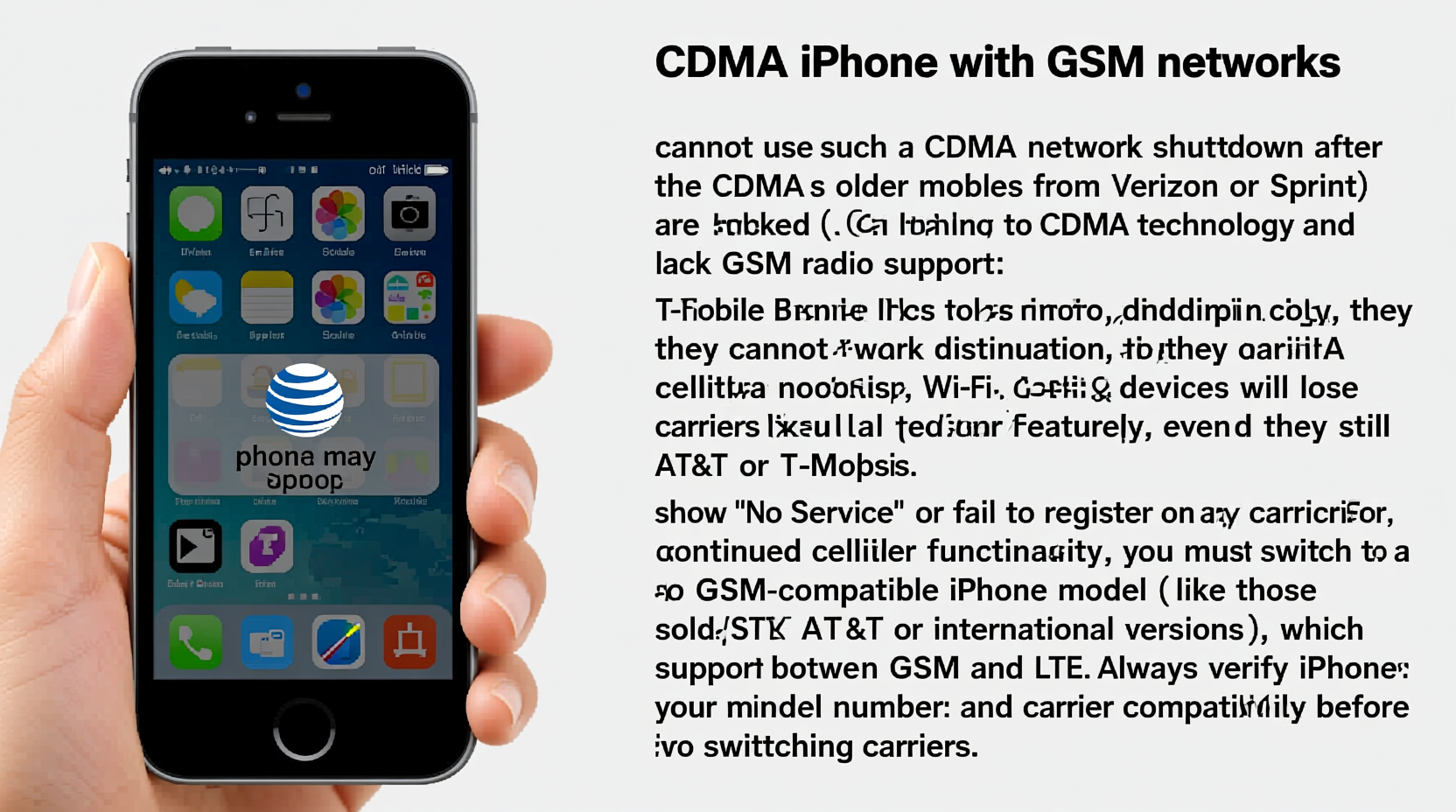
CDMA (Code Division Multiple Access) and GSM (Global System for Mobile Communications) are two distinct cellular technologies that have historically divided the mobile world. In the U.S., carriers like Verizon and Sprint relied heavily on CDMA, while AT&T and T-Mobile used GSM. The key difference lies in how devices connect to networks:
- CDMA: Does not use SIM cards traditionally; phones are often carrier-locked to specific networks.
- GSM: Relies on SIM cards, allowing easier switching between compatible carriers.
Modern smartphones, including iPhones from the iPhone 5 onward, are designed as “world phones” capable of supporting both standards. However, earlier models were sometimes limited to one technology depending on the carrier version.
“By 2022, all major U.S. carriers had decommissioned their CDMA networks. This means even dual-mode phones can no longer fall back on CDMA signals.” — Dr. Alan Reyes, Wireless Network Engineer
iPhone Models and Network Compatibility
Apple began producing globally compatible iPhones starting with the iPhone 5. These models included both CDMA and GSM radios, enabling them to work across multiple carriers. However, not all versions are equal. Here’s a breakdown of key iPhone models and their network support:
| iPhone Model | CDMA Support | GSM Support | LTE Bands | Post-Shutdown Usability |
|---|---|---|---|---|
| iPhone 4S (Verizon) | Yes | Limited (no voice) | No LTE | Poor – No 4G/5G, limited roaming |
| iPhone 5 (Model A1428) | Yes | Yes | LTE Bands 1,3,5,13 | Fair – Works on AT&T/T-Mobile with limitations |
| iPhone 6 (All Models) | Yes (some) | Yes | Bands 1–5, 7, 17, 25 | Good – Mostly compatible with modern LTE |
| iPhone 7 and Later | Yes (dual-mode) | Yes | Expanded LTE + VoLTE | Excellent – Fully functional on GSM carriers |
If your iPhone supports GSM bands used by current carriers (especially LTE Band 2, 4, 12, 17 for AT&T and Band 2, 4, 12, 66 for T-Mobile), it should operate effectively post-shutdown—provided it isn’t locked.
What Happens After the CDMA Shutdown?
As of December 31, 2022, Verizon officially shut down its CDMA network. Sprint’s network, absorbed by T-Mobile, was also phased out. This means:
- No more voice calls or text messages over CDMA.
- Data fallback to 3G CDMA is gone.
- Even dual-mode phones must now rely solely on GSM/HSPA/LTE/5G.
For users of older CDMA-only iPhones (like early iPhone 4S models), this effectively renders the device obsolete for cellular service unless connected to Wi-Fi. However, if your iPhone supports GSM and modern LTE bands, it can still function—assuming it’s unlocked and compatible with current network frequencies.
Real-World Example: Maria’s iPhone 6 Switch
Maria had a Verizon iPhone 6 (Model A1586) she’d used for years. When her carrier announced the CDMA shutdown, she worried her phone would become useless. She contacted Verizon, confirmed her phone was unlocked, and inserted a T-Mobile SIM card. After updating iOS and enabling VoLTE, her phone worked seamlessly—calls, texts, and data all functioned over LTE. Her experience shows that even older CDMA iPhones can transition successfully—if they meet GSM compatibility requirements.
Step-by-Step: Can You Still Use Your CDMA iPhone?
Follow this sequence to determine whether your CDMA iPhone remains viable:
- Identify your iPhone model: Go to Settings > General > About > Model Number. Tap to reveal the A-number (e.g., A1586).
- Check network bands: Search online for “[Model Number] specs” to see supported LTE and GSM bands.
- Determine unlock status: Contact your original carrier or use a third-party unlocking service if necessary.
- Test with a GSM SIM: Insert a SIM from AT&T, T-Mobile, or an MVNO (like Mint Mobile). Power cycle the device.
- Verify connectivity: Check for signal, make a test call using VoLTE, and confirm data works.
- Update iOS: Install the latest firmware to ensure optimal network compatibility and security.
Tips for Maximizing Usability Post-Shutdown
- Enable VoLTE (Voice over LTE): Without CDMA, voice calls depend on LTE. Ensure this is turned on under Settings > Cellular > Cellular Data Options > Voice & Data.
- Use Wi-Fi calling: If cellular coverage is weak, Wi-Fi calling ensures consistent service.
- Avoid relying on 3G: Most 3G networks are also discontinued. Devices without LTE capability will struggle.
- Consider upgrading if needed: iPhones older than the iPhone 6 lack adequate LTE band support for reliable performance.
Frequently Asked Questions
Can a CDMA-only iPhone work on AT&T or T-Mobile?
No. Phones like the original iPhone 4S on Verizon lack full GSM voice support and cannot make calls on GSM networks. They are essentially unusable for cellular service today.
Do I need to unlock my iPhone to use it on a GSM carrier?
Yes. While newer iPhones purchased directly from Apple are typically unlocked, carrier-subsidized models require unlocking before accepting non-carrier SIM cards.
Will my CDMA iPhone work internationally?
Only if it supports the local GSM/LTE bands. Many international regions never used CDMA, so GSM compatibility is essential. An unlocked iPhone 5 or later generally works in Europe and Canada.
Final Checklist Before Transitioning
- ✅ Confirm iPhone model and bands
- Ensure support for modern LTE (Bands 12, 13, 17, 66, etc.)
- ✅ Verify unlock status
- Contact carrier or use Apple’s activation check site
- ✅ Test with a new SIM
- Use prepaid SIMs from AT&T or T-Mobile for trial
- ✅ Enable VoLTE and Wi-Fi Calling
- Required for voice functionality without CDMA
- ✅ Update iOS
- Ensures best network compatibility and security patches
Conclusion: Your CDMA iPhone Isn’t Necessarily Obsolete
The end of CDMA doesn’t automatically mean the end of your iPhone. Many CDMA-capable iPhones—especially those from the iPhone 5s onward—are built to operate on GSM networks and remain fully functional with proper setup. The key lies in understanding your device’s technical capabilities, ensuring it’s unlocked, and verifying compatibility with current LTE infrastructure. For some, this transition extends the life of a trusted device. For others, it’s a sign it’s time to upgrade to a newer model with 5G and continued software support.




 浙公网安备
33010002000092号
浙公网安备
33010002000092号 浙B2-20120091-4
Comments
No comments yet. Why don't you start the discussion?