
Anxiety affects millions of people worldwide, manifesting in persistent worry, physical tension, and intrusive thoughts. While therapy and medication are effective treatments, many seek accessible, low-cost tools to manage symptoms. One such tool—journaling—has gained attention not just as a personal habit but as a practice supported by psychological research. The question remains: can writing in a journal every day meaningfully reduce anxiety? The answer, backed by decades of clinical and experimental studies, is a resounding yes—when done with intention and consistency.
Journals have long been used for self-expression, from historical figures like Marcus Aurelius to modern-day diarists. But beyond introspection, structured journaling engages cognitive processes that directly influence emotional regulation. Psychology has increasingly validated this simple act as a form of expressive therapy, capable of reducing rumination, clarifying thoughts, and lowering stress biomarkers. This article explores the science behind daily journaling, its mechanisms, optimal techniques, and real-world applications for anxiety reduction.
The Psychological Mechanisms Behind Journaling
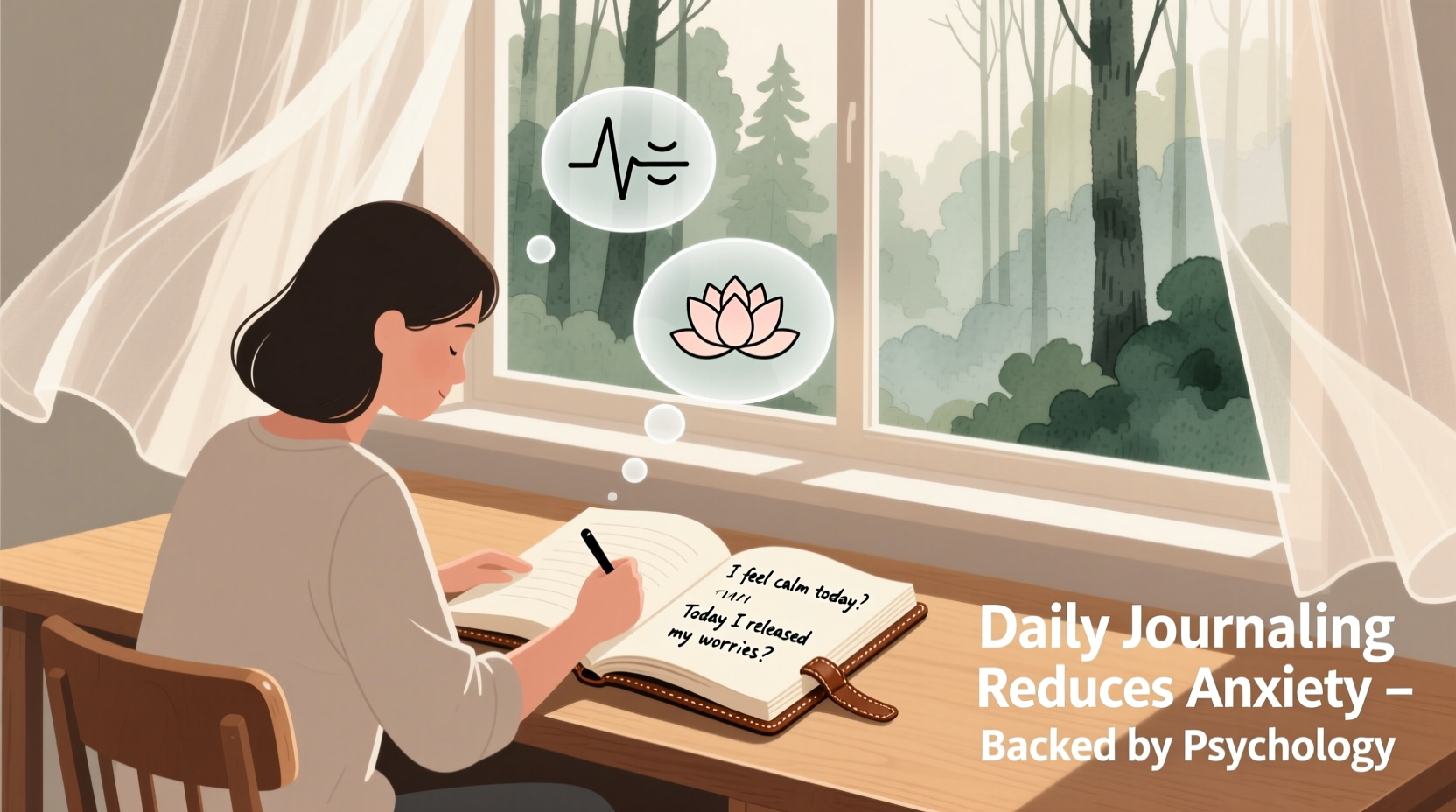
Daily journaling works not because it magically erases anxiety, but because it alters how the brain processes stressful information. Several key psychological mechanisms explain its effectiveness:
- Emotional Regulation: Writing about emotions activates the prefrontal cortex, the brain region responsible for reasoning and impulse control. This helps counteract the amygdala’s overactivity—the area linked to fear and threat detection.
- Cognitive Processing: Translating chaotic feelings into coherent sentences forces the mind to organize abstract distress into tangible narratives. This process, known as “meaning-making,” reduces the perceived threat of anxious thoughts.
- Reduced Rumination: Chronic anxiety often involves repetitive, unproductive thinking. Journaling externalizes these loops, creating psychological distance and reducing their emotional grip.
- Inhibition Reduction: James Pennebaker’s seminal work on expressive writing shows that suppressing emotions increases physiological stress. Journaling breaks this cycle by allowing safe emotional release.
These mechanisms don’t require poetic skill or hours of writing. Even 10–15 minutes per day can initiate measurable changes in mood and perception.
“Expressive writing can help people move from simply reliving trauma to rethinking it. That shift is where healing begins.” — Dr. James W. Pennebaker, Professor of Psychology, University of Texas at Austin
Clinical Evidence: What Research Says About Journaling and Anxiety
Over 150 studies have examined expressive writing’s impact on mental health. A meta-analysis published in Advances in Psychiatric Treatment (2005) reviewed 136 studies and concluded that structured writing interventions significantly reduced anxiety and depression symptoms across diverse populations—from college students to cancer patients.
One landmark study by Smyth (1998) analyzed 130 participants with chronic health conditions, including asthma and rheumatoid arthritis. Those who wrote about traumatic experiences for 20 minutes a day over three days showed significant improvements in both psychological well-being and objective health markers compared to controls.
More recent research confirms these findings. A 2020 randomized controlled trial in Journal of Affective Disorders assigned 83 adults with generalized anxiety disorder (GAD) to either a daily journaling group or a control group. After four weeks, the journaling group reported a 30% average reduction in anxiety scores on the GAD-7 scale, along with improved sleep quality and fewer panic episodes.
Neuroimaging studies further support these outcomes. Functional MRI scans show decreased amygdala activation and increased connectivity between emotional and regulatory brain regions after consistent expressive writing.
Effective Journaling Techniques for Anxiety Relief
Not all journaling is equally effective. Random note-taking may offer minimal benefit. To harness psychology-backed results, use evidence-based methods:
1. Expressive Writing (Pennebaker Method)
Write continuously for 15–20 minutes about your deepest thoughts and feelings regarding a stressful or traumatic event. Do this for 3–5 consecutive days. Avoid editing or worrying about style. The goal is emotional disclosure, not storytelling.
2. Gratitude Journaling
List three things you’re grateful for each day. Research by Emmons & McCullough (2003) shows this practice increases positive affect and reduces anxiety by shifting attention away from threat-based thinking.
3. Stream-of-Consciousness Writing
Set a timer and write whatever enters your mind without filtering. This technique helps identify recurring anxious patterns and interrupt mental loops.
4. Cognitive Reframing Journal
Structure entries around: (a) Situation, (b) Automatic Thought, (c) Emotional Response, (d) Alternative Perspective. This mirrors cognitive-behavioral therapy (CBT) techniques proven to reduce anxiety distortions.
| Technique | Best For | Frequency | Duration |
|---|---|---|---|
| Expressive Writing | Trauma processing, emotional release | 3–5 days consecutively | 15–20 min/day |
| Gratitude Journaling | Preventing rumination, boosting mood | Daily, long-term | 5–10 min/day |
| Stream-of-Consciousness | Identifying thought patterns | As needed during high anxiety | 10–15 min/session |
| Cognitive Reframing | Challenging anxious beliefs | Daily or post-trigger | 10–20 min/day |
A Real-Life Example: Sarah’s Journey with Daily Journaling
Sarah, a 34-year-old project manager, struggled with persistent anxiety triggered by workplace pressure and perfectionism. She often lay awake at night replaying conversations, fearing criticism. Medication helped slightly, but she wanted a sustainable self-management tool.
After reading about expressive writing, she committed to journaling for 15 minutes each evening. Initially, her entries were fragmented: “I messed up the presentation… everyone noticed… I’m not good enough.” But over time, she began analyzing the roots of these fears—childhood expectations, fear of failure—and started challenging them in writing.
Within three weeks, Sarah noticed fewer nighttime ruminations. By week six, she reported feeling “lighter” emotionally and more confident in meetings. Her therapist noted improved insight during sessions, attributing progress partly to the clarity journaling provided. After three months, Sarah transitioned to gratitude journaling as maintenance, citing a “noticeable drop” in baseline anxiety.
Her experience reflects a common trajectory: initial discomfort, gradual cognitive restructuring, and sustained emotional relief.
Common Pitfalls and How to Avoid Them
While journaling is powerful, some habits undermine its benefits:
- Overanalyzing entries: Rereading old journals obsessively can reactivate distress. Limit review to once weekly, if at all.
- Using it to catastrophize: Writing only negative predictions reinforces anxiety. Balance emotional expression with solution-focused or positive reflections.
- Forcing consistency: Missing a day isn’t failure. Aim for regularity, not perfection.
- Expecting immediate results: Neural and emotional shifts take time. Most studies show effects emerge after 2–4 weeks.
Step-by-Step Guide to Starting a Therapeutic Journaling Practice
Follow this seven-day timeline to build an effective routine:
- Day 1: Choose a private notebook or digital app. Commit to 10 minutes daily at a consistent time (e.g., before bed).
- Day 2: Write freely about what’s causing stress. Don’t censor—just release.
- Day 3: Identify one anxious thought and explore its origin. Ask: “When did I first feel this way?”
- Day 4: List three small things you felt grateful for today, no matter how minor.
- Day 5: Use the cognitive reframing template to challenge a recent worry.
- Day 6: Reflect on any patterns noticed so far. Are certain triggers recurring?
- Day 7: Evaluate how you feel compared to Day 1. Adjust format if needed.
After the first week, continue with a blend of expressive and gratitude writing. Reassess monthly.
Frequently Asked Questions
Can journaling make anxiety worse?
Temporarily, yes—especially when confronting traumatic memories. Some people feel emotionally raw after expressive writing. This usually passes within hours. If distress persists, pause and consult a mental health professional. Start gently with gratitude or neutral topics if you’re highly sensitive.
Is digital journaling as effective as handwriting?
Research shows comparable benefits, though handwriting may enhance memory and emotional processing due to motor engagement. Choose the medium that feels most comfortable and secure. Privacy is critical—use passwords or encrypted apps if journaling digitally.
How long should I journal each day?
Studies suggest 15–20 minutes is optimal for expressive writing. For maintenance, 5–10 minutes suffices. Quality matters more than quantity. Even brief, focused entries can yield results if done consistently.
Final Thoughts: Turning Words Into Wellness
Daily journaling is not a cure-all, but it is a scientifically supported tool for managing anxiety. Its power lies in transforming internal chaos into structured understanding. By externalizing fears, identifying patterns, and practicing cognitive reframing, individuals gain agency over their emotional lives.
The beauty of journaling is its accessibility. No cost, no prescription, no special training—just pen and paper or a blank screen. When grounded in psychological principles, it becomes more than a diary; it becomes a form of self-therapy.
If anxiety has ever left you feeling trapped in your own mind, consider this: the act of writing may be the simplest way to create space between you and your thoughts. Start small. Be honest. Keep going. Over time, the page becomes not just a witness to your struggles, but a partner in your resilience.




 浙公网安备
33010002000092号
浙公网安备
33010002000092号 浙B2-20120091-4
Comments
No comments yet. Why don't you start the discussion?