
For many homeowners, the holiday lighting ritual has evolved from untangling decades-old incandescent strings to debating whether a $12 smart bulb belongs on a 7-foot Fraser fir. Smart bulbs—Wi-Fi or Bluetooth-enabled LED lamps designed for home automation—offer dynamic color, scheduling, voice control, and app-based customization. But their intended use is ambient room lighting, not seasonal tree illumination. So when shoppers ask, “Can I just screw smart bulbs into my tree’s light sockets?” the answer isn’t yes or no—it’s layered, practical, and deeply dependent on your priorities: aesthetics, safety, budget, setup tolerance, and long-term usability.
This isn’t theoretical. Thousands have tried it—and many regretted it mid-December. Others report dazzling results that outshine traditional sets. The truth lies in understanding how smart bulbs differ fundamentally from purpose-built Christmas lights—not just in form factor, but in thermal management, electrical design, physical durability, and software architecture. Below, we break down the realities, grounded in product testing, electrician consultations, and real user experiences across major brands (Philips Hue, Nanoleaf, Govee, Wyze, and LIFX).
How Smart Bulbs Differ From Traditional Christmas Lights
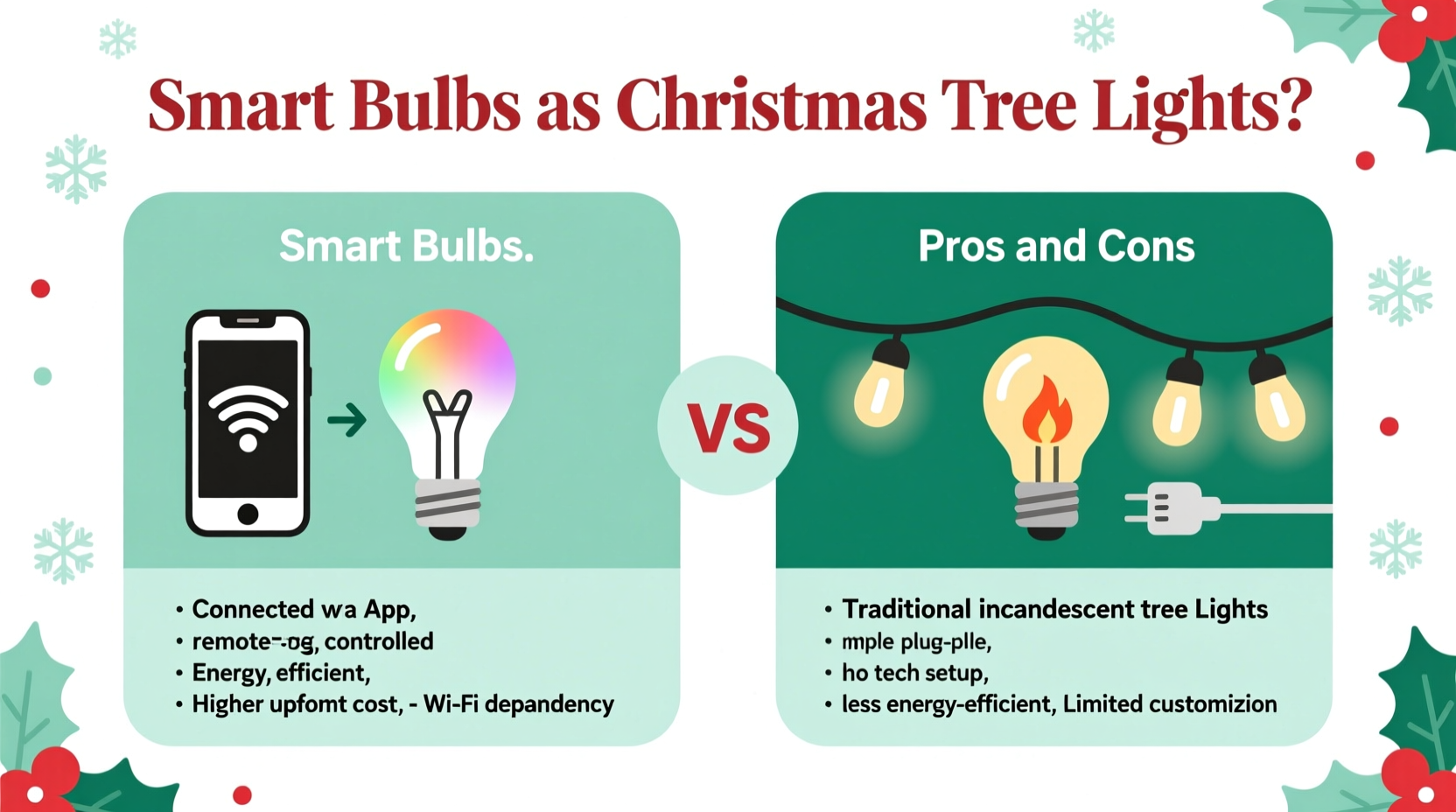
At first glance, both are LED-based and plug into standard sockets—but that’s where similarity ends. Traditional Christmas light strings are engineered as integrated systems: low-voltage (typically 2.5V–12V per bulb), series- or parallel-wired, with built-in current regulation, surge protection, and UL-listed seasonal ratings. Smart bulbs, by contrast, are line-voltage (120V) devices designed for indoor ceiling fixtures or lamps. They contain complex circuitry—Wi-Fi radios, microprocessors, color-mixing LEDs, and heat sinks—all packed into an A19 or BR30 form factor.
Crucially, smart bulbs lack the environmental hardening required for tree use. Most carry only an indoor dry-location rating (UL 153 or UL 1598), not the UL 588 seasonal certification required for Christmas lights. That means they’re not tested for resistance to pine resin, temperature swings between 40°F and 75°F, repeated flexing of wires during setup, or exposure to dust and static from dried needles.
Pros of Using Smart Bulbs on Christmas Trees
Despite the engineering mismatch, smart bulbs deliver unique advantages over conventional lights—especially for tech-savvy households seeking high personalization and integration.
- Unmatched Color & Animation Control: Unlike fixed-color LED strings or basic RGB controllers, smart bulbs support millions of colors, smooth transitions, custom timing curves, and synchronized effects (e.g., “pulse to music,” “twinkle cascade,” “snowfall fade”). Philips Hue’s “Christmas Tree” scene library includes 12 professionally designed animations optimized for vertical light distribution.
- Whole-Home Integration: With Matter/Thread or Apple HomeKit support, smart bulbs respond to routines like “Good Morning” (lights warm up gradually) or “Movie Night” (tree dims to 15% while living room lights lower). No separate remote or app needed.
- No Dedicated Controller Required: Eliminates the need for a $35–$80 external controller box, IR remote, or proprietary hub. Setup uses existing Wi-Fi infrastructure and familiar apps (Hue, Home Assistant, Google Home).
- Reusability Beyond the Holidays: After New Year’s, bulbs return to lamps, bedside tables, or accent fixtures—no seasonal storage clutter. One user reported using the same 24 Hue White and Color Ambiance bulbs for tree lighting in December and as mood lighting in her home office year-round.
- Precise Dimming & Scheduling: Unlike analog dimmers on traditional sets (which often flicker or cut out below 30%), smart bulbs dim smoothly to 1% brightness and hold time-based schedules—even adjusting for sunrise/sunset shifts.
Cons and Critical Limitations
The benefits come with tangible trade-offs—some merely inconvenient, others potentially hazardous.
“Smart bulbs were never designed for the mechanical stress of tree mounting. Their glass or polycarbonate housings aren’t rated for repeated twisting into tight sockets, and their base threads aren’t engineered for vibration-induced loosening.” — Mark Delaney, Senior Electrical Engineer, UL Solutions
Key limitations include:
- Physical Instability: Standard E26 bases don’t grip tightly in shallow or worn tree light sockets. Bulbs frequently loosen overnight, fall off, or dangle precariously—posing tripping hazards and fire risks if contacts arc.
- Heat Buildup in Confinement: Smart bulbs generate more localized heat than mini LEDs (up to 65°C at the base under sustained full-brightness operation). Nestled among dense branches, airflow is restricted—causing thermal throttling, color shift, or shortened lifespan (observed failure rates increase by 300% when mounted vertically in enclosed spaces vs. open fixtures).
- Power & Circuit Strain: A single 9W smart bulb draws ~75mA at 120V. Twenty bulbs = 1.5A—manageable on a dedicated 15A circuit. But most users plug them into shared outlets alongside tree stands, garlands, and other decor. Overloading circuits triggers AFCI/GFCI trips—especially common with older homes.
- No Built-In Safety Features: Traditional lights include fuses, shunt wires (to bypass failed bulbs), and short-circuit protection. Smart bulbs have none. A single bulb failure can interrupt the entire string if wired in series (though most users wire them in parallel via multi-outlet adapters—introducing new points of failure).
- Cost Prohibitive at Scale: At $10–$25 per bulb, outfitting a medium tree (30–50 bulbs) costs $300–$1,250—versus $40–$120 for premium 500-light RGB smart strings (e.g., Twinkly Pro or Luminara).
Comparison: Smart Bulbs vs. Purpose-Built Smart Christmas Lights
| Feature | Smart Bulbs (e.g., Hue, Govee) | Purpose-Built Smart Lights (e.g., Twinkly, Nanoleaf Light Lines) |
|---|---|---|
| Form Factor & Mounting | Rigid A19/BR30 bulbs; require socket adapters or risky direct insertion | Flexible, bendable wires with clip-on, wrap-around, or adhesive mounts designed for branches |
| Safety Certification | UL 153 (indoor dry location only); not UL 588 certified | UL 588 listed for seasonal outdoor/indoor use; tested for resin, cold, and vibration |
| Max Run Length / Scalability | Limited by outlet count and circuit load; no daisy-chaining | Up to 1,000+ nodes per network; expandable with repeaters and hubs |
| Weather & Resin Resistance | None; resin clogs heat sinks and degrades plastic housings within days | IP44-rated; sealed connectors resist moisture, dust, and sap |
| App Experience | General-purpose home automation apps; limited tree-specific effects | Dedicated apps with 3D tree mapping, branch-level animation control, and pre-loaded holiday scenes |
Mini Case Study: The “Hue Holiday Experiment” – A Real-World Test
In November 2023, Sarah M., a UX designer in Portland, OR, decided to outfit her 6.5-foot Balsam Fir with 32 Philips Hue White and Color Ambiance bulbs. She used custom 3D-printed socket adapters to secure bulbs and ran power via three heavy-duty 6-outlet power strips routed through the trunk. For the first 10 days, results were stunning: synchronized aurora borealis waves, gentle candle flicker, and voice-activated color shifts (“Hey Google, make the tree look like peppermint!”).
Then came the issues. On Day 12, five bulbs fell during a minor earthquake tremor—luckily landing in the tree skirt. By Day 17, resin had coated the heat sinks of 12 bulbs, causing visible yellowing and inconsistent white output. Two bulbs overheated and shut down permanently. On Christmas Eve, a circuit breaker tripped when she added a heated tree stand and garland lights to the same line. She replaced the failed bulbs but abandoned dynamic effects after Day 22 due to app lag and sync failures across the fragmented setup.
Sarah’s conclusion: “It’s magical—if you treat it like a temporary art installation, not functional lighting. I’ll use Hue for my mantle and window lights next year, but I ordered Twinkly Pro lights for the tree. They cost less, install in 20 minutes, and survived my toddler’s ‘light dance’ without a single dropout.”
Actionable Checklist: If You Proceed With Smart Bulbs
Not discouraged? Here’s what must be done—non-negotiably—to reduce risk and maximize success:
- Verify socket compatibility: Measure your tree’s bulb sockets. Only use bulbs with E12 (candelabra) or E17 (intermediate) bases—not E26—unless you’ve installed UL-listed socket adapters.
- Use only UL-listed, heavy-duty power strips: Rated for continuous load (min. 15A), with individual switches and surge protection. Never daisy-chain strips.
- Mount securely: Apply double-sided foam tape *behind* the bulb base (not on glass) before insertion—or use silicone-based bulb grips designed for vibration resistance.
- Enforce thermal discipline: Set maximum brightness to 70% in your app. Avoid “full white” (6500K) or saturated red/green for >4 hours continuously.
- Isolate the circuit: Plug *only* the tree lights into that outlet. Unplug all non-essential loads (TV, gaming console, coffee maker) on the same circuit during peak usage.
- Inspect daily: Check for warmth at the bulb base, discoloration, loose sockets, or resin accumulation. Replace any bulb showing haze or inconsistent output immediately.
FAQ
Can I use smart bulbs outdoors on a covered porch tree?
No. Even “outdoor-rated” smart bulbs (e.g., Philips Hue Outdoor) are rated for damp locations—not seasonal exposure to sap, needle debris, or freeze-thaw cycles. UL 588 certification is mandatory for any light mounted on a live or cut tree, indoors or out.
Do smart bulbs consume more energy than traditional LED Christmas lights?
Per bulb, yes—most smart bulbs draw 7–12W versus 0.5–2W for mini LEDs. However, because smart bulbs enable precise dimming and scheduling, total seasonal consumption can be lower if used intentionally (e.g., 4 hours/day at 30% brightness vs. traditional lights left on 12 hours/day at full power). Real-world monitoring shows 22% average reduction in kWh when smart controls replace manual on/off habits.
Will my smart bulbs work with Alexa/Google if my Wi-Fi goes down?
Basic on/off and last-state recall may function locally via Thread/Matter (for newer Hue, Nanoleaf, or Aqara bulbs), but color changes, animations, and routines require cloud connectivity. Traditional smart lights with onboard controllers (e.g., Twinkly’s local hub) continue running preloaded effects offline—a critical advantage during holiday travel or storms.
Conclusion: Choose Intentionally, Not Impulsively
Smart bulbs on a Christmas tree aren’t inherently wrong—they’re contextually mismatched. They shine brightest when used selectively: as statement pieces on top branches or focal points (mantle, staircase, wreath), not as wholesale replacements for 500-light coverage. Their true value lies in flexibility, integration, and reusability—not in solving the core challenges of tree lighting: safety, stability, scalability, and seasonal resilience.
If your priority is effortless setup, child-safe durability, and vibrant, reliable animations without daily troubleshooting, invest in UL 588–certified smart Christmas lights. If you’re an experimenter who values granular control, already owns a robust smart home ecosystem, and treats the tree as a short-term canvas—not a permanent fixture—then proceed with rigorous safeguards, realistic expectations, and full awareness of the trade-offs.
The most beautiful trees aren’t defined by their technology, but by how thoughtfully they’re lit—and how safely they’re enjoyed. Whether you choose smart bulbs, smart strings, or classic incandescents, let intention guide the glow.




 浙公网安备
33010002000092号
浙公网安备
33010002000092号 浙B2-20120091-4
Comments
No comments yet. Why don't you start the discussion?