
As holiday seasons approach, homes across neighborhoods light up with festive cheer. What once served purely as decoration now holds unexpected utility: smart Christmas lights are increasingly being used as subtle tools in home security strategies. When programmed strategically, these intelligent lighting systems can simulate occupancy, confuse intruders, and even integrate with broader smart home defenses. The idea isn’t to replace alarms or cameras—but to complement them by creating an illusion of presence, activity, and vigilance.
Burglars often target unoccupied homes, relying on predictable cues like dark windows, undisturbed mail, or silence. By disrupting those signals, homeowners can reduce risk without investing in expensive surveillance upgrades. Smart Christmas lights—when timed, scheduled, and randomized—become part of a psychological deterrent system. This article explores how this works, what configurations are most effective, and how to implement them safely and efficiently.
How Lighting Influences Perceived Occupancy
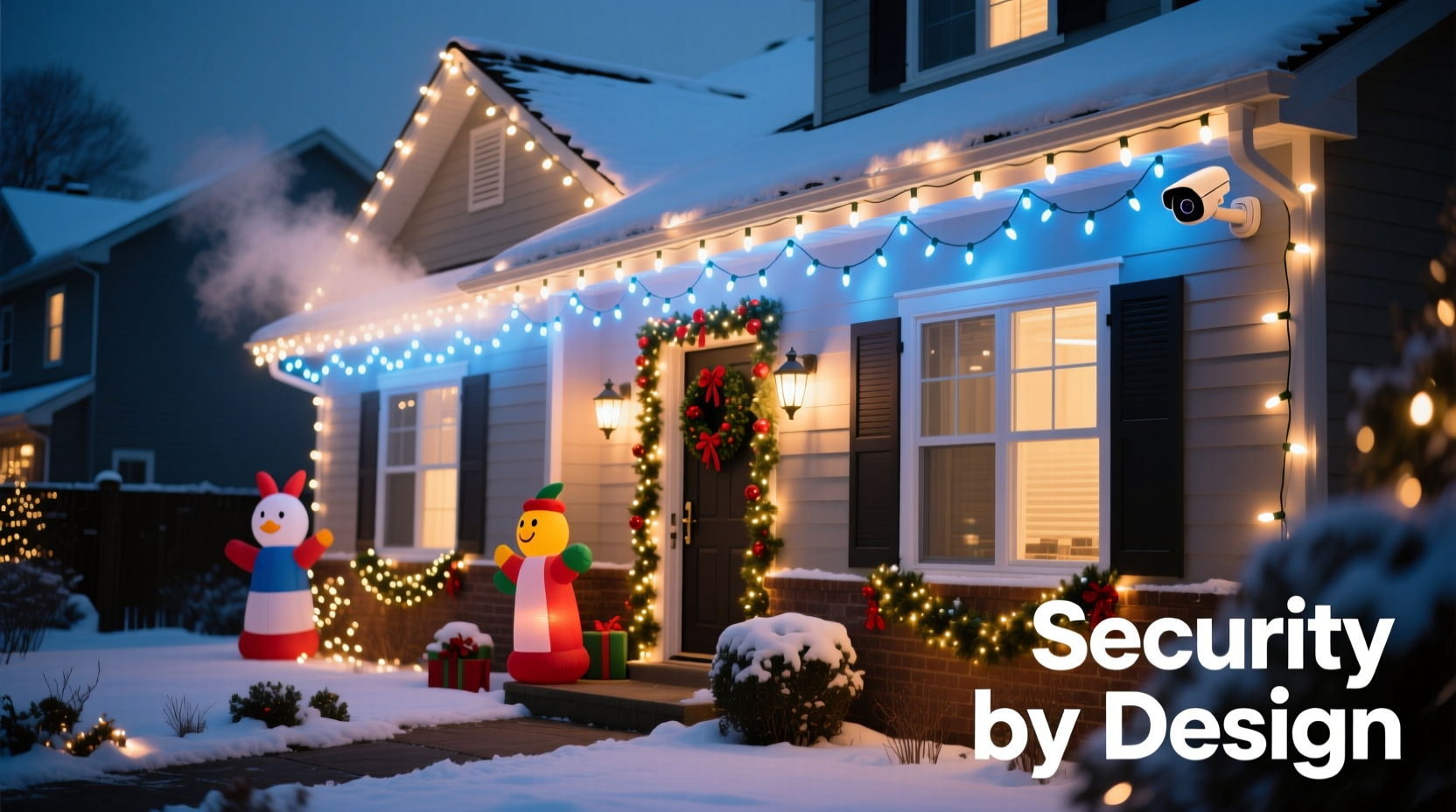
Lighting is one of the strongest visual indicators of human activity. A house with lights on—even intermittently—suggests someone is home. Traditional timers have long been used to turn lamps on and off while residents are away, but they follow predictable patterns that experienced criminals can detect. Smart lighting systems eliminate this flaw through variability, remote control, and integration with other devices.
Smart Christmas lights go beyond indoor lamps. Positioned along roofs, trees, walkways, and porches, they provide exterior illumination that mimics active household engagement. Unlike static displays, modern LED strands can change color, brightness, sequence, and timing—all controllable via smartphone apps, voice assistants, or automation platforms like IFTTT or Apple HomeKit.
The key lies not just in turning lights on, but in making their behavior unpredictable. A light that blinks red and green at 7:00 p.m. every night signals automation. But one that flickers occasionally between 5:30 and 9:15, changes hues randomly, or dims gradually creates the impression of someone adjusting settings manually from inside.
Integration with Smart Home Security Systems
Standalone smart lights offer benefits, but their real power emerges when integrated into a full smart home ecosystem. Many popular brands—such as Philips Hue (with compatible outdoor strips), LIFX, Nanoleaf, or Govee—support routines that trigger based on motion sensors, geolocation, or camera alerts.
For example, if a porch camera detects movement after dark, it can signal nearby smart Christmas lights to flash briefly—a subtle but startling cue that may deter loiterers. Alternatively, when your phone leaves a geofenced area around your home, the system can activate a “vacation mode” that simulates daily living patterns using both interior and exterior lighting.
This synergy enhances the realism of the security illusion. Imagine a scenario where:
- Your front-pathway lights turn on at dusk.
- A few minutes later, colored roof lights cycle gently.
- At random intervals, the display dims or shifts to cooler tones, suggesting someone adjusted ambiance for movie time.
- Late at night, everything shuts down abruptly—mimicking someone going to bed.
These nuances make the difference between looking automated and appearing lived-in.
Real-World Example: The Winter Break Deterrent
Consider a family from Colorado who travels to Florida for two weeks each December. In past years, they returned to find signs of attempted break-ins—scratches on back doors, displaced window screens. After installing addressable smart Christmas lights synced with their Ring doorbell and indoor Hue bulbs, they activated a custom \"Away Mode\" routine.
The setup cycled outdoor lights every evening between 5:00 and 10:30 PM, with randomized pauses and transitions. Occasionally, the system triggered a brief strobe effect upon motion detection. Neighbors reported seeing “lots of activity” at the house, assuming the family had stayed local. Upon return, the homeowners found no signs of tampering—and their insurance provider noted a reduced risk profile due to enhanced monitoring capabilities.
“Perception matters more than reality in home security. If a house looks occupied, it’s less likely to be tested.” — Daniel Reeves, Residential Security Consultant, SafeHaven Advisors
Building an Effective Security Illusion: A Step-by-Step Approach
Creating a convincing illusion requires planning and consistency. Follow this timeline to deploy your smart Christmas lights as part of a broader security strategy.
- Assess Your Lighting Zones (Day 1)
Identify high-visibility areas: rooflines, entryways, driveways, front yard trees. Prioritize locations visible from the street or adjacent properties. - Select Compatible Smart Lights (Day 2–3)
Choose weather-resistant, Wi-Fi- or Bluetooth-enabled LED strings with app control and scheduling. Look for models supporting randomization and scene transitions. - Test Connectivity & Range (Day 4)
Ensure all lights connect reliably to your network. Use extenders if needed. Test responsiveness remotely via your phone. - Create Variable Lighting Scenes (Day 5)
Design 3–5 different lighting profiles: “Evening On,” “Movie Night Dim,” “Late Activity,” and “All Off.” Include gradual fades and color shifts. - Schedule with Randomization (Day 6)
Use your app’s random start/end feature. Set lights to activate within a 90-minute window each evening rather than at a fixed time. - Link to Motion Detection (Optional, Day 7)
If you have outdoor cameras or sensors, create automations where detected motion triggers a brief light response (e.g., a quick pulse). - Activate Away Mode (Ongoing)
Before leaving home, enable your full simulation routine. Combine with indoor smart plugs controlling TVs, radios, or lamps for maximum effect.
Comparison: Traditional vs. Smart Holiday Lighting for Security
| Feature | Traditional Timers + Static Lights | Smart Christmas Lights + Automation |
|---|---|---|
| Timing Predictability | High – same on/off times daily | Low – randomized schedules |
| Remote Control | No | Yes – via smartphone |
| Motion Response | None | Possible via integrations |
| Visual Realism | Moderate – suggests automation | High – mimics human behavior |
| Energy Efficiency | Low to moderate | High – LEDs + dimming controls |
| Setup Complexity | Low | Moderate |
| Cost Over Time | Lower upfront, higher energy use | Higher initial cost, lower operating cost |
Common Pitfalls and How to Avoid Them
Even well-intentioned setups can backfire if poorly executed. Here are frequent mistakes and solutions:
- Over-lighting the property: A constantly blazing display looks unnatural and signals absence. Instead, mimic typical usage—lights come on in phases, shift tone, then turn off.
- Using only decorative modes: While animated雪花or twinkling effects add flair, rely primarily on steady or slowly changing scenes that resemble ambient lighting.
- Ignoring indoor coordination: Exterior lights alone aren’t enough. Sync with smart bulbs inside to illuminate rooms at plausible times (e.g., kitchen at dinner hour, bedroom before bed).
- Forgetting maintenance: Burnt-out segments or disconnected strings ruin the illusion. Check connections weekly and replace faulty sections promptly.
Security Checklist: Maximize Protection with Smart Lights
Use this checklist before deploying your holiday lighting strategy:
- ✅ Choose UL-listed, outdoor-rated smart lights with strong weather resistance
- ✅ Confirm stable Wi-Fi coverage near installation zones
- ✅ Install surge protectors for all outdoor electrical connections
- ✅ Program multiple lighting scenes with varied intensity and color temperature
- ✅ Enable randomization in scheduling (avoid clock-time precision)
- ✅ Integrate with at least one other smart device (camera, plug, lock)
- ✅ Test the full system remotely before departure
- ✅ Inform a trusted neighbor about your plan—without revealing exact details
Frequently Asked Questions
Can smart Christmas lights really prevent break-ins?
While no single measure guarantees safety, studies show that illuminated homes are targeted less frequently. According to the University of North Carolina’s Department of Criminal Justice, 60% of convicted burglars surveyed said they would avoid homes with visible lights on. Smart lights enhance this deterrent by introducing unpredictability, making it harder for criminals to confirm vacancy.
Do I need special equipment beyond the lights themselves?
Not necessarily. Most standalone smart light systems work via app control over standard outlets. However, for optimal results, consider pairing them with motion sensors, security cameras, or indoor smart bulbs. These additions strengthen the perception of occupancy and allow cross-device automation.
Are there privacy risks in using smart lighting for security?
Potentially, yes. Devices connected to the internet can be vulnerable to hacking if not properly secured. Always change default passwords, enable two-factor authentication, keep firmware updated, and isolate IoT devices on a separate network if possible. Avoid broadcasting real-time status updates publicly (e.g., social media posts saying “Our lights are on!” while you’re away).
Conclusion: Turning Festivity Into Function
Smart Christmas lights are no longer just seasonal decorations—they’ve evolved into functional components of modern home security. When used thoughtfully, they contribute to a layered defense strategy that relies on perception, technology, and behavioral mimicry. The goal isn’t deception for its own sake, but prevention through plausibility.
By varying light patterns, integrating with existing smart systems, and avoiding predictable behaviors, homeowners can project vitality even when miles away. Combined with physical safeguards like locks, cameras, and neighborhood awareness, smart lighting becomes a quiet yet powerful ally in protecting property and peace of mind.




 浙公网安备
33010002000092号
浙公网安备
33010002000092号 浙B2-20120091-4
Comments
No comments yet. Why don't you start the discussion?