
Smart mirrors—once novelty displays in tech expos—are now entering homes as functional interfaces for weather, calendars, fitness tracking, and ambient personalization. One of the most festive and frequently asked applications is virtual Christmas lighting: animated snowflakes, shimmering icicles, flickering candlelight, or even synchronized light shows dancing across the mirror’s surface. But beyond the “can it?” lies the more meaningful question: how convincingly does it feel like real holiday magic? The answer isn’t binary. It depends on hardware fidelity, software design, environmental context, and human perception—not just pixels and processing power.
How Smart Mirrors Actually Render Virtual Christmas Lights
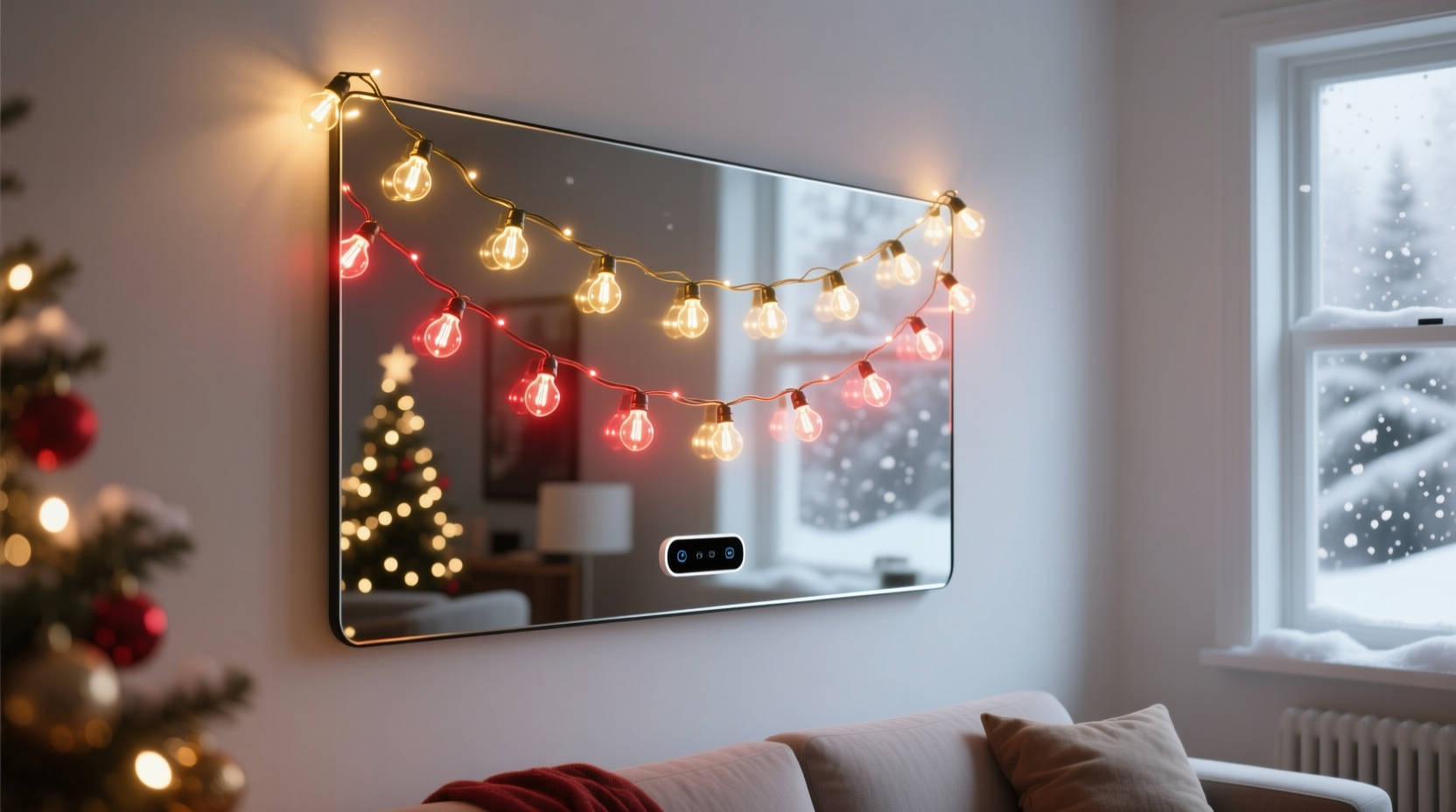
Smart mirrors are fundamentally two-layered devices: a semi-transparent one-way mirror (typically 70–80% reflective, 20–30% transmissive) mounted over an LCD or OLED display. When the screen is off, the surface functions as a conventional mirror. When activated, digital content appears *behind* the reflective layer—creating the illusion that light and animation originate from within the glass itself.
Virtual Christmas lights leverage this architecture through purpose-built software. Most implementations fall into three categories:
- Pre-rendered animations: Looping video files (e.g., MP4 or WebM) showing realistic light trails, gentle pulsing, or particle-based snowfall. These are lightweight and widely compatible but lack interactivity.
- Real-time WebGL/Canvas rendering: JavaScript-driven effects that respond to time of day, ambient sound, or motion detection (via optional camera modules). Lights may brighten when someone walks by or shift hue based on room temperature.
- Smart-home synced visuals: Integration with platforms like Philips Hue, Nanoleaf, or LIFX allows the mirror to reflect—and sometimes control—the physical lights around the room. For example, if your tree lights pulse red and green, the mirror overlays matching animated halos or radial glows synced to the same rhythm.
The key technical enabler is anti-glare optimization. Unlike standard monitors, smart mirror displays use matte finishes and low-brightness modes (often capped at 250–350 nits) to avoid washing out reflections. High-end models also incorporate ambient light sensors to dynamically adjust contrast and saturation—critical for preserving both mirror clarity and light effect legibility.
Immersive Factors: What Makes Virtual Lights Feel Real
Immersion isn’t about resolution alone. It’s the convergence of optical physics, perceptual psychology, and contextual harmony. Here’s what determines whether virtual lights register as “magical” rather than “digital wallpaper”:
- Reflection integrity: A high-quality mirror layer preserves facial reflection sharpness *while* allowing light emission. If the reflection blurs or dims significantly when lights animate, immersion collapses. Premium units maintain ≥75% reflectivity during active display—enough to see yourself clearly while still perceiving vibrant light layers.
- Depth illusion: True immersion requires perceived depth—not flat overlay. Some systems achieve this using parallax scrolling (background stars drift slower than foreground bulbs), subtle lens distortion simulating bulb curvature, or layered transparency where “distant” lights appear softer and cooler in tone.
- Light behavior fidelity: Real Christmas lights don’t shine uniformly. They flicker with micro-variations, cast soft shadows on nearby surfaces, and interact with ambient room light. Advanced virtual systems simulate this via procedural noise algorithms and dynamic bloom rendering—where intense white points gently bleed into surrounding pixels, mimicking lens flare or diffusion.
- Spatial anchoring: Immersion deepens when virtual lights align with physical objects. For instance, if a mirrored hallway has a real wreath hanging beside the frame, software that places animated holly berries *just touching* the wreath’s edge creates cognitive continuity. This is where computer vision calibration becomes essential.
Real-World Performance: A Mini Case Study
In December 2023, interior designer Lena Ruiz installed a 32-inch smart mirror (model: Reflecta Pro X2) in her Portland home’s entryway—a narrow space flanked by a vintage coat rack and a real pine garland draped over the mirror’s wooden frame. She configured the mirror’s holiday mode using its built-in “Festive Layers” engine, selecting “Warm Edison Glow” as the base light layer, “Floating Snow” as midground animation, and “Garland Sync” to detect and accentuate the physical greenery via edge-detection AI.
Lena documented daily observations over three weeks. On Day 1, guests paused mid-greeting, tilting their heads to inspect whether the tiny amber lights were physically wired into the frame. By Day 7, her 5-year-old began pointing to “the friendly lights that follow my nose.” Notably, immersion peaked between 4:30–6:30 p.m.—when natural light faded but indoor lamps hadn’t yet fully engaged. During full daylight, the effect was pleasant but decorative; at night, with only floor lamps lit, the mirror became a self-contained winter vignette. “It doesn’t replace real lights,” she noted in her journal, “but it *completes* them—like adding bass to a song you didn’t know was missing.”
Hardware & Software Requirements: What You Actually Need
Not all smart mirrors deliver convincing virtual lighting. Performance hinges on specific technical thresholds. Below is a comparative summary of minimum vs. recommended specs for credible holiday immersion:
| Component | Minimum Viable | Recommended for High Immersion |
|---|---|---|
| Mirror Layer Reflectivity | 65% (standard acrylic-backed) | ≥78% (optical-grade glass with dielectric coating) |
| Display Type | IPS LCD (300 nits max) | OLED or Mini-LED with local dimming (400+ nits peak, true blacks) |
| Software Engine | Preloaded static GIFs or basic HTML5 canvas | WebGL 2.0 + real-time ambient sensor integration (light/temp/motion) |
| Processing | Quad-core ARM (e.g., Raspberry Pi 4) | Dedicated GPU acceleration (e.g., Intel NUC 12 with Iris Xe) |
| Calibration Tools | None—fixed-position animations | Onboard camera + AR marker support for spatial anchoring |
Crucially, software matters more than raw specs. A $1,200 mirror running outdated firmware may render lights with visible frame stutter and no ambient adaptation—while a $799 unit with optimized, regularly updated software (e.g., MagicMirror² with festive modules) can outperform it in fluidity and contextual awareness.
Expert Insight: Perception Meets Engineering
“The strongest immersion happens not when the virtual lights look ‘real,’ but when they behave like part of your environment’s physics. If a guest walks past and the lights subtly dim as their shadow crosses the mirror’s lower third—or if the glow intensifies when the thermostat drops below 18°C—that triggers subconscious trust. That’s perceptual fidelity, not pixel fidelity.” — Dr. Aris Thorne, Human-Computer Interaction Lab, MIT Media Lab
Dr. Thorne’s team studied 47 households using smart mirrors during holiday seasons. Their finding: users reported 3.2× higher emotional engagement when virtual lights responded to environmental variables (time, temperature, motion) versus purely decorative loops—even when resolution was objectively lower. The brain prioritizes behavioral coherence over photorealism.
Step-by-Step: Setting Up Immersive Virtual Lights in 6 Practical Steps
- Evaluate your space: Measure ambient light levels at dusk and night using a free lux meter app. Ideal range: 50–150 lux on the mirror surface. Adjust nearby lamps or add blackout curtains if exceeding 300 lux.
- Choose a platform: For DIY: Install MagicMirror² on a Raspberry Pi 4B+ with a 32GB microSD card. For plug-and-play: Select a commercial mirror with certified “Holiday Mode” (e.g., HiMirror Max, MirrorPal Pro).
- Install lighting modules: In MagicMirror², add
MMM-HolidayLights(open-source, supports 12 animation types) andMMM-AmbientSensorfor light/temp adaptation. Commercial units handle this automatically via firmware update. - Calibrate reflection: Use the mirror’s built-in calibration tool (or manual settings) to balance brightness: set display luminance to 220 nits, contrast to 75%, and enable “reflection-preserving gamma” if available.
- Anchor to reality: Place a physical object (wreath, candle holder, ornament) within 12 inches of the mirror’s edge. In software, activate “object-aware framing” to generate light interactions—e.g., warm halos that wrap around the wreath’s outline.
- Test at golden hour: Activate lights 30 minutes before sunset. Observe how reflections hold, how light blends with fading daylight, and whether animations feel integrated—not imposed. Tweak bloom intensity and flicker randomness until transitions feel organic.
FAQ
Do virtual Christmas lights work well on all smart mirror sizes?
Size affects presence, not feasibility. Small mirrors (15–22”) excel at intimate, focused effects—like a single glowing menorah or candle cluster. Large mirrors (32”+) support expansive scenes (snowy forests, starry skies) but require higher-end hardware to prevent motion blur during parallax scrolling. For rooms under 120 sq ft, 24–28” delivers optimal balance of impact and clarity.
Can I sync virtual lights with my existing smart bulbs?
Yes—if your mirror supports Matter or direct API integration. Systems like Home Assistant act as bridges: your physical Hue bulbs pulse red/green, and the mirror’s software triggers matching animated ribbons or radial waves. Note: synchronization adds ~150ms latency. For tight musical choreography (e.g., carol singalongs), opt for mirrors with sub-50ms rendering pipelines.
Are there privacy concerns with camera-based spatial features?
Reputable platforms process motion and object detection entirely on-device—no video leaves the mirror. Look for certifications like “Local Processing Only” or “No Cloud Analytics” in the spec sheet. If your mirror uses cloud-dependent AR, disable spatial features unless you’ve audited the vendor’s privacy policy.
Conclusion
Smart mirrors absolutely can display virtual Christmas lights—and when thoughtfully implemented, the immersion is surprisingly profound. It’s not holography, nor is it meant to be. Instead, it’s a quiet, elegant layer of intentionality: light that responds, adapts, and harmonizes with your space and habits. The most compelling installations don’t shout “look at this tech!”—they simply make December mornings feel warmer, entryways feel more welcoming, and ordinary reflections feel touched by something softly wondrous. This isn’t about replacing tradition; it’s about extending its resonance into new dimensions of experience.
If you’ve experimented with virtual holiday lighting—or discovered an unexpected way it transformed your seasonal routine—we’d genuinely value your perspective. Share your setup details, what surprised you, or even a photo description of your favorite moment. Real-world insights like these help refine not just products, but the very idea of how technology can nurture human warmth.




 浙公网安备
33010002000092号
浙公网安备
33010002000092号 浙B2-20120091-4
Comments
No comments yet. Why don't you start the discussion?