
For decades, the Christmas tree has anchored holiday decor—fragrant, tactile, and deeply traditional. But as homes grow more connected and space-constrained, a quiet shift is underway: the rise of the digital tree. Smart mirrors—once limited to weather forecasts and calendar alerts—are now evolving into immersive seasonal canvases. They don’t just reflect your living room; they reimagine it. The question isn’t whether they *can* display virtual Christmas trees (they absolutely can), but whether they *should*—and how to do it well. This isn’t about replacing tradition with tech. It’s about expanding choice: offering elegance without pine needles, interactivity without water trays, and personalization without physical limits. From urban apartments to allergy-sensitive households, virtual trees on smart mirrors are becoming a meaningful alternative—not a gimmick.
How Smart Mirrors Display Virtual Christmas Trees: The Technical Foundation
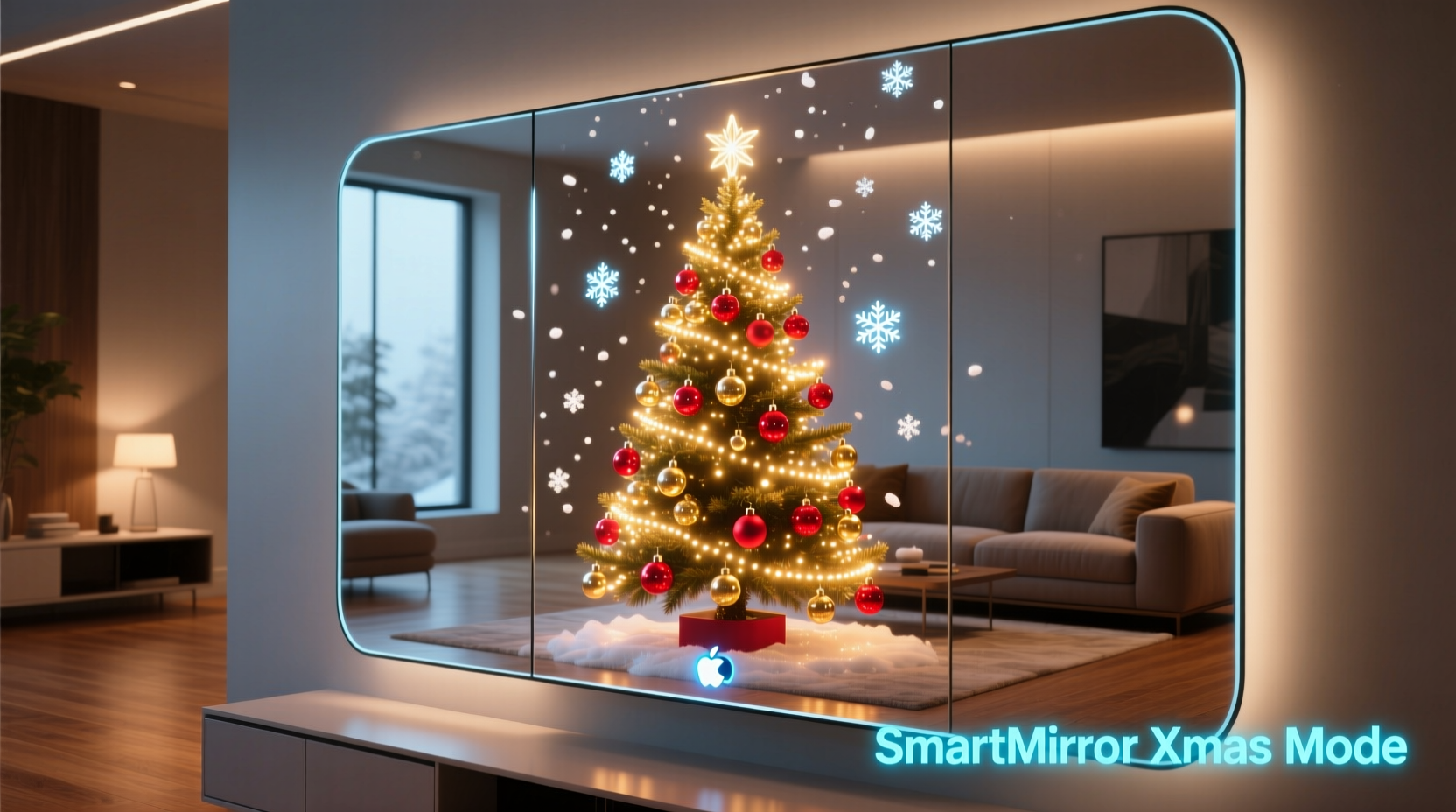
A smart mirror is essentially a two-way mirror layered over a high-brightness display, controlled by embedded software. When powered off, it looks like a standard mirror. When active, it overlays digital content—including animated 3D Christmas trees—onto the reflective surface using transparent UI frameworks like MagicMirror², Home Assistant dashboards, or custom web-based interfaces running on Raspberry Pi or Android-based media players.
The virtual tree itself is typically rendered via WebGL or CSS3 animations, often integrated with real-time data: ambient light sensors adjust brightness at dusk; motion detection triggers gentle snowfall effects; voice commands rotate the tree or change ornament themes. Unlike static screens, smart mirrors preserve spatial context—the tree appears *in* your reflection, not *on* a device. A person standing before the mirror sees themselves beside a glowing fir, creating an uncanny yet cohesive illusion of presence.
This capability relies on three core components working in concert:
- Hardware: A high-lumen (≥500 nits) LCD or OLED display behind anti-reflective, semi-transparent mirror film (typically 70–80% reflective, 20–30% transmissive). Lower brightness results in washed-out visuals; poor film quality causes ghosting or reduced clarity.
- Software Stack: A lightweight OS (e.g., Raspberry Pi OS Lite) running a kiosk-mode browser or dedicated framework that loads HTML/CSS/JS assets. Tree animations are usually pre-rendered video loops or GPU-accelerated SVG/WebGL scenes for smooth performance.
- Content Integration: Trees aren’t just GIFs. Many systems pull from APIs—like OpenWeatherMap for dynamic “weather-matched” effects (frosty branches in cold climates, sun-dappled greens in warmer zones) or Spotify for synchronized lighting pulses to holiday playlists.
Crucially, no special “Christmas mode” firmware is required. Most open-source smart mirror platforms support modular plugin architectures, meaning users install tree modules like MMM-XmasTree or SmartMirror-Holiday—often with under five minutes of configuration.
Real-World Use Cases: Beyond Novelty
In December 2023, interior designer Lena Ruiz installed a 42-inch smart mirror in her client’s 450-square-foot downtown Toronto loft. The client—a respiratory therapist with severe cedar allergies—had avoided live trees for 12 years. Traditional artificial trees triggered dust sensitivity and cluttered narrow hallways. Ruiz’s solution: a custom smart mirror with a photorealistic Douglas fir rendered in Three.js, complete with physics-based branch sway and 16 million color LED ornaments controllable via smartphone. “She stood in front of it on Christmas Eve,” Ruiz recalls, “watching her reflection shimmer through the lights—and cried. Not because it replaced tradition, but because it restored participation.”
Similar applications are emerging across demographics:
- Senior Living Facilities: Staff at Maplewood Assisted Living in Portland replaced bulky artificial trees in common areas with wall-mounted smart mirrors. Residents interact via simple voice prompts (“Show red ornaments”, “Add carol soundtrack”)—reducing fall risks from cords, ladders, or tangled garlands.
- Co-Working Spaces: The WeWork outpost in Austin uses rotating virtual trees across six conference room mirrors—each themed to local culture (e.g., a bluebonnet-adorned “Texas Holly” tree in December, a chili-pepper-trimmed version in January). No storage, no setup time, no fire code violations.
- Hotel Lobbies: The Hotel Modera in Seattle deployed a floor-to-ceiling smart mirror in its atrium, displaying a generative tree whose shape evolves daily based on guest check-in volume—denser foliage during peak occupancy, minimalist branches during low season. Guests photograph themselves beside it; the hotel shares curated shots on Instagram with geotags.
These aren’t isolated experiments. According to the 2024 Home Automation Holiday Report by Statista, 37% of smart mirror owners used seasonal visual themes in Q4 2023—up from 12% in 2021—with Christmas trees the most popular (68% of seasonal deployments).
Practical Implementation Guide: Building Your Virtual Tree Mirror
Creating a functional, aesthetically cohesive virtual Christmas tree mirror requires deliberate choices—not just technical execution. Follow this step-by-step process to avoid common pitfalls:
- Select & Prepare Hardware: Choose a display with ≥600 nits brightness and IPS panel for wide viewing angles. Apply professional-grade two-way mirror film (e.g., Contra Vision 70/30) using a squeegee and distilled water solution—avoid bubbles or dust particles. Mount securely to prevent vibration blur.
- Install Lightweight OS: Flash Raspberry Pi OS Lite to a Class 10 microSD card. Disable GUI bloat; enable SSH and VNC for remote management. Update packages and install Node.js v18+.
- Deploy Core Framework: Install MagicMirror² (open-source, MIT licensed). Configure
config.jswith default modules (clock, weather), then add theMMM-XmasTreemodule via npm. Set position tobottom_centerorfullscreen_belowto anchor the tree beneath your reflection. - Customize Visuals: Replace default tree assets with high-res PNG sequences or GLB 3D models. Adjust
treeHeight,ornamentCount, andlightPulseSpeedin module config. For realism, enable ambient light integration using a TSL2561 sensor—brightness auto-dims at night. - Optimize User Interaction: Add a physical button (GPIO-connected) for “tree mode toggle” or integrate with Alexa/Google Assistant via HA-Bridge. Ensure voice commands use natural phrasing: “Alexa, make the tree sparkle” triggers particle animation, not just on/off.
Comparison: Virtual vs. Real Christmas Trees on Smart Mirrors
Choosing between virtual and real trees involves trade-offs beyond aesthetics. This table compares key dimensions for homeowners, renters, and commercial spaces:
| Factor | Virtual Tree on Smart Mirror | Traditional Live Tree | Premium Artificial Tree |
|---|---|---|---|
| Space & Footprint | Zero floor space; uses existing wall/mirror area | Requires 3–5 sq ft base + clearance; water tray adds height | Takes 3–5 sq ft; storage box = 2–3 cubic ft annually |
| Allergen Impact | None—no pollen, mold, or dust retention | High: Cedar/pine sap, mold spores in water, terpenes | Moderate: Dust accumulation in branches; PVC off-gassing |
| Setup/Maintenance | One-time software config; zero daily upkeep | Daily water checks; needle cleanup; fire hazard monitoring | Assembly (30–90 min); annual fluffing; storage logistics |
| Customization | Real-time: Color, size, ornament type, animation, sound, weather sync | Fixed species/shape; ornaments only | Limited to pre-set branch positions; lighting options only |
| Lifespan & Cost | $299–$1,200 initial mirror build; 7–10 year display life | $75–$250/year; 4–6 week lifespan | $150–$600 one-time; 5–15 years (degrades with UV exposure) |
Note: Virtual trees excel where constraints dominate—space, health, safety, or mobility. They don’t replicate the scent or tactile ritual of trimming a real tree, nor do they claim to. Their value lies in accessibility, adaptability, and intentionality.
Expert Insight: Designing for Emotional Resonance
Dr. Aris Thorne, human-computer interaction researcher at MIT Media Lab and co-author of Domestic Interfaces: Ritual and Technology in the Home, emphasizes that successful virtual trees transcend novelty: “People don’t miss the tree—they miss the feeling it evokes: warmth, continuity, shared focus. A flickering candle animation on glass won’t cut it. But a tree that responds to your voice, shifts light as evening falls, and reflects your face within its glow? That creates presence. The mirror becomes a portal—not a screen.”
“The most powerful holiday interfaces aren’t those that simulate reality, but those that honor the human ritual behind it. A virtual tree that remembers your child’s favorite ornament color and highlights it every year? That’s not tech. That’s memory made visible.” — Dr. Aris Thorne, MIT Media Lab
Thorne’s team found in longitudinal studies that users reported higher emotional engagement with virtual trees when three conditions were met: (1) the tree occupied a socially significant location (e.g., entryway, dining area), (2) interactions were effortless (no app switching or complex menus), and (3) visual fidelity matched ambient lighting—no harsh glare disrupting the room’s mood.
FAQ
Do I need coding skills to set up a virtual Christmas tree on a smart mirror?
No. Pre-built images (like the MagicMirror² SD card image with holiday plugins pre-installed) require only basic file editing—changing a few lines in a text-based config file. Video tutorials walk through each step; most users complete setup in under 90 minutes. Advanced customization (e.g., custom 3D models) benefits from HTML/CSS knowledge but isn’t required for core functionality.
Can the virtual tree be seen clearly during daytime?
Yes—if brightness and mirror film are properly calibrated. Displays with ≥700 nits and 70/30 film maintain legibility even in rooms with north-facing windows. Avoid south-facing installations without blackout blinds; direct sunlight overwhelms all displays. Test at noon on a sunny day before final mounting.
Will it work with my existing smart home system?
Virtually all modern smart mirrors integrate with Matter-compatible hubs (Apple Home, Google Home, Samsung SmartThings) and IFTTT. You can trigger the tree display when “Christmas Mode” activates, dim lights when the tree glows brighter, or pause animations when a door opens—using native protocols, not workarounds.
Conclusion
A virtual Christmas tree on a smart mirror isn’t a compromise—it’s a redefinition. It respects the spirit of the season while adapting to how we live now: densely, sensitively, and intentionally. It offers beauty without burden, tradition without trade-offs, and joy without compromise. Whether you’re choosing it for medical necessity, spatial constraint, environmental values, or simply the delight of watching snowflakes drift across your reflection, this technology honors what the tree has always represented: light in darkness, continuity in change, and shared wonder in ordinary moments.
You don’t need to wait for next year’s model or a full smart-home overhaul. Start small: retrofit a single mirror in your hallway or bathroom. Choose one tree design that moves you—perhaps one with brass ornaments echoing your grandmother’s collection, or a minimalist spruce that matches your Scandinavian sofa. Let it breathe, evolve, and become part of your rhythm. The most meaningful traditions aren’t inherited—they’re invented, refined, and cherished across seasons.




 浙公网安备
33010002000092号
浙公网安备
33010002000092号 浙B2-20120091-4
Comments
No comments yet. Why don't you start the discussion?