
For decades, video games were dismissed as mindless entertainment or even blamed for promoting aggression and sedentary lifestyles. However, a growing body of scientific research is challenging this outdated view. Cognitive scientists, neurologists, and educators are now uncovering compelling evidence that certain types of video games can significantly enhance problem-solving abilities, spatial reasoning, memory, and decision-making speed. The relationship between gaming and cognition is not just anecdotal—it’s being rigorously studied in laboratories and classrooms around the world.
The idea that play can be intellectually enriching isn’t new. Children have long learned through puzzles, board games, and imaginative scenarios. What makes video games unique is their dynamic, interactive nature. Unlike passive media, games require players to make decisions under pressure, adapt to changing conditions, and experiment with strategies—all within complex virtual environments. These demands engage multiple regions of the brain simultaneously, creating fertile ground for cognitive development.
How Video Games Challenge the Brain
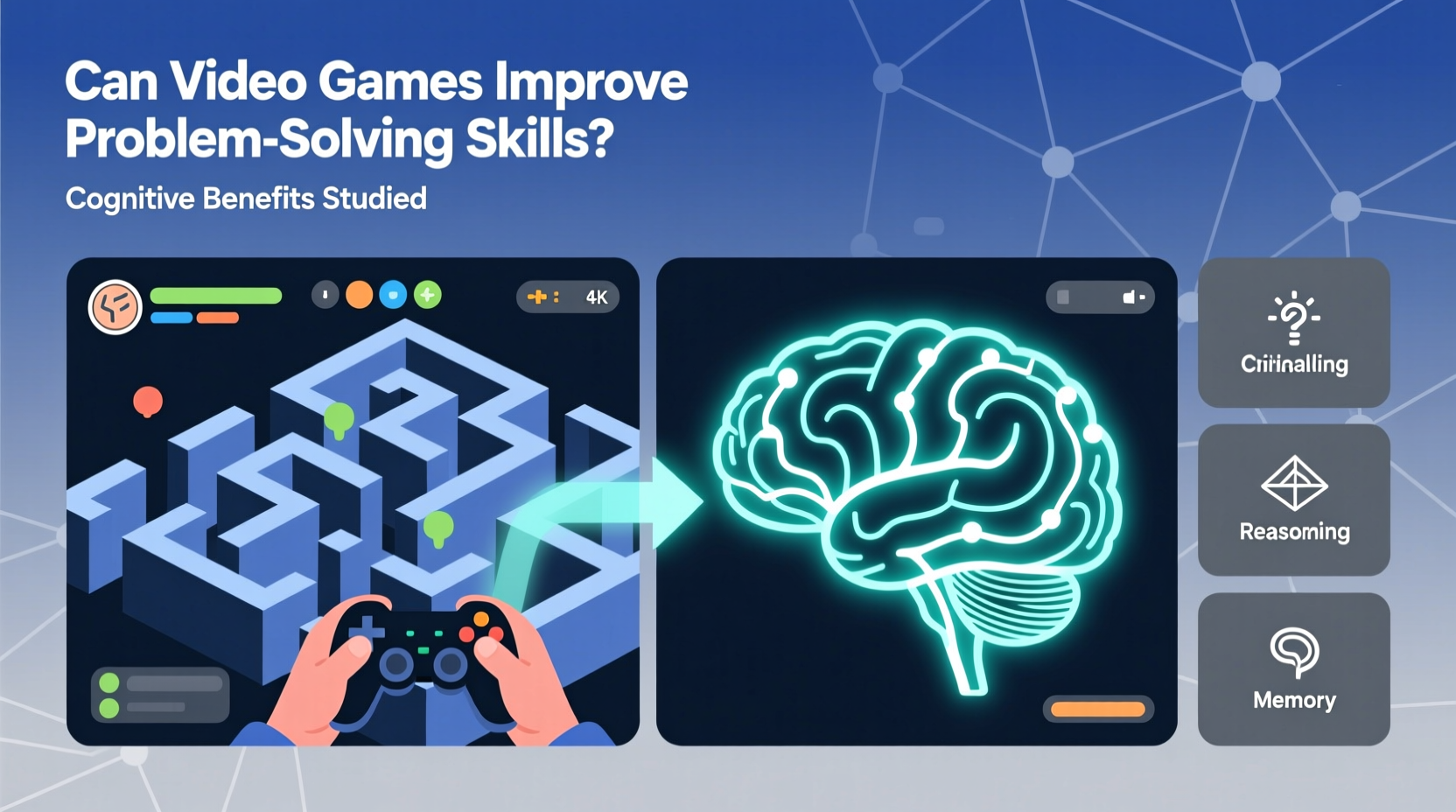
At their core, most video games are structured problem-solving exercises. Whether navigating a maze, managing limited resources, coordinating team tactics, or deciphering narrative clues, players constantly face obstacles that require analysis, planning, and adjustment. This engagement mirrors real-world cognitive tasks but in a controlled, repeatable format.
Neuroimaging studies have shown that playing action games—such as first-person shooters—activates areas of the brain associated with attention, visual processing, and executive control. Strategy games like *Civilization* or *StarCraft* stimulate prefrontal cortex activity linked to planning and multitasking. Puzzle-based games such as *Portal* or *The Witness* encourage lateral thinking and pattern recognition, skills directly transferable to academic and professional settings.
A 2013 study published in PLOS ONE found that individuals who played strategic video games showed measurable improvements in problem-solving ability over time, independent of their intelligence quotient (IQ). The researchers concluded that consistent gameplay contributed to gains in cognitive flexibility—the mental ability to switch between thinking about two different concepts or to think about multiple concepts simultaneously.
“Video games are not distractions from learning—they can be powerful tools for it. When designed well, they provide immediate feedback, scaffolded challenges, and intrinsic motivation, all of which support deep cognitive engagement.” — Dr. C. Shawn Green, Cognitive Psychologist, University of Wisconsin-Madison
Types of Games That Enhance Problem-Solving Skills
Not all video games offer the same cognitive benefits. The impact depends heavily on game mechanics, pacing, and required player input. Below is a breakdown of game genres most strongly associated with improved problem-solving and critical thinking.
| Game Genre | Cognitive Skills Developed | Example Titles |
|---|---|---|
| Strategy (RTS/Turn-Based) | Planning, resource management, foresight, multitasking | StarCraft II, Civilization VI, XCOM 2 |
| Puzzle/Logic | Pattern recognition, deductive reasoning, spatial awareness | Portal 2, The Talos Principle, Baba Is You |
| Action-Adventure | Situational analysis, quick decision-making, environmental navigation | The Legend of Zelda: Breath of the Wild, Metroid Prime |
| Simulation & Management | Systems thinking, cause-effect reasoning, long-term planning | Two Point Hospital, Cities: Skylines, Oxygen Not Included |
| Cooperative Multiplayer | Communication, teamwork, adaptive strategy | It Takes Two, Deep Rock Galactic, Overcooked! 2 |
Games that emphasize exploration, experimentation, and consequence-based outcomes tend to foster deeper cognitive processing. For example, in *Breath of the Wild*, players must observe weather patterns, use physics creatively (e.g., rolling boulders downhill), and combine elements (fire + wind = fire tornado) to overcome challenges. This open-ended design encourages systems thinking—a skill highly valued in engineering, science, and business.
Scientific Evidence: What Studies Reveal
Over the past two decades, dozens of peer-reviewed studies have examined the cognitive effects of video gaming. While early research focused on potential harms, more recent work highlights significant benefits when games are played in moderation and with intentionality.
A landmark 2015 meta-analysis conducted by researchers at the University of Oxford reviewed over 100 studies involving more than 10,000 participants. It found consistent positive associations between video game play and enhanced performance in several domains:
- Attention control: Gamers outperformed non-gamers in tasks requiring sustained focus and rapid switching between stimuli.
- Working memory: Players demonstrated better short-term retention and manipulation of information.
- Processing speed: Gamers made faster, more accurate decisions under time pressure.
- Problem-solving efficiency: Frequent players developed solutions more quickly in novel scenarios.
One particularly influential study from the University of Rochester tested non-gamers on a series of visual puzzles before and after playing 50 hours of an action game (*Medal of Honor*) over nine weeks. Compared to a control group playing non-action games, the action gamers improved their problem-solving accuracy by 25% and showed increased neural efficiency in attention-related brain networks.
Another line of research explores “transfer effects”—whether skills learned in games apply outside the digital environment. A 2020 study published in Nature Human Behaviour followed medical students training in laparoscopic surgery. Those who regularly played fast-paced video games performed procedures with greater precision and speed, suggesting that hand-eye coordination and spatial judgment honed through gaming had real-world clinical benefits.
Limitations and Caveats
While promising, these findings come with important caveats. Benefits are most pronounced with moderate play—typically defined as 1 to 3 hours per week. Excessive gaming, especially of highly addictive or socially isolating titles, can lead to diminished returns or negative outcomes such as sleep disruption or reduced academic performance.
Moreover, not all games are created equal. Passive, repetitive gameplay offers little cognitive stimulation. The key lies in challenge level: games must remain slightly beyond current skill to maintain engagement and promote growth—a principle known as the “zone of proximal development” in educational psychology.
Real-World Applications: From Classrooms to Careers
Educators and employers are beginning to harness the cognitive power of gaming in practical ways. In some schools, teachers use games like *Minecraft: Education Edition* to teach geometry, collaboration, and creative problem-solving. Students build scale models, simulate historical events, or engineer simple machines—all while immersed in a familiar digital environment.
In corporate training, gamified simulations help employees practice crisis response, customer service, or logistics planning without real-world risk. Airlines use flight simulators rooted in gaming technology; hospitals train surgeons using VR platforms derived from game engines. Even military units employ custom-built strategy games to prepare officers for battlefield decision-making.
“We don’t train pilots on actual jets their first day. Why should we expect professionals to master complex systems without simulation? Games are the next evolution of experiential learning.” — Lt. Col. David Johnson, U.S. Air Force Training Command (ret.)
Mini Case Study: Using Games to Improve Math Learning
In a public middle school in Austin, Texas, a math teacher introduced *DragonBox Algebra* into her curriculum—a puzzle game that teaches algebraic principles through intuitive visual mechanics. Within one semester, students using the game alongside traditional instruction scored 30% higher on standardized algebra assessments compared to peers in control classes.
What made the difference? The game allowed students to experiment freely. They could make mistakes without fear of grades, test hypotheses instantly, and gradually uncover abstract rules through concrete interaction. One student described it as “figuring out magic tricks—you see what happens, then reverse-engineer how it works.”
This case illustrates a broader truth: when games are aligned with learning objectives and integrated thoughtfully, they don’t replace teaching—they amplify it.
How to Maximize Cognitive Benefits from Gaming
To truly benefit cognitively from video games, intentionality matters. Mindless scrolling through levels won’t yield results. Instead, adopt a deliberate approach similar to physical exercise: choose the right type of activity, maintain consistency, and progressively increase difficulty.
Checklist: Optimizing Your Gaming for Cognitive Growth
- ✅ Play games that require planning, adaptation, or strategic thinking—not just reflexes.
- ✅ Limit sessions to 60–90 minutes to avoid mental fatigue.
- ✅ Reflect after gameplay: What worked? What failed? How would you adjust?
- ✅ Alternate between genres to develop diverse cognitive skills.
- ✅ Discuss strategies with others—verbalizing decisions strengthens understanding.
- ✅ Avoid games designed solely for endless engagement (e.g., loot-box-driven titles).
- ✅ Balance gaming with physical activity, reading, and social interaction.
Step-by-Step Guide to Building Problem-Solving Skills Through Gaming
- Assess your current habits: Track how much time you spend gaming and what types of games you play.
- Set a goal: Identify a specific skill to improve—e.g., faster decision-making or better spatial visualization.
- Select a targeted game: Choose one that aligns with your goal (e.g., *Tetris Effect* for spatial rotation).
- Play with purpose: Focus on learning, not just winning. Pause to analyze choices.
- Review and reflect: After each session, write down one insight or strategy you discovered.
- Apply off-screen: Try using similar logic in daily life—e.g., optimizing your commute route like a strategy game.
- Rotate regularly: Every few weeks, switch to a new genre to broaden your cognitive toolkit.
Frequently Asked Questions
Can video games really make you smarter?
While games don’t increase innate intelligence, they can improve specific cognitive functions such as working memory, attention, and fluid reasoning—skills closely related to intelligent behavior. Think of them as mental workouts rather than IQ boosters.
Are mobile games effective for cognitive training?
Some are. Casual games like *Lumosity* or *Peak* offer mini-puzzles that may sharpen basic skills, but their long-term impact is debated. More complex mobile titles—such as *Mini Metro* or *Reigns*—that require strategic planning can offer meaningful cognitive engagement.
Is there an age limit for benefiting from gaming?
No. Research shows cognitive benefits across age groups. Older adults who play strategy games report improved memory and slower cognitive decline. Children develop executive function earlier. The key is matching game complexity to developmental stage.
Conclusion: Level Up Your Mind
The evidence is clear: when chosen wisely and played with purpose, video games can be powerful catalysts for cognitive growth. They train the brain to solve problems faster, think more flexibly, and adapt to uncertainty—all essential skills in today’s fast-changing world. Far from being a waste of time, thoughtful gaming can complement formal education, enhance professional capabilities, and keep the mind agile across the lifespan.
The next time someone dismisses gaming as frivolous, consider sharing what science now confirms: behind every puzzle solved, every strategy refined, and every obstacle overcome in a virtual world, real neurons are firing, connections are strengthening, and problem-solving skills are evolving. It’s not just play—it’s progress.




 浙公网安备
33010002000092号
浙公网安备
33010002000092号 浙B2-20120091-4
Comments
No comments yet. Why don't you start the discussion?