
For many language learners, traditional methods like textbooks and grammar drills often feel disconnected from real-world communication. Enter anime—a cultural phenomenon that has quietly become a powerful tool in the language-learning toolkit. While it may seem like entertainment first and education second, watching anime can significantly enhance language acquisition, especially for beginners. With its exaggerated expressions, clear pronunciation, and contextual storytelling, anime offers an engaging way to absorb vocabulary, intonation, and cultural nuances. But how effective is it really? And what strategies turn passive viewing into active learning?
The Cognitive Benefits of Visual Language Learning
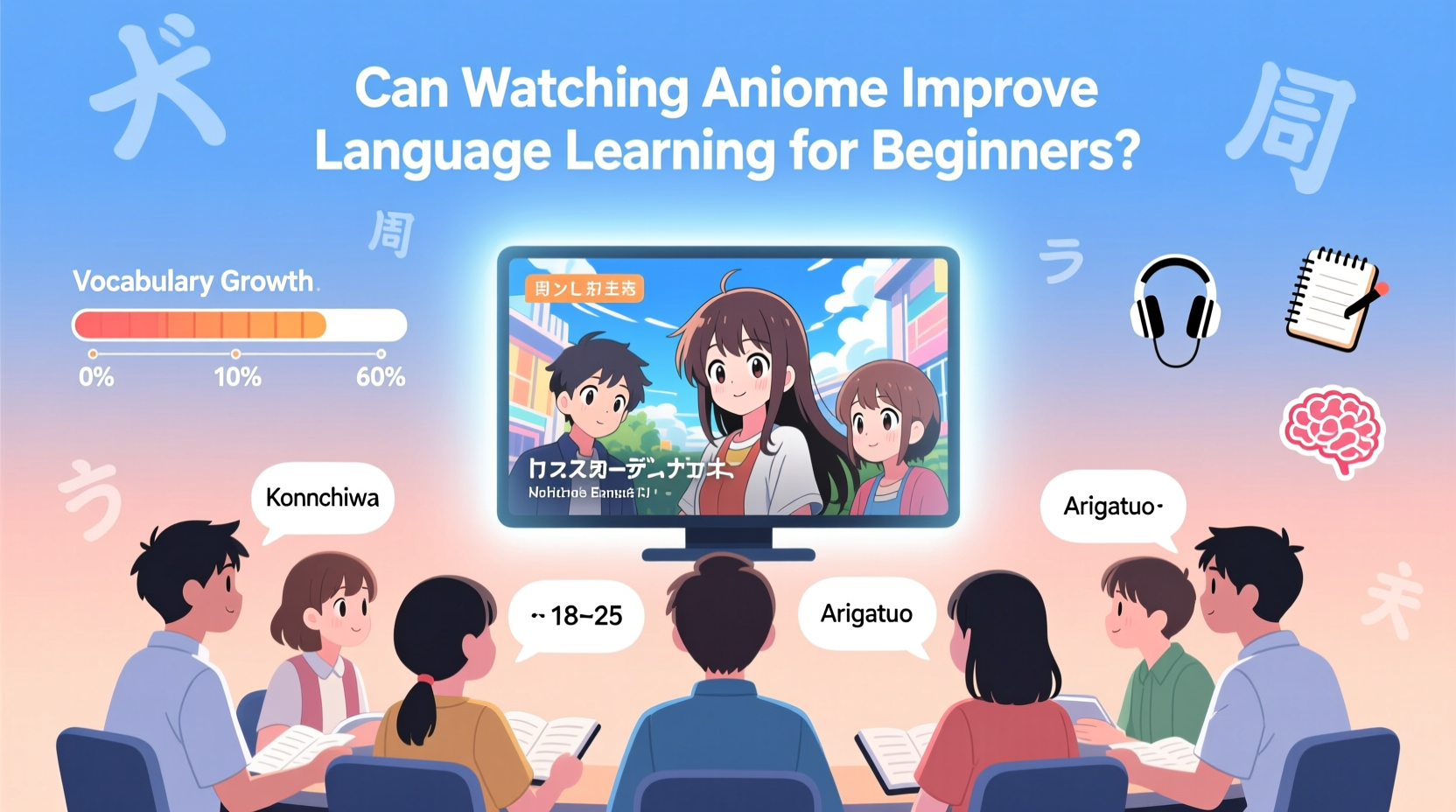
Language acquisition isn't just about memorizing words—it's about building neural pathways through exposure, repetition, and context. Watching anime engages multiple cognitive systems simultaneously: visual cues help interpret meaning, auditory input trains the ear to recognize sounds, and emotional engagement increases memory retention.
According to Dr. James H. Byers, a linguist specializing in second-language acquisition, “Learners retain up to 65% more when information is presented visually and auditorily compared to text alone.” Anime provides precisely this multisensory input. Characters gesture, react emotionally, and speak in natural (if dramatized) rhythms, helping beginners associate words with actions and feelings—not abstract definitions.
“Contextual immersion, even through fictional narratives, accelerates vocabulary uptake and listening comprehension faster than isolated word lists.” — Dr. Aiko Tanaka, Applied Linguistics Researcher, Kyoto University
For beginners, this means encountering high-frequency words repeatedly—like greetings, emotions, or daily routines—in situations where their meaning becomes obvious through context. For example, hearing \"ohayou gozaimasu\" every morning in school-based anime reinforces both the phrase and its appropriate usage time.
How Anime Supports Key Language Skills
Anime doesn’t replace structured study, but it complements it by strengthening core competencies essential for language mastery. Below is a breakdown of how different aspects of anime contribute to skill development:
Vocabulary Acquisition Through Repetition and Context
Beginners often struggle with remembering new words because they lack meaningful associations. Anime solves this by embedding vocabulary in memorable scenes. Words like \"taberu\" (to eat), \"iku\" (to go), or \"dame\" (no good) appear frequently across genres—from cooking shows to battle sequences—making them easier to internalize.
Pronunciation and Listening Comprehension
Japanese animation often features exaggerated enunciation, especially in children’s or slice-of-life anime, which helps beginners distinguish between similar-sounding syllables like \"ra,\" \"ri,\" \"ru,\" \"re,\" and \"ro.\" Unlike native speakers in fast-paced conversations, anime characters tend to articulate clearly, particularly during emotional moments or dramatic pauses.
Additionally, the use of sound effects (onomatopoeia) such as \"grrr\" (anger), \"waku waku\" (excitement), or \"zutto\" (quietly) exposes learners to expressive language not typically found in textbooks.
Cultural Fluency and Pragmatic Understanding
Language cannot be separated from culture. Anime reflects social hierarchies, politeness levels (keigo), and everyday customs—such as bowing, gift-giving, or using honorifics (-san, -kun, -chan). Observing these interactions teaches pragmatic competence: knowing not just *what* to say, but *when* and *how* to say it.
A beginner might not grasp all the grammatical rules behind keigo, but repeated exposure to characters switching between casual and formal speech based on age or status builds intuitive understanding over time.
Effective Strategies for Using Anime as a Learning Tool
Simply watching anime with subtitles won’t guarantee progress. To transform entertainment into education, learners need a strategic approach. The following method ensures consistent improvement without burnout.
Step-by-Step Guide: Turning Anime Into a Language Workout
- Choose Beginner-Friendly Anime: Start with shows featuring simple dialogue and everyday settings—e.g., Shirokuma Cafe, Chi’s Sweet Home, or Yuru Camp△. Avoid complex fantasy or mecha anime early on.
- Use Subtitles Wisely: Begin with English subtitles to follow the plot. After two viewings, switch to Japanese subtitles to connect spoken sounds with written kana/kanji.
- Watch in Short Segments: Break episodes into 5–7 minute clips. Replay each segment three times: once for comprehension, once to catch new words, once to shadow (repeat aloud).
- Create a Vocabulary Journal: Note down 3–5 new words per session. Include context: “Used when apologizing,” “Said by younger sister.”
- Practice Output: Mimic character lines in front of a mirror. Record yourself and compare pronunciation. Try writing short dialogues using phrases you’ve learned.
- Review Weekly: Re-watch previous clips without subtitles. Test your recall by summarizing scenes aloud in simple Japanese.
Checklist: Maximize Your Anime Study Sessions
- ☐ Select shows with realistic conversation and minimal jargon
- ☐ Use dual subtitles (English → Japanese) progressively
- ☐ Limit sessions to 20–30 minutes to maintain focus
- ☐ Pause and repeat difficult lines until understood
- ☐ Shadow speaking with correct mouth movements and intonation
- ☐ Review flashcards of learned phrases before each session
- ☐ Track progress weekly with a short self-test
Common Pitfalls and How to Avoid Them
While anime offers immense potential, misuse can lead to frustration or inaccurate learning. Here are frequent mistakes beginners make—and how to correct them.
| Mistake | Why It’s Problematic | Solution |
|---|---|---|
| Only watching with English subtitles | Learner focuses on reading, not listening; misses phonetic patterns | Gradually phase out English subs; use Japanese kana subtitles instead |
| Binge-watching without review | No reinforcement leads to poor retention | Limit to 1–2 episodes per week with active note-taking |
| Choosing overly complex anime | Fantasy terms, archaic speech, or slang confuse beginners | Stick to modern, conversational anime with relatable plots |
| Ignoring grammar structure | Memorizes phrases without understanding sentence logic | Pair anime with basic grammar lessons (e.g., particle usage) |
| Trying to understand everything at once | Leads to cognitive overload and discouragement | Focus on keywords and gist; accept partial comprehension |
Real Example: How Maria Went from Zero to N5 in 6 Months
Maria, a university student from Spain, began studying Japanese with no prior exposure. Instead of relying solely on apps, she incorporated one 20-minute anime session daily into her routine. She started with Chi’s Sweet Home, a show about a kitten exploring a city, narrated in simple, repetitive Japanese.
Each day, she watched the same five-minute clip twice—first with English subtitles, then with Japanese subtitles. She wrote down phrases like “Kore wa?” (“What’s this?”) and “Tabetai!” (“I want to eat!”), practicing them aloud. After two weeks, she could predict character lines before they were spoken.
By month three, she transitioned to Yuru Camp△, which introduced travel-related vocabulary. She used Anki to review new words and recorded herself mimicking campfire conversations. At six months, Maria passed the JLPT N5 exam—largely crediting anime for improving her listening score.
“It didn’t feel like studying,” she said. “I was curious about the story, and the language came naturally.”
Frequently Asked Questions
Is anime too informal or exaggerated to be useful for real conversations?
Some anime uses stylized speech, but many series reflect authentic daily interactions. Slice-of-life, workplace, or family-centered anime often mirror real-world Japanese. The key is selecting appropriate content and balancing it with formal study. Over time, you’ll learn to distinguish between dramatic expressions and usable language.
Should I watch anime with or without subtitles?
Start with English subtitles to build comprehension. After one full viewing, rewatch with Japanese subtitles to link sound and script. Eventually, remove subtitles entirely to test listening skills. This phased approach prevents dependency while building confidence.
Can watching anime alone make me fluent?
No single method guarantees fluency. Anime is best used as a supplement to structured learning—textbooks, speaking practice, grammar drills. However, consistent exposure through anime dramatically improves listening speed, vocabulary range, and cultural intuition, which are critical components of fluency.
Conclusion: Make Anime Work for Your Language Goals
Watching anime isn’t a shortcut—but it is a highly effective accelerator for language learning. When approached with intention, it transforms passive screen time into immersive education. Beginners gain access to authentic pronunciation, high-frequency vocabulary, and cultural context in a format that’s enjoyable and repeatable.
The most successful learners aren’t those who study the longest, but those who stay engaged. Anime keeps motivation high, reduces anxiety around mistakes, and makes repetition feel natural. Combine it with smart strategies—targeted selection, active listening, and regular output—and you’ll find yourself understanding more than you thought possible.




 浙公网安备
33010002000092号
浙公网安备
33010002000092号 浙B2-20120091-4
Comments
No comments yet. Why don't you start the discussion?