
Language learning is no longer confined to textbooks and classroom drills. With the global rise of digital media, learners are turning to immersive, engaging content—like anime—to accelerate their progress. While traditional methods emphasize grammar rules and rote memorization, modern approaches recognize the power of authentic exposure. Anime, with its rich dialogue, diverse accents, and real-life conversational patterns, has emerged as a surprisingly effective tool for language learners, particularly those studying Japanese. But does it actually work? Can consistent anime viewing lead to measurable improvements in listening, speaking, reading, and even cultural fluency?
The answer is not a simple yes or no—it depends on how it’s used. When approached strategically, anime can be a powerful supplement to formal study. It exposes learners to natural speech rhythms, colloquial expressions, and cultural nuances that textbooks often overlook. However, passive binge-watching without intention yields minimal results. The real benefit lies in active engagement, repetition, and integration with other learning practices.
How Anime Enhances Listening and Pronunciation Skills
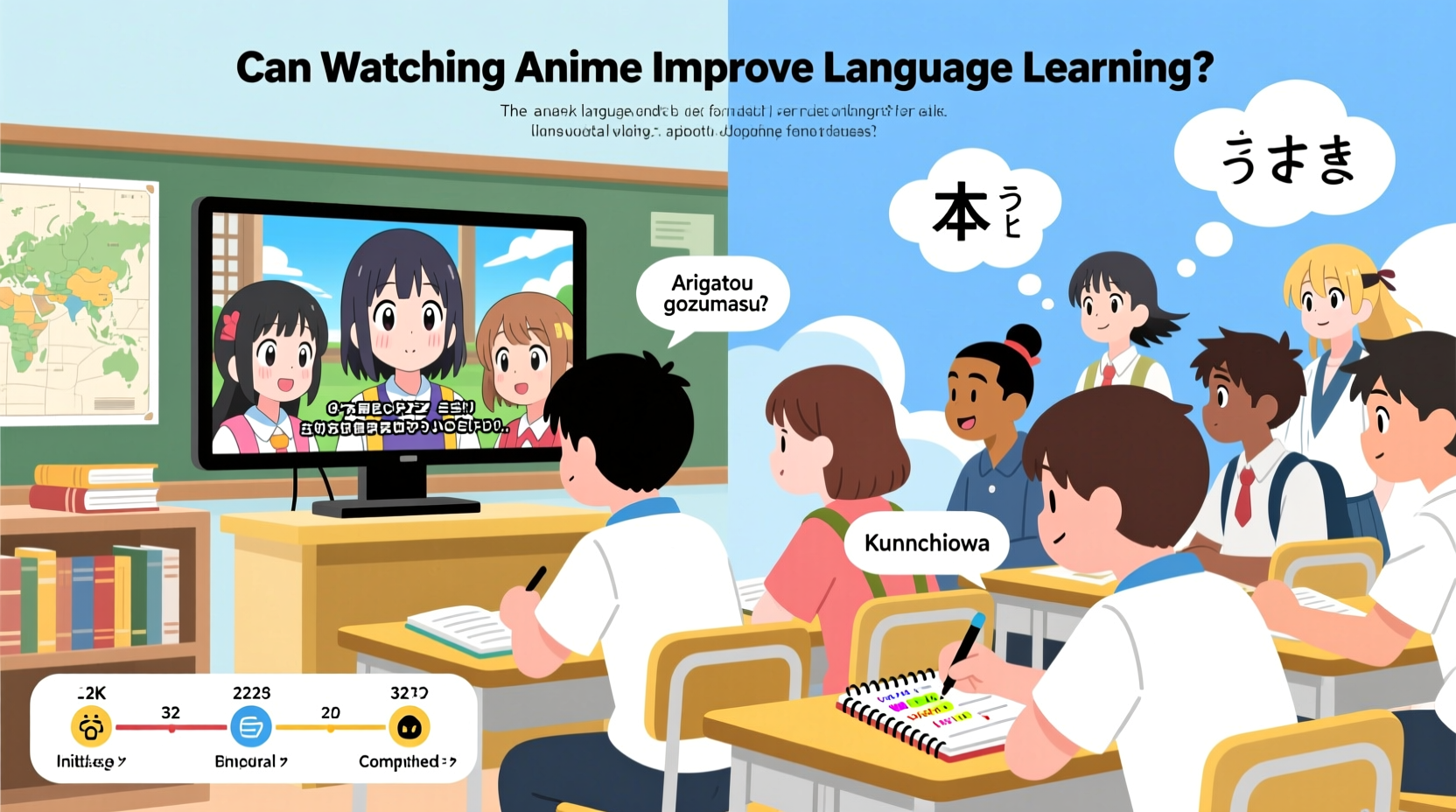
One of the most immediate benefits of watching anime is improved auditory comprehension. Unlike scripted audio lessons, anime features real-time conversations with varied intonations, speeds, and regional dialects. Characters speak with emotion, hesitation, sarcasm, and excitement—mirroring how people actually communicate.
For beginners, this may seem overwhelming. Fast-paced dialogue, slang, and homophones can obscure meaning. But with repeated exposure, the brain begins to identify patterns. Learners start recognizing common sentence endings like “ne,” “yo,” or “da yo,” and distinguish between polite and casual speech based on tone and context.
Over time, regular viewers develop what linguists call \"phonemic awareness\"—the ability to perceive individual sounds in speech. This is crucial for accurate pronunciation. By mimicking character intonation and rhythm, learners naturally refine their accent and speaking cadence. Shadowing—repeating lines immediately after hearing them—is a proven technique used by polyglots, and anime provides an accessible platform for practicing it.
Building Vocabulary and Grammar Through Context
Anime scripts are dense with everyday expressions, idioms, and situational phrases. Unlike textbook dialogues about ordering food or asking for directions, anime covers a wide emotional and social spectrum: apologies, encouragement, arguments, jokes, and heartfelt confessions. These contexts make vocabulary more memorable because they’re tied to strong visual and emotional cues.
Consider the word “ganbatte” (頑張って), which means “do your best.” In a sports anime like Haikyuu!!, teammates shout it during intense matches. In a school drama, a friend might whisper it before an exam. Each usage reinforces the word’s emotional weight and appropriate context. This kind of associative learning is far more effective than flashcards alone.
Grammar structures also appear organically. Viewers encounter keigo (polite speech) in formal settings, plain form among friends, and even regional dialects. Over time, these patterns become intuitive. For example, seeing how “~n desu” is used to explain reasoning helps internalize its function better than memorizing a rule.
“Authentic input is essential for language acquisition. When learners engage with emotionally resonant content, retention increases significantly.” — Dr. Naomi Tanaka, Applied Linguist, Kyoto University
Reading Practice: Subtitles, Scripts, and Kanji Recognition
Watching anime with Japanese subtitles turns passive viewing into active reading practice. Unlike English subtitles, which encourage mental translation, native subtitles help learners connect spoken words with their written forms. This is especially valuable for mastering kanji, hiragana, and katakana recognition.
Learners can pause scenes to analyze sentence structure, look up unfamiliar words, and observe particles in action. Tools like language learning apps (e.g., LingQ, Tadoku) integrate anime clips with clickable dictionaries, making it easier to build vocabulary while watching.
For advanced learners, comparing dubbed versions with original audio reveals translation nuances. Some phrases don’t have direct equivalents, forcing creative adaptations. Understanding these differences deepens linguistic insight and cultural literacy.
Do’s and Don’ts of Using Subtitles for Learning
| Do | Don't |
|---|---|
| Use Japanese subtitles to reinforce reading | Rely solely on English subtitles |
| Pause and look up new words | Watch without note-taking |
| Re-watch episodes for deeper understanding | Assume all dialogue is standard Japanese |
| Use dual subtitles (Japanese + native language) | Translate every single word obsessively |
A Real Example: From Beginner to Fluent Speaker
Take the case of Marcus Lee, a university student from Toronto who began studying Japanese with no prior experience. Initially, he struggled with textbook exercises and found grammar drills tedious. After discovering Shirokuma Cafe (Polar Bear Café), a comedy anime featuring slow, clear dialogue and everyday interactions, he started watching one episode daily with Japanese subtitles.
Marcus didn’t just watch—he took notes. He wrote down new phrases, recorded himself repeating lines, and used Anki to review vocabulary from each episode. Within six months, he could understand over 70% of casual conversations in the show. By his second year, he was able to hold basic conversations with native speakers and passed the JLPT N4 exam.
“Anime made Japanese feel alive,” Marcus said. “I wasn’t just learning a language—I was connecting with characters, emotions, and humor. That motivation kept me going when textbooks couldn’t.”
His success wasn’t due to anime alone, but to how he integrated it into a broader strategy: consistent exposure, active note-taking, and deliberate practice.
Step-by-Step Guide to Learning Language Through Anime
To maximize the educational value of anime, follow this structured approach:
- Choose the Right Genre: Start with slice-of-life, school, or family-themed anime that use natural, everyday language.
- Set Up Subtitles: Use Japanese subtitles (if available). If not, use dual subtitles to compare translations.
- Watch Actively: Pause frequently to write down new words, phrases, or grammar points.
- Shadow Dialogues: Repeat lines aloud, matching the speaker’s intonation and speed.
- Review Weekly: Compile a vocabulary list from each episode and review using spaced repetition software.
- Re-watch Episodes: Watch the same episode 2–3 times: first with subtitles, then without, then with audio only.
- Engage with Community: Join forums or Discord groups to discuss plots and language in Japanese.
Cultural Fluency: Beyond Words
Language is inseparable from culture. Anime offers a window into Japanese social norms, values, and etiquette. Bowing, honorifics (-san, -kun, -chan), and indirect communication styles are woven into interactions. Observing how characters navigate hierarchy, express humility, or avoid confrontation provides context that textbooks rarely convey.
For instance, the frequent use of “sumimasen” (excuse me/sorry) reflects cultural emphasis on politeness and social harmony. Seeing it used in crowded trains, restaurants, or apologies helps learners grasp its emotional weight beyond literal translation.
This cultural insight improves pragmatic competence—the ability to use language appropriately in social situations. A learner who understands when to use humble vs. honorific language is better equipped for real-world conversations than someone who only knows grammar rules.
Common Pitfalls and How to Avoid Them
Despite its benefits, anime isn’t a magic solution. Several risks can hinder progress if not managed:
- Unrealistic Speech: Some characters use exaggerated or fictional speech (e.g., robot voices, archaic samurai dialect). These aren’t representative of modern Japanese.
- Slang Overload: Teen dramas or comedies may feature heavy slang or gendered speech (e.g., “ore” for masculine “I”), which can confuse beginners.
- Passive Consumption: Watching without focus leads to minimal retention. It becomes entertainment, not education.
To avoid these traps, balance anime with structured learning. Use it as a reinforcement tool, not a replacement for grammar study or conversation practice. Stick to realistic genres early on, and consult native speaker resources when unsure about usage.
Checklist: Optimizing Anime for Language Learning
- ☑ Choose shows with natural, everyday dialogue
- ☑ Use Japanese or dual subtitles
- ☑ Take notes on new vocabulary and grammar
- ☑ Repeat lines aloud (shadowing)
- ☑ Re-watch episodes for deeper comprehension
- ☑ Look up cultural references and honorifics
- ☑ Track progress with a language journal
Frequently Asked Questions
Can I learn Japanese fluently just by watching anime?
No single method guarantees fluency. Anime is a powerful supplement, but it should be combined with grammar study, writing practice, and real conversation. Fluency requires output as well as input.
Is it better to watch with English or Japanese subtitles?
Japanese subtitles are more beneficial for learning, as they link sound to script. English subtitles can help with initial comprehension but encourage mental translation, which slows fluency development.
What anime should I watch as a beginner?
Recommended titles include Yotsuba&!, Chiisai Hito (Little Miss Pencil), Shirokuma Cafe, and Non Non Biyori. These feature clear speech, simple vocabulary, and relatable daily scenarios.
Conclusion: Turn Passion Into Progress
Watching anime can indeed improve language learning skills over time—but only when done intentionally. It’s not about how many episodes you consume, but how deeply you engage with them. When paired with active listening, vocabulary tracking, and cultural reflection, anime becomes more than entertainment; it becomes a dynamic classroom filled with real human expression.
The key is consistency and purpose. Whether you’re rewatching a favorite scene to master a phrase or discussing plot twists in your target language, every moment spent mindfully contributes to growth. Language learning is a journey of immersion, and anime offers one of the most enjoyable paths forward.




 浙公网安备
33010002000092号
浙公网安备
33010002000092号 浙B2-20120091-4
Comments
No comments yet. Why don't you start the discussion?