
As holiday decorating becomes more sophisticated, homeowners are increasingly using a mix of lighting technologies—some powered by alternating current (AC), others by direct current (DC). With the rise of LED string lights, solar-powered displays, and smart lighting systems, it's common to wonder whether these different types can safely coexist on the same electrical circuit. The short answer: technically yes, but only under specific conditions. The long answer involves understanding voltage, power sources, load distribution, and potential safety hazards.
Mixing AC and DC Christmas lights isn't about plugging them into the same outlet—it's about how they draw power and interact with your home’s electrical system. Misunderstanding this can lead to flickering lights, blown fuses, damaged controllers, or even fire risks. This guide breaks down what happens when AC and DC systems meet, when it’s safe to combine them, and how to avoid costly or dangerous mistakes.
Understanding AC vs. DC Power in Holiday Lighting
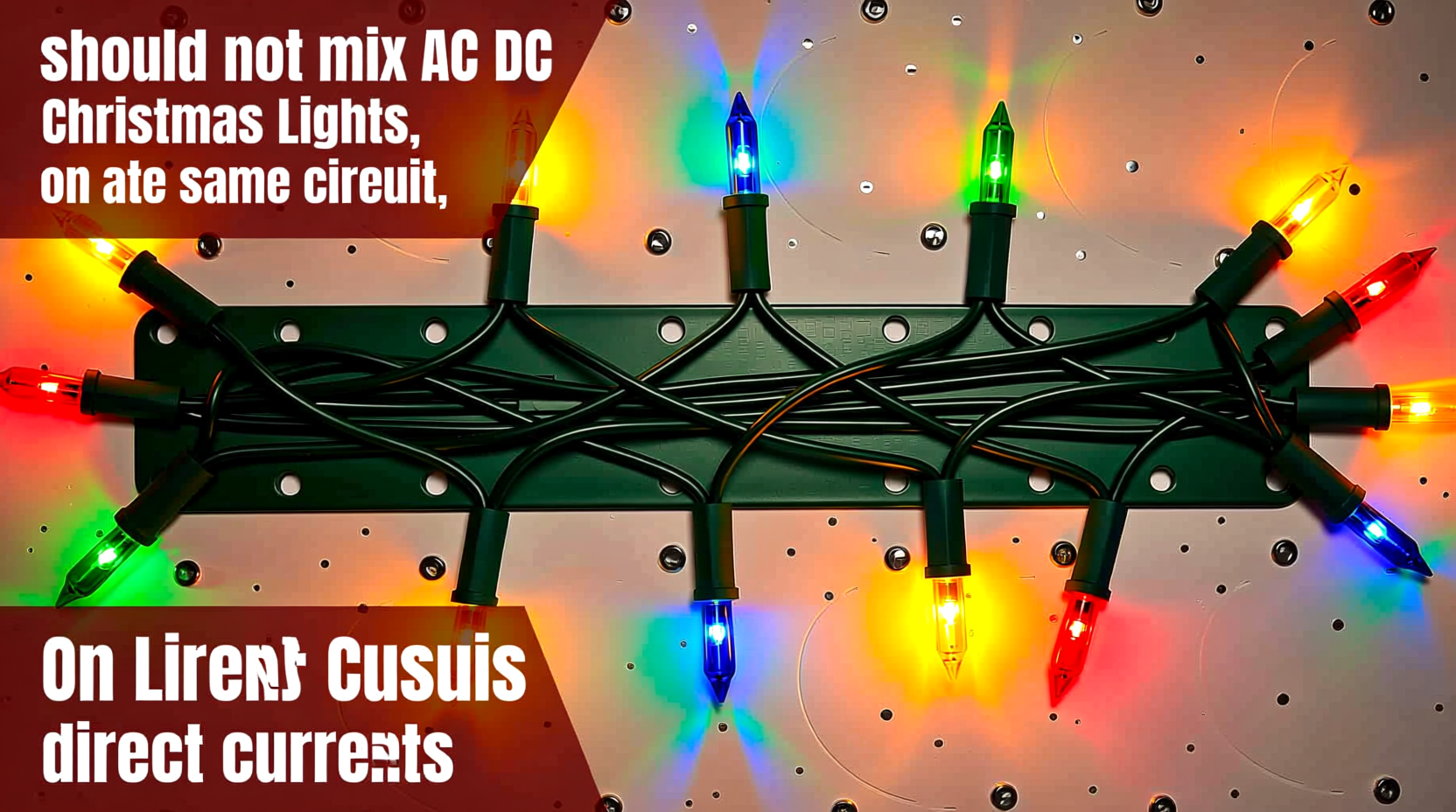
Alternating current (AC) and direct current (DC) are fundamentally different ways of delivering electricity. Most household outlets supply AC power—typically 120 volts in North America—which reverses direction many times per second. This is ideal for transmitting power over long distances and running high-wattage appliances. Traditional incandescent Christmas lights and many modern LED strings are designed to run directly from AC outlets.
Direct current (DC), on the other hand, flows in one direction and is commonly used in low-voltage applications. Many modern LED Christmas lights operate on DC, usually stepped down to 12V or 24V via a transformer or power adapter. Battery-powered lights, solar garden displays, and smart lighting strips almost always use DC power.
The key issue isn’t the type of current itself, but how devices are powered. You cannot directly connect a DC-powered light strip to an AC circuit without proper conversion. However, multiple lighting systems can share the same circuit if each has its own appropriate power supply and does not overload the circuit’s capacity.
“Mixing AC and DC lights on the same circuit isn’t inherently dangerous—if isolation and proper conversion are maintained. The real danger comes from assuming all ‘plugged-in’ lights behave the same.” — Daniel Reeves, Electrical Systems Engineer
When It’s Safe (and When It’s Not) to Combine AC and DC Lights
Safety depends on whether the AC and DC lights are truly sharing the circuit at the electrical level or simply drawing power from the same source through independent paths. Here’s how to tell the difference:
- Safe Scenario: AC-powered mini lights and DC-powered LED strip lights both plug into outlets on the same circuit, but each uses its own plug-in adapter. The DC lights convert AC to DC internally or via an external driver. No electrical mixing occurs—only shared circuit capacity.
- Unsafe Scenario: Attempting to wire DC lights directly into an AC circuit without a transformer, or daisy-chaining DC strips to an AC-powered controller not rated for mixed loads.
The risk arises when people assume compatibility based on plug shape or voltage labels. A label saying “12V” doesn’t mean it can handle 12V AC—it may require regulated 12V DC. Applying AC to such a device can destroy internal electronics instantly.
Electrical Load and Circuit Capacity: What You Need to Know
A standard residential circuit in the U.S. is typically 15 or 20 amps at 120 volts, allowing for 1,800 to 2,400 watts of total load. While individual LED lights consume very little power (often less than 10 watts per string), multiple strings, timers, projectors, and inflatables can add up quickly.
When mixing AC and DC lights, the total wattage drawn from the circuit matters more than the current type. For example:
| Light Type | Voltage | Power per String | Quantity on One 15A Circuit |
|---|---|---|---|
| AC LED Mini Lights | 120V AC | 4.8W | Up to 375 strings |
| DC LED Strip Lights (with adapter) | 12V DC (input: 120V AC) | 24W/meter | ~30 meters (with controller) |
| Incandescent Mini Lights | 120V AC | 40W | Up to 45 strings |
| Solar-Powered Lights (grid-charged) | Varies (usually charged via AC) | Low (charging only) | Limited by charger wattage |
The table shows that while DC lights often have higher localized consumption due to inefficient drivers, their overall impact depends on length and density. The critical rule: never exceed 80% of the circuit’s rated capacity (1,440W for a 15A circuit) to prevent overheating and tripped breakers.
Step-by-Step Guide: Safely Combining AC and DC Lights on One Circuit
If you plan to use both AC and DC Christmas lights on the same circuit, follow this sequence to ensure safety and performance:
- Identify your circuit’s rating. Check the breaker panel—most lighting circuits are 15A or 20A at 120V.
- List all devices to be connected. Include lights, timers, motors, and chargers. Note their wattage (found on labels or packaging).
- Calculate total load. Add up the wattage of all devices. Ensure the sum is below 80% of the circuit’s capacity.
- Verify power supplies. Confirm that DC lights are powered through proper AC-to-DC adapters or drivers. Do not hardwire DC lights into AC lines.
- Use surge-protected power strips. Plug devices into UL-listed power strips with built-in surge protection and overload cutoffs.
- Test before final installation. Run all lights for at least 30 minutes to check for overheating, flickering, or tripped breakers.
- Label the circuit. Mark the breaker with “Holiday Lights – Do Not Unplug” during the season to prevent accidental shutdowns.
This process ensures that even though AC and DC lights are electrically isolated, they coexist safely within the same power infrastructure.
Common Mistakes and Hidden Risks
Even experienced decorators make errors when integrating new lighting tech. These are the most frequent—and potentially dangerous—missteps:
- Mixing incompatible controllers: Using an AC dimmer switch with DC LED strips can damage the driver or cause erratic behavior.
- Daisy-chaining beyond limits: Connecting too many DC strips in series can overload the power supply, leading to voltage drop or fire.
- Ignoring heat buildup: Power adapters stacked together or enclosed in tight spaces can overheat, especially when running 24/7.
- Using non-UL-listed adapters: Cheap, unregulated power supplies may not provide clean DC output, harming sensitive electronics.
Real-World Example: A Home Decorator’s Close Call
In suburban Colorado, homeowner Lisa Tran decided to upgrade her front yard display with new RGB LED strip lights powered by a 24V DC driver, while keeping her existing AC-powered icicle lights on the roofline. She plugged both the driver and the AC strings into the same outdoor power strip, thinking it was safe since everything was “plugged in.”
After two nights, the strip lights began flickering. On the third night, the entire display went dark. An electrician diagnosed the issue: the DC power supply had failed due to sustained overcurrent caused by marginal voltage fluctuations on the shared circuit. While no fire occurred, the $120 driver was destroyed, and the circuit breaker had tripped repeatedly without notice.
The fix? The electrician recommended splitting high-draw DC systems onto a dedicated indoor outlet, using a higher-capacity driver, and installing a whole-house surge protector. Lisa now runs her AC lights on the outdoor circuit and powers DC strips from an interior garage outlet on a separate 20A line.
Her experience highlights a subtle but critical point: even when AC and DC devices don’t interact electrically, they can still affect each other through shared circuit instability.
Checklist: Preparing Your Mixed Lighting Setup
Before turning on your holiday display, go through this checklist to ensure safety and reliability:
- ✅ All DC lights are powered through correct AC-to-DC adapters or drivers
- ✅ Total wattage of all devices is under 80% of circuit capacity
- ✅ Power strips are UL-listed and have overload protection
- ✅ Cords are inspected for cracks, frays, or exposed wires
- ✅ Outdoor connections are elevated and protected from moisture
- ✅ Timers or smart plugs are rated for the total load
- ✅ Breaker panel is labeled to indicate holiday circuit usage
- ✅ A fire extinguisher is accessible near the main electrical panel
Frequently Asked Questions
Can I plug a DC LED strip into the same outlet as my AC Christmas lights?
Yes, as long as the DC strip uses its own power adapter to convert AC to DC. The outlet provides AC power; the adapter handles conversion. Just ensure the total load doesn’t exceed the circuit’s capacity.
What happens if I connect DC lights directly to an AC circuit?
Doing so will likely destroy the LEDs or driver immediately. AC voltage alternates, which can cause reverse-bias damage to diodes and fry control chips. Always use the correct power supply.
Do mixed AC/DC setups use more electricity?
Not inherently. Efficiency depends on the lights themselves, not the current type. However, low-quality AC-to-DC adapters can waste energy as heat. Opt for high-efficiency (85%+) drivers to minimize loss.
Final Recommendations and Best Practices
While mixing AC and DC Christmas lights on the same circuit is possible, it demands attention to detail. The safest approach is to treat each lighting system independently—respecting its power needs—while managing the shared circuit like any other electrical load.
Prioritize quality components: use UL-listed adapters, avoid extension cord daisy-chaining, and never modify plugs or wiring. Consider upgrading to a dedicated holiday circuit if you regularly deploy large displays. Smart power strips with energy monitoring can help track real-time consumption and alert you to anomalies.
Finally, remember that the goal isn’t just functionality—it’s safety, longevity, and peace of mind. A dazzling display means nothing if it risks your home or family.




 浙公网安备
33010002000092号
浙公网安备
33010002000092号 浙B2-20120091-4
Comments
No comments yet. Why don't you start the discussion?