
Mixing LED mini lights, incandescent C7s, battery-operated net lights, and vintage-style rope lights on a single tree is a beloved design choice—rich in texture, dimension, and nostalgia. But beneath the festive glow lies a practical concern: electrical safety. Overloading circuits isn’t just about tripped breakers; it’s about heat buildup in cords, degraded insulation, and potential fire risk. The short answer is yes—you *can* mix light types safely—but only when guided by voltage compatibility, wattage math, and outlet-level awareness—not intuition or aesthetics alone. This article breaks down exactly how to do it right, using real-world calculations, verified standards from UL and the National Electrical Code (NEC), and lessons learned from holiday electricians who’ve seen every kind of “festive fuse.”
Understanding Why Mixing Lights Is Risky (and Why It’s Often Done Wrong)
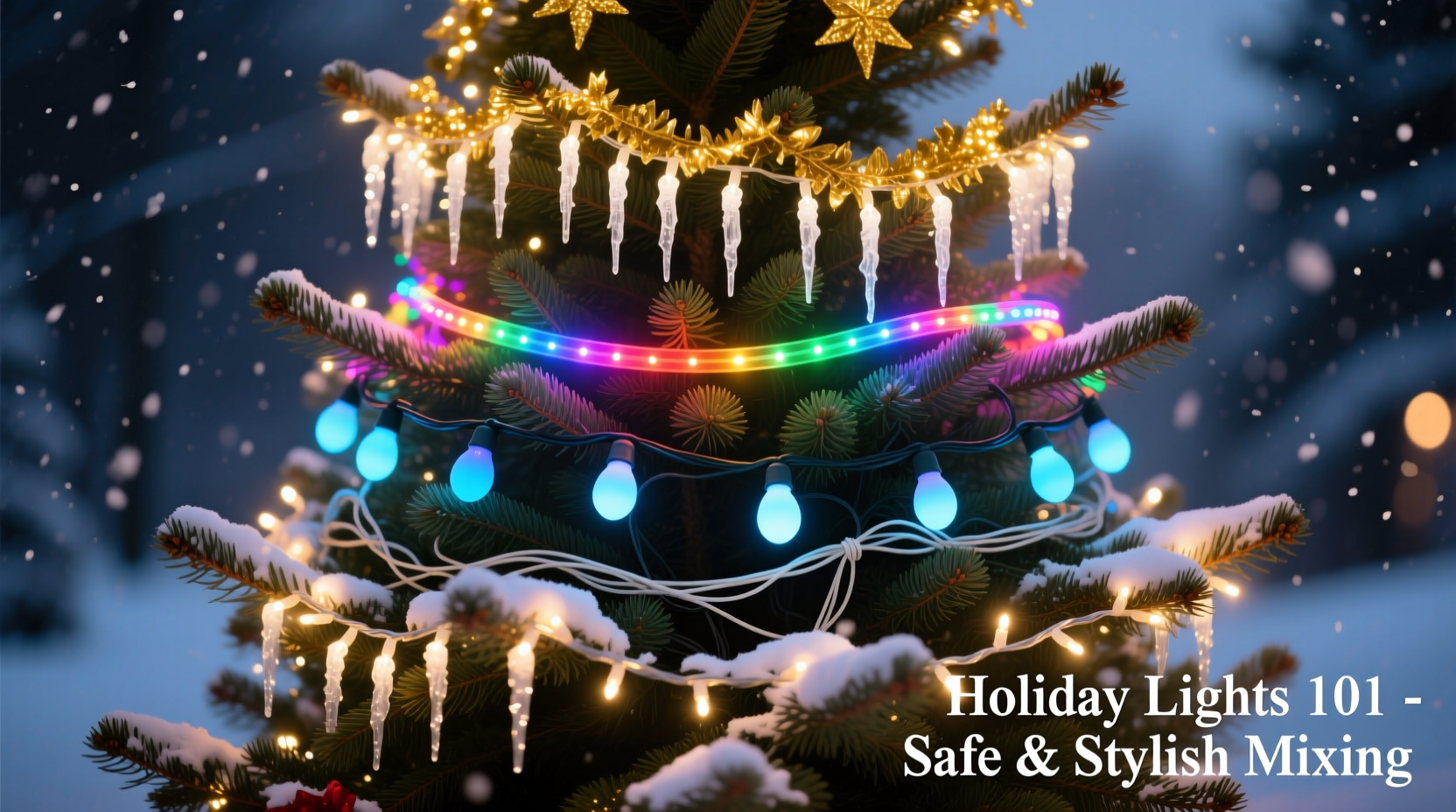
Most people assume “if it plugs in, it’s fine.” That assumption fails because Christmas lights aren’t interchangeable like USB cables. Each type operates under distinct electrical parameters:
- Voltage: Most plug-in string lights are 120V AC (U.S./Canada), but low-voltage options (12V or 24V) require transformers—and mixing them directly into a standard outlet circuit creates immediate incompatibility.
- Wattage per string: A 100-light LED set may draw only 4.8 watts, while a 50-light incandescent set of the same length can pull 200+ watts. That’s a 40× difference in thermal load on the same cord.
- Current rating (amps): Standard household outlets are rated for 15 amps (1800 watts at 120V). Yet many users daisy-chain six or more strings without checking cumulative draw—especially dangerous when combining high-wattage vintage bulbs with modern LEDs that share the same outlet.
- Cord gauge and construction: Older incandescent strings often use thinner 22-gauge wire, while newer LED sets may use 20- or 18-gauge for longer runs. When overloaded, thinner cords heat up faster—sometimes reaching 140°F before the breaker trips.
A 2023 NFPA report found that 31% of home Christmas fires involved decorative lighting—and nearly half of those occurred due to “overloaded extension cords or power strips,” not faulty bulbs. The risk isn’t theoretical. It’s measurable, preventable, and entirely avoidable with basic arithmetic and planning.
How to Calculate Your Tree’s Total Load—Step by Step
Forget guesswork. Use this verified, NEC-aligned process to determine your safe limit—before you hang a single bulb.
- Identify every light string’s wattage. Check the UL label on the plug end or packaging. If missing, use these industry-standard averages:
- LED mini lights (100-count): 4–6 watts
- LED C7/C9 bulbs (25-count): 12–18 watts
- Incandescent mini lights (100-count): 40–60 watts
- Incandescent C7 bulbs (25-count): 175–250 watts
- Battery-operated LED nets or clusters: 0 watts on your circuit (but verify battery life)
- Add all wattages together. Example: 2 × LED mini (5W each) + 1 × LED C9 (15W) + 1 × incandescent C7 (210W) = 245 watts.
- Apply the 80% Rule. Per NEC Article 210.20(A), continuous loads (like lights on for >3 hours) must not exceed 80% of circuit capacity. For a standard 15-amp circuit: 15A × 120V = 1800W × 0.8 = 1440 watts maximum.
- Account for shared outlets. Is your tree outlet also powering a garland, projector, or sound system? Subtract those watts too. A typical animated snow globe draws 25W; a fiber-optic star top uses 8W.
- Verify cord ratings. Look for the “UL Listed” mark and check the amp rating printed on the cord jacket (e.g., “13A 125V”). Never exceed that number—even if the circuit allows more.
Do’s and Don’ts of Mixing Light Types
| Action | Do | Don’t |
|---|---|---|
| Voltage Matching | Only combine lights rated for 120V AC on standard outlets. Use separate transformers for 12V/24V systems (e.g., landscape-grade rope lights). | Mix 120V and low-voltage lights on the same outlet—even with an adapter. Voltage mismatch can fry drivers and cause arcing. |
| Daisy-Chaining | Follow manufacturer limits strictly (e.g., “Connect up to 45 sets” for LED minis). Use UL-listed power strips with built-in circuit breakers. | Chain incandescent strings beyond their listed max—even if they “fit” physically. Heat compounds exponentially with each added string. |
| Outlet Sharing | Dedicate one 15-amp circuit solely to your tree and nearby decor. Run it from a GFCI-protected outlet. | Plug tree lights into the same outlet powering your refrigerator, space heater, or vacuum cleaner. Those appliances cycle on/off unpredictably, stressing connections. |
| Physical Integration | Layer LED base lights first (cool-running), then wrap incandescent accents sparingly on outer branches where airflow is best. | Bundle hot-running incandescent cords tightly under tinsel or flocking. Trapped heat degrades insulation faster than visible wear. |
| Timer Use | Set timers to run lights 6–8 hours nightly. Reduces thermal stress and cuts energy use by up to 70%. | Leave lights on unattended overnight or while traveling—even with LEDs. Faults can still occur (e.g., damaged sockets, rodent-chewed cords). |
Real-World Case Study: The 9-Foot Fraser Fir Incident
In December 2022, a Portland, Oregon homeowner decorated a 9-foot Fraser fir with 12 light strings: eight LED mini sets (5W each), two incandescent C7s (220W each), one warm-white LED rope light (18W), and one battery-powered copper wire garland. All were plugged into a single 15-amp outlet via a 6-outlet power strip rated for 15A.
On night three, the power strip’s internal breaker tripped repeatedly after 90 minutes. The owner reset it manually—until smoke rose from the strip’s housing. An electrician later measured total draw at 1,642 watts—just 158W below the 1440W 80% limit. But the strip itself was rated for only 1,800W *peak*, not continuous load—and its internal wiring was 16-gauge, not the 14-gauge required for sustained 13.7-amp flow.
The fix? They replaced the strip with a UL-listed, 14-gauge, 15A-rated model; moved one incandescent C7 string to a separate circuit; and added a programmable timer. No further issues occurred—all while keeping the mixed-light aesthetic intact. As licensed master electrician Lena Torres explained during the inspection: “It wasn’t the mix that failed. It was the assumption that ‘under the limit’ means ‘safe.’ Ampacity depends on wire thickness, ambient temperature, and duty cycle—not just a wattage sum.”
“The biggest misconception is that LED lights make everything safe. Yes, they run cooler—but they don’t eliminate the need for proper circuit management. A 15-amp circuit overloaded with 14 strings of cheap LED lights can fail just as catastrophically as one with three incandescent sets—if the wiring, connectors, or power strip can’t handle the sustained current.” — Lena Torres, Master Electrician & Holiday Lighting Safety Advisor, NECA
Practical Checklist: Before You Plug In Your Mixed-Light Tree
- ☑️ Locate your tree’s dedicated circuit breaker and label it “XMAS TREE” for quick access.
- ☑️ Verify every light string has a UL or ETL certification mark (not just “CE” or “RoHS”).
- ☑️ Measure total wattage using labels or a Kill A Watt meter—then apply the 80% rule.
- ☑️ Inspect all cords for cracked insulation, bent prongs, or exposed copper—replace damaged sets immediately.
- ☑️ Use only heavy-duty, 14-gauge (or thicker) extension cords rated for indoor/outdoor use—never lamp or appliance cords.
- ☑️ Install a plug-in AFCI/GFCI adapter ($12–$20) if your outlet isn’t already protected.
- ☑️ Set a timer or smart plug to limit runtime to ≤8 hours/day.
- ☑️ Keep a fire extinguisher (Class C rated) within 30 feet of the tree.
Frequently Asked Questions
Can I mix LED and incandescent lights on the same string—or do they need separate plugs?
No—never splice or modify strings to combine LED and incandescent bulbs on one circuit. Their drivers, resistors, and current profiles are incompatible. Always keep them on separate strings with individual plugs, even if both go to the same power strip.
What if my lights have different plug types—like end-to-end vs. stackable?
End-to-end (male/female) strings are designed for daisy-chaining *within the same product line*. Stackable (two female ends) plugs usually indicate non-chainable sets meant for parallel connection only. Mixing plug types risks back-feeding voltage or exceeding socket amp ratings. Use a UL-listed multi-outlet power strip—not improvised adapters.
Do solar-powered or battery-operated lights affect my circuit load?
No—they draw zero power from your home circuit. However, batteries degrade faster in cold garages or near heat sources. Replace alkaline batteries every 30–45 days during active use, and never mix old/new or different chemistries (e.g., lithium + alkaline) in one device.
Conclusion: Beauty and Safety Are Not Mutually Exclusive
A mixed-light Christmas tree doesn’t have to be a compromise between visual richness and electrical responsibility. It can—and should—be both. The tools exist: UL-certified hardware, NEC-compliant calculations, and real-time measurement devices. What’s needed isn’t technical expertise, but disciplined attention to detail—the same care you’d give to selecting ornaments or choosing the perfect tree stand. Every watt counted, every cord inspected, every outlet verified adds up to something deeper than convenience: peace of mind. That quiet confidence when the tree glows at dusk—not just because it’s beautiful, but because you know, down to the last amp, that it’s safe.
This holiday season, hang your favorite lights with intention. Layer cool-running LEDs deep in the boughs for ambient fill, place vintage-inspired incandescents where they catch the eye—not where they trap heat—and let battery-powered accents add whimsy without wires. Then step back, admire the balance of old and new, and remember: the most enduring traditions aren’t just joyful. They’re thoughtful, grounded, and quietly resilient.




 浙公网安备
33010002000092号
浙公网安备
33010002000092号 浙B2-20120091-4
Comments
No comments yet. Why don't you start the discussion?