
Fitness doesn’t require a gym membership, expensive equipment, or even much space. For many people, the idea of getting in shape from home is appealing—but skepticism lingers: Can you actually build strength, improve endurance, and reshape your body using just a resistance band? The answer, backed by exercise science and real-world results, is a resounding yes—provided you approach it strategically.
Resistance bands are lightweight, portable, and surprisingly versatile. They offer variable tension, joint-friendly resistance, and can mimic many movements performed with free weights or machines. When used consistently and intelligently, they can support muscle growth, cardiovascular conditioning, flexibility, and functional fitness. But like any training tool, their effectiveness depends on how you use them.
The Science Behind Resistance Band Training
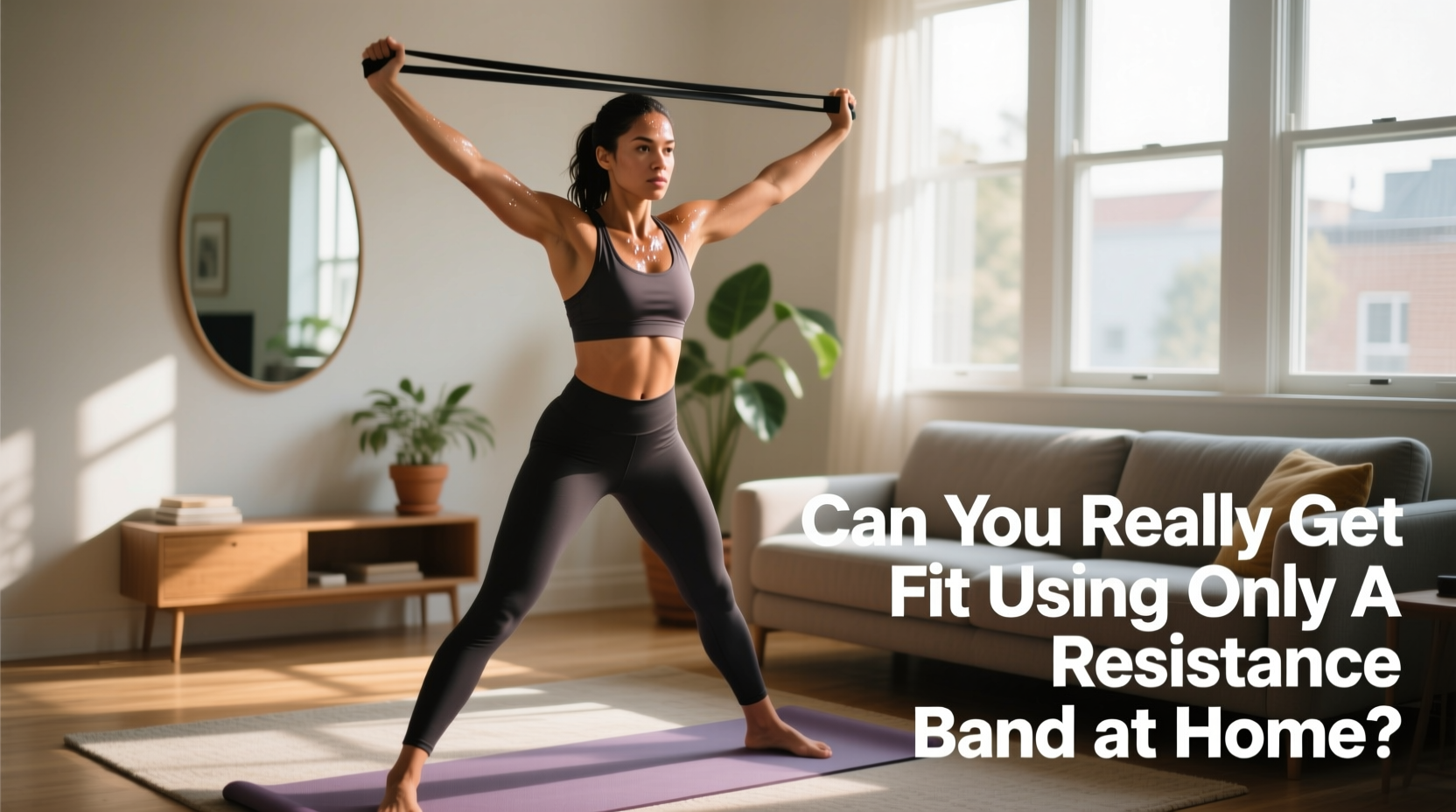
Resistance bands work by providing elastic tension throughout a movement’s range of motion. Unlike dumbbells, which rely on gravity, bands increase resistance as they stretch. This means muscles are challenged more at the peak of the movement—a concept known as \"accommodating resistance.\" Studies have shown that resistance band training can produce strength gains comparable to traditional weightlifting when volume and intensity are matched.
A 2019 meta-analysis published in the Journal of Human Kinetics concluded that elastic resistance training led to significant improvements in muscular strength across multiple muscle groups, especially when exercises were performed to near-fatigue over several weeks. Another study from the Scandinavian Journal of Medicine & Science in Sports found that participants using resistance bands three times per week for eight weeks increased their lower-body strength by up to 25%—similar to those using conventional gym equipment.
“Resistance bands are an evidence-based alternative to free weights. When programmed correctly, they elicit similar neuromuscular activation and hypertrophy.” — Dr. Lena Patel, Exercise Physiologist, University of Colorado
The key lies in progressive overload—the principle of gradually increasing demand on the musculoskeletal system to continue making gains. With bands, this means increasing repetitions, slowing tempo, combining bands for greater tension, or advancing to thicker, higher-resistance levels over time.
What “Getting Fit” Really Means—and How Bands Deliver
\"Getting fit\" isn't a single outcome—it's a combination of goals including strength, endurance, mobility, body composition, and cardiovascular health. Resistance bands can contribute meaningfully to each of these areas:
- Strength: By performing compound movements (like squats, rows, and presses) with proper form and progressive resistance, you can stimulate muscle growth and strength development.
- Muscular Endurance: High-repetition circuits with moderate-tension bands enhance local muscle stamina, improving performance in daily activities and sports.
- Flexibility & Mobility: Bands assist with dynamic stretching and controlled mobility drills, helping maintain joint health and reduce injury risk.
- Functional Fitness: Many band exercises engage stabilizing muscles, enhancing balance, coordination, and real-world movement patterns.
- Cardiovascular Conditioning: When used in circuit-style workouts with minimal rest, bands elevate heart rate and support aerobic capacity.
While resistance bands won’t replicate maximal-load lifts like heavy deadlifts, they provide enough stimulus for most people—especially beginners and intermediates—to achieve meaningful fitness improvements.
Designing an Effective Home Workout Routine
To get fit using only resistance bands, structure matters. A well-designed routine should target all major muscle groups across multiple planes of motion, include progression strategies, and allow for recovery. Here’s a practical weekly framework:
Weekly Resistance Band Plan (Beginner to Intermediate)
| Day | Focus | Exercises | Sets x Reps |
|---|---|---|---|
| Monday | Full Body Strength | Banded Squats, Seated Rows, Push-Ups with Band Across Back, Glute Bridges | 3 x 12–15 |
| Tuesday | Active Recovery | Band-Assisted Stretches, Shoulder Mobilizations | 2 x 10–12 |
| Wednesday | Upper Body & Core | Bent-Over Rows, Chest Press, Bicep Curls, Triceps Extensions, Plank with Row | 3 x 12–15 |
| Thursday | Lower Body Power | Lateral Walks, Standing Leg Kickbacks, Wall Sit with Adduction, Step-Back Lunges | 3 x 15 per side |
| Friday | Circuit Conditioning | Squat to Press, Band Rotations, Jump-Simulation Kicks, Mountain Climbers with Band | 4 rounds, 45 sec work / 15 sec rest |
| Saturday | Mobility & Balance | Hip Circles, Thoracic Spine Rotations, Single-Leg Deadlifts with Band | 2 x 10–12 |
| Sunday | Rest | Complete rest or light walking | N/A |
This plan ensures balanced development, prevents overuse, and builds consistency. As strength improves, increase resistance by switching to a heavier band or layering multiple bands together.
Progression Strategies for Long-Term Gains
To avoid plateaus, apply one or more of the following techniques every 3–4 weeks:
- Increase resistance level (light → medium → heavy)
- Add 1–2 sets per exercise
- Slow down the eccentric (lowering) phase (e.g., 4 seconds down, 1 second up)
- Reduce rest between sets (from 60 to 30 seconds)
- Incorporate supersets (pair upper and lower body moves)
- Use tempo variations (e.g., pause at peak contraction)
Real Results: A Case Study
Sarah, a 38-year-old teacher from Portland, had limited time and access to gyms after having her second child. She invested in a set of looped and tube-style resistance bands and committed to 30-minute workouts four days a week. Her initial routine focused on basic squats, assisted push-ups, and seated rows.
Over 12 weeks, she progressed from light to heavy resistance, added unilateral work (single-leg and single-arm exercises), and incorporated short cardio bursts using rapid banded kicks and jumps. She paired her training with improved sleep and modest dietary adjustments—no extreme calorie cuts.
By the end of the period, Sarah lost 7 pounds of fat, gained noticeable muscle tone in her arms and glutes, and reported feeling stronger during daily tasks like carrying groceries and lifting her children. Her resting heart rate dropped from 78 to 66 bpm, and she could perform 15 full push-ups without assistance—up from zero.
Her success wasn’t due to magic—it was consistency, smart programming, and understanding how to make resistance bands work for her goals.
Maximizing Effectiveness: Do’s and Don’ts
To get the most out of resistance band training, follow best practices while avoiding common mistakes.
| Do’s | Don’ts |
|---|---|
| Choose the right resistance level—challenging but controllable | Use a band that’s too loose or too tight for the movement |
| Anchor bands securely to avoid snapping or slipping | Attach bands to unstable furniture or sharp edges |
| Focus on form and muscle engagement, not speed | Rush through reps with poor posture or jerky motions |
| Combine bands for progressive overload | Stick with the same band and routine indefinitely |
| Store bands away from direct sunlight and heat | Leave bands stretched or exposed to UV rays for long periods |
FAQ: Common Questions About Resistance Band Fitness
Can resistance bands build muscle like weights?
Yes, provided you apply progressive overload. Muscle growth depends on mechanical tension, metabolic stress, and muscle damage—all achievable with bands when used with sufficient intensity and volume. While maximum strength gains may plateau faster than with heavy barbells, most individuals can build substantial lean mass using bands alone.
Are resistance bands safe for older adults or people with joint issues?
Absolutely. In fact, resistance bands are often recommended for rehabilitation and low-impact training because they provide smooth, controlled resistance without compressive loads on joints. Physical therapists frequently use bands to help patients regain strength after injury or surgery.
How many resistance bands do I need to start?
A set of 3–5 bands with varying tensions (light, medium, heavy, extra-heavy, and looped mini-bands) covers most needs. Start with two or three and expand as you progress. Tube bands with handles are great for upper body; flat loops excel for lower body and mobility.
Your Action Plan: Getting Started Today
Starting a resistance band fitness journey requires no special skills—just commitment and clarity. Follow this checklist to begin building real results from home:
- Select a quality band set with multiple resistance levels and durable construction (latex-free options available).
- Clear a small workout area (5x5 feet is plenty) and ensure safe anchoring points.
- Learn foundational movements: squat, hinge, push, pull, lunge, rotate.
- Create a schedule: aim for 3–5 sessions per week, 20–40 minutes each.
- Track progress: log workouts, note resistance used, and record milestones (e.g., “first unassisted push-up”).
- Reassess every 4 weeks: adjust resistance, volume, or structure based on results.
Remember, fitness is cumulative. Small efforts repeated consistently yield transformative outcomes. You don’t need perfection—just persistence.
“The best exercise equipment is the one you’ll actually use. For millions, that’s a resistance band.” — Dr. Marcus Lee, Sports Medicine Specialist
Conclusion
You absolutely can get fit using only a resistance band at home. From building strength and endurance to enhancing mobility and supporting fat loss, resistance bands offer a scalable, accessible, and scientifically supported path to better health. They’re ideal for busy schedules, limited spaces, and diverse fitness levels—from postpartum recovery to senior conditioning.
The limiting factor isn’t the tool—it’s the approach. Train with intention, prioritize consistency over intensity, and progressively challenge your body. Whether you're restarting fitness after a break or seeking a sustainable long-term solution, resistance bands can be the foundation of a capable, confident, and resilient physique.




 浙公网安备
33010002000092号
浙公网安备
33010002000092号 浙B2-20120091-4
Comments
No comments yet. Why don't you start the discussion?