
Every November, millions of households pull out boxes of Christmas lights stored since last year—some dating back a decade. While reusing lights saves money and reduces waste, it also introduces real risks: frayed wires, cracked sockets, corroded connections, and degraded insulation can all spark electrical faults, overheating, or even fire. The U.S. Consumer Product Safety Commission estimates that holiday lighting causes an average of 700 home fires annually—nearly half involving outdated, damaged, or improperly reused strings. Reusing lights isn’t inherently unsafe—but doing so without rigorous evaluation is. This article details exactly how to assess, test, and prepare vintage or previously used Christmas lights for safe seasonal operation. No assumptions. No shortcuts. Just field-tested, electrician-vetted methods grounded in National Fire Protection Association (NFPA) 101 and UL 588 standards.
Why “Just Plugging It In” Is Never Enough
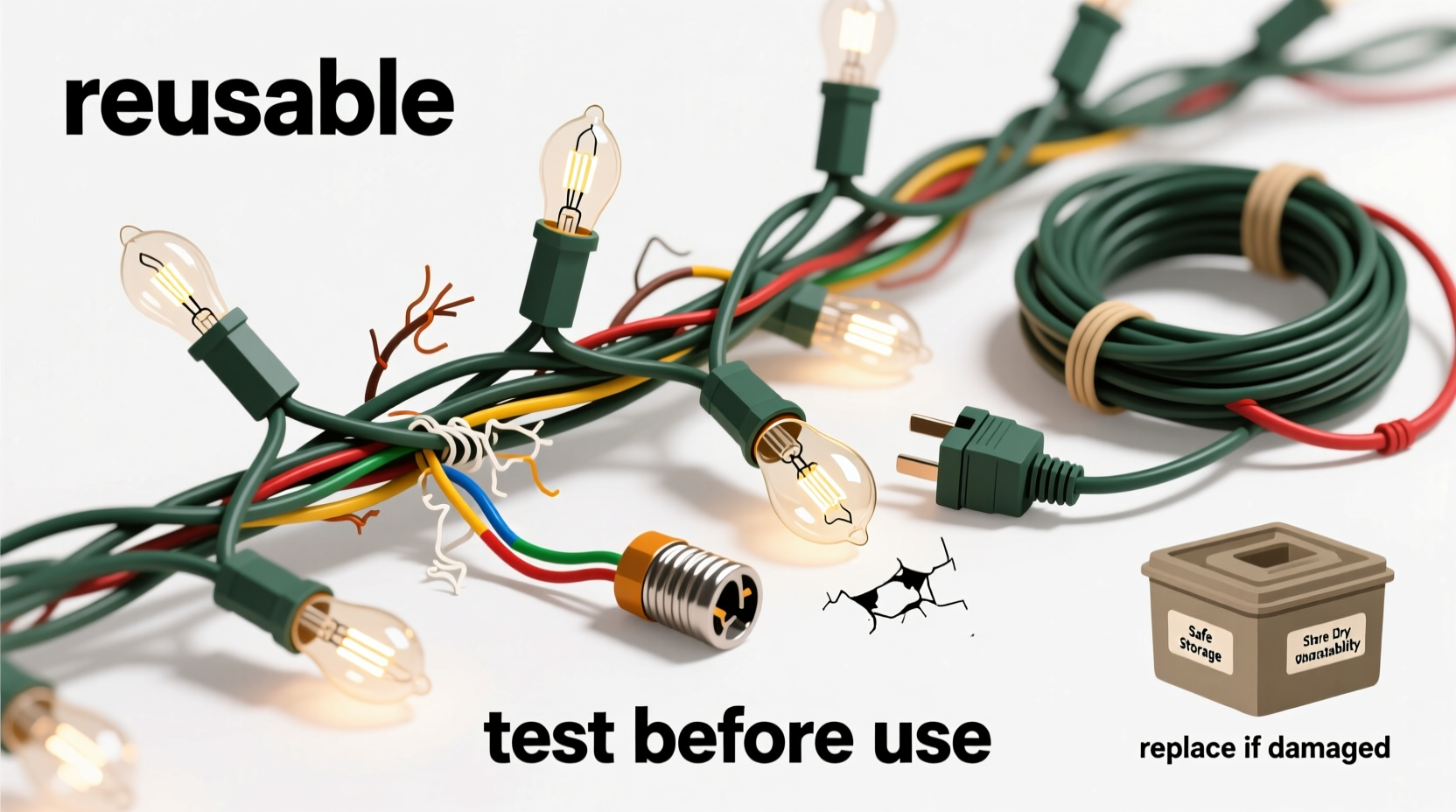
Christmas light strings degrade silently. PVC insulation becomes brittle from UV exposure and temperature cycling—even in storage. Copper wires oxidize at contact points. Miniature bulbs generate heat that stresses solder joints over time. A string that worked flawlessly three years ago may now draw excess current due to internal resistance shifts or partial short circuits. Worse, many older sets lack modern safety features: no built-in fuses, no thermal cutoffs, no ground-fault protection, and no UL certification renewal. According to the Electrical Safety Foundation International (ESFI), 41% of holiday-related electrical fires involve lights older than eight years—and 68% of those occurred because users skipped basic visual and functional checks before plugging in.
“Age alone doesn’t disqualify a light string—but cumulative stress does. If you wouldn’t trust a 10-year-old extension cord on your patio outlet, don’t trust a 10-year-old light string on your roofline.” — Carlos Mendez, Certified Master Electrician and NFPA 70E Instructor
Step-by-Step Safety Inspection Protocol
Follow this sequence before powering any reused light string. Skip a step, and you risk missing a critical failure point. Perform all steps in daylight or under bright, shadow-free lighting.
- Uncoil fully and lay flat on a clean, dry surface—never inspect while coiled or draped.
- Examine every inch of cord for cracks, stiffness, discoloration (yellowing or chalky white residue), or exposed copper.
- Check each socket for brittleness, warping, melted plastic, or corrosion (green/white powder around metal contacts).
- Test bulb integrity: Gently wiggle each bulb. Any looseness indicates poor socket contact—a major source of arcing and heat buildup.
- Inspect plug and end connectors for bent prongs, scorch marks, or warmth after brief use (if previously tested).
- Verify labeling: Look for UL/ETL certification mark and “Indoor/Outdoor” designation matching your intended use.
Functional Testing: Beyond the “On/Off” Switch
A light string that illuminates doesn’t guarantee safety. Dim bulbs, intermittent flickering, or warm sections indicate underlying issues. Here’s how to go deeper:
1. Voltage Drop Test (for multi-string setups)
Using a digital multimeter set to AC voltage, measure voltage at the first socket and again at the last socket while the string is powered. A drop exceeding 5% (e.g., >6V on a 120V circuit) signals excessive resistance—often caused by corroded connections or undersized wiring. Discard if drop exceeds 8%.
2. Continuity & Short-Circuit Check
Unplug the string. Set multimeter to continuity (or ohms). Touch probes to the two prongs of the plug. You should read open circuit (OL or infinite resistance). Any reading under 100kΩ indicates dangerous leakage or internal shorting—discard immediately.
3. Ground-Fault Simulation (for outdoor-rated strings only)
If the string has a 3-prong plug, verify grounding integrity: Set multimeter to continuity. Touch one probe to the round grounding pin and the other to bare metal on a socket housing (scrape paint if needed). A beep confirms grounding path. No beep? The ground is broken—unsafe for outdoor or damp locations.
Do’s and Don’ts of Reused Light Handling
| Action | Do | Don’t |
|---|---|---|
| Storage | Wind loosely around a cardboard tube; store upright in climate-controlled, dry space | Wrap tightly with rubber bands or store in damp basements/garages |
| Cleaning | Wipe cords with dry microfiber cloth; use 70% isopropyl alcohol on cotton swab for socket contacts | Submerge in water, use abrasive cleaners, or spray with household disinfectants |
| Repair | Replace entire damaged section using UL-listed splice kits rated for outdoor use | Solder exposed wires without heat-shrink tubing or use electrical tape as permanent fix |
| Usage Limits | Operate max 6 hours/day; unplug when unattended or overnight | Leave on 24/7 for weeks or connect more than three strings end-to-end unless labeled “stackable” |
| Replacement Threshold | Retire after 5 seasons of regular use—or immediately after any visible damage, overheating, or bulb burnout pattern | Keep using “until they stop working,” especially if bulbs require frequent replacement |
Real-World Case Study: The 2022 Cedar Ridge Incident
In December 2022, a home in Cedar Ridge, Ohio suffered $142,000 in fire damage traced to a reused string of incandescent mini-lights purchased in 2014. The homeowner reported the lights had worked “fine” for seven prior seasons but began flickering erratically that year. Rather than discard them, he replaced two burnt-out bulbs and plugged them into an outdoor GFCI outlet. Within 4.5 hours, the string’s transformer housing ignited—caused by a cracked socket allowing moisture ingress and carbon tracking across degraded insulation. Fire investigators found 17 micro-fractures along the cord and oxidation on 8 of 100 socket contacts. Crucially, the string lacked a UL label update post-2017 (when UL 588 was revised to require mandatory thermal cutoffs for transformers). This incident underscores why visual inspection must be paired with functional verification—and why age-based retirement matters as much as appearance.
When Reuse Becomes Risk: Red Flags That Demand Immediate Retirement
Some signs mean “do not plug in”—even for testing. These are non-negotiable disqualifiers:
- Brittle, chalky, or cracked cord insulation — Indicates polymer breakdown; high risk of short circuit or shock.
- Melted, warped, or discolored sockets — Proof of past overheating; thermal runaway likely upon next use.
- Bare copper wire visible anywhere along the cord or at connections — Direct shock and arc-flash hazard.
- Plug prongs showing scorch marks, pitting, or green corrosion — Compromised connection causing resistive heating.
- No UL/ETL mark, or mark is faded/illegible — Cannot verify compliance with current safety standards.
- Transformer or controller housing emitting odor, warmth, or buzzing during brief power-on test — Internal component failure imminent.
FAQ: Critical Questions Answered
Can I replace just one bulb in an old string—or do I need to replace them all?
For incandescent mini-lights wired in series: Yes, replacing one bulb is safe—if the new bulb matches voltage, wattage, and base type (e.g., T1¾, wedge, or shunted). But if more than 3 bulbs have failed in the same string over one season, internal resistance has likely shifted. Replace the entire string. For LED strings (parallel-wired), individual bulb replacement is rarely possible or recommended—most use integrated SMD chips. If one LED fails, others usually follow within months due to shared driver stress.
Is it safer to use LED lights instead of incandescent when reusing old sets?
Not necessarily. While LEDs run cooler and use less energy, many older LED strings (pre-2015) used low-grade drivers with poor surge protection and inadequate thermal management. A 2019 UL study found that 32% of reused LED strings older than 7 years failed thermal cutoff tests—compared to 24% for incandescents of similar age. Prioritize certification and condition over technology type.
What’s the safest way to dispose of unsafe lights?
Do not throw in curbside trash. Take to an e-waste recycling center certified to R2 or e-Stewards standards. Lights contain copper, lead-solder traces, and sometimes cadmium in older LEDs—hazardous if landfilled. Many hardware stores (Home Depot, Lowe’s) and municipal holiday collection programs accept lights year-round for responsible material recovery.
Conclusion: Respect the Current, Not Just the Convenience
Reusing Christmas lights reflects thoughtful stewardship—of resources, budgets, and tradition. But electricity demands respect, not nostalgia. A single compromised socket, a hairline crack in insulation, or a corroded connection transforms festive illumination into a latent ignition source. The steps outlined here—rigorous visual inspection, multimeter-based functional verification, strict adherence to Do’s and Don’ts, and zero tolerance for red-flag defects—aren’t burdensome rituals. They’re the minimum standard for protecting what matters most: your home, your loved ones, and the quiet peace of the season. Don’t wait for flickering or warmth to warn you. Inspect intentionally. Test deliberately. Retire decisively. And when in doubt, choose safety over sentiment. Your future self—standing beneath undamaged rafters, surrounded by steady, safe light—will thank you.




 浙公网安备
33010002000092号
浙公网安备
33010002000092号 浙B2-20120091-4
Comments
No comments yet. Why don't you start the discussion?