
Every holiday season, thousands of households plug strings of twinkling lights into power strips—only to discover flickering outlets, tripped breakers, or worse: warm cords, burning smells, or melted plastic. The question isn’t whether it’s *possible* to run Christmas lights on a power strip—it’s whether it’s *safe*, *sustainable*, and *code-compliant*. The answer depends entirely on three interlocking factors: the total wattage of your lights, the rated capacity of the power strip, and the underlying circuit’s amperage limit. This guide cuts through marketing hype and seasonal assumptions with precise calculations, real-world examples, and actionable safety protocols—backed by electrical standards and field-tested experience.
Why “Just Plugging In” Is Riskier Than It Looks
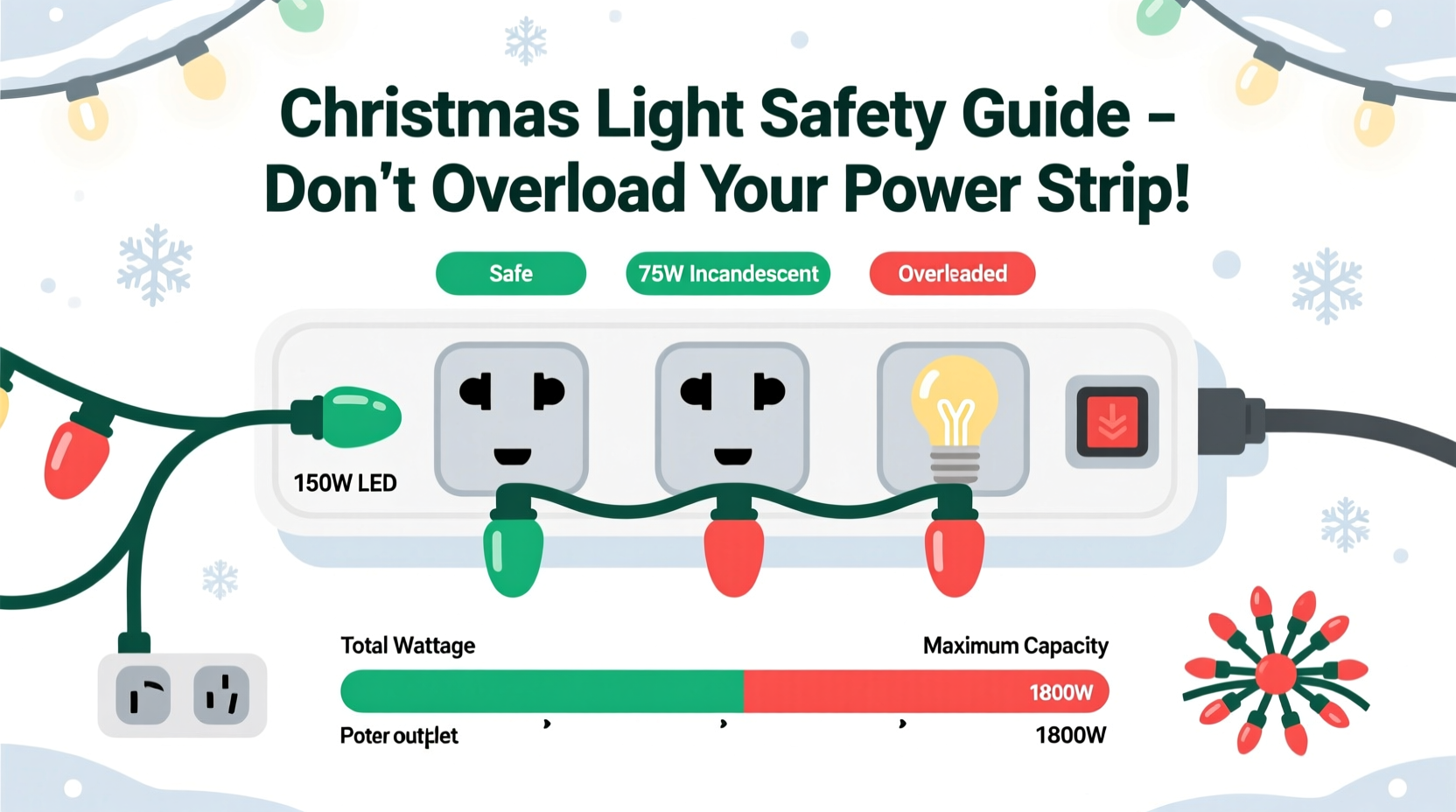
Most consumers assume that because a power strip has multiple outlets, it can handle multiple light strings. That assumption ignores how electricity flows: every device draws wattage; wattage converts to amperage (current); and current generates heat. Exceeding safe amperage thresholds—even briefly—degrades insulation, stresses internal wiring, and increases fire risk. According to the U.S. Consumer Product Safety Commission (CPSC), holiday-related electrical fires cause an average of 160 deaths and $37 million in property damage annually—and over 40% involve improper use of extension cords or power strips.
The core problem is misalignment between labeling and reality. A power strip labeled “15A” doesn’t mean “safe for any 15-amp load.” It means the strip *itself* is rated to carry up to 15 amps *continuously*—but only if installed correctly, ventilated, and not daisy-chained. Meanwhile, many LED light strings draw as little as 2–4 watts per 100 bulbs, while older incandescent mini-lights can consume 20–40 watts per string. A single overloaded strip can easily exceed 1,800 watts—the standard limit for a 15-amp residential circuit.
“Power strips are not surge protectors, and they’re certainly not circuit extenders. They’re distribution points—not capacity amplifiers.” — James R. Lefebvre, P.E., Senior Electrical Inspector, National Fire Protection Association (NFPA)
Your Real-World Wattage Calculation Framework
Before plugging anything in, calculate your total load using this verified four-step method:
- Identify the wattage per light string. Check the UL label on the cord or packaging. If unavailable, use these verified averages:
– LED mini-lights (100-count): 2.4–4.8 W
– LED C7/C9 bulbs (25-count): 5–7 W
– Incandescent mini-lights (100-count): 20–40 W
– Incandescent C7 bulbs (25-count): 175–250 W - Multiply by number of strings. Example: 12 strings of LED mini-lights at 4 W each = 48 W total.
- Add all other devices on the same strip. Don’t forget animated displays, inflatable figures, or outdoor timers—they add up fast. A typical inflatable snowman draws 65–90 W; a programmable timer adds 1–3 W.
- Compare against two hard limits:
– Power strip rating (usually printed near the plug or on the housing)
– Circuit breaker rating (typically 15A or 20A at 120V = 1,800W or 2,400W)
Power Strip vs. Circuit Capacity: What You Must Know
A power strip is only as safe as the circuit feeding it—and most homeowners don’t know their circuit’s true capacity. Standard residential circuits are either 15-amp or 20-amp, operating at 120 volts. That translates to:
| Circuit Rating | Max Continuous Load (NEC 80% Rule) | Max Safe Wattage | Real-World Light String Capacity* |
|---|---|---|---|
| 15-amp circuit | 12 amps | 1,440 W | 360 strings of 4W LED lights or 36 strings of 40W incandescents |
| 20-amp circuit | 16 amps | 1,920 W | 480 strings of 4W LED lights or 48 strings of 40W incandescents |
*Assumes no other loads on the circuit (e.g., refrigerators, sump pumps, or outdoor receptacles).
Crucially, the National Electrical Code (NEC) requires continuous loads—those operating for 3+ hours—to be limited to 80% of circuit capacity. Holiday lights almost always qualify as continuous loads. So even a 20-amp circuit shouldn’t exceed 1,920 watts for extended display periods.
Now consider the power strip itself. Most consumer-grade models are rated for 15 amps (1,800W), but many budget strips lack internal thermal protection, use undersized copper traces, or feature brittle plastic housings. UL 1363 certification is non-negotiable—look for the UL mark and verify it’s listed for “power tap” use, not just “surge protection.” Industrial-grade strips (UL 1449 Type 3) with heavy-duty 14-gauge wiring and built-in circuit breakers are strongly advised for outdoor or high-density applications.
A Real-World Failure Scenario: The Thompson Family Garage Display
In December 2022, the Thompson family in Portland, Oregon, set up an elaborate outdoor display: 120 feet of LED icicle lights, 48 net lights, a 6-foot animated reindeer, and two inflatable snowmen—all plugged into a single $12 power strip rated for 15A. They’d used the same setup for five years without incident. This year, however, they added a new 1,200W heated roof de-icer to the same circuit—unaware it shared the breaker with their garage outlets.
At 5:17 p.m., after three hours of operation, the power strip’s housing began emitting a faint acrid odor. By 5:22, the outlet plate behind it was warm to the touch. At 5:25, the breaker tripped. When they reset it, the strip’s internal fuse blew instantly. An electrician later confirmed the total load had reached 1,790W—within the strip’s 1,800W rating—but the combined heat from the de-icer, ambient garage temperature (42°F), and poor ventilation around the coiled cords pushed internal conductor temperatures past safe thresholds. The strip’s lack of thermal cutoff (a UL 1363 requirement for premium units) allowed sustained overheating until failure.
This wasn’t user error alone—it was a cascade of unverified assumptions: assuming the strip could handle its full rating, ignoring ambient conditions, and overlooking shared circuit loads. It underscores why wattage math must include context—not just numbers.
Safety-Critical Checklist: Before You Plug Anything In
- ✅ Verify UL certification on both the power strip and all light strings (look for UL 588 for lights, UL 1363 for strips).
- ✅ Calculate total wattage—including timers, inflatables, and controllers—not just lights.
- ✅ Confirm circuit amperage by checking your breaker panel (label may say “15A” or “20A”).
- ✅ Apply the 80% rule: never exceed 12A on a 15A circuit, 16A on a 20A circuit.
- ✅ Use only one power strip per outlet; never daisy-chain strips or extension cords.
- ✅ Inspect cords and plugs for cracks, fraying, or discoloration before use.
- ✅ Ensure ventilation: keep strips away from carpets, curtains, insulation, or enclosed spaces.
- ✅ Install GFCI protection for all outdoor or garage circuits (required by NEC since 2020).
Step-by-Step: Building a Safe, Scalable Light Setup
Follow this sequence to eliminate guesswork and ensure long-term reliability:
- Map your circuits. Turn off one breaker at a time and test which outlets and lights go dark. Label each breaker clearly. Identify which circuits serve outdoor receptacles.
- Inventory all lighting equipment. Record wattage, voltage, and length for every string and accessory. Group by location (front yard, porch, tree, roof).
- Allocate loads by circuit. Assign no more than 1,440W to a 15A circuit or 1,920W to a 20A circuit—and subtract known permanent loads (e.g., garage door opener: 500W).
- Select power strips strategically. Use only UL 1363-certified strips with visible amperage ratings and thermal cutoffs. For outdoor use, choose weather-resistant models rated IP65 or higher.
- Wire top-down, not side-to-side. Plug the strip directly into the outlet—not into an extension cord. Run lights from the strip, not from one string to another beyond manufacturer limits.
- Test incrementally. Turn on one string, wait 2 minutes, check for warmth. Add another. Repeat until full load is reached. If any component exceeds 104°F (40°C) surface temperature, reduce load immediately.
- Set a timer or smart switch. Limit runtime to 6–8 hours nightly—reducing heat buildup and energy use without sacrificing ambiance.
Frequently Asked Questions
Can I plug multiple power strips into one outlet if they’re all low-wattage LED lights?
No. Daisy-chaining power strips violates NEC 210.21(B)(1) and voids UL certification. Even low-wattage loads create cumulative resistance, increasing fire risk. Each outlet should feed only one certified power strip—or better yet, one dedicated outdoor receptacle per display zone.
My light package says “up to 210 strings can be connected end-to-end.” Does that mean I can plug 210 strings into one power strip?
No. That “end-to-end” rating refers only to the light string’s internal wiring and fusing—not the power strip’s capacity. It assumes ideal conditions: no ambient heat, perfect ventilation, and no other loads. Always calculate total wattage separately and compare it to your strip’s and circuit’s limits.
Are smart power strips safer for holiday lights?
Only if they’re UL 1363-listed and include real-time load monitoring and automatic thermal shutoff—not just Wi-Fi control. Many “smart” strips prioritize connectivity over safety engineering. Prioritize certification over features.
Conclusion: Light Up Responsibly, Not Just Brightly
Holiday lighting should evoke joy—not anxiety. Understanding wattage isn’t about memorizing formulas; it’s about respecting physics, honoring code requirements, and protecting what matters most: your home, your memories, and your family’s safety. A single miscalculation can turn festive cheer into emergency response. But with disciplined calculation, certified equipment, and thoughtful circuit management, you can create dazzling displays that last for years—not just one season. Start tonight: pull out your breaker panel, grab a pen and paper, and map your circuits. Then test one string at a time—not next week, not after the first snowfall, but now. Because the safest Christmas light display isn’t the brightest one. It’s the one that hums quietly, stays cool to the touch, and lets you enjoy the season without a second thought.




 浙公网安备
33010002000092号
浙公网安备
33010002000092号 浙B2-20120091-4
Comments
No comments yet. Why don't you start the discussion?