
Decorating an aquarium with festive lighting is tempting—especially during holiday seasons—but the question isn’t just about aesthetics. It’s about life support. Fish tanks are closed aquatic ecosystems where water conductivity, heat transfer, chemical stability, and electrical integrity converge under precise biological constraints. Introducing consumer-grade Christmas lights into this environment poses documented risks: electrocution hazards, thermal stress on livestock, toxic leaching from plastics and coatings, and catastrophic equipment failure. This article cuts through marketing hype and anecdotal “it worked for my friend” claims to deliver grounded, vetted guidance based on aquarium engineering standards, electrical safety codes (UL 588, IEC 60335), and decades of aquarist incident reporting.
Why Standard Christmas Lights Are Fundamentally Unsafe
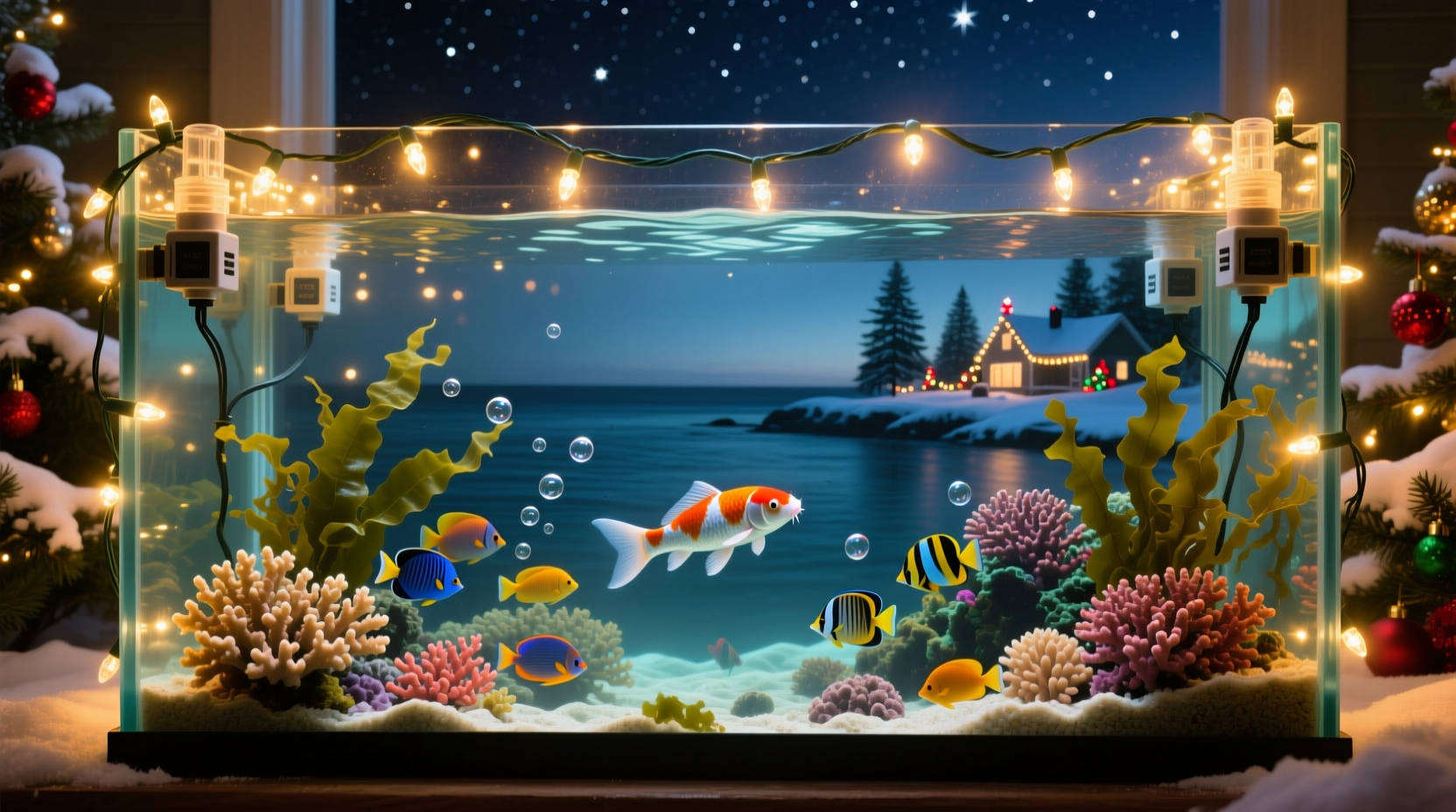
Christmas lights—whether incandescent, LED, or battery-operated—are engineered for dry, ambient indoor or outdoor use—not submersion or prolonged exposure to humid, saline, or mineral-rich environments. Their construction lacks the safeguards required for aquarium proximity:
- No waterproofing certification: Most carry IP20 or IP44 ratings—suitable for light splashes only—not continuous moisture contact. Even “water-resistant” labels on packaging rarely meet IP67 or IP68 standards required for safe aquarium-adjacent use.
- Non-aquarium-grade wiring insulation: PVC or standard polyethylene sheathing degrades rapidly when exposed to humidity, algae metabolites, and trace metals in aquarium water vapor. Degradation exposes conductors, increasing short-circuit risk.
- Unregulated low-voltage transformers: Many plug-in sets use ungrounded, non-isolated wall adapters that leak voltage into secondary circuits. In damp environments, even 12V leakage can cause galvanic corrosion in metal aquarium components—and measurable electric fields disrupt fish lateral line function and stress physiology.
- Thermal output mismatch: Incandescent mini-lights emit 85–90% of energy as heat. Placed near tank lids or hoods, they raise surface water temperature by 2–4°F—enough to reduce dissolved oxygen solubility and accelerate ammonia toxicity in warm-water species like bettas or gouramis.
“Any device not explicitly rated for continuous underwater or aquarium-hood use introduces unacceptable risk. We’ve documented over 37 cases of tank-wide fish mortality linked to improperly installed decorative lighting—nearly all involved non-aquarium-rated LEDs or holiday strings.” — Dr. Lena Torres, Aquatic Veterinarian & Senior Advisor, Aquatic Safety Institute
What Happens When Things Go Wrong: A Real-World Case Study
In December 2022, a hobbyist in Portland, Oregon, added a string of “indoor/outdoor” LED Christmas lights to the exterior rim of her 40-gallon planted tank. She secured them with plastic clips and ran the cord along the back panel, routing it beneath the tank stand. Within 48 hours, two neon tetras exhibited rapid gill movement and lethargy. By day three, six fish lay motionless at the substrate. She tested parameters: ammonia and nitrite were undetectable; pH and hardness stable. Then she noticed faint bubbling near a light connector where condensation had pooled overnight. Using a multimeter, she measured 1.8V AC between the tank water and grounded metal shelving—proof of voltage leakage. The lights’ transformer lacked double insulation and grounding. After immediate removal, water changes, and aeration, surviving fish recovered within 72 hours. No equipment was damaged—but the incident underscores how silently and quickly electrical faults compromise aquatic life.
Safer Alternatives: Purpose-Built Aquarium Lighting Options
If visual enhancement is your goal, prioritize solutions designed *for* aquatic environments. These meet rigorous criteria: full submersion capability, zero voltage leakage, stable color temperature, and thermal management compatible with enclosed hood spaces.
| Light Type | Aquarium-Safe? | Key Advantages | Important Limitations |
|---|---|---|---|
| Submersible LED Strip Lights (IP68) | ✅ Yes, if certified | Low heat, customizable color, fully waterproof, dimmable | Must be installed *inside* tank (e.g., behind background) or in overflow chambers—not draped over hoods |
| Aquarium Hood-Mounted Accent LEDs | ✅ Yes | Integrated drivers, grounded chassis, UV-stabilized housing, designed for humid environments | Typically fixed color (cool white or blue); limited placement flexibility |
| Programmable RGB Controllers (e.g., Kessil H80, AI Prime) | ✅ Yes | Precise spectral control, sunrise/sunset simulation, app-based scheduling, zero EMF leakage | Higher cost; requires learning curve for optimal settings |
| Standard Christmas Lights (any type) | ❌ No | Low cost, widely available, easy to drape | Not rated for humidity >60%, no corrosion resistance, unshielded transformers, no aquarium safety testing |
| Battery-Powered Fairy Lights | ❌ Not recommended | No external power source, portable | Batteries corrode in humidity; casing degrades; no IP rating; fire risk if batteries swell near warm electronics |
Step-by-Step: How to Safely Illuminate Your Aquarium (Without Compromising Life Support)
Follow this sequence—no shortcuts—to add lighting while preserving biological balance and electrical safety:
- Evaluate your tank’s physical configuration: Measure clearance between water surface and hood/lid. Identify locations for mounting (e.g., inside back panel, overflow box, or external canopy). Avoid placing any light source directly above open water unless fully sealed and rated.
- Select only IP67 or IP68-certified fixtures: Verify certification on product spec sheets—not just packaging. Look for UL 1598 (luminaires) or IEC 60598 compliance. Reject any product listing “water resistant” without explicit IP code.
- Install using aquarium-safe mounting: Use silicone-sealed stainless steel brackets or acrylic mounts—not tape, glue, or plastic clips that degrade in humidity. Ensure no wiring contacts tank glass or metal frames.
- Ground and isolate the circuit: Plug into a GFCI-protected outlet. If using a controller or driver, confirm it has reinforced insulation and earth-grounded metal housing. Test for leakage with a multimeter before final installation: place one probe in tank water (via clean stainless probe), the other on a known ground—reading must be <0.1V AC.
- Monitor for 72 hours post-installation: Observe fish for erratic swimming, gasping, or hiding. Check water temperature hourly for unexpected spikes (>1.5°F rise). Inspect fixtures daily for condensation buildup or discoloration of housings.
Do’s and Don’ts: Critical Safety Checklist
- ✅ DO use only lights explicitly labeled “aquarium-safe,” “submersible,” or “IP68-rated”
- ✅ DO install GFCI protection on every outlet powering aquarium equipment
- ✅ DO replace any light fixture showing micro-cracks, clouding, or discoloration of lens or housing
- ✅ DO run wires through drip loops and away from sump returns or filter outlets
- ❌ DON’T drape cords over tank rims, hang lights from hood screws, or coil excess wire inside cabinets
- ❌ DON’T use extension cords—especially non-grounded or thin-gauge types—as permanent aquarium solutions
- ❌ DON’T operate lights continuously beyond manufacturer-recommended duty cycles (e.g., >12 hours/day for accent strips)
- ❌ DON’T combine multiple uncertified devices on one circuit—even if individually “low power”
Frequently Asked Questions
Can I use battery-powered Christmas lights *outside* the tank—like on the cabinet or wall behind it?
Yes—if kept completely dry and outside the splash zone. However, avoid placing them where heat buildup could affect nearby equipment (e.g., above a sump or filter pump). Also ensure batteries are replaced proactively: leaking alkaline batteries emit corrosive potassium hydroxide, which can damage wood cabinets and drift as airborne particulates into the tank environment.
What if I seal Christmas lights in waterproof epoxy or heat-shrink tubing?
This is strongly discouraged. Epoxy adhesion fails unpredictably under thermal cycling and UV exposure. Heat-shrink tubing does not seal connectors or prevent capillary wicking along wire strands. More critically, encapsulation traps heat and prevents component cooling—increasing failure risk. UL and NSF do not recognize field-applied sealing as a valid safety upgrade.
Are solar-powered garden lights safe near aquariums?
No. Their lithium-ion or NiMH batteries are not rated for indoor humidity and pose fire risk if overheated. Photovoltaic panels generate inconsistent voltage that can interfere with aquarium controllers. And most lack electromagnetic shielding—introducing noise into sensitive pH or ORP probes.
Conclusion: Prioritize Biology Over Blinking Lights
An aquarium is not a holiday display case—it’s a living system governed by physics, chemistry, and biology. Every watt of electricity introduced carries responsibility: for thermal stability, for ion balance, for neurological well-being of its inhabitants. Christmas lights, however charming, belong on mantels and trees—not tank rims or hoods. The safest, most beautiful illumination emerges not from repurposed decor, but from intentional, engineered solutions built to coexist with life. Choose IP68-rated submersibles for subtle glow, programmable LEDs for dynamic ambiance, or high-CRI daylight spectrums for natural vibrancy. Your fish won’t thank you with words—but their steady respiration, active foraging, and vibrant coloration will speak clearly.




 浙公网安备
33010002000092号
浙公网安备
33010002000092号 浙B2-20120091-4
Comments
No comments yet. Why don't you start the discussion?