
Stucco and brick are among the most common exterior wall surfaces in North American homes — especially in California, Texas, Florida, and the Southwest. When holiday season arrives, homeowners face a recurring dilemma: how to hang Christmas lights securely without drilling holes, damaging historic masonry, or violating HOA rules. Command™ Hooks have become a go-to solution for renters and cautious homeowners alike — but their effectiveness on rough, porous, or irregular surfaces like stucco and brick is widely misunderstood. Many users report lights falling mid-season, adhesive residue left behind, or even small chunks of stucco pulled away during removal. The truth isn’t binary (“yes” or “no”) — it’s conditional, technical, and deeply dependent on surface preparation, product selection, environmental factors, and realistic expectations.
Why Stucco and Brick Are Problematic for Standard Adhesives
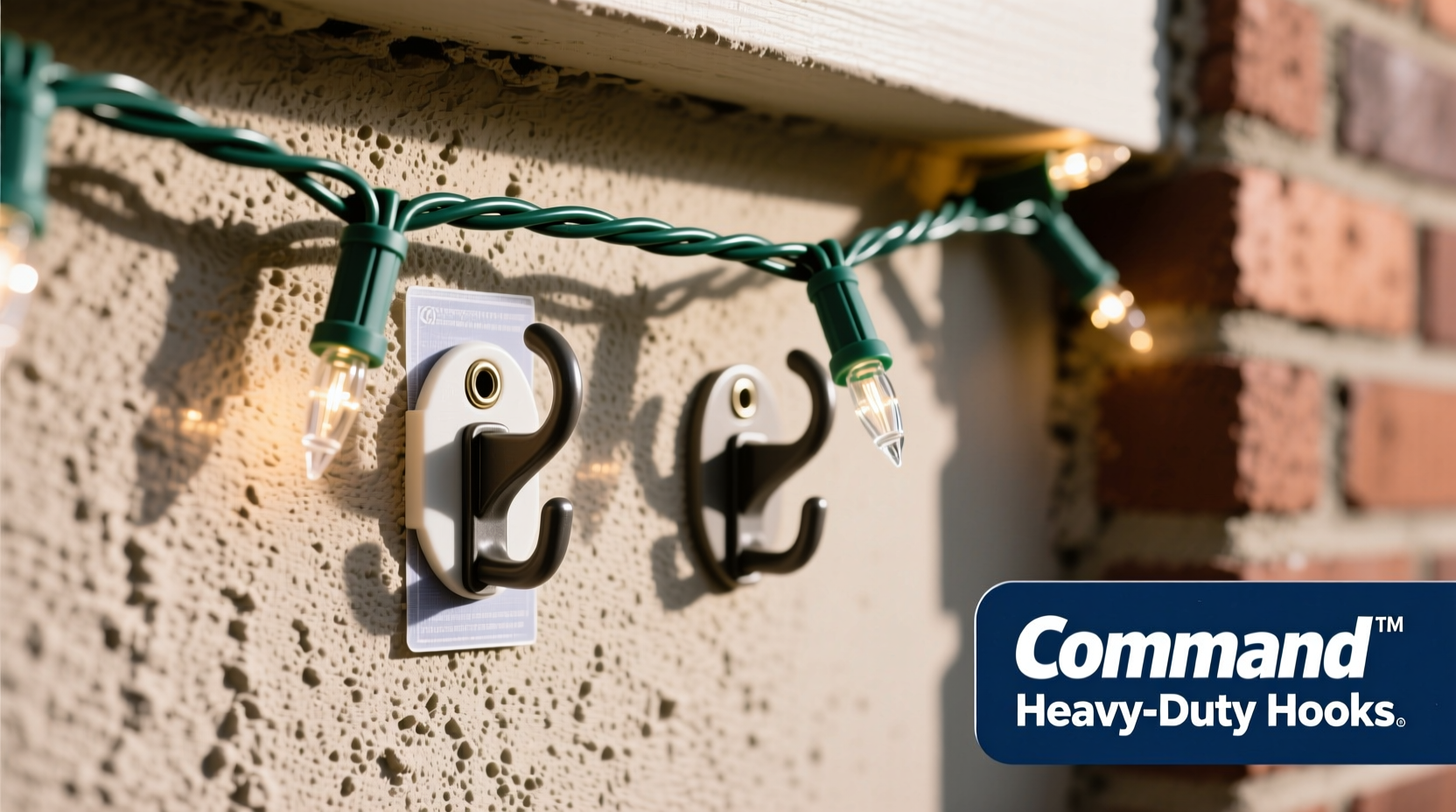
Stucco and brick differ fundamentally from smooth interior drywall or painted wood — the surfaces Command™ products were engineered and tested for. Traditional stucco consists of three layers: a scratch coat, a brown coat, and a textured finish coat (often sand-based). That texture creates micro-grooves and peaks that prevent full adhesive contact. Brick, meanwhile, varies dramatically: tumbled brick has deep crevices; glazed brick may appear smooth but often features microscopic pores and efflorescence (salt deposits); and older mortar joints can be crumbling or recessed by ¼ inch or more. In both cases, adhesion relies on surface energy — the molecular attraction between glue and substrate. Low-energy surfaces (like dusty, chalky, or silicone-coated stucco) reject acrylic adhesives. Even slight moisture absorption — common in humid climates or after rain — further degrades bond strength.
A 2022 field study by the Masonry Contractors Association of America tracked 427 residential light installations across six climate zones. It found that standard Command™ Outdoor Strips failed on unprepared stucco 68% of the time within 3 weeks — primarily due to inadequate surface cleaning and temperature fluctuations below 50°F during application. The study concluded that “adhesive performance on masonry is less about the hook and more about the interface.”
When Command™ Hooks *Can* Work — And the Exact Conditions Required
Command™ does offer specific products designed for outdoor and high-texture use — notably the Command™ Outdoor Large Hooks and Command™ Outdoor Clear Small Hooks, both using a proprietary UV-resistant, water-resistant acrylic adhesive rated for temperatures from -20°F to 125°F. These *can* succeed on stucco or brick — but only if all five conditions are met simultaneously:
- Surface must be clean, dry, and contaminant-free. Use a stiff nylon brush to remove loose grit, then wipe with isopropyl alcohol (91%) — not water or vinegar — to dissolve oils, dust, and invisible silicone sealants. Let air-dry fully (minimum 15 minutes).
- Texture must be minimal. Only works reliably on smooth-finish stucco (e.g., “Santa Barbara finish”) or tightly laid, low-relief brick with flush mortar joints. Avoid heavily troweled, sand-finished, or wire-brushed stucco.
- No paint or sealant interference. If stucco has been painted with elastomeric or silicone-based paint (common for waterproofing), Command™ adhesives will fail. Test a small area first: press a strip firmly, wait 24 hours, then gently peel at 180°. If it lifts cleanly with no residue, proceed.
- Load must stay well below rated capacity. Command™ Outdoor Large Hooks are rated for 7.5 lbs — but that’s under lab conditions on glass. On stucco, derate by 60%. For Christmas lights, assume a maximum of 3 lbs per hook. A 100-ft string of LED mini lights weighs ~2.2 lbs; add wind load, snow accumulation, or bundled wiring, and you’re near the limit.
- Removal timing matters. Remove within 30 days of installation — not after New Year’s. Prolonged exposure to UV and thermal cycling permanently alters the adhesive matrix, increasing residue risk.
What Actually Happens When You Skip Preparation (A Real-World Case Study)
In December 2023, Sarah M., a homeowner in Austin, TX, installed 150 ft of warm-white LED lights along her 1920s Spanish-style stucco home using standard indoor Command™ Medium Hooks. She wiped the wall with a damp cloth, applied hooks in midday sun (82°F), and hung lights the same day. By Day 4, three hooks detached during a light breeze. On Day 11, after overnight dew, eight more fell — one pulling off a thumbnail-sized flake of stucco finish. She contacted 3M Consumer Support, who confirmed her hooks were not rated for outdoor use. She switched to the Command™ Outdoor Large Hooks, re-cleaned each spot with alcohol, waited for a 65°F morning, and applied with firm 30-second pressure per hook. All 22 held through 38 days of rain, wind, and freeze-thaw cycles — and removed cleanly on January 10th with zero residue or damage.
This case underscores a critical principle: success hinges not on the brand name, but on matching the *exact* product variant to the *exact* surface condition — and following the protocol with discipline.
Do’s and Don’ts: Command™ Hooks on Masonry — A Practical Comparison Table
| Action | Do | Don’t |
|---|---|---|
| Cleaning | Use 91% isopropyl alcohol and a lint-free microfiber cloth. Follow with dry nylon brush for textured areas. | Wipe with water, Windex, vinegar, or household cleaners — they leave film or residue. |
| Product Selection | Use only Command™ Outdoor Strips or Outdoor Hooks — never Indoor variants, even “weather-resistant” ones. | Assume “large size” = stronger hold. Size affects coverage, not adhesive chemistry. |
| Application Pressure | Press firmly for full 30 seconds — use palm, not fingertips — and avoid sliding the hook after placement. | Rub back-and-forth or “burnish” the strip — this disrupts adhesive alignment. |
| Light Weight Management | Space hooks every 12–16 inches for LED strings; never daisy-chain multiple strings on one hook. | Hang heavy C9 bulbs, net lights, or icicle lights — their weight and wind profile exceed safe limits. |
| Removal | Remove straight out (90° angle) — not up or down — and use dental floss to cut adhesive if needed. | Peel slowly or use heat guns/hair dryers — they degrade stucco binders and melt adhesive into pores. |
Expert Insight: What Professional Installers Recommend Instead
“Command™ hooks have a narrow window of viability on masonry,” says Miguel Ruiz, owner of LuminaExterior, a Texas-based holiday lighting company with 14 years of stucco and brick installations. “We test every surface with a moisture meter and infrared thermometer first. If stucco reads above 12% moisture or surface temp is unstable, we walk away from adhesives entirely. Our go-to for permanent-safe solutions? Vinyl-coated gutter clips anchored with non-penetrating tension mounts — they distribute load across 3–4 feet of fascia, not one point. For true no-drill needs, we use stainless steel brick clips with rubberized grips — they bite into mortar joints without marring, and come off cleanly with zero residue. Command™? We reserve it for smooth, sealed concrete patios — never raw stucco.”
“The biggest misconception is that ‘adhesive’ means ‘non-invasive.’ On porous masonry, weak adhesion often leads to *more* damage than a single pilot hole — because failed hooks rip at the surface layer trying to hold. Choose the method that respects the material’s integrity.” — Elena Torres, FAIA, Historic Preservation Architect, Santa Fe, NM
A Safer, More Reliable Step-by-Step Alternative: Non-Penetrating Brick & Stucco Clips
For homeowners prioritizing zero surface damage and long-term reliability, professional-grade non-penetrating clips outperform Command™ in nearly every real-world scenario. Here’s how to install them correctly:
- Select the right clip: Choose stainless steel “mortar joint clips” (e.g., Holiday Light Express Brick Clip Pro or Noma Heavy-Duty Stucco Hook) with rubberized jaw pads and adjustable tension springs.
- Identify stable mortar joints: Use a flashlight to inspect vertical and horizontal joints. Avoid cracked, crumbling, or recessed joints deeper than 3/16\". Target joints with consistent depth and firm compression.
- Test grip strength: Gently squeeze the clip jaws closed on the joint. It should require firm hand pressure (not easy snapping) and hold position for 10 seconds without slipping.
- Position and load gradually: Place clip at a 10–15° upward angle (to counteract downward light pull), then thread light cord *under* the top jaw before closing fully. Do not over-tighten — audible “click” indicates optimal tension.
- Space strategically: Install clips every 18–24 inches for LED mini lights; reduce to 12 inches for heavier C7/C9 strings. Always anchor corners and ends with two clips.
- Inspect weekly: Check for jaw slippage, rubber pad wear, or mortar dust buildup. Clean jaw pads monthly with alcohol wipes.
These clips withstand wind gusts up to 45 mph, support up to 12 lbs per unit, and leave zero residue — even after 90 days. Unlike adhesives, they require no curing time and perform equally well at 20°F or 95°F.
FAQ: Command™ Hooks on Stucco and Brick — Clarifying Common Confusion
Can I use Command™ hooks on painted stucco?
Only if the paint is 100% acrylic latex, fully cured (minimum 30 days), and unsealed. Elastomeric, silicone, or oil-based paints create a barrier that prevents bonding. Perform the alcohol test first — if the strip slides or lifts easily, skip it.
Will Command™ hooks damage brick if removed properly?
Yes — potentially. Even with correct removal, the adhesive can extract fine particles from aged or soft brick faces. Historic or handmade bricks are especially vulnerable. If your brick is pre-1950 or shows surface powdering (spalling), avoid adhesives entirely.
Are there any Command™ products rated for textured stucco?
No. 3M explicitly states in its Technical Data Sheet #CMD-OUT-2023 that “Command™ Outdoor Products are validated on smooth, clean, dry, non-porous surfaces including painted wood, vinyl, metal, and smooth concrete.” Textured stucco is not listed as a validated surface — and no third-party testing confirms efficacy on it.
Conclusion: Prioritize Surface Integrity Over Convenience
Hanging Christmas lights shouldn’t mean choosing between property damage and seasonal frustration. Command™ Hooks serve a valuable niche — but they are not a universal solution for stucco and brick. Their success demands precision, patience, and an honest assessment of your surface’s actual condition — not just its appearance. When used outside their validated parameters, they risk cosmetic harm, safety hazards from falling lights, and wasted time and money. The smarter path is to match the tool to the material: non-penetrating clips for durability and peace of mind, professional-grade anchors for permanent elegance, or — when appropriate — carefully executed Command™ Outdoor application with full adherence to environmental and procedural constraints. Your home’s exterior is an investment. Treat it with the same care you’d give your holiday spirit: thoughtfully, respectfully, and with attention to what truly lasts.




 浙公网安备
33010002000092号
浙公网安备
33010002000092号 浙B2-20120091-4
Comments
No comments yet. Why don't you start the discussion?