
Hanging Christmas lights can transform a home into a winter wonderland, but the method of installation matters—especially when dealing with delicate surfaces like plaster walls. Many homeowners turn to Command hooks for their convenience and advertised “no-damage” promise. But when it comes to heavy light draping—long strands, multiple layers, icicle lights, or commercial-grade LEDs—the question arises: can Command hooks really support the load without damaging plaster or failing mid-season?
The short answer is: sometimes—but with significant limitations. The long answer involves understanding weight distribution, adhesive performance, plaster integrity, and safer alternatives for lasting, secure installations.
Understanding Command Hook Weight Limits
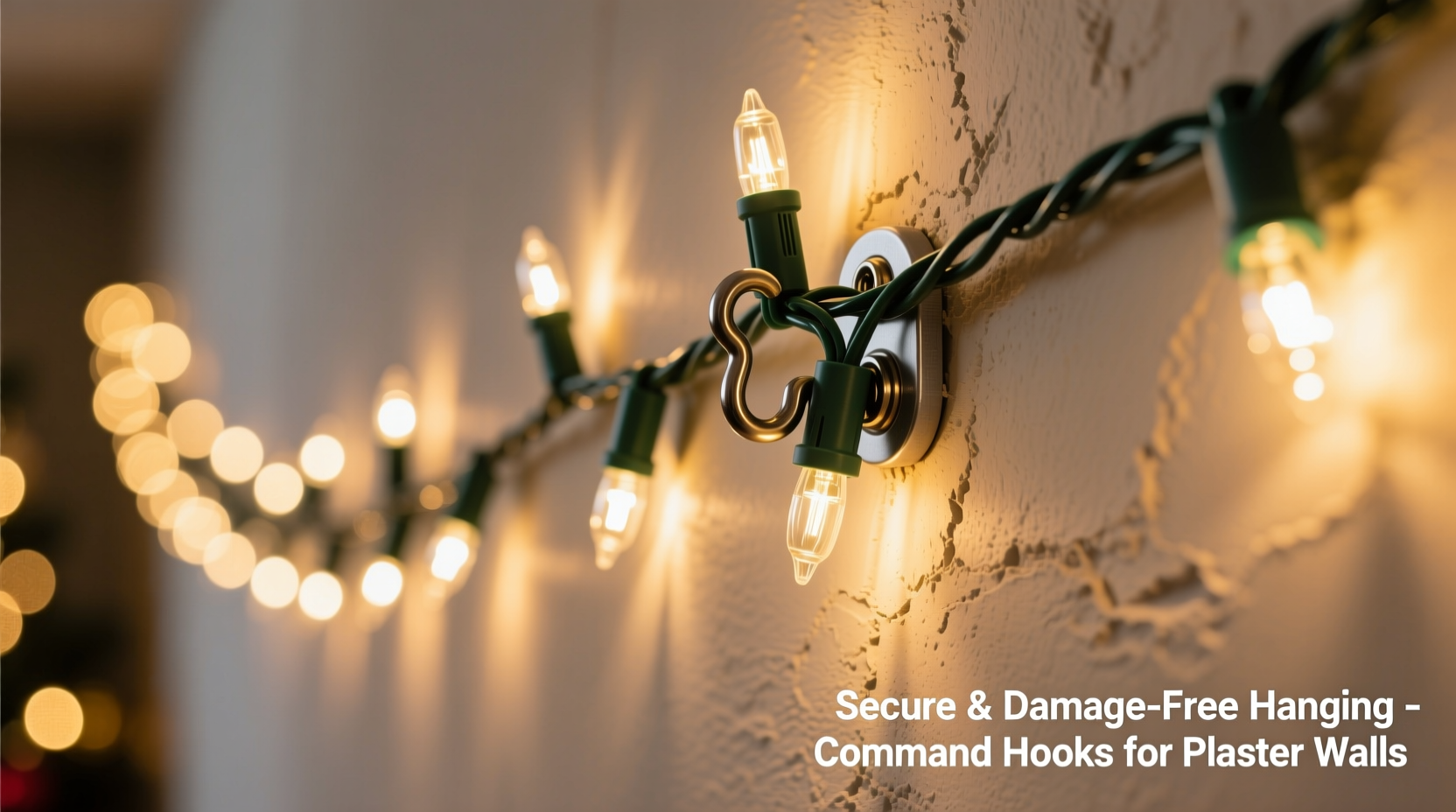
Command hooks are designed with specific weight ratings based on size and type. These range from 0.5 pounds for small clear hooks to up to 7.5 pounds for the largest utility versions. However, these numbers assume ideal conditions: clean, smooth, non-porous surfaces such as painted drywall, glass, or tile.
Plaster walls, especially older ones, rarely meet those criteria. They often have micro-cracks, uneven textures, or porous paint finishes that compromise adhesion. Even modern plaster-over-drywall installations can be problematic due to surface porosity and age-related brittleness.
Heavy Christmas light draping typically exceeds the safe capacity of standard Command hooks. A single string of 100 incandescent mini-lights weighs about 1 pound. Add in extension cords, connectors, and layered displays, and total strand weights can easily reach 5–10 pounds across a span. When concentrated at individual hook points, this creates stress points that exceed manufacturer limits.
Why Plaster Walls Are High-Risk for Adhesive Hooks
Plaster is fundamentally different from drywall. It's made from lime, gypsum, or cement-based materials applied in layers over wooden lath or metal mesh. While durable under compression, plaster is brittle in tension and shear forces—exactly the kind of stress created when a hook pulls outward from the wall.
When an adhesive hook fails on plaster, it doesn’t just fall off cleanly. It often takes a chunk of paint or surface plaster with it. In older homes (pre-1950s), the risk is even greater due to weaker bonding between lath and plaster, which can lead to full sections cracking or detaching.
Humidity, temperature fluctuations, and seasonal changes also affect adhesive performance. Double-sided foam tapes used in Command products rely on consistent pressure and stable temperatures to maintain bond strength. Cold garage-stored hooks applied in winter may never fully adhere, while heat from indoor lighting can soften the adhesive over time.
“Adhesives work best on modern substrates. Historic plaster is unpredictable—what sticks today might fail tomorrow.” — Dr. Alan Reyes, Building Conservation Specialist, National Trust for Historic Preservation
Weight Comparison: Light Types vs. Hook Capacity
| Light Type | Avg. Weight per 100 Lights | Max Command Hook Support (Ideal) | Safe on Plaster? |
|---|---|---|---|
| Mini Incandescent | 1.0 – 1.3 lbs | Up to 7.5 lbs (large utility) | Only if spaced & under 5 lbs total |
| LED Mini | 0.5 – 0.8 lbs | Yes, with medium hooks | Likely yes, if spaced properly |
| Icicle Lights (300-count) | 2.5 – 3.5 lbs | Marginal | No—risk of pull-through |
| Commercial Rope Lights (25 ft) | 4.0 – 6.0 lbs | At limit | Not recommended on plaster |
Note: Even if total strand weight falls within a hook’s rated capacity, dynamic loads (wind, accidental tugs, settling buildings) increase failure risk. Distributing weight across multiple anchors is essential.
Step-by-Step: Safer Alternatives for Heavy Light Displays on Plaster
If you're committed to a dramatic light display but want to protect your plaster walls, follow this sequence to minimize damage and maximize security.
- Assess the Total Load: Weigh all light strands, cords, and controllers. Use a kitchen scale for accuracy. Group lights by section (e.g., above window, along eaves).
- Choose Mechanical Fasteners Over Adhesives: For loads over 3 pounds, use small brass picture hooks or cup hooks screwed lightly into wall studs or masonry anchors. These distribute force better than tape.
- Locate Studs or Lath Points: Use a stud finder. On older plaster, lath strips run vertically every 16 inches. Screwing into these provides far more holding power than adhesive on surface plaster.
- Use Wall Anchors for Off-Stud Mounting: If no stud is available, use plastic toggle anchors or self-drilling hollow-wall anchors rated for 10+ pounds. Drill a pilot hole carefully to avoid cracking.
- Distribute the Load: Hang lights every 12–18 inches using multiple low-profile hooks. Avoid concentrating weight at one point.
- Test Before Finalizing: Hang lights temporarily and let them sit for 24 hours. Check for sagging, pulling, or cracks forming around attachment points.
Real Example: A Victorian Home’s Holiday Display Gone Wrong
In Portland, Oregon, homeowner Maria K. attempted to hang 12 strands of mixed LED and incandescent lights along her second-story bay window using large Command utility hooks. The total weight was estimated at 8 pounds. She cleaned the surface with alcohol and pressed each hook firmly.
The display stayed intact for two weeks. Then, during a rainy night with high indoor humidity, three hooks near the top corner detached. One took a 3-inch-wide patch of ceiling plaster with it, exposing lath underneath. The falling cord pulled down adjacent strands, creating a tangled mess and tripping a circuit breaker.
After consulting a preservation contractor, Maria learned that the original 1910 plaster had degraded behind the paint layer, reducing surface cohesion. The adhesive could not grip effectively. For the next season, she switched to miniature screw-in cup hooks placed at lath intervals, reducing strain and preventing recurrence.
Her revised method added 20 minutes to setup but eliminated damage and provided peace of mind throughout the holidays.
Checklist: Can You Safely Use Command Hooks on Plaster for Christmas Lights?
- ✅ Total light weight per hook point is under 50% of the rated capacity
- ✅ Surface is clean, dry, and free of dust, wax, or gloss finishes
- ✅ Plaster is modern (post-1970) or reinforced with drywall overlay
- ✅ Lights are LED (lighter) and not densely layered
- ✅ No exposure to moisture, drafts, or extreme temperature shifts
- ✅ You can monitor the installation weekly for signs of slippage
- ❌ Avoid if: Plaster is historic, cracked, or previously repaired
- ❌ Avoid if: Using incandescent, rope, or icicle lights in multiples
Expert Recommendations for Long-Term Wall Safety
Preservation experts consistently advise caution when modifying historic interiors. The appeal of “damage-free” hanging solutions is strong, but real-world performance often falls short on fragile substrates.
“For heritage homes, mechanical fasteners with minimal penetration are safer than relying on adhesives that can fail catastrophically. A tiny screw hole is repairable. a collapsed plaster section is not.” — Lena Cho, Architectural Conservator, Smithsonian Institution
Experts recommend treating plaster walls like museum artifacts: minimize stress, avoid lateral pulls, and prioritize reversibility. That means opting for small, removable hardware instead of betting on polymer tapes that degrade over time.
For renters or those avoiding permanent fixtures, consider alternative display methods: floor-to-ceiling tension wires, freestanding light frames, or outdoor mounting (if wiring allows) to shift the burden away from interior walls entirely.
Frequently Asked Questions
Can I double up Command hooks to increase weight capacity?
No. Doubling hooks side by side does not double strength—adhesive bonds don't scale linearly, and uneven pressure causes one strip to fail first, transferring full load to the remaining hook. This often leads to cascading failure. Instead, space hooks farther apart to distribute weight across more wall area.
What’s the best way to remove Command hooks from plaster without damage?
Slow and steady wins. Warm the adhesive with a hairdryer for 30 seconds, then slowly peel downward at a 180-degree angle (parallel to the wall). Never yank sideways. If resistance increases, reapply heat. After removal, dab any residue with rubbing alcohol—avoid scrubbing to prevent scratching.
Are there stronger adhesive options than Command for plaster?
Some industrial tapes like VHB (Very High Bond) from 3M offer superior strength, but they are permanent and will almost certainly damage plaster upon removal. They are not suitable for temporary holiday decor. No consumer-grade adhesive is reliably safe for heavy loads on aged plaster.
Conclusion: Prioritize Safety Over Convenience
While Command hooks are excellent for lightweight items on stable surfaces, they are not a reliable solution for heavy Christmas light draping on plaster walls. The combination of material fragility, adhesive limitations, and seasonal environmental shifts makes failure likely—even under seemingly safe conditions.
Instead of risking costly repairs or ruined decorations, invest in smarter hanging strategies. Use small mechanical fasteners at structural points, distribute weight evenly, and choose lighter LED strands whenever possible. The extra effort pays off in durability, safety, and preserved wall integrity.
Beautiful holiday lighting should enhance your home—not endanger its structure. Make informed choices this season, and your plaster walls will thank you long after the ornaments come down.




 浙公网安备
33010002000092号
浙公网安备
33010002000092号 浙B2-20120091-4
Comments
No comments yet. Why don't you start the discussion?