
As the holiday season approaches, homes light up with festive displays, and many homeowners rely on extension cords to power their Christmas lights. A common question arises: can you use extension cords to connect lights that are plugged into different circuits? While the short answer is yes—under the right conditions—the full picture involves understanding household electrical systems, load distribution, cord ratings, and safety protocols. Using extension cords across circuits without proper knowledge can lead to tripped breakers, overheating, or even fire hazards.
This guide breaks down everything you need to know about safely powering Christmas lights across multiple circuits using extension cords. From understanding your home’s wiring to choosing the right cord and avoiding common mistakes, this article ensures your holiday lighting remains bright—and safe.
Understanding Household Electrical Circuits
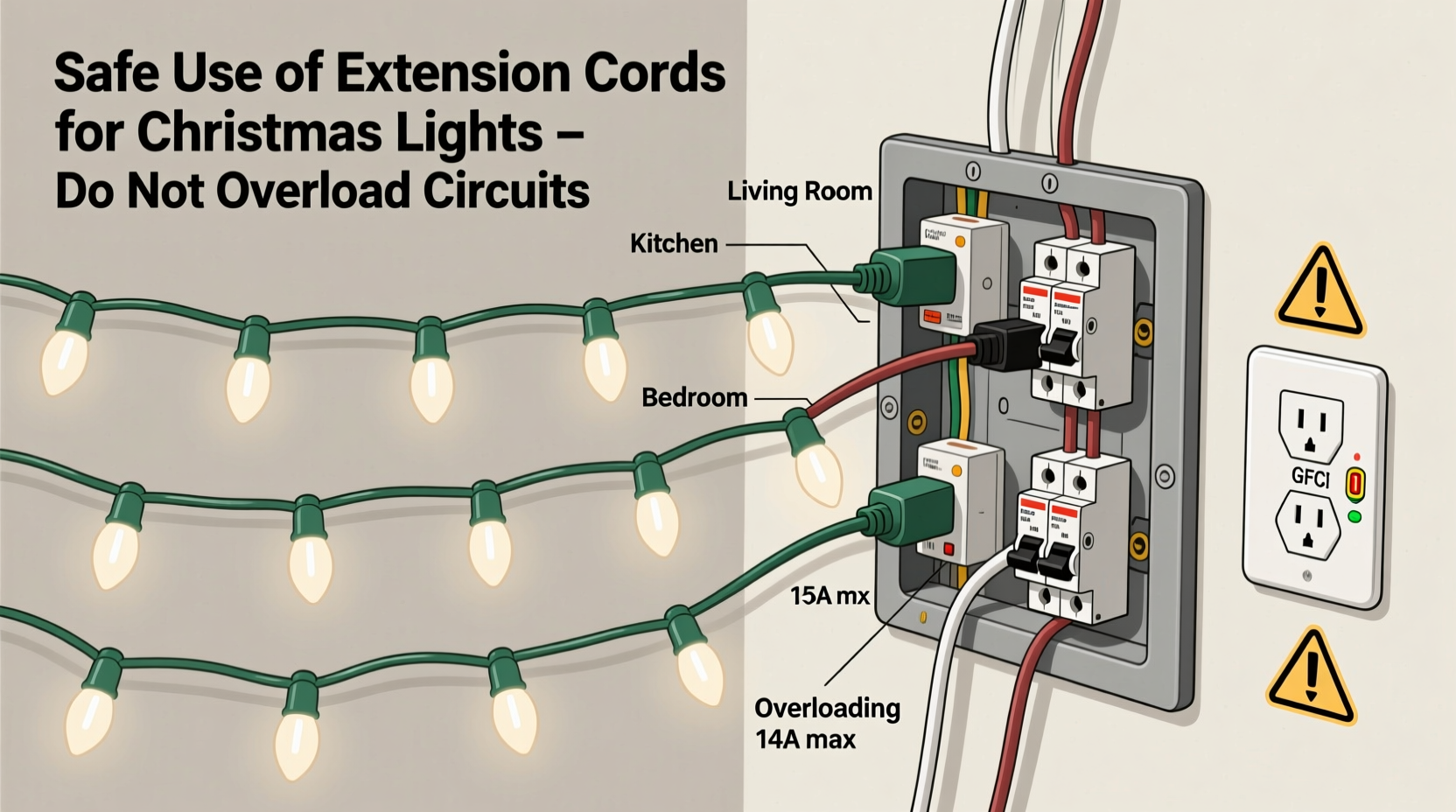
A typical North American home has multiple 15- or 20-amp electrical circuits distributed throughout. Each circuit is protected by a breaker in the main panel and powers specific outlets, often grouped by room or function (e.g., kitchen counter outlets, living room outlets). Most standard circuits operate at 120 volts and can handle around 1,800 watts (for 15A) or 2,400 watts (for 20A).
Christmas lights, especially older incandescent models, consume more power than people realize. A single strand of 100 mini incandescent bulbs can draw up to 40 watts. Connect ten strands together, and you're already near 400 watts. Add several such runs across your house, and the cumulative load becomes significant.
The idea of using extension cords across different circuits stems from a desire to distribute this load. For example, if you have half your lights powered from a living room circuit and the other half from a hallway circuit, you reduce the risk of overloading one breaker. But doing this requires careful planning—not just plugging in wherever there's an outlet.
“Using extension cords across circuits isn’t inherently unsafe, but it becomes dangerous when users ignore total load, cord quality, and circuit capacity.” — James L. Reynolds, Licensed Electrician & Home Safety Consultant
Can You Plug Extension Cords Into Different Circuits?
Yes, you can use extension cords to power Christmas lights connected to different circuits—but not by daisy-chaining cords between circuits or creating a looped configuration. What you’re really doing is using separate extension runs from separate outlets, each on its own circuit. This is safe and often recommended to balance the electrical load.
For instance, imagine decorating the front of your house. The left side connects to an outdoor outlet fed by Circuit A, while the right side uses an outlet from Circuit B. Running two independent extension cords—one from each circuit—is perfectly acceptable. Just ensure each cord powers only what that circuit can safely support.
What you should never do is bridge two circuits with a single extension cord or create a multi-plug adapter that draws from both circuits simultaneously. That creates a potential phase conflict, increases fire risk, and violates electrical codes.
Safety Checklist for Using Extension Cords with Christmas Lights
To avoid hazards, follow this actionable checklist before setting up your display:
- Check cord rating: Use only outdoor-rated extension cords labeled “UL Listed” for exterior use.
- Match gauge to load: For longer runs or multiple light strands, use 16-gauge or lower (thicker) cords—12- or 14-gauge for heavy loads.
- Inspect cords: Look for fraying, cracked insulation, or bent prongs. Discard damaged cords.
- Limit daisy-chaining: Never connect more than three standard light strings end-to-end unless labeled for it.
- Use GFCI protection: Plug into GFCI outlets or use a GFCI-protected cord, especially outdoors.
- Don’t overload circuits: Keep total wattage under 80% of the circuit’s capacity (e.g., 1,440W max on a 15A circuit).
- Secure cords safely: Use cord clips, not nails or staples, to prevent damage.
- Turn off when unattended: Use timers to automatically shut off lights at night.
Choosing the Right Extension Cord: A Comparison Table
| Cord Gauge | Max Amperage | Recommended Use | Max Run Length (Outdoor) | Not Recommended For |
|---|---|---|---|---|
| 18 AWG | 5 amps | Short runs, LED lights only | Up to 25 feet | Incandescent lights, long runs |
| 16 AWG | 7 amps | Moderate-length runs, mixed LEDs | Up to 50 feet | Heavy-duty or commercial displays |
| 14 AWG | 12 amps | Long runs, multiple incandescent strands | Up to 100 feet | Indoor-only applications |
| 12 AWG | 20 amps | Commercial displays, high-wattage setups | Up to 150 feet | Lightweight seasonal use |
Note: Lower gauge numbers mean thicker wires and higher current capacity. Always choose a cord rated for outdoor use (look for “OW” or “SJOOW” jacketing) if used outside.
Step-by-Step Guide: Setting Up Christmas Lights Across Multiple Circuits
Follow these steps to safely power your Christmas lights using extension cords on different circuits:
- Map Your Circuits: Turn off breakers one at a time to identify which outlets belong to which circuit. Label them temporarily.
- Calculate Total Load: Add up the wattage of all light strands planned for each area. Check labels or use a wattage meter.
- Distribute Evenly: Assign light sections to different circuits based on proximity and load capacity. Aim for balanced usage.
- Select Appropriate Cords: Choose outdoor-rated cords with sufficient gauge and length for each run.
- Plug In Separately: Connect each extension cord to an outlet on its respective circuit—do not interconnect circuits.
- Test Before Finalizing: Power everything on for at least 30 minutes. Check for warm cords, flickering, or tripped breakers.
- Install Timers: Use heavy-duty outdoor timers to limit operation to 6–8 hours per night, reducing heat buildup and energy use.
- Inspect Weekly: During the season, check cords and connections weekly for wear, moisture, or damage.
Real-World Example: Avoiding a Holiday Hazard
Consider the case of Mark T., a homeowner in Ohio who wanted to create a large rooftop light display. He had two exterior outlets—one on the garage circuit (15A), the other on the porch circuit (also 15A). Excited to finish quickly, he bought several inexpensive 18-gauge extension cords and daisy-chained multiple incandescent light strings across both sides of his house.
On the third night, the garage circuit tripped repeatedly. He reset it multiple times, unaware that one cord was running hot due to being overloaded. By day five, the insulation near the outlet had begun to melt. A neighbor noticed the smell of burning plastic and alerted him. After calling an electrician, Mark learned that he’d exceeded the safe load on both circuits and used cords too thin for the distance and wattage.
The fix? The electrician advised switching to 14-gauge cords, replacing incandescent lights with LEDs, and using a timer. Mark redistributed the lights more evenly and avoided further issues. His display stayed lit—and safe—for the rest of the season.
“Many holiday electrical fires start with simple misjudgments: wrong cord size, ignored wattage limits, or lack of GFCI protection.” — National Fire Protection Association (NFPA) Holiday Safety Report
Common Mistakes to Avoid
Even experienced decorators make errors that compromise safety. Here are the most frequent pitfalls:
- Using indoor cords outdoors: Indoor cords lack weather-resistant insulation and degrade quickly.
- Overlooking voltage drop: Long cord runs reduce voltage, causing lights to dim and motors (like in animated figures) to stall or overheat.
- Ignoring GFCI requirements: Outdoor outlets must be GFCI-protected by code. If not, use a GFCI adapter.
- Running cords under rugs or snow: Trapped heat and moisture increase shock and fire risks.
- Leaving lights on 24/7: Continuous use accelerates wear and increases energy costs.
Frequently Asked Questions
Can I connect two extension cords from different circuits to the same light string?
No. A single light string must be powered from one source. Connecting it to two circuits could create a short circuit or backfeed hazard. Each light set should have one continuous power path from a single outlet.
Is it safe to leave extension cords plugged in all winter?
It’s acceptable if the cords are rated for outdoor use, properly secured, and inspected regularly. However, disconnect during storms or extreme weather. Also, unplugging when not in use extends cord life and reduces risk.
How many Christmas lights can I safely connect to one extension cord?
It depends on the cord gauge and light type. As a rule:
- LEDs: Up to 10–15 strings on a 16-gauge cord (check manufacturer limits).
- Incandescents: No more than 3–5 strings on the same cord.
Final Recommendations for a Safe, Bright Season
Using extension cords for Christmas lights across different circuits is not only possible—it’s a smart way to manage electrical load and prevent overloads. The key is doing it correctly: use the right cords, respect circuit limits, avoid daisy-chaining, and prioritize safety features like GFCI and timers.
Modern LED lights have made holiday decorating safer and more energy-efficient. They draw far less power, produce less heat, and allow longer runs without overloading circuits. Whenever possible, upgrade older incandescent sets to LEDs—they last longer and reduce strain on your electrical system.
Remember, convenience should never override safety. Taking an extra hour to plan your setup can prevent hours of frustration—or worse, an emergency. Your holiday spirit deserves to shine without putting your home at risk.




 浙公网安备
33010002000092号
浙公网安备
33010002000092号 浙B2-20120091-4
Comments
No comments yet. Why don't you start the discussion?