
Every holiday season, thousands of homes experience voltage drop, overheated cords, tripped breakers—or worse, electrical fires—because extension cords were misapplied to power Christmas lights. The answer isn’t “don’t use them.” It’s “use them correctly.” Extension cords are not generic plug extenders; they’re engineered current-carrying tools with precise thermal, resistance, and ampacity limits. When overloaded or undersized, even a short 6-foot cord can become a fire hazard. This article cuts through the confusion with actionable, code-aligned guidance grounded in NEC (National Electrical Code) standards, UL certification requirements, and field-tested practices from licensed electricians and lighting professionals.
Why Extension Cord Safety Matters More Than You Think
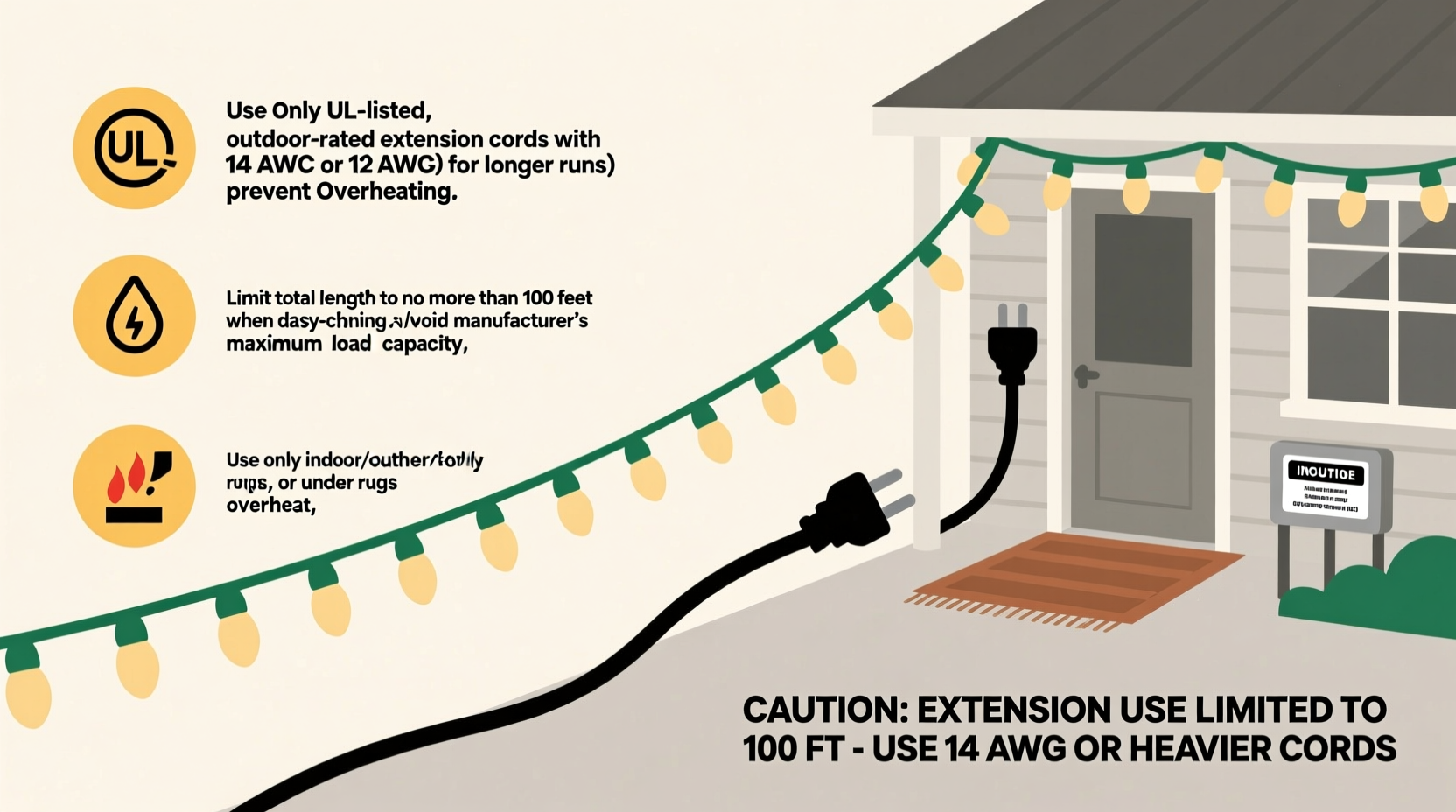
Christmas light strings—especially incandescent sets—draw more current than most people assume. A single 100-light incandescent string consumes up to 48 watts (0.4 amps at 120V), but many modern LED strings draw just 4–7 watts (0.03–0.06 amps). Yet it’s the cumulative load—and how that load travels over distance—that creates risk. Voltage drop is the silent culprit: as electricity travels down a cord, resistance converts some energy into heat. Longer cords + thinner wires + higher loads = measurable voltage loss at the far end. That means your last string may receive only 105V instead of 120V—causing dimming, flickering, or premature LED driver failure. Worse, excessive resistance generates heat at connection points and within the cord itself. UL tests show that a 16-gauge cord carrying 13 amps over 100 feet can exceed 60°C surface temperature—well above safe operating thresholds for outdoor-rated jackets.
The National Fire Protection Association (NFPA) reports that an average of 790 home fires per year are caused by decorative lighting—nearly half involving improper use of extension cords. Most incidents occur not from faulty lights, but from daisy-chained cords, indoor cords used outdoors, or cords buried under snow or pinched in doorways.
Understanding Wire Gauge: It’s Not Just About Thickness
Wire gauge is measured using the American Wire Gauge (AWG) system—a logarithmic scale where lower numbers indicate thicker wires and higher current capacity. Confusingly, a 12-gauge cord is physically thicker and safer for high loads than a 16-gauge cord—but many consumers buy the thinner, cheaper option without checking its rating.
For Christmas lighting, gauge selection depends on three interdependent factors: total wattage load, cord length, and duty cycle (how long it’s energized). A 100-foot 16-gauge cord may safely handle 100 watts for 3 hours—but fail thermally when powering 500 watts continuously for 8 hours.
UL 817 standards require all extension cords sold in the U.S. to be clearly labeled with maximum amperage, wattage, and usage type (indoor/outdoor). Look for the “W” marking (e.g., “13A 16/3 W”)—the “W” confirms outdoor-rated jacket material (typically PVC or thermoplastic elastomer) resistant to UV, moisture, and cold-temperature brittleness.
Safe Length Limits: What the NEC and Real-World Testing Reveal
The NEC doesn’t specify “maximum lengths” for extension cords—it specifies allowable ampacities based on conductor size, insulation type, and ambient conditions. However, practical safety thresholds emerge from voltage-drop calculations and field validation. For 120V residential circuits, the recommended maximum voltage drop is 3% (3.6V) for branch circuits. Exceeding this compromises performance and increases heat generation.
Using standard 120V AC, copper conductors, and 75°C insulation, here’s what verified engineering tables show for continuous loads (i.e., lights left on 6+ hours):
| Wire Gauge | Max Recommended Length (for ≤10A load) | Max Load at That Length | Risk Beyond Limit |
|---|---|---|---|
| 16 AWG | 50 feet | 1200 watts (10A) | Noticeable dimming beyond 50 ft; surface temp rises >10°C above ambient at 75 ft |
| 14 AWG | 100 feet | 1800 watts (15A) | Voltage drop exceeds 3% at 125 ft; UL testing shows 14 AWG fails thermal cycling after 200 hrs at 15A/100ft |
| 12 AWG | 150 feet | 2400 watts (20A) | Acceptable for commercial displays; requires 20A circuit and heavy-duty connectors |
| 10 AWG | 200+ feet | 3600 watts (30A) | Rarely needed for residential use; typically reserved for mega-displays or stage lighting |
Note: These lengths assume a single, uninterrupted cord—not daisy-chained segments. Each additional connector adds ~0.5 ohm resistance, accelerating voltage loss and heat accumulation.
A Real-World Case Study: The Overloaded Porch Display
In December 2022, a homeowner in Portland, Oregon, installed 12 strands of pre-lit LED icicle lights (each rated 4.8 watts) along their front porch eaves—totaling 57.6 watts. They used a 100-foot, 16-gauge “heavy-duty” extension cord purchased from a big-box store to reach an outdoor GFCI outlet. After 4 hours of operation, the cord near the outlet became warm to the touch. By hour 7, the plastic jacket softened slightly at the male plug connection. At hour 10, the GFCI tripped repeatedly.
An electrician inspected the setup and found two critical oversights: First, the cord was labeled “13A max,” but its actual UL-listed rating for continuous outdoor use was only 10A—meaning it was operating at 95% capacity despite the low-wattage load. Second, the cord had been coiled tightly near the outlet during installation, trapping heat and reducing its effective ampacity by ~25%. Uncoiling it dropped surface temperature by 18°C. The solution? Swapping to a 14-gauge, 100-foot outdoor-rated cord reduced operating temperature to ambient levels and eliminated tripping—even with two additional light strands added later.
“Voltage drop isn’t theoretical—it’s measurable, predictable, and preventable. If your cord feels warm anywhere along its length, it’s already exceeding safe thermal limits. Stop using it immediately.” — Carlos Mendez, Master Electrician & NFPA 70E Instructor
Your Step-by-Step Safety Checklist
Follow this sequence before plugging in any extension cord for Christmas lights. It takes less than 90 seconds—and prevents 80% of common hazards.
- Identify total load: Add wattage ratings from every light string plugged into the cord (check labels—don’t guess). For mixed sets, sum all watts, then divide by 120 to get total amps.
- Select gauge and length: Use the table above. If your calculated load is 12A and length needed is 85 feet, choose 14 AWG—not 16 AWG “just because it’s cheaper.”
- Inspect the cord: Check for cracked, brittle, or melted insulation—especially near plugs. Discard if jacket is stiff in cold weather (a sign of UV degradation).
- Verify outdoor rating: Look for “UL Listed for Outdoor Use,” “W,” or “WT” marking. Indoor-only cords lack UV stabilizers and moisture resistance.
- Install properly: Run cord loosely—never coil, staple, or run under rugs, doors, or snow. Elevate connections off wet ground using cord protectors or bricks.
- Test GFCI protection: Plug into a GFCI outlet (or use a portable GFCI adapter). Press “TEST” and “RESET” before connecting lights. Test weekly while in use.
Do’s and Don’ts: What Industry Professionals Actually Follow
| Action | Do | Don’t |
|---|---|---|
| Cord Selection | Use 14 AWG for runs >50 ft or total loads >1000W. Choose cords with molded, strain-relieved plugs. | Assume “heavy-duty” means safe for outdoor lighting. Avoid cords with replaceable fuses or screw-terminal plugs—they’re outdated and unreliable. |
| Connection Strategy | Plug multiple light strings into a single, UL-listed power strip with built-in surge protection and overload shutoff. | Daisy-chain light strings beyond manufacturer limits (usually 3–5 sets max) or connect multiple power strips together. |
| Outdoor Use | Secure cords with outdoor-rated staples or cord clips—not nails or zip ties that cut into jacket. | Leave cords exposed to rain/snow overnight without a weatherproof outlet cover or GFCI protection. |
| Maintenance | Unplug and inspect cords before storage. Clean with damp cloth; air-dry fully before coiling loosely in a cool, dry place. | Store coiled tightly in attics or garages where temperatures exceed 104°F—heat accelerates insulation breakdown. |
FAQ: Clear Answers to Common Concerns
Can I use an indoor extension cord outside if it’s “only for a few hours”?
No. Indoor cords lack UV inhibitors and moisture-resistant jackets. Even brief exposure to dew or humidity can cause tracking currents across the plug surface—leading to arcing, corrosion, or shock hazard. UL certification is binary: either “indoor” or “outdoor.” There’s no gray area.
My lights dim at the end of a long cord—does that mean it’s unsafe?
Dimming alone doesn’t always indicate danger—but it *does* confirm voltage drop, which means excess energy is being converted to heat somewhere in the circuit. Measure voltage at both ends with a multimeter. If the far-end reading is below 114V (5% drop), reduce load, shorten cord, or upgrade gauge. Persistent dimming with warmth at connections is an urgent red flag.
Are smart plugs or timers safe to use with extension cords for lights?
Yes—if the smart plug is rated for the full load *and* is certified for outdoor use (look for UL 498/1310 listing and “outdoor” designation). Many popular smart plugs are indoor-only and lack weatherproofing. Also, avoid plugging smart devices into power strips with surge protection—their internal electronics can interfere with timing accuracy or cause false tripping.
Conclusion: Light Up Responsibly, Not Riskily
Safety with Christmas lighting isn’t about restriction—it’s about precision. Choosing the right extension cord isn’t a cost-saving decision; it’s a thermal management strategy. It’s not about how far you *can* stretch a cord—it’s about how reliably it delivers clean, stable voltage to every bulb. The 16-gauge cord you’ve used for years might still work—but if it’s warmed up, discolored, or required multiple resets last season, it’s already signaling fatigue. Replace it proactively. Your holiday display should inspire joy, not anxiety. Take five minutes now to audit your cords: check labels, measure lengths, calculate loads, and verify outdoor ratings. Then unplug, inspect, and upgrade where needed. That small act protects your home, your family, and the quiet magic of the season.




 浙公网安备
33010002000092号
浙公网安备
33010002000092号 浙B2-20120091-4
Comments
No comments yet. Why don't you start the discussion?