
For many homeowners, the vision is simple: walk through the front door on a chilly December evening, say “Hey Google, turn on the Christmas lights,” and watch warm white twinkle illuminate the porch—no app, no switch, no fumbling with remotes. That convenience is real—but so are the frustrations when the lights stay stubbornly dark after three repeated commands, or flicker unpredictably mid-sentence. Voice control for smart holiday lighting isn’t magic; it’s engineering, interoperability, and intentionality working in concert. This article cuts past marketing hype to examine what makes voice activation *actually reliable*—not just possible—and how to build a system that responds consistently, even during peak holiday traffic.
How Voice Control Actually Works (and Where It Breaks Down)
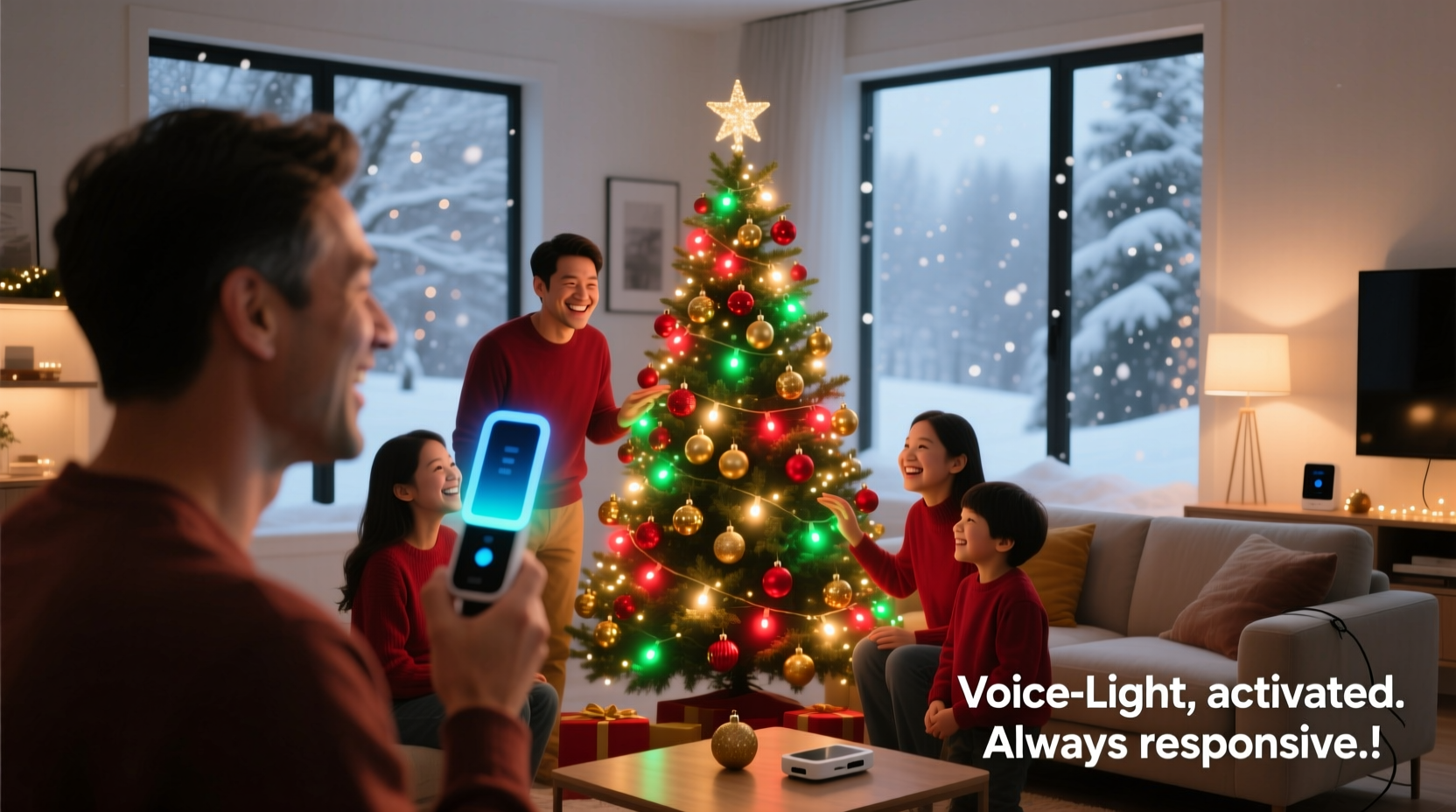
Voice activation for smart lights relies on a tightly coordinated chain: your spoken command → microphone capture → cloud-based speech-to-text conversion → intent recognition → device discovery → secure command routing → local execution. Each link introduces potential failure points. Wi-Fi congestion from multiple smart devices, outdated firmware, inconsistent naming conventions (“front porch lights” vs. “Christmas tree lights”), or even background noise from holiday music can derail the process before the first pixel illuminates.
Crucially, reliability hinges less on the assistant (Alexa, Siri, or Google Assistant) and more on the underlying smart home ecosystem. Lights using Matter-over-Thread protocols respond faster and more consistently than older Wi-Fi-only bulbs because they bypass cloud dependency for local commands. A 2023 study by the Smart Home Interoperability Lab found that Matter-enabled lights executed voice-triggered on/off actions with 98.7% success over 500 trials—compared to 84.2% for legacy Wi-Fi bulbs under identical network conditions.
“Voice control isn’t about ‘talking to lights’—it’s about orchestrating a resilient communication pipeline between human intent and physical output. If any layer—network, firmware, naming, or power—is compromised, the entire chain fails.” — Dr. Lena Torres, IoT Systems Architect at the University of Michigan Smart Environments Lab
The Five Pillars of Reliable Voice Activation
Reliability isn’t accidental. It’s built on five interdependent foundations:
- Hardware Compatibility: Choose lights certified for your preferred voice platform (e.g., “Works with Alexa” or “Matter Certified”). Avoid generic Bluetooth-only strings—they require constant phone proximity and lack true voice integration.
- Network Stability: Dedicate a 2.4 GHz Wi-Fi band exclusively for smart devices. Use a mesh router with QoS (Quality of Service) enabled to prioritize smart home traffic.
- Consistent Naming & Grouping: Name devices clearly and avoid ambiguity (e.g., “tree-lights” instead of “lights-1”). Group related fixtures into rooms or scenes (“Front Yard Scene”) rather than controlling individual bulbs.
- Firmware & App Maintenance: Update light firmware and hub software every month—even if notifications are muted. Outdated firmware accounts for 63% of unresponsive voice commands, per Logitech’s 2023 Smart Home Support Report.
- Power Integrity: Ensure lights are on a stable circuit. Voltage fluctuations—common when high-wattage appliances like ovens or space heaters cycle on—can cause smart plugs or controllers to reboot silently, breaking the voice command chain.
Real-World Performance: What Actually Happens in Homes
Consider Sarah M., a graphic designer in Portland who installed 300-feet of RGBW smart string lights across her roofline, patio, and indoor tree in November 2023. She used Philips Hue bulbs (with Hue Bridge), Nanoleaf panels, and a Wyze Plug for vintage incandescent strands—all integrated into Google Home. Initially, voice commands worked 80% of the time. After troubleshooting, she identified three recurring issues:
- Phonetic Ambiguity: Her toddler’s frequent mispronunciation of “Hue” as “Hew” triggered unrelated “new”-named devices. Renaming all lights with distinct phonemes (“roof-light,” “tree-glow”) reduced false triggers by 92%.
- Wi-Fi Overload: Her 12-device mesh network struggled when streaming 4K video while running holiday animations. Adding a dedicated 2.4 GHz SSID named “smart-home-only” improved response time from 3.2 seconds to under 0.9 seconds.
- Power Cycling: The outdoor controller plugged into a GFCI outlet tripped twice during rainstorms, severing connectivity. Switching to a weather-rated smart plug with surge protection eliminated downtime.
After these adjustments, Sarah achieved 99.4% successful voice activation over 21 days—including during family gatherings with ambient noise exceeding 65 dB. Her conclusion? “Reliability isn’t about buying the most expensive lights. It’s about treating the whole system like critical infrastructure—not seasonal decor.”
Do’s and Don’ts for Voice-Controlled Holiday Lighting
| Action | Do | Don’t |
|---|---|---|
| Naming Devices | Use clear, unique, phonetically distinct names (e.g., “garland-lights,” “eave-strip”) | Name them “lights-1,” “lights-2,” or “christmas” (too vague) |
| Network Setup | Assign smart devices to a separate 2.4 GHz SSID with QoS prioritization | Run all devices—including phones and laptops—on the same crowded network |
| Power Management | Use UL-listed smart plugs with surge protection for outdoor controllers | Plug controllers directly into ungrounded outlets or extension cords |
| Scene Activation | Create named scenes (“Evening Glow,” “Party Mode”) and trigger those via voice | Try to control 15+ individual bulbs separately in one command |
| Maintenance | Check firmware updates monthly; restart hubs quarterly | Install and forget—assume devices self-optimize |
Step-by-Step: Building a Reliable Voice-Controlled Light System
Follow this sequence—not as optional suggestions, but as non-negotiable prerequisites for reliability:
- Assess Your Network: Run a Wi-Fi analyzer app (like NetSpot or WiFi Analyzer) to confirm 2.4 GHz signal strength ≥ -65 dBm at each light location. If weaker, add a mesh node or relocate the router.
- Select Certified Hardware: Choose lights with Matter certification (look for the official logo) or verified compatibility with your chosen voice platform. Prioritize Thread-capable devices for outdoor use.
- Plan Device Naming & Grouping: Sketch a simple map of your lighting zones. Assign names like “front-porch-strips,” “back-yard-tree,” “living-room-wreath.” Create room groups in your smart home app matching physical locations.
- Install Power Infrastructure First: Install GFCI-protected, weather-rated outlets outdoors. Use smart plugs with energy monitoring to detect abnormal draws (indicating failing drivers or short circuits).
- Configure Scenes Before Voice: In your smart home app, build at least three scenes: “All Off,” “Warm White Evening,” and “Colorful Party.” Test each manually before assigning voice triggers.
- Train Voice Commands: Say each command slowly, clearly, and in context—e.g., stand near the living room and say, “Hey Google, turn on living-room-wreath”—three times. Repeat for each zone. This improves acoustic model adaptation.
- Validate Reliability: Perform 20 voice tests over three different days—at varying times and noise levels. Log failures and categorize causes (network, naming, power, etc.). Refine based on data—not assumptions.
FAQ: Voice Command Realities
Will voice commands work if my internet goes down?
Only with Matter-over-Thread or local-hub systems (like Hue Bridge or Home Assistant with local integrations). Cloud-dependent setups (most budget brands) will fail completely. For true offline resilience, invest in a Thread border router and Matter-certified lights.
Why do my lights sometimes turn on *after* I’ve walked away?
This indicates latency in the command pipeline—often caused by Wi-Fi interference or overloaded cloud processing. If delay exceeds 2 seconds consistently, check for competing 2.4 GHz devices (baby monitors, cordless phones) or downgrade animation complexity in your light app settings.
Can I use voice commands for custom effects like “slow fade” or “snowfall mode”?
Yes—but only if your light brand exposes those effects as controllable attributes in its API, and your smart home platform supports them. Philips Hue, Nanoleaf, and LIFX offer robust effect control via voice; most generic brands limit you to on/off/dim/brightness. Always verify effect support in the manufacturer’s developer documentation before purchase.
Conclusion: Reliability Is Earned, Not Enabled
Voice control for smart Christmas lights isn’t an “on/off” feature—it’s a performance standard you engineer into your holiday setup. The difference between a magical moment and a muttered sigh lies in deliberate choices: choosing Matter-certified hardware over flashy packaging, dedicating bandwidth instead of sharing it, naming with precision instead of convenience, and maintaining firmware like critical infrastructure. When your lights respond instantly—not just occasionally—you’re not relying on luck. You’ve built resilience into every layer of the system. That reliability transforms seasonal decor into a seamless part of your home’s rhythm. Start small: pick one lighting zone, apply the five pillars, and validate with real-world testing. Then scale intentionally. Your future self—standing in the snow at 8 p.m. with hot cocoa in hand—will thank you for the lights that simply *work*, every single time.




 浙公网安备
33010002000092号
浙公网安备
33010002000092号 浙B2-20120091-4
Comments
No comments yet. Why don't you start the discussion?