
Every holiday season, the same question arises: do last year’s Christmas lights still work? Tangled strands buried in storage boxes often spark frustration when half the bulbs fail to illuminate. While traditional troubleshooting involves plugging them into an outlet and hoping for the best, modern technology offers smarter solutions. The good news is that yes — with a few clever techniques and the device most of us carry daily, your smartphone can play a key role in diagnosing whether old Christmas lights are still functional.
This guide explores how smartphones, combined with basic tools and observation, can help determine if your vintage light strings are worth keeping or should be retired. From visual inspection tricks using your phone’s flashlight and camera to leveraging apps and multimeters paired with smartphone guidance, you’ll learn reliable, efficient methods to test, troubleshoot, and even repair older sets.
How Smartphones Can Aid in Testing Old Christmas Lights
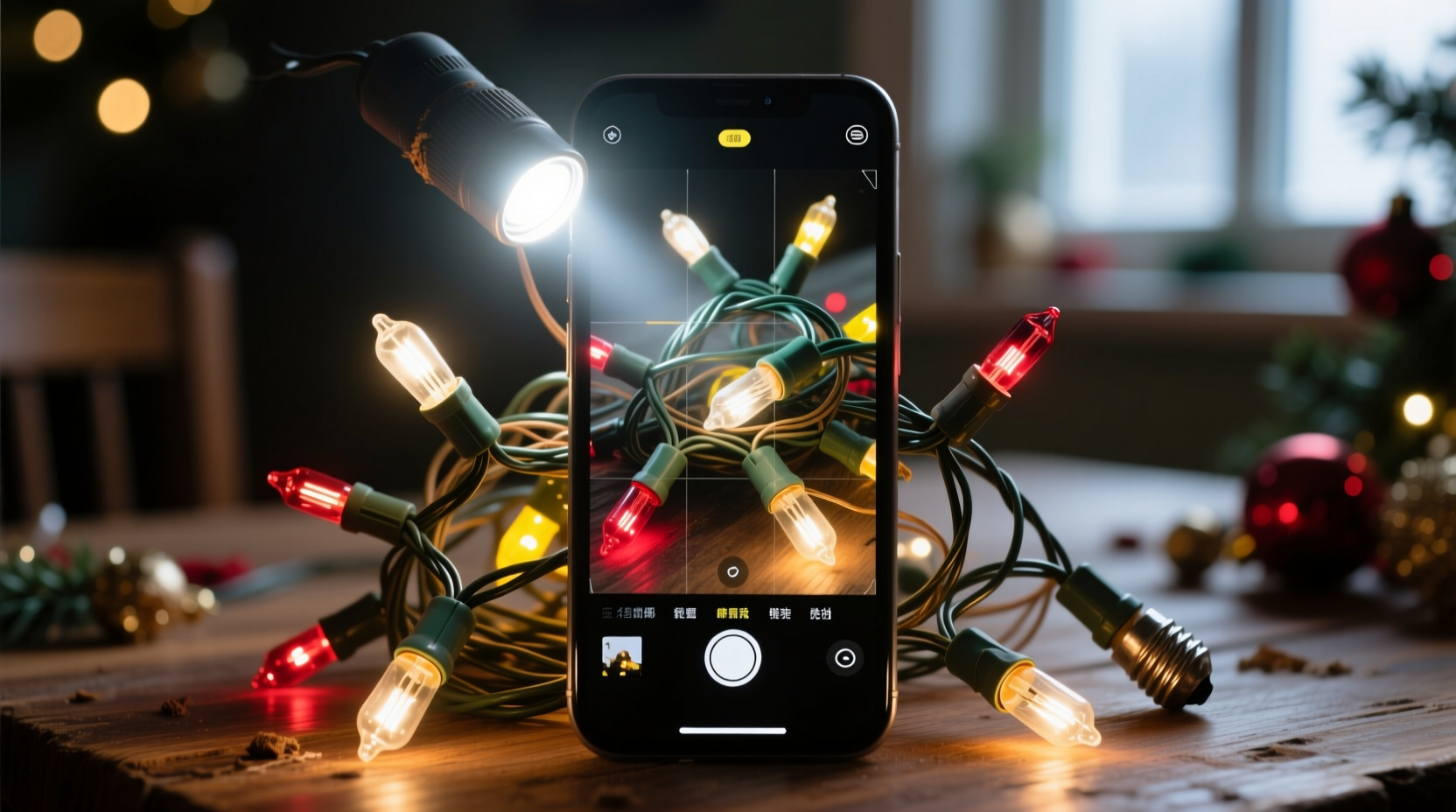
Your smartphone isn’t just a communication tool — it’s a portable diagnostic kit. While it cannot directly power or measure electrical current on its own, it enhances your ability to inspect, analyze, and research faulty lighting systems. Here’s how:
- High-resolution camera: Zoom in on tiny filaments inside bulbs to check for breaks.
- Bright flashlight: Illuminate dark corners of sockets and wiring during inspection.
- Internet access: Search for replacement bulb types, wiring diagrams, or troubleshooting videos.
- Voltage testing apps (with accessories): When used with Bluetooth-enabled multimeters, some apps display real-time electrical readings.
- Note-taking and organization: Document which strands work, take photos of damaged areas, and track repairs over time.
While the phone itself doesn’t emit enough current to test circuits, it acts as a force multiplier in identifying issues quickly and accurately.
Step-by-Step Guide: Using Your Smartphone to Diagnose Light Failure
Follow this systematic process to assess whether your old Christmas lights are salvageable, using only your smartphone and minimal additional tools.
- Unpack and untangle carefully: Lay the strand flat on a clean surface. Avoid pulling sharply — kinks can damage internal wires.
- Inspect visually with your phone’s flashlight: Shine the light along the entire length. Look for cracked sockets, exposed copper, frayed insulation, or melted plastic.
- Check individual bulbs: Remove each bulb gently and examine the filament under bright light. Use your phone’s camera zoom to see fine details. A broken or sagging filament means the bulb is dead.
- Look for the “one bad apple” effect: In series-wired lights (most older strands), one burnt-out bulb can kill the whole circuit. Identify dark bulbs early.
- Use your phone to search for specs: Find the voltage per bulb (often 2.5V or 3.5V) by checking packaging or searching the model number online.
- Test continuity with a multimeter (guided by phone): Watch YouTube tutorials on how to use a multimeter while you perform tests on fuses, sockets, and wires.
- Document findings: Take notes or photos of problem areas. Label non-working sections for repair or disposal.
This method reduces guesswork and helps avoid repeated failed plug-in attempts that could pose fire risks.
Using Apps and Online Resources to Support Diagnosis
Smartphones shine brightest when connected to expert knowledge. Numerous apps and websites offer interactive support for diagnosing and repairing Christmas lights.
For example, DIY repair communities like Reddit’s r/ChristmasLights or dedicated forums such as ChristmasLightSetc.com provide step-by-step advice based on specific brands and models. Simply snap a photo of your light string and upload it with a question — experienced users often respond within hours.
Additionally, video platforms host countless tutorials demonstrating how to:
- Replace mini-light bulbs without damaging sockets
- Identify shunt failures in series circuits
- Test fuses located in plug ends
- Convert old strands to LED replacements
Some advanced users pair their smartphones with Bluetooth-enabled digital multimeters. These devices send voltage, continuity, and resistance data directly to a companion app, allowing precise diagnostics. While not essential, they add scientific accuracy to what would otherwise be trial-and-error testing.
“The biggest mistake people make is assuming all lights in a dark section are bad. Often, it's just one bulb or a blown fuse. A smartphone camera can spot that single failure in seconds.” — Mark Reynolds, Electrical Technician & Holiday Lighting Installer
Do’s and Don’ts: Common Pitfalls When Testing Old Lights
To ensure safety and effectiveness, follow these guidelines when using your smartphone and other tools to evaluate old Christmas lights.
| Do | Don’t |
|---|---|
| Use your phone’s flashlight to inspect tight spaces | Shine the light directly into your eyes or reflect off shiny surfaces carelessly |
| Take close-up photos of damaged components for later reference | Rely solely on visual inspection — always test electrically before discarding |
| Search for repair videos matching your light type | Assume all Christmas lights work the same way — wiring varies by era and brand |
| Use a multimeter guided by instructional apps | Plug suspect strands into outlets multiple times hoping they’ll suddenly work |
| Label tested strands (working, needs repair, discard) | Mix working and non-working strands together after testing |
Staying organized prevents confusion during future holiday setups and makes seasonal decorating faster and safer.
Mini Case Study: Reviving Grandma’s Vintage Lights
Sarah from Ohio inherited a box of C7 Christmas lights from her grandmother — large, classic bulbs used on outdoor trees in the 1970s. Excited to preserve family tradition, she unpacked them before Thanksgiving but found only half the strand lit up when plugged in.
Instead of tossing them, Sarah used her iPhone to assist in revival. She started by photographing the entire strand, then used the flashlight to peer into each socket. One bulb had a visibly broken filament; another showed signs of arcing (blackened base).
She searched “vintage C7 bulb replacement” on her phone and discovered a specialty retailer selling exact replicas. After ordering a five-pack, she replaced the faulty bulbs. Still, the strand flickered. Remembering a YouTube video, she watched a tutorial on checking fuses in screw-based plugs. Using a $10 multimeter she bought online, she tested continuity and found a blown fuse. Replaced it with a spare included in the new bulb pack, and the full strand lit up perfectly.
The entire process took less than two hours, cost under $15, and preserved a cherished heirloom — all guided by smartphone research and imaging.
Tips for Maximizing Success with Older Light Strings
Older Christmas lights, especially pre-LED incandescent models, require more attention than modern sets. However, many remain fully functional with minor maintenance.
- Always unplug before handling: Even low-voltage strands can deliver shocks if damaged.
- Clean sockets with isopropyl alcohol: Corrosion inhibits conductivity. Use a cotton swab dipped in alcohol and dry thoroughly.
- Check both fuses in plug ends: Many strands have dual fuses — one may blow while the other remains intact.
- Test segments separately: If you have multiple strands, don’t daisy-chain them during testing. Isolate faults more easily.
- Upgrade selectively: Replace only dead sections with compatible LED bulbs to reduce energy use and heat output.
FAQ
Can I use my smartphone to detect electrical current in Christmas lights?
No, standard smartphones cannot detect live electrical current. You need a non-contact voltage tester or multimeter for that. However, your phone can guide you through using these tools safely via instructional videos and apps.
Why do some bulbs in a strand burn out while others stay lit?
In parallel-wired strands (common in newer lights), individual bulbs operate independently. But in older series-wired strings, one dead bulb breaks the circuit. Some bulbs have “shunts” that activate when the filament fails, maintaining continuity — but these don’t always work reliably.
Is it safe to keep using 20-year-old Christmas lights?
If they pass visual inspection (no cracked wires, secure connections, intact insulation) and function properly after testing, yes. However, consider replacing very old sets with modern LED versions for better safety, efficiency, and durability.
Final Checklist Before Storing or Discarding
Before deciding whether to keep or toss your old Christmas lights, run through this final verification list using your smartphone as a tool:
- ✅ Visually inspected every inch of the strand using phone flashlight
- ✅ Removed and checked all bulbs for filament damage
- ✅ Tested fuses with a multimeter (tutorial followed on phone)
- ✅ Verified full illumination after repairs
- ✅ Photographed and labeled the strand for next year
- ✅ Researched replacement parts availability for future maintenance
If all items are checked, the strand is ready for reuse. If major wiring damage exists or replacements are obsolete, recycling may be the safest choice.
Conclusion
You don’t need specialized equipment to determine if old Christmas lights still work — just your smartphone and a bit of patience. By combining high-quality visuals, instant access to repair knowledge, and smart documentation, you can breathe new life into nostalgic decorations that might otherwise be discarded prematurely.
Testing isn’t just about functionality; it’s about safety, sustainability, and preserving memories. With careful inspection and informed decisions, many vintage light sets can continue shining for years to come — guided by the powerful little computer in your pocket.




 浙公网安备
33010002000092号
浙公网安备
33010002000092号 浙B2-20120091-4
Comments
No comments yet. Why don't you start the discussion?