
In an era where smartphone cameras dominate social media feeds and everyday photography, the question arises: do dedicated compact cameras still hold value? The Canon PowerShot G7 X, released in 2014 with a Mark II in 2016 and a Mark III in 2019, has long been a favorite among vloggers, travelers, and content creators. Meanwhile, the iPhone 8, though now several generations old, represented a turning point in computational photography. In 2024, comparing these two devices isn’t just about megapixels—it’s about understanding how purpose, sensor size, processing, and real-world use shape photo quality.
This isn’t a contest between cutting-edge techs; it’s a practical evaluation of whether a real camera still outperforms even an older flagship phone under typical conditions. The answer may surprise those who assume smartphones have completely overtaken compact cameras.
Sensor Size and Image Quality: The Physical Advantage
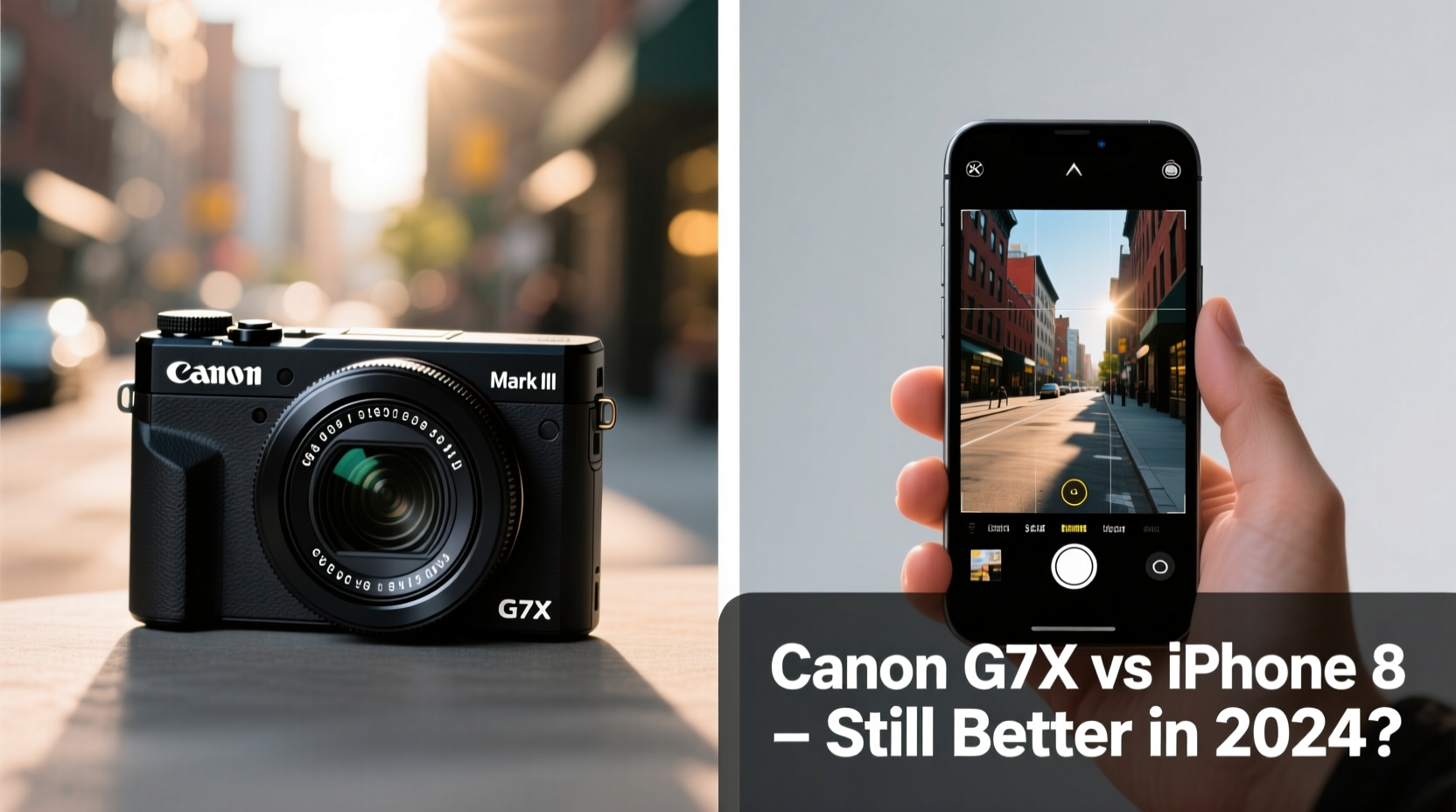
The most fundamental difference lies in hardware: the Canon G7 X features a 1-inch CMOS sensor—nearly four times larger than the iPhone 8’s sensor. Larger sensors capture more light, deliver better dynamic range, and produce less noise in low-light environments. This physical advantage translates directly to image fidelity.
The G7 X’s aperture range (f/1.8–f/2.8) also dwarfs the iPhone 8’s fixed f/1.8 lens, but more importantly, the combination of sensor size and lens design allows for genuine optical depth-of-field control. While the iPhone uses software to simulate bokeh, the G7 X achieves natural background blur through physics.
“Sensor size remains the single most important factor in image quality. No amount of AI can fully compensate for the limitations of a tiny sensor.” — David Kim, Imaging Scientist at DxO Labs
Low-Light Performance: Where Cameras Still Shine
Take a night scene: city lights, indoor cafes, or candlelit dinners. The iPhone 8, despite Apple’s early strides in Smart HDR and noise reduction, struggles with shadow detail and color accuracy once ambient light drops. Its small sensor gathers limited data, forcing aggressive digital processing that often results in smudged textures and unnatural skin tones.
In contrast, the Canon G7 X (especially the Mark II or III) handles low light with greater finesse. With manual ISO control, RAW shooting capability, and a faster lens, it preserves highlight detail and minimizes chroma noise. Even without flash, it produces cleaner, more balanced exposures. In 2024, this gap hasn't closed—because while newer iPhones have improved dramatically, the G7 X series remains relevant due to its foundational hardware strengths.
Real-World Example: Street Photography at Dusk
A travel blogger photographing Lisbon’s alleyways at twilight used both devices side by side. The iPhone 8 defaulted to a bright but flat image, lifting shadows so much that cobblestone textures vanished. The G7 X, set to aperture priority mode, retained rich tonal gradations and accurate warm glows from street lamps. Post-processing revealed recoverable highlights and usable ISO 1600 shots—something the iPhone struggled with even using third-party apps.
Video Capabilities: Beyond Megapixels
For hybrid shooters, video matters. The iPhone 8 supports 4K at 30fps and excellent stabilization thanks to electronic image stabilization (EIS), but lacks a microphone input, neutral density filter, or log profile. It excels in daylight vlogging but falters in variable lighting.
The Canon G7 X Mark II introduced 4K video, and the Mark III refined it with improved bitrate and focus tracking. More crucially, it offers full manual exposure control, focus peaking, and external mic support via adapter. For creators aiming to grow beyond smartphone limitations, these features are essential.
Autofocus on the G7 X is contrast-detect based, which can be slower than modern dual-pixel systems, but in controlled scenarios—like product shots or interviews—it delivers cinematic smoothness. The flip-up touchscreen also makes framing selfies easier than relying solely on the iPhone’s front camera.
Detailed Comparison: Canon G7 X (Mark III) vs iPhone 8
| Feature | Canon G7 X Mark III | iPhone 8 |
|---|---|---|
| Sensor Size | 1-inch (13.2 x 8.8 mm) | Approx. 1/3-inch |
| Aperture Range | f/1.8–f/2.8 (zoom dependent) | f/1.8 (wide only) |
| Zoom Capability | 4.2x optical (24–100mm equiv.) | Digital zoom only (up to 10x) |
| RAW Support | Yes (via USB or app) | No native RAW; HEIF available |
| Battery Life (still photos) | ~235 shots per charge | Unlimited (within phone battery) |
| Low-Light Usability | Excellent with manual settings | Fair (noise increases significantly) |
| Portability & Convenience | Moderate (fits in jacket pocket) | High (always in your pocket) |
When the iPhone Wins: Practicality and Integration
Let’s be clear: the iPhone 8 wins in convenience. It's always with you. Its camera launches instantly, connects seamlessly to apps, and uploads directly to Instagram or cloud storage. Face detection, portrait mode, and auto-enhance tools require zero effort. For spontaneous moments—a child’s laugh, a sudden sunset—the iPhone is unmatched in accessibility.
Moreover, ecosystem integration gives it an edge. Photos sync across devices via iCloud, facial recognition organizes albums, and editing tools like Lightroom Mobile work fluidly. The G7 X requires file transfer via SD card or Wi-Fi, adding steps most casual users avoid.
If your goal is sharing quick, decent-quality images without post-processing, the iPhone 8—even in 2024—is sufficient. But if you aim to create archival-quality images, experiment creatively, or build a portfolio, the G7 X offers a level of control no iPhone 8 setting can replicate.
Checklist: Choosing Between G7 X and iPhone 8
- ✅ Need shallow depth of field without software tricks? → Choose G7 X
- ✅ Shooting frequently in low light or concerts? → Choose G7 X
- ✅ Prioritize instant sharing and minimal workflow? → Choose iPhone
- ✅ Want to learn photography fundamentals (exposure, focus, composition)? → Choose G7 X
- ✅ Already own both? Use iPhone for candids, G7 X for intentional shots
Future-Proofing Your Gear in 2024
While the iPhone 8 is outdated by today’s standards (newer models feature Night Mode, LiDAR, and ProRAW), its inclusion here highlights a broader truth: even aging smartphones benefit from software updates and ecosystem maturity. However, the G7 X series, particularly the Mark III, receives firmware updates and remains compatible with modern workflows, including live streaming to YouTube via USB.
Investing in a dedicated camera doesn’t mean abandoning your phone. Instead, think of the G7 X as a creative upgrade—not a replacement. It teaches intentionality. You frame differently when you’re not swiping open a lock screen. You consider light, distance, and timing. These habits elevate all your photography, even when you return to your phone.
FAQ
Can the Canon G7 X replace my smartphone camera?
Not entirely. It lacks instant connectivity and portability. But for high-quality stills and videos, especially in challenging lighting, it surpasses the iPhone 8—and many current mid-range phones.
Is the Canon G7 X worth buying in 2024?
Yes, especially used or refurbished. At discounted prices, it offers exceptional value for bloggers, travelers, and hobbyists wanting better-than-phone image quality without DSLR bulk.
Does the iPhone 8 support RAW photography?
No. While HEIF captures slightly more dynamic range than JPEG, true RAW (DNG) is unavailable without third-party accessories or apps, unlike the G7 X which supports RAW output via Canon Camera Connect.
Final Verdict: Yes, Real Cameras Are Still Better—For Those Who Want More
In 2024, the Canon G7 X remains superior to the iPhone 8 in image quality, dynamic range, and creative flexibility. Smartphones have closed the gap in daylight snapshots, but when light fades or creativity demands control, dedicated cameras reclaim their ground. The G7 X proves that sensor physics and optical design still matter.
That said, “better” depends on context. For daily documentation, the iPhone wins. For expressive, lasting imagery, the G7 X does. The real question isn’t whether real cameras are obsolete—it’s whether you’re willing to carry one for the sake of better photos.




 浙公网安备
33010002000092号
浙公网安备
33010002000092号 浙B2-20120091-4
Comments
No comments yet. Why don't you start the discussion?