
In a world where fast fashion cycles accelerate and social media amplifies style pressure, how we relate to our wardrobes has never been more psychologically charged. Two opposing trends have emerged in recent years: the minimalist capsule wardrobe and the expressive, mood-driven approach of dopamine dressing. One advocates for owning less; the other celebrates wearing more color, texture, and joy—regardless of rules. But beneath the surface lies a deeper question: Can simplifying your closet actually reduce stress? Or does true emotional relief come from self-expression through clothing? The answer isn't binary—it's layered, personal, and rooted in both psychology and practicality.
The Rise of the Capsule Wardrobe: Less as Liberation
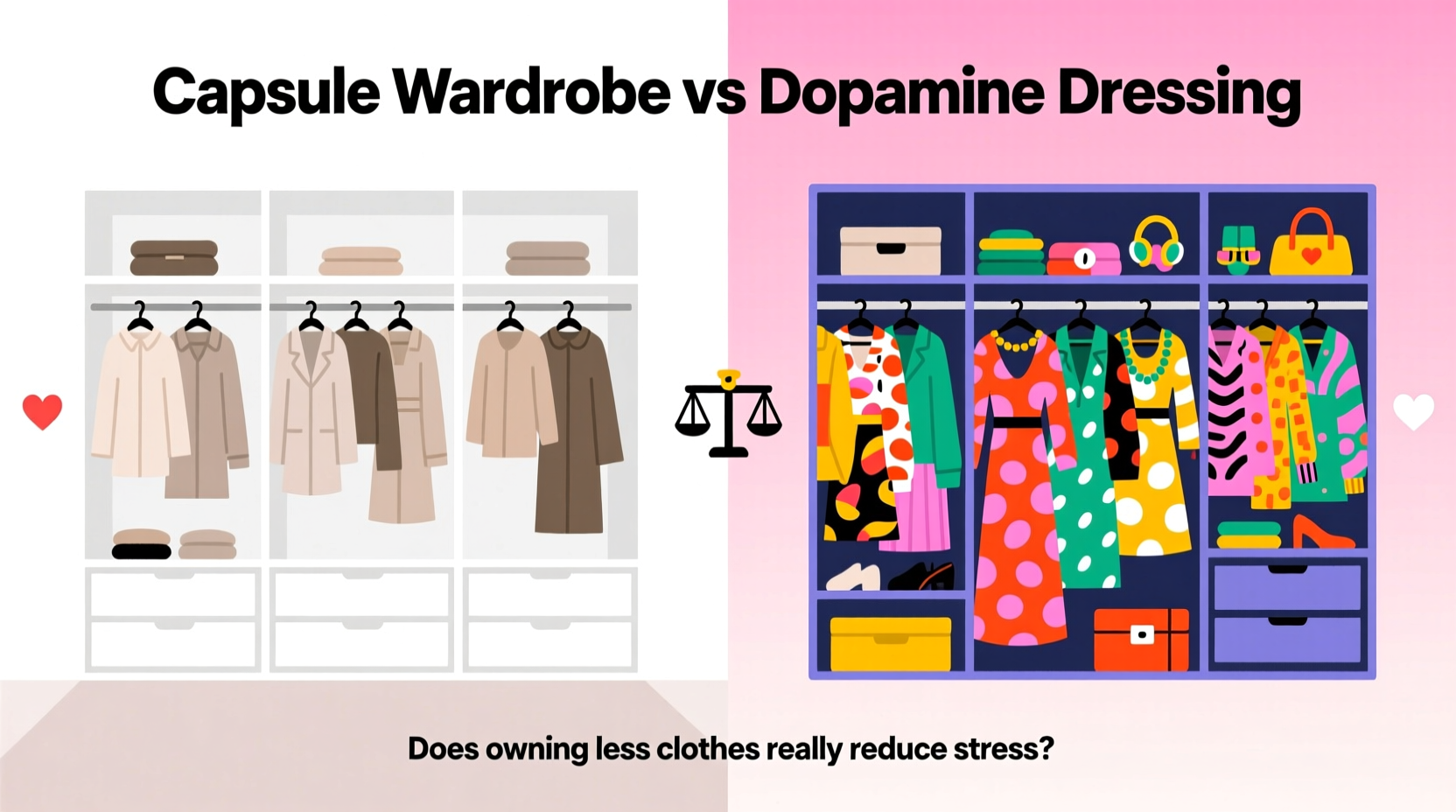
The concept of a capsule wardrobe dates back to the 1970s, popularized by London boutique owner Susie Faux and later refined by designer Donna Karan. It centers on curating a small collection of high-quality, versatile garments—typically 30 to 50 pieces—that can be mixed and matched across seasons. The goal is simplicity: fewer decisions, less clutter, and more intentionality.
For many, this model offers tangible psychological relief. Morning outfit selection—a seemingly minor task—can trigger decision fatigue, especially when faced with an overflowing closet. Behavioral economist Sheena Iyengar’s research shows that too many choices lead to anxiety and reduced satisfaction. A capsule wardrobe reduces cognitive load by eliminating redundant options and streamlining daily routines.
“Reducing choice in areas like clothing frees up mental bandwidth for more meaningful decisions.” — Dr. Barry Schwartz, author of *The Paradox of Choice*
But beyond efficiency, the appeal of minimalism often ties into broader lifestyle goals: sustainability, financial discipline, and mindfulness. By owning fewer clothes, people report feeling more in control—not just of their closets, but of their consumption habits and time.
Dopamine Dressing: Fashion as Emotional Fuel
In contrast to minimalism, dopamine dressing surged during the pandemic, when people sought emotional uplift amid isolation. The idea is simple: wear clothes that spark joy, confidence, or excitement—even if they’re bold, mismatched, or impractical. Think bright red blazers, sequined skirts on a Tuesday, or clashing patterns worn unapologetically.
This trend draws from neuroscience. Wearing something you love activates the brain’s reward system, releasing dopamine—a neurotransmitter linked to pleasure and motivation. Psychologists refer to this as “enclothed cognition,” the phenomenon where what we wear influences how we think and feel.
A 2021 study published in *Clothing and Textiles Research Journal* found that participants who dressed in personally meaningful or colorful attire reported higher mood and self-esteem, even when working remotely. For those struggling with low energy or depression, choosing a vibrant outfit can act as a non-verbal affirmation: *I am here. I matter.*
Yet dopamine dressing is often criticized as impulsive or unsustainable. Critics argue it encourages overconsumption, especially when joy becomes tied to new purchases rather than existing pieces. However, proponents clarify that the philosophy isn’t about buying more—it’s about wearing what brings joy, whether vintage, gifted, or long-ignored.
Comparing the Philosophies: A Practical Breakdown
To understand how each approach impacts stress levels, consider their core principles side by side.
| Aspect | Capsule Wardrobe | Dopamine Dressing |
|---|---|---|
| Mindset | Minimalism, efficiency, restraint | Self-expression, emotion, spontaneity |
| Goal | Reduce decision fatigue, own less | Elevate mood, celebrate individuality |
| Wardrobe Size | 30–50 curated pieces | No set limit; emphasis on variety |
| Color & Style | Neutral base, cohesive palette | Bold colors, eclectic combinations |
| Stress Reduction Mechanism | Fewer choices, less clutter | Emotional uplift, identity affirmation |
| Potential Downsides | Risk of monotony, rigidity | Overwhelm from excess, impulse buys |
Neither approach is inherently superior. The real value lies in understanding which aligns with your current emotional needs and lifestyle demands.
Finding Balance: The Hybrid Approach
What if you don’t have to choose? Increasingly, style experts advocate for a blended model—one that honors both clarity and creativity. Imagine a capsule wardrobe built around your most joyful pieces. Or a flexible core collection that allows room for playful experimentation.
This hybrid method works best when grounded in self-awareness. Ask: What kind of stress am I experiencing? Is it clutter-induced overwhelm? Or emotional flatness? Your answer guides the solution.
Step-by-Step Guide: Build a Joy-Driven Capsule Wardrobe
- Clear your closet: Remove everything. Clean shelves, assess space.
- Identify your “joy” items: Pull out 10–15 pieces you genuinely love wearing. These become anchors.
- Add functional basics: Choose neutral tops, bottoms, and layers that pair well with your favorites.
- Limit quantity: Cap your total at 40 pieces, including shoes and outerwear.
- Rotate seasonally: Swap in 5–7 seasonal items that excite you (e.g., a floral dress in spring).
- Review monthly: Note what you wear, what you ignore. Adjust for comfort and emotion.
This structure preserves the mental ease of minimalism while making space for emotional resonance. You’re not sacrificing self-expression for simplicity—you’re integrating them.
Real-Life Example: Maria’s Wardrobe Transformation
Maria, a 38-year-old project manager, spent years cycling between extremes. Her closet held 80+ items, yet she felt she had “nothing to wear.” Mornings were stressful; she’d often default to black pants and a gray sweater, despite loving color.
After reading about dopamine dressing, she bought a fuchsia blazer. Wearing it to a virtual meeting, she received unexpected compliments and felt unusually confident. Inspired, she tried pairing it with her capsule basics. The result? She started mixing bold pieces with her neutrals and realized she didn’t need to choose between order and joy.
She pared down to 45 pieces, keeping only what fit well and sparked positive emotion. Within weeks, her morning routine shortened by 15 minutes, and her mood improved. “I used to see my closet as a problem,” she said. “Now it feels like a tool for self-care.”
Expert Insight: The Psychology of Clothing Choices
Dr. Karen Pine, professor of psychology and co-author of *Fashion Psychology*, emphasizes that clothing is deeply tied to identity and emotional regulation.
“Clothes are not just fabric—they’re extensions of the self. When people feel constrained by rigid systems, even a minimalist one, it can backfire. The key is autonomy: choosing what to wear because it reflects who you are, not because a trend says so.” — Dr. Karen Pine
Her research shows that individuals who view their wardrobe as a form of self-expression report lower cortisol levels and higher resilience during stressful periods. However, this benefit disappears when fashion feels like a chore or obligation.
The takeaway? Stress reduction doesn’t come from owning fewer clothes alone—it comes from alignment between your wardrobe and your inner state.
Checklist: Assess Your Wardrobe’s Impact on Stress
- ✅ Do I spend more than 10 minutes choosing an outfit most days?
- ✅ Do I avoid certain clothes because they don’t fit, feel uncomfortable, or remind me of a past self?
- ✅ Do I feel guilty when I buy something “impractical” but joyful?
- ✅ Is my closet organized, or does opening it cause dread?
- ✅ Do I wear clothes to please others, or to reflect my mood?
- ✅ Have I donated or sold items in the last 6 months?
- ✅ Do I have at least 5 go-to outfits I feel great in?
If you answered “no” to three or more, your wardrobe may be contributing to stress—regardless of size.
FAQ: Common Questions About Wardrobes and Well-Being
Can a capsule wardrobe include bold or colorful pieces?
Absolutely. A capsule isn’t limited to neutrals. Many successful capsules center around a vibrant theme—like all jewel tones or summer whites. The key is cohesion and versatility, not blandness.
Isn’t dopamine dressing just an excuse to shop more?
It can be, if misunderstood. True dopamine dressing is about wearing what already brings you joy—not chasing novelty. If every “mood boost” requires a purchase, it may reflect emotional spending, not self-expression.
How do I know if I own too many clothes?
A clear sign is underuse. If 70% of your clothes haven’t been worn in the past year, or if getting dressed feels overwhelming, it’s time to reassess. Quantity matters less than relevance.
Conclusion: Own What Serves You—Not the Trend
The debate between capsule wardrobes and dopamine dressing isn’t about right or wrong—it’s about resonance. Owning fewer clothes *can* reduce stress, but only if the process feels liberating, not restrictive. Similarly, wearing joyful clothes *can* boost mood, but not if it leads to clutter or guilt.
The most sustainable, stress-reducing wardrobe is one that reflects who you are *now*—not who you think you should be. It balances function with feeling, simplicity with selfhood. Whether you gravitate toward minimalism, maximalism, or a blend of both, the goal is alignment: between your outer choices and inner truth.




 浙公网安备
33010002000092号
浙公网安备
33010002000092号 浙B2-20120091-4
Comments
No comments yet. Why don't you start the discussion?