
A streamlined approach to dressing begins not with more choices, but fewer. In the modern professional world, where efficiency and consistency matter, a 30-item capsule wardrobe offers a powerful solution. It reduces decision fatigue, eliminates clutter, and ensures you always look polished—without needing an overflowing closet. This guide walks through the principles, steps, and real-world strategies to create a functional, stylish work capsule using just 30 carefully selected pieces.
Why a 30-Item Capsule Wardrobe Works for Professionals
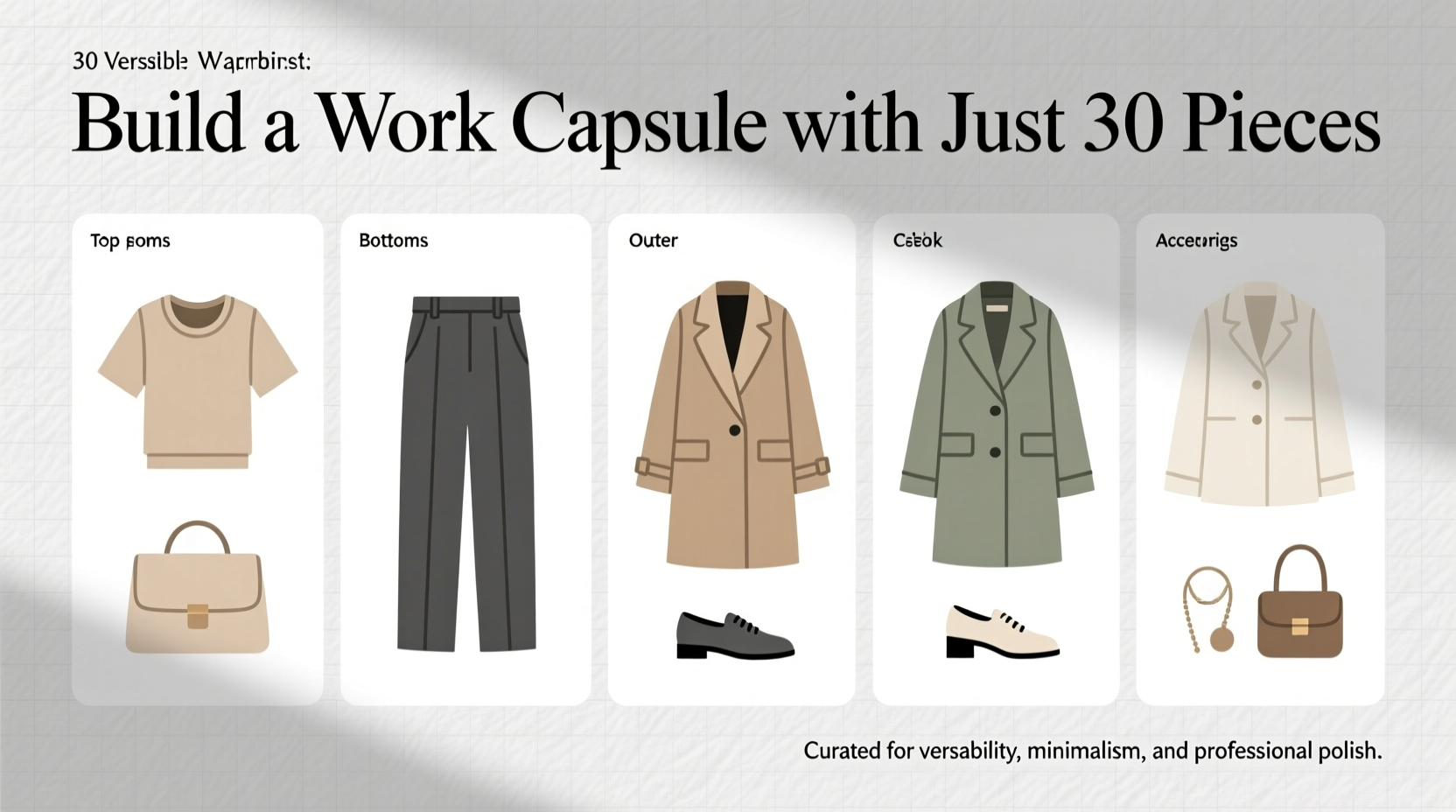
The concept of a capsule wardrobe was popularized in the 1970s by London boutique owner Susie Faux, who described it as a small collection of timeless, interchangeable clothing suitable for all occasions within a season. Today, professionals across industries—from tech to finance to creative fields—are adopting minimalist wardrobes to reduce stress and increase focus.
Limiting your work wardrobe to 30 items forces intentionality. Each piece must earn its place by being versatile, high-quality, and aligned with your personal style and workplace dress code. The result is a curated system that simplifies mornings, reduces laundry load, and supports sustainable fashion practices.
“Minimalism isn’t about having less for the sake of austerity—it’s about making room for what truly adds value.” — Courtney Carver, founder of Project 333
Step-by-Step: Building Your 30-Item Work Capsule
Creating a 30-piece work capsule requires planning, editing, and clarity. Follow this timeline-based process over one week to avoid overwhelm and ensure lasting success.
- Day 1–2: Audit Your Current Wardrobe
Remove everything from your closet. Sort items into categories: tops, bottoms, dresses, outerwear, shoes, and accessories. Try each on. Keep only those that fit well, are in good condition, and align with your work environment. - Day 3: Define Your Style & Dress Code
Determine whether your workplace leans business formal, business casual, or smart casual. Note any recurring patterns in outfits you feel confident wearing. Identify your dominant colors, preferred silhouettes, and go-to combinations. - Day 4: Set Your Core Palette
Choose 3–4 neutral base colors (e.g., navy, charcoal, white, camel) and 1–2 accent tones (burgundy, olive, blush). This creates cohesion and maximizes mix-and-match potential. - Day 5: Select Core Pieces
Pick foundational items first—blazers, trousers, sheath dresses, button-downs—that can be layered and styled multiple ways. - Day 6: Fill Gaps Strategically
Identify missing links: perhaps a black pencil skirt or a lightweight cardigan. Purchase only what’s necessary, prioritizing quality over quantity. - Day 7: Finalize & Organize
Lay out all 30 items. Test at least five full outfits. Store off-season clothes elsewhere. Arrange your closet by category and color for easy access.
What Counts as One Item? Clarifying the Rules
A common point of confusion is determining what constitutes a single item. To maintain consistency, use this standard definition:
- A blouse = 1 item
- A pair of pants = 1 item
- A dress = 1 item
- A blazer = 1 item
- A pair of shoes = 1 item
- A belt or scarf = 1 item (if worn visibly)
This prevents inflation of your count through minor accessories. For example, three scarves count as three separate items. Shoes should be limited to 3–4 pairs maximum to preserve space for clothing essentials.
Sample 30-Item Capsule Wardrobe for Office Wear
The following table outlines a balanced, realistic 30-item breakdown suitable for most office environments. Adjust based on climate, gender expression, and industry norms.
| Category | Items | Quantity |
|---|---|---|
| Tops | Button-down shirts, blouses, knit tops, turtlenecks | 8 |
| Bottoms | Trousers, chinos, pencil skirts, tailored shorts (seasonal) | 5 |
| Dresses | Sheath dresses, shirt dresses, wrap styles | 3 |
| Outerwear | Blazer, trench coat, cardigan, wool coat (seasonal) | 4 |
| Knits & Sweaters | Cashmere pullovers, fine-gauge sweaters | 3 |
| Shoes | Oxfords, loafers, ankle boots, pumps | 4 |
| Accessories | Belt, silk scarf, watch, structured handbag | 3 |
| Total | 30 |
Note: This distribution assumes layering versatility. For instance, a blazer can elevate a blouse and trousers or pair with a dress. A neutral handbag works across all outfits.
Maximizing Outfit Combinations with Minimal Pieces
With only 30 items, maximizing combinations is essential. Aim for at least 15 distinct work-ready outfits from your capsule. Here's how:
- Adopt a uniform base: Use one or two core bottom colors (e.g., navy and gray) that pair with every top.
- Layer strategically: Combine knits with collared shirts or dresses with blazers to create visual variety.
- Rotate accessories: Swap scarves or belts to refresh an outfit without adding new garments.
- Use color blocking intentionally: Introduce an accent color through a top or accessory to shift the mood of an ensemble.
Real Example: Maria’s Transition to a 30-Item Work Capsule
Maria, a 34-year-old project manager at a mid-sized marketing firm, spent years rotating through dozens of clothes, often feeling underdressed despite a full closet. After reading about capsule wardrobes, she decided to try a 30-item version for her hybrid office schedule.
She began by removing everything from her closet and keeping only pieces she’d worn in the past six months. She identified her ideal palette: charcoal, cream, burgundy, and soft blue. Her final capsule included:
- Two pairs of black and gray trousers
- One navy pencil skirt
- Six tops in coordinating solids and subtle prints
- A tailored blazer and a longline cardigan
- Three dresses for client meetings
- Loafers, ankle boots, and ballet flats
- A silk scarf and leather tote
Within two weeks, Maria reported spending 70% less time choosing outfits and receiving multiple compliments on her “put-together” appearance. More importantly, she felt calmer and more focused during her morning routine.
Do’s and Don’ts of Capsule Wardrobe Building
To avoid common pitfalls, refer to the following comparison guide:
| Do’s | Don’ts |
|---|---|
| Choose fabrics that resist wrinkling (wool blends, ponte knit, cotton poplin) | Include trendy pieces that may feel outdated in 6 months |
| Invest in one high-quality coat or blazer | Buy low-cost items just to fill the count |
| Test all combinations before finalizing | Forget seasonal transitions—plan ahead for layering needs |
| Wear each item at least once per month | Hold onto items “just in case” they might be needed |
| Repair or replace worn pieces promptly | Allow the capsule to degrade due to neglect |
Frequently Asked Questions
Can I include jeans in my 30-item work capsule?
Yes—if your workplace allows denim. Opt for dark wash, straight-leg jeans in stretch cotton that can transition from casual Fridays to informal meetings. Count them as one of your five bottom slots.
How do I handle seasonal changes without exceeding 30 items?
Rotate seasonally. Store off-season pieces separately. For example, swap a wool coat and turtleneck in winter for a linen shirt and lightweight jacket in summer. Maintain the 30-item limit year-round by exchanging, not accumulating.
What if I need to attend formal events outside regular work duties?
Keep one formal outfit (e.g., a cocktail dress or suit) outside the capsule if such events are rare. If frequent, integrate a versatile piece—like a black sheath dress—that serves both meeting and evening roles.
Checklist: Launch Your 30-Item Capsule Wardrobe
Follow this concise action plan to get started:
- Empty your closet and sort all clothing
- Keep only items that fit, flatter, and are work-appropriate
- Define your color palette (3 neutrals + 1–2 accents)
- Select 8 tops, 5 bottoms, 3 dresses, 4 outerwear pieces, 3 knits, 4 shoes, 3 accessories
- Ensure every item coordinates with at least 3 others
- Create 5+ complete outfits and photograph them
- Store non-capsule items out of sight
- Review monthly and adjust as needed
Final Thoughts: Less Isn’t Lack—It’s Liberation
A 30-item capsule wardrobe isn’t a restriction—it’s a reclamation of time, energy, and self-expression. By focusing on quality over quantity, coherence over clutter, and function over fleeting trends, you build a wardrobe that works for you, not against you. Professionals who adopt this model often find it extends beyond clothing: clearer closets lead to clearer minds.
The goal isn’t perfection. It’s progress. Start with what you have. Edit ruthlessly. Build slowly. Wear with confidence.




 浙公网安备
33010002000092号
浙公网安备
33010002000092号 浙B2-20120091-4
Comments
No comments yet. Why don't you start the discussion?