
When summer heat rolls in, a malfunctioning car air conditioner can turn your daily commute into an uncomfortable ordeal. While some AC issues require professional repair, many problems stem from simple, fixable causes. Understanding the basics of how your vehicle’s cooling system works—and knowing what to check first—can save time, money, and frustration. This guide walks through the most frequent reasons your car's AC might fail and provides practical steps to diagnose and resolve them.
How Car Air Conditioning Works: A Quick Overview
Your car’s air conditioning system operates on a closed-loop refrigeration cycle. It uses a refrigerant (commonly R-134a or newer R-1234yf) that changes between liquid and gas states to absorb heat from the cabin and release it outside. Key components include the compressor, condenser, evaporator, expansion valve, and accumulator or receiver-drier. When you turn on the AC, the compressor pressurizes the refrigerant, sending it through the system where it cools the air blown into the cabin.
If any part of this system fails or becomes compromised, cooling performance drops—or stops altogether. The good news? Many failures follow predictable patterns and can be identified with basic observation and simple checks.
Common Causes of Car AC Failure
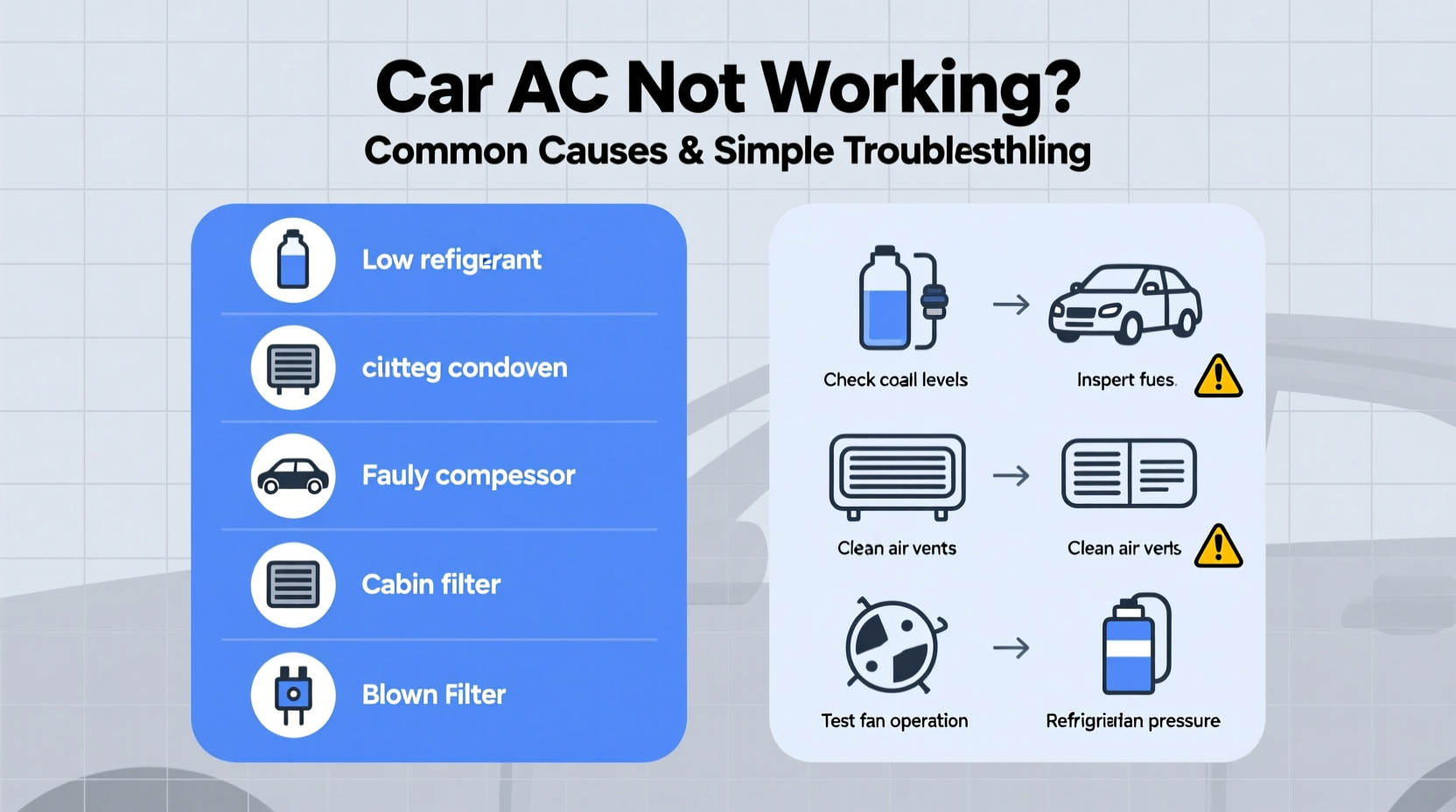
Before reaching for tools or calling a mechanic, consider these frequent culprits behind weak or non-functional AC systems:
- Low refrigerant levels – Often due to leaks over time, leading to poor cooling or no cold air.
- Failed compressor – The heart of the system; if it doesn’t engage, no cooling occurs.
- Clogged or dirty condenser – Located in front of the radiator, it dissipates heat; blockages reduce efficiency.
- Electrical issues – Blown fuses, faulty relays, or wiring problems can disable the compressor.
- Malfunctioning blend door actuator – Controls airflow direction; failure may result in warm air only.
- Blocked cabin air filter – Restricts airflow, reducing cooling effectiveness even if the system is otherwise functional.
“Over 60% of AC complaints we see are due to low refrigerant or electrical faults that could have been caught early with routine inspection.” — Mark Reynolds, ASE-Certified Technician with 18 years of experience
Simple Troubleshooting Steps You Can Do at Home
You don’t need specialized tools to begin diagnosing your car’s AC problem. Follow this step-by-step process to identify likely issues:
- Check if the compressor engages: Start the engine, set the AC to maximum cool, and listen for a click followed by a change in engine idle. Look under the hood—the center pulley of the AC compressor should start spinning. If it doesn’t, the compressor isn’t activating.
- Inspect the fuse and relay: Locate your vehicle’s main fuse box (usually near the battery or inside the cabin). Refer to the owner’s manual to find the AC fuse and relay. Visually inspect the fuse for breaks; swap the relay with a similar one (like the horn relay) to test functionality.
- Feel the hoses under the hood: With the AC running, carefully touch the two large AC lines near the firewall—one should be cold, the other hot. If both are warm, refrigerant isn’t circulating properly.
- Examine airflow from vents: Is air blowing weakly? Replace the cabin air filter, typically located behind the glovebox or under the dashboard.
- Look for debris on the condenser: Shine a flashlight through the grille in front of the radiator. Leaves, bugs, or road grime can insulate the condenser, preventing heat release.
Troubleshooting Checklist
Use this checklist to methodically evaluate your AC system:
- ☐ Compressor clutch engages when AC is turned on
- ☐ AC fuse is intact and securely seated
- ☐ Relay clicks and functions (swap test performed)
- ☐ Cold and hot AC lines present after 2 minutes of operation
- ☐ Cabin air filter replaced within the last 12 months
- ☐ Condenser fins are clean and unobstructed
- ☐ No visible oil stains or residue near AC lines (sign of leak)
- ☐ Refrigerant level appears adequate (if equipped with sight glass)
When to Recharge Refrigerant (And When Not To)
Refrigerant doesn’t get “used up” under normal conditions. If levels are low, there’s likely a leak. While DIY recharge kits are widely available, they should only be used as a temporary measure—if at all.
| Scenario | Recommended Action |
|---|---|
| AC blows cool but not cold, system was recharged recently | Investigate for small leaks; avoid repeated top-offs |
| No cold air, compressor runs, no visible damage | Professional pressure test recommended before recharge |
| Oil residue around fittings or hoses | Do not recharge—leak must be repaired first |
| New car or known full system | No recharge needed unless performance declines |
Adding refrigerant without fixing a leak wastes money and harms the environment. Modern refrigerants are greenhouse gases, and venting them is illegal in many regions.
Real-World Example: Sarah’s Summer Breakdown
Sarah noticed her 2015 Honda Civic wasn’t cooling as well in mid-July. At first, the air was just slightly warm, but within days, no cold air came out. She checked online and tried a refrigerant kit from a local auto store. It worked—for three days. Then performance dropped again.
She took it to a local shop, where a technician found a slow leak at the compressor seal and a failing clutch bearing. Because she had added refrigerant without addressing the root cause, the system continued to degrade. Repair cost: $480. Had she sought diagnosis earlier, a simple seal replacement might have sufficed for under $150.
Sarah’s case highlights a common mistake: treating symptoms instead of causes. Simple observation—like noting when the compressor stopped engaging—could have led to earlier intervention.
Frequently Asked Questions
Why does my AC work fine at highway speeds but blow warm air in traffic?
This often indicates poor airflow through the condenser. Check if the cooling fan behind the radiator activates when the AC is on. A failed fan motor or relay will reduce heat dissipation during idle, causing warm air output.
Can a clogged cabin air filter stop my AC from cooling?
While a dirty filter won’t stop refrigerant circulation, it severely restricts airflow. Reduced airflow means less contact between air and the cold evaporator core, resulting in diminished cooling. Replace filters every 12 months or 15,000 miles.
Is it safe to drive with a broken AC compressor?
If the compressor has seized but the belt still drives other accessories, it may be unsafe. A seized compressor can cause the serpentine belt to overheat, slip, or break—potentially disabling power steering or alternator function. Have it inspected promptly.
Preventive Maintenance Tips
Regular care extends the life of your AC system and maintains efficiency:
- Run the AC for at least 10 minutes weekly, even in winter, to keep seals lubricated.
- Use the “recirculate” mode in heavy traffic to reduce humidity load.
- Replace the cabin air filter on schedule.
- Listen for unusual noises (grinding, squealing) when the AC turns on.
- Address weak cooling immediately—don’t wait for total failure.
Conclusion: Act Early, Save Time and Money
A non-working car AC doesn’t always mean a major repair. Often, the issue lies in something as simple as a blown fuse, a clogged filter, or a tripped relay—all easily checked and corrected. By understanding the system and performing regular inspections, you can maintain reliable cooling and avoid expensive breakdowns.




 浙公网安备
33010002000092号
浙公网安备
33010002000092号 浙B2-20120091-4
Comments
No comments yet. Why don't you start the discussion?