
Seeing the check engine light illuminate on your dashboard can be unsettling. Whether it’s glowing steadily or flashing like a warning beacon, this small indicator carries significant implications for your vehicle’s health and your safety. Many drivers react with confusion—should they pull over immediately? Can they make it home? Is it safe to keep driving?
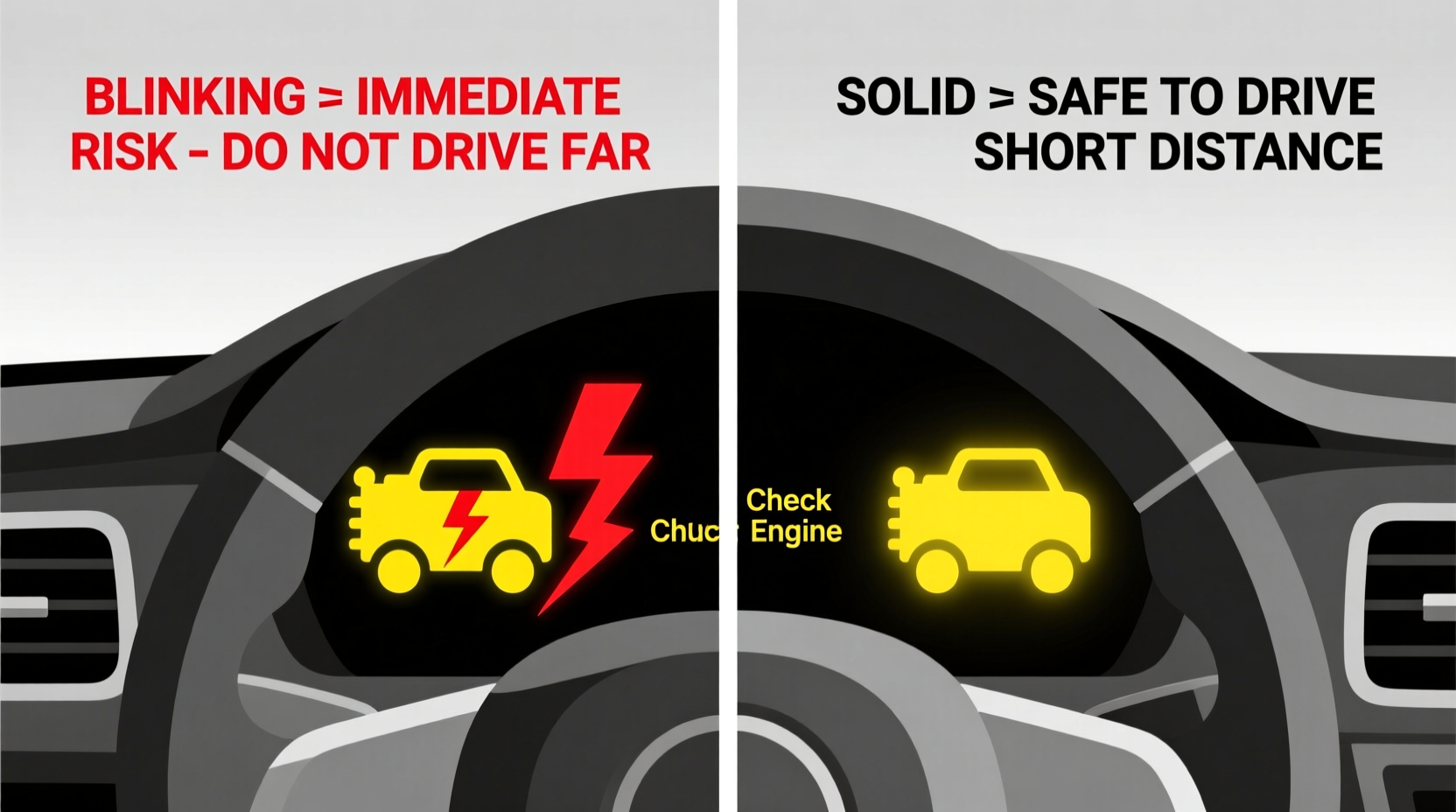
The answer depends largely on one critical detail: whether the light is blinking or solid. Understanding the difference between these two states isn’t just about avoiding costly repairs—it’s about preventing breakdowns, protecting your engine, and ensuring you don’t put yourself in danger on the road.
What the Check Engine Light Actually Means
The check engine light (CEL) is part of your car’s onboard diagnostics system (OBD-II), which monitors hundreds of sensors throughout the engine, transmission, emissions, and fuel systems. When the system detects a malfunction that could affect performance or emissions, it triggers the CEL and stores a diagnostic trouble code (DTC).
These codes range from minor issues—like a loose gas cap—to major mechanical failures such as misfiring cylinders or failing catalytic converters. The way the light behaves—steady or blinking—is the vehicle’s way of communicating urgency.
“Think of the check engine light as your car’s voice. A steady glow is a whisper; a blinking light is a scream.” — Mark Reynolds, ASE-Certified Master Technician
Blinking vs Solid: Key Differences in Severity
The behavior of the check engine light is designed to convey risk level:
- Steady (Solid) Light: Indicates a non-emergency issue. The problem exists but isn't causing immediate harm to the engine. You should still have the vehicle inspected, but continued driving for a short distance (e.g., to a repair shop) is generally safe.
- Blinking (Flashing) Light: Signals an active, severe problem—typically a cylinder misfire that’s dumping unburned fuel into the exhaust system. This can rapidly overheat and destroy the catalytic converter, a costly component. Immediate action is required.
A blinking check engine light often occurs during acceleration or under load and may stop when the engine idles. However, even if the blinking stops, the underlying issue remains dangerous and requires prompt attention.
Is It Safe to Drive With a Solid Check Engine Light?
In most cases, yes—but with caution. A solid light doesn’t mean “ignore it,” but rather “address it soon.” Common causes include:
- Loose or faulty gas cap
- Oxygen sensor failure
- Faulty mass airflow sensor
- Minor spark plug or coil issues
- Evaporative emission control leaks
If your car runs normally—no strange noises, vibrations, or loss of power—you can likely drive a short distance to reach a mechanic. However, delaying service can lead to reduced fuel economy, increased emissions, and eventual damage to other components.
Driving Tips with a Solid CEL
- Avoid aggressive acceleration or towing heavy loads.
- Keep speeds moderate and avoid highway driving if the vehicle feels sluggish.
- Check for obvious issues like a missing or loose gas cap and tighten it securely.
- Use an OBD-II scanner (available at auto parts stores) to read the code if possible.
Why a Blinking Check Engine Light Requires Immediate Action
A blinking check engine light is one of the clearest warnings your car can give. It almost always indicates a severe engine misfire, where one or more cylinders are not combusting fuel properly. Unburned fuel exits the combustion chamber and enters the exhaust system, where it ignites inside the hot catalytic converter.
This causes extreme heat buildup—sometimes exceeding 2,000°F—which can melt internal components of the catalytic converter. Replacing a damaged converter can cost anywhere from $900 to $2,500 depending on the vehicle.
Common Causes of a Flashing CEL
- Failed ignition coil or spark plug
- Severe vacuum leak
- Fuel injector malfunction
- Internal engine problems (e.g., low compression)
- Timing issues or sensor failures affecting ignition timing
While the engine may continue running, it will likely feel rough, vibrate excessively, or hesitate during acceleration. Continuing to drive under these conditions risks permanent engine or exhaust damage.
Step-by-Step Guide: What to Do When the Light Comes On
Reacting correctly can save you time, money, and potential danger. Follow this timeline-based response plan:
- Stay Calm: Don’t panic. Assess how the car is performing. Is it running smoothly? Any noise or vibration?
- Determine the Light Type: Is it solid or blinking? This decision point dictates your next move.
- If Blinking:
- Reduce speed gradually.
- Find a safe place to pull over within 1–2 miles.
- Turn off the engine.
- Call for towing or roadside assistance.
- If Solid:
- Check for simple fixes (e.g., gas cap).
- Continue driving cautiously to the nearest repair facility.
- Monitor for changes in performance.
- Get a Diagnostic Scan: Visit an auto parts store or mechanic to retrieve the trouble code(s). Many offer free scans.
- Schedule Repairs: Even if the issue seems minor, unresolved problems can escalate.
Do’s and Don’ts When the Check Engine Light Activates
| Do’s | Don’ts |
|---|---|
| Check if the gas cap is tight | Ignore a blinking light |
| Drive gently to reduce strain | Accelerate hard or tow heavy loads |
| Use an OBD-II scanner to read codes | Assume the problem will fix itself |
| Pull over safely if blinking or symptoms worsen | Continue driving with severe engine shaking |
| Seek professional diagnosis promptly | Delay repairs beyond a few days |
Real-World Example: A Driver’s Close Call
Consider Sarah, a 34-year-old teacher commuting home after work. Her check engine light began flashing during her drive. She felt a rhythmic shudder in the steering wheel and noticed reduced acceleration. Instead of pushing through, she remembered reading about blinking lights being serious.
She exited the highway at the next ramp, pulled into a parking lot, and turned off the engine. She called her local mechanic, who advised against driving the car. A diagnostic revealed a failed ignition coil causing a persistent misfire. The catalytic converter was already showing signs of overheating but hadn’t failed yet.
By stopping early, Sarah avoided a $2,000 repair bill and potential roadside breakdown. Her quick decision saved both money and stress.
How Mechanics Diagnose Check Engine Light Issues
Professional mechanics use advanced OBD-II scanners to retrieve stored trouble codes. But reading the code is only the first step. Interpreting it correctly requires expertise.
For example, a P0300 code indicates a random/multiple cylinder misfire. While this might point to spark plugs, further investigation could reveal:
- Worn ignition coils
- Fouled spark plugs
- Clogged fuel injectors
- Vacuum leaks
- Low fuel pressure
A skilled technician will perform additional tests—such as a cylinder balance test, fuel pressure check, or smoke test for leaks—to pinpoint the root cause. This prevents unnecessary part replacements and ensures lasting repairs.
“Just replacing parts based on a code without testing is like guessing in the dark. Proper diagnosis saves customers hundreds.” — Luis Mendez, Lead Diagnostician at Metro Auto Care
FAQ: Common Questions About the Check Engine Light
Can I reset the check engine light myself?
You can temporarily clear the light using an OBD-II scanner or by disconnecting the battery, but this doesn’t fix the underlying issue. The light will likely return once the car completes its self-checks. Resetting without repair is not recommended and may mask serious problems.
Will the check engine light go off by itself?
Yes, sometimes. If the issue was temporary—like a loose gas cap that you tightened—the system may retest over several drive cycles and turn the light off automatically. However, if the problem persists, the light will stay on or return.
How long can I drive with a solid check engine light?
There’s no universal answer. Some issues allow safe driving for weeks; others degrade quickly. As a rule, get the vehicle checked within 50–100 miles. Delaying increases the risk of secondary damage, especially to oxygen sensors or the catalytic converter.
Checklist: Immediate Actions Based on Light Behavior
- Observe: Is the light blinking or solid?
- Assess: Any change in engine performance (shaking, stalling, noise)?
- If blinking: Pull over within 1–2 miles. Do not continue driving.
- If solid: Drive cautiously to a repair shop. Avoid high speeds and heavy loads.
- Scan: Get a free code read at an auto parts store if available.
- Repair: Schedule a professional inspection—even if the car seems fine.
- Prevent: Maintain regular service intervals to catch issues early.
Conclusion: Prioritize Safety Over Convenience
The check engine light is not something to dismiss or delay indefinitely. A solid light demands timely attention; a blinking light demands immediate action. Understanding the difference empowers you to make informed decisions that protect your vehicle, your wallet, and your safety.
Modern cars are complex machines, and their warning systems exist for good reason. Responding appropriately to the check engine light—especially recognizing the red flag of a blinking indicator—can prevent catastrophic failures and expensive repairs. Don’t gamble with engine health for the sake of convenience.




 浙公网安备
33010002000092号
浙公网安备
33010002000092号 浙B2-20120091-4
Comments
No comments yet. Why don't you start the discussion?