
In the digital age, where games are just a tap away, two classics stand out for their enduring appeal: chess and Snake. One originated centuries ago as a strategic war simulation; the other emerged in the 1990s on early mobile phones as a simple reflex-based challenge. While they differ vastly in mechanics and complexity, both have been played by millions—and both claim to sharpen the mind. But when it comes to actual cognitive benefits, which game truly wins?
The answer isn’t straightforward. Chess demands foresight, planning, and deep concentration. Snake relies on reaction time, spatial awareness, and hand-eye coordination. Each engages different parts of the brain. Understanding how they affect cognition—memory, problem-solving, attention, and decision-making—can help determine which offers more substantial long-term mental benefits.
Cognitive Skills Developed by Chess
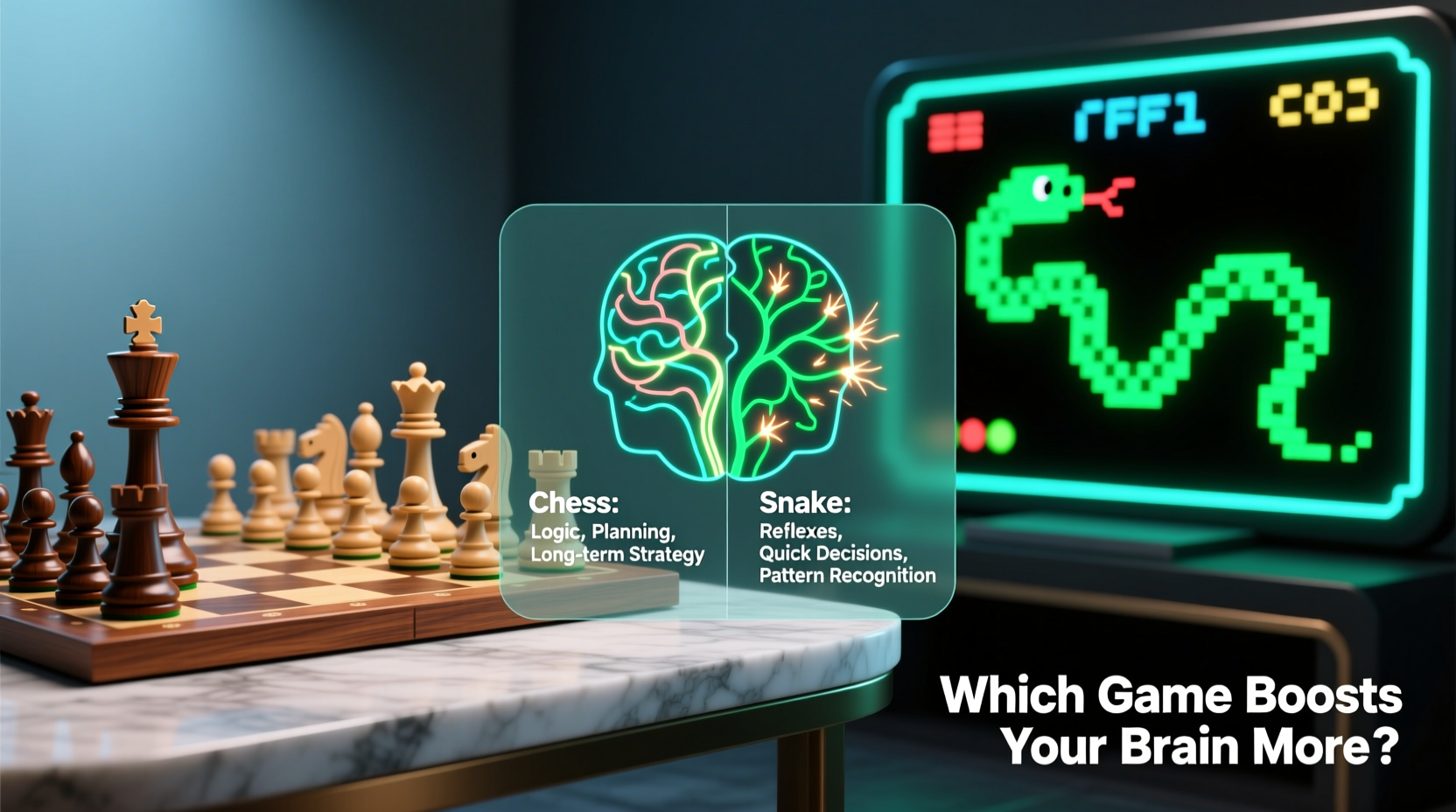
Chess is often hailed as the ultimate brain sport. It’s not just a game of kings and queens—it’s a complex system requiring players to anticipate moves, evaluate positions, and adapt strategies in real time. Research consistently shows that regular chess play strengthens several high-level cognitive functions.
- Strategic Planning: Players must think multiple moves ahead, considering not only their own plans but also possible counter-moves from opponents.
- Working Memory: Holding sequences of potential moves in mind improves short-term memory capacity.
- Pattern Recognition: Experienced players recognize common tactical motifs (like forks or pins) almost instantly, a skill linked to expertise in many domains.
- Decision-Making Under Pressure: Time-limited games force rapid yet accurate evaluations, mimicking real-world decision environments.
“Chess activates regions associated with executive function, long-term planning, and abstract reasoning—skills crucial beyond the board.” — Dr. Sarah Langston, Cognitive Neuroscientist, University of Edinburgh
Mental Benefits of Playing Snake
At first glance, Snake might seem like a simplistic arcade-style game: guide a growing line around a screen without hitting walls or yourself. Yet beneath its minimalism lies a powerful tool for enhancing certain brain functions.
Snake primarily trains the brain’s ability to process visual stimuli quickly and react with precision. Unlike chess, it doesn’t involve strategy or prediction, but it excels at improving:
- Reaction Time: The fast pace requires immediate responses, strengthening neural pathways involved in motor control.
- Hand-Eye Coordination: Precise directional inputs under pressure enhance sensorimotor integration.
- Spatial Awareness: Players must constantly track the snake’s position relative to obstacles and food, improving mental mapping skills.
- Focus and Attention Span: A single lapse leads to failure, encouraging sustained attention during gameplay.
While Snake lacks the depth of chess in terms of intellectual complexity, it serves as an excellent micro-workout for the brain’s attentional systems. Think of it as mental sprinting versus chess’s marathon of thought.
Comparative Analysis: Chess vs Snake
| Skill Area | Chess Benefit | Snake Benefit |
|---|---|---|
| Memory | High – develops working and long-term memory through pattern retention | Low – limited memory load; mostly procedural |
| Problem-Solving | Very High – involves multi-step logic and contingency planning | Minimal – reactive rather than analytical |
| Attention & Focus | High – requires sustained concentration over extended periods | High – demands constant vigilance and quick shifts in focus |
| Reaction Speed | Low – turn-based; no time-critical input needed | Very High – success depends on split-second decisions |
| Creativity & Strategy | High – encourages innovative tactics and adaptive thinking | Negligible – no strategic depth or creative options |
| Learning Curve | Steep – mastery takes years of study and practice | Shallow – easy to learn, hard to master due to speed limits |
This comparison reveals a clear distinction: chess builds higher-order thinking skills, while Snake sharpens lower-level perceptual and motor abilities. Neither is inherently “better”—but if the goal is overall brain development, chess holds a significant edge.
A Real-World Example: The Student Who Played Both
Consider the case of Leo Tan, a 17-year-old high school student from Singapore who began playing chess competitively at age 12. He also regularly played Snake during breaks between classes. Over three years, his academic performance improved significantly, particularly in math and logic-based subjects. His teachers noted enhanced problem-solving skills and better classroom engagement.
When asked about his habits, Leo said, “I used Snake to wake up my brain during short breaks—it helped me refocus. But chess changed how I think. I started seeing problems in layers, like moves on a board.”
His experience reflects broader findings: casual games like Snake can serve as effective cognitive resets, while structured games like chess foster lasting intellectual growth.
How to Maximize Brain Benefits from Either Game
Whether you lean toward chess or Snake, intentional play matters more than frequency. Passive gaming yields minimal gains. To extract real cognitive value, follow this checklist:
📋 **Cognitive Enhancement Checklist**- Set specific goals (e.g., “Solve one chess puzzle daily”)
- Limited session times to prevent mental fatigue
- Track progress (win rates, fastest completion times, fewer mistakes)
- Reflect after each game: What went well? What could be improved?
- Vary difficulty levels to stay challenged
Step-by-Step Guide to Building a Brain-Training Routine
- Choose Your Primary Game: Pick based on your current needs—strategy (chess) or focus/reflexes (Snake).
- Allocate Time: Dedicate 15–20 minutes per day, ideally at consistent times (morning or post-study).
- Start Simple: Beginners should focus on fundamentals before advancing.
- Incorporate Variety: Alternate days or use Snake as a warm-up before chess sessions.
- Review and Adjust Monthly: Assess improvements in attention, memory, or mood and adjust accordingly.
Frequently Asked Questions
Can playing Snake really improve brain function?
Yes, but within limits. Snake enhances reaction time, visual tracking, and moment-to-moment focus. These are valuable skills, especially for tasks requiring alertness. However, it does not develop reasoning or long-term planning abilities like chess does.
Do I need to be good at chess to benefit my brain?
No. Even novice players gain cognitive advantages simply by engaging in deliberate thinking and pattern recognition. The act of learning and practicing—not mastery—is what stimulates neural growth.
Is one game better for children than adults?
Chess tends to benefit older children (10+) more due to its complexity. Younger kids may find Snake more accessible and enjoyable, making it a useful introduction to game-based cognitive training. For adults, both offer distinct perks depending on lifestyle and mental fitness goals.
Conclusion: Choose Based on Your Cognitive Goals
When comparing chess and Snake in terms of brain health, the verdict leans decisively toward chess for comprehensive mental development. Its impact on memory, logic, creativity, and emotional regulation is supported by decades of research. That said, Snake has its place—as a tool for boosting alertness, refining reflexes, and providing a quick mental reset during busy days.
The smartest approach isn’t choosing one over the other, but integrating both strategically. Use Snake for short bursts of focus and motor training. Invest in chess for deeper intellectual growth. Together, they form a balanced regimen for a sharper, more agile mind.
🚀 Ready to upgrade your brain training? Start today: play one game of chess with full concentration, then try beating your best Snake score. Track your progress weekly and notice the subtle shifts in clarity, patience, and precision—in games and in life.




 浙公网安备
33010002000092号
浙公网安备
33010002000092号 浙B2-20120091-4
Comments
No comments yet. Why don't you start the discussion?