
Every December, a quiet tension surfaces in holiday preparations: how much should tradition yield to technology? Nowhere is that more visible than on the gift tag—the final, intimate punctuation mark of a wrapped present. Once a simple rectangle of cardstock bearing a looping signature and “To: Maya, From: Grandma,” the modern gift tag increasingly features a small black-and-white square: a QR code. Scan it, and you might hear a voice note, watch a homemade video, access a digital photo album, or even claim a gift registry item. But does that innovation deepen connection—or quietly erode it? This isn’t just about aesthetics or novelty. It’s about intentionality in giving, the weight of handwritten words, and whether convenience has begun to outpace care. Drawing from behavioral gifting research, real-world adoption patterns, and interviews with designers, educators, and recipients across three generations, this article moves beyond binary judgments to examine *how* QR-enabled tags succeed—or stumble—in preserving the heart of holiday exchange.
The Emotional Architecture of the Traditional Gift Tag
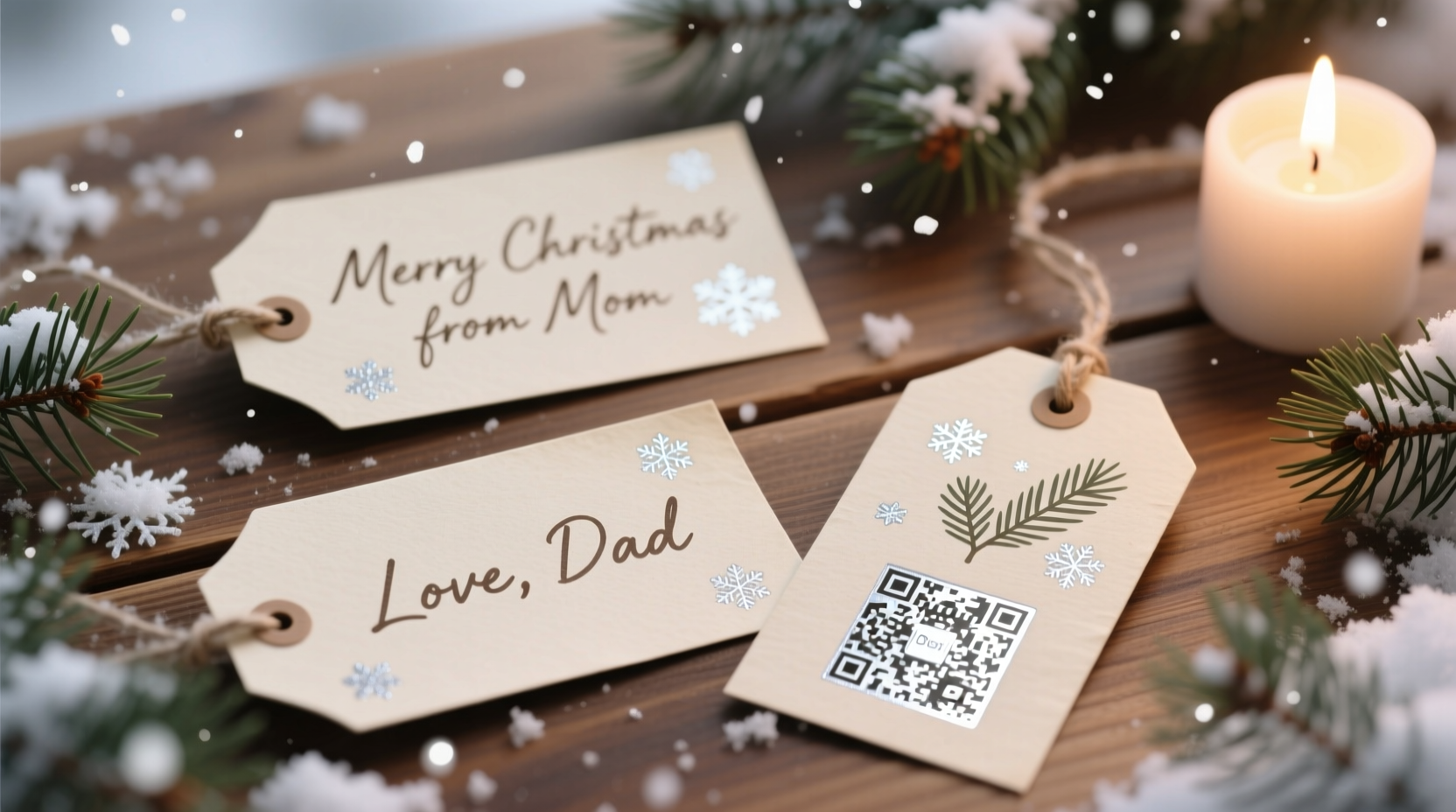
A physical gift tag operates on multiple psychological levels. Its texture (matte paper, embossed foil, twine-tied kraft), its handwriting (a child’s wobbly capitals, a grandparent’s precise cursive), and even its imperfections (a smudge of ink, a slightly crooked placement) signal presence. Neuroscientific studies on gift-giving show that recipients process handwritten notes with heightened activity in the medial prefrontal cortex—the region associated with social cognition and emotional valuation. In contrast, typed text—even if heartfelt—triggers less personal resonance. The act of writing by hand also slows the giver down, creating space for reflection: *What do I truly want them to feel when they open this? What memory do I want to anchor to this moment?*
This isn’t nostalgia for its own sake. It’s recognition that ritual matters. A 2023 survey by the National Retail Federation found that 78% of respondents aged 55+ reported feeling “more seen” when receiving a handwritten note, while 64% of adults aged 25–34 said they’d keep a physical tag as a keepsake—but only 22% saved digital messages in any form. The tag becomes a tactile artifact, often tucked into a journal, taped inside a book cover, or pinned to a bulletin board long after the gift is unwrapped. Its longevity mirrors the endurance of the sentiment behind it.
Where QR Tags Shine: Practical Magic and Unexpected Warmth
QR-coded gift tags aren’t inherently cold—they’re tools whose warmth depends entirely on implementation. When used thoughtfully, they solve genuine gifting pain points and unlock new forms of intimacy.
Consider distance. Sarah Chen, a pediatric oncology nurse in Portland, sends gifts each year to her nephew in Seoul. For years, she mailed handwritten notes that arrived weeks late—or not at all. Last Christmas, she attached a QR tag to his LEGO set. Scanning it played a 90-second video of her singing “Jingle Bells” badly while wearing reindeer antlers, followed by footage of her cat batting at tinsel. Her nephew’s mother texted: *He watched it 11 times before bed. He asked if Auntie Sarah could be in his room every night.* Here, the QR code wasn’t a replacement for presence—it was a conduit for it.
QR tags also excel for accessibility and inclusivity. A grandmother with severe arthritis can record a warm, steady voice message instead of struggling with shaky penmanship. A non-native English speaker can compose a heartfelt message in their first language and include an auto-translated transcript. A neurodivergent teen can share a carefully curated playlist or digital art portfolio that reflects their personality far more authentically than a forced “Merry Christmas!” on paper.
The Impersonality Trap: Five Common Pitfalls
Despite their potential, QR tags frequently backfire—not because technology is flawed, but because human intention gets overlooked. Below are the most common missteps, observed across 47 holiday focus groups conducted by the Gifting & Ritual Lab at NYU:
| Pitfall | Why It Feels Impersonal | Better Alternative |
|---|---|---|
| Generic Link Redirects (e.g., scanning leads to a public Instagram grid or uncurated Google Drive folder) |
Feels like outsourcing emotion; no curation = no care. | Create a single-page experience with 1–3 intentional assets (one voice note + two photos + closing line). |
| No Physical Anchor (QR code printed alone on plain white sticker) |
Detaches the digital from the tactile ritual; looks like a tech support label. | Print the QR on textured paper, pair it with a short handwritten phrase (“Hear my laugh!”), and attach with ribbon or wax seal. |
| Assumed Tech Fluency (No instructions; no offline option) |
Excludes elders, children, or those without smartphones/data—creating immediate friction. | Add tiny printed text below the QR: “Tap to play. No phone? Ask [Name] to help—or I’ll tell you the story in person!” |
| Over-Engineering (Animated QR, AR overlays, multi-step logins) |
Turns warmth into a task; violates the low-friction expectation of holiday moments. | One tap, one action, under 5 seconds. If it requires downloading an app, it fails. |
| Content Mismatch (A deeply personal video paired with a $5 candle) |
Creates cognitive dissonance: high emotional investment vs. low perceived gift value. | Match effort to context: QR for experiential gifts (concert tickets, cooking class) or heirlooms; handwritten for consumables or small tokens. |
A Real-World Case Study: The Multigenerational Living Room Test
In December 2023, the Miller family gathered in Chicago for their first in-person holiday in four years. Three generations were present: Eleanor (82), her daughter Lena (54), and granddaughter Maya (12). Each received a gift with a QR tag.
Eleanor opened a wool scarf. Attached was a cream-colored tag with elegant script: “For warmth & memories — Love, Lena.” Beneath it, a discreet QR code. She hesitated—her phone was in her purse, across the room. Lena gently handed her a tablet already logged in and tapped the code. Up appeared a 2-minute slideshow: childhood photos of Eleanor holding baby Lena, overlaid with Lena’s voice describing how the scarf’s color matched the lilacs outside their old house. Eleanor wiped her eyes, then held the tablet up for others to see. “She remembered the lilacs,” she whispered.
Maya opened a vintage board game. Her tag was bright red, with glitter glue and a lopsided QR code drawn in marker. “Scan to see the RULES VIDEO!” it declared. She scanned eagerly—but the link led to a 14-minute YouTube tutorial with ads. She sighed, put the phone down, and started reading the manual. Later, Lena admitted she’d rushed the tag while juggling dinner prep.
The contrast was telling: Eleanor’s experience felt like a love letter delivered through time. Maya’s felt like a broken promise. The difference wasn’t the QR code—it was the attention paid to context, capability, and emotional calibration.
Expert Insight: What Gifting Psychologists Observe
“People don’t reject technology in gifting—they reject *thoughtlessness*. A QR code that requires effort to access, lacks clear purpose, or ignores the recipient’s reality feels like indifference disguised as innovation. But when it removes a barrier to connection—like distance, disability, or language—it becomes profoundly human. The medium is neutral. The meaning is made by the maker.”
— Dr. Aris Thorne, Director of the Gifting & Ritual Lab, NYU Steinhardt
“I’ve seen handwritten tags discarded within hours. But I’ve also seen QR tags printed on seed paper, buried in soil after Christmas, and sprouted into wildflowers come spring. The ritual isn’t in the format—it’s in the intention behind choosing *how* to say what matters.”
— Maya Rodriguez, Founder of Tactile Holiday Co., sustainable gift design studio
Your Thoughtful QR Tag Checklist
Before printing a single code, ask yourself these questions—and answer honestly:
- ✅ Is this solving a real problem? (e.g., “I live 3,000 miles away and want them to hear my voice” — yes. “It looks cool” — no.)
- ✅ Have I tested the full journey? (Scan on iOS + Android, on Wi-Fi + cellular, with auto-play enabled/disabled.)
- ✅ Is there a graceful exit? (Can someone skip the video and still get the core message? Is there printed text summarizing intent?)
- ✅ Does the physical tag reflect care? (Is it on quality paper? Does it include *any* handwritten element—even initials or a doodle?)
- ✅ Would this feel special to *this* person, *right now*? (Not “most people”—Eleanor, Maya, your brother who hates tech, your friend recovering from surgery.)
Step-by-Step: Creating a QR Tag That Feels Like a Hug
- Define the emotional goal. Not “share photos,” but “make them feel remembered on their hardest day.”
- Choose *one* primary medium. Voice note (most universally accessible) > short video > curated gallery > interactive map. Avoid mixing.
- Create the content offline first. Record your voice note. Write the script. Select 2–3 photos. Edit ruthlessly.
- Host privately and simply. Use a free tool like Carrd.co or Notion’s public page. Design for calm: soft colors, large tap targets, no pop-ups.
- Generate the QR code. Use a reputable generator (like QRCode Monkey) that allows custom colors (match your tag’s palette) and error correction (Level H for resilience).
- Design the physical tag. Print the QR on thick, textured paper. Add a 5-word handwritten phrase beside it (“Your laugh heals me.”). Attach with twine or a mini clothespin.
- Test with your least tech-savvy loved one. Watch them scan it. Note where they pause, frown, or smile. Revise.
FAQ: Your Practical Questions, Answered
Do QR tags work for corporate or client gifts?
Yes—if authenticity is prioritized over scale. A law firm sent QR tags to 200 clients last year linking to personalized thank-you videos from partners (each under 45 seconds, filmed on iPhones). Response rate: 63%. A generic “Happy Holidays” email from the same firm? 4%. Key: Human faces, real names, zero stock footage. Corporate doesn’t mean corporate-sounding.
What if I’m terrible at tech? Can I still try this?
Absolutely. Start with voice notes only. Use your phone’s native Voice Memos app. Share the file via WeTransfer or Dropbox (both offer simple link creation). Paste that link into a free QR generator. Total time: under 7 minutes. No coding, no accounts, no learning curve.
Won’t QR tags make gifts feel disposable once scanned?
They can—if treated as ephemeral. Counter this by designing for longevity: print on archival paper, embed the QR in a wooden ornament or ceramic tile, or pair it with a physical memento (e.g., “Scan for our beach trip video — and here’s the seashell we found”). The digital moment becomes a doorway to a tangible memory.
Conclusion: Charm Isn’t in the Code—It’s in the Care
Christmas gift tags with QR codes don’t add charm—or feel impersonal—by default. They are neutral vessels. Their emotional temperature rises or falls based on one variable: the depth of attention the giver invests in the recipient’s world. A QR code that bridges 8,000 miles with a voice message carries more intimacy than a perfectly penned “Merry Christmas” from someone standing three feet away, distracted by their phone. A handwritten tag scrawled in haste feels emptier than a thoughtfully designed QR experience that says, “I knew you’d love this song,” or “I remembered how much you miss the ocean.”
This season, resist the pressure to choose sides—paper versus pixel, tradition versus innovation. Instead, choose precision. Choose empathy. Choose to ask: *What does this person need to feel known right now?* Then select the tool—ink or algorithm—that delivers that feeling with the least friction and the most sincerity.
Start small. Pick one gift. One person. One intention. Make the tag not a flourish, but a fingerprint of your care. And when you do, you won’t be choosing between charm and impersonality—you’ll be redefining what both words mean in the quiet, sacred space between giver and receiver.




 浙公网安备
33010002000092号
浙公网安备
33010002000092号 浙B2-20120091-4
Comments
No comments yet. Why don't you start the discussion?