
As the holiday season approaches, many homeowners and decorators turn to string lights not just for illumination, but as a centerpiece of festive ambiance. While brightness and color selection are often prioritized, one subtle yet powerful factor determines whether your display feels calming or chaotic: animation speed. The rhythm at which lights transition—whether through a gentle slow fade or an energetic rapid chase—can profoundly influence emotional tone. Understanding how to control this element allows you to craft lighting that enhances mood without becoming a visual distraction.
This guide explores the technical and psychological aspects of Christmas light animation speeds, comparing slow fade and rapid chase effects in real-world applications. You’ll learn how to adjust these settings on common controllers, evaluate which style suits different environments, and apply expert-backed principles to create displays that feel intentional, soothing, and harmonious with their surroundings.
The Psychology of Light Motion
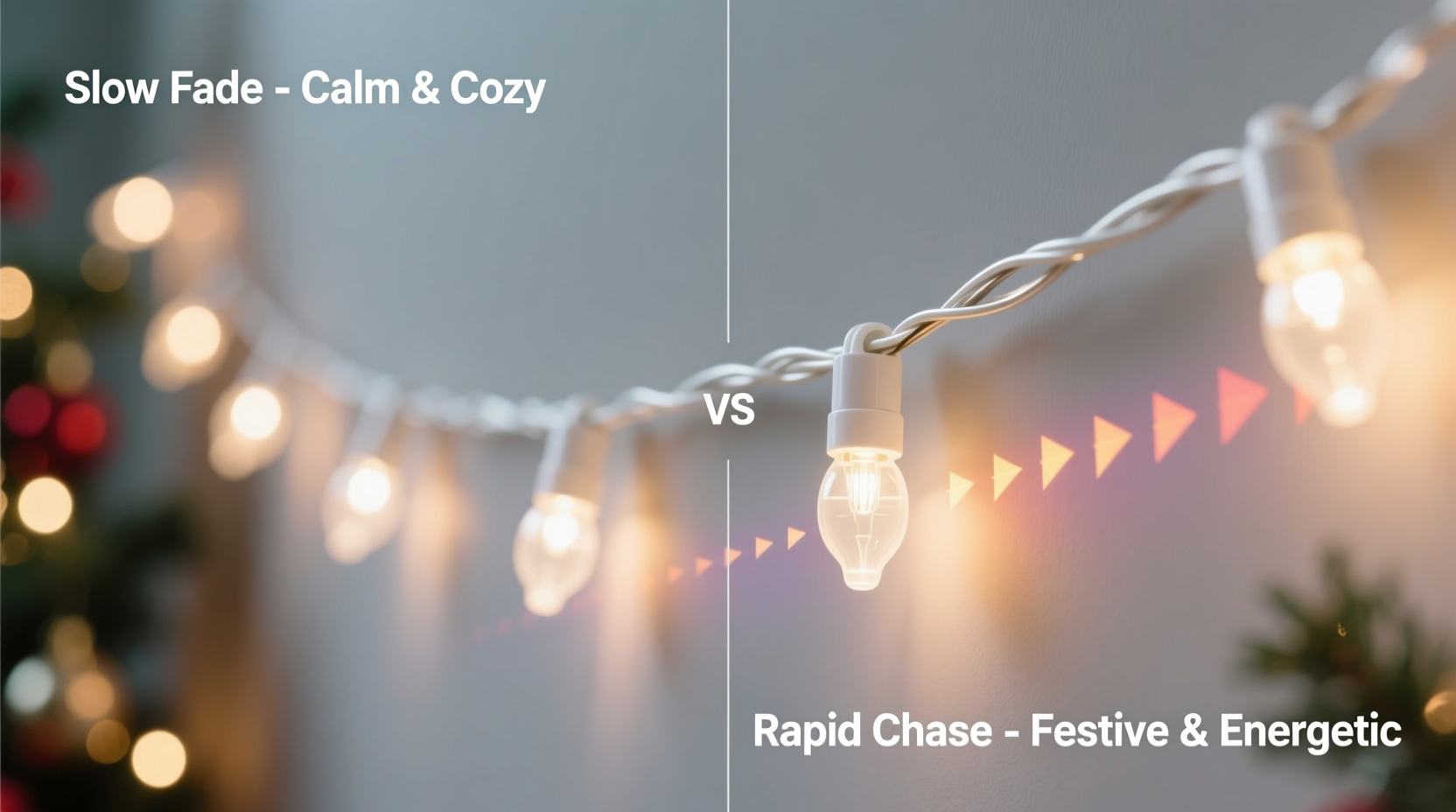
Human perception responds strongly to motion, especially in low-light conditions typical during winter evenings. Rapid movements trigger alertness; they capture attention by simulating change or urgency. In contrast, slow, predictable transitions promote relaxation and contemplation. This principle is well-documented in environmental psychology, where lighting dynamics are used to shape behavior in spaces ranging from hospitals to retail stores.
Dr. Lena Torres, an environmental design researcher at the Nordic Lighting Institute, explains:
“Rhythmic, slow-moving light patterns mimic natural phenomena like sunrise or flickering firelight—stimuli our brains have evolved to associate with safety and rest. Fast, erratic sequences, while exciting, can increase cognitive load, especially in residential areas meant for calm.”
In the context of holiday lighting, this means that a rapid chase effect—where lights appear to \"run\" across a strand—may energize a commercial storefront but overwhelm a quiet neighborhood porch. A slow fade, where colors blend gradually over several seconds, supports a meditative atmosphere ideal for homes, patios, or wellness-oriented spaces.
Slow Fade vs Rapid Chase: A Technical Breakdown
To make informed decisions, it’s essential to understand what happens behind the scenes when you select an animation mode. Most modern LED Christmas lights use microcontroller-based systems (like those from LOR – Light-O-Rama, or generic IC chips such as the WS2812B) that allow precise timing control. Here's how each animation works:
- Slow Fade: Each LED gradually shifts from one color or brightness level to another over a period of 3–8 seconds. This creates a seamless gradient effect, minimizing abrupt changes.
- Rapid Chase: LEDs turn on and off quickly in sequence, producing the illusion of movement. Cycle times range from 0.1 to 0.5 seconds per step, creating high-frequency visual pulses.
The difference isn't merely aesthetic—it affects electrical load, heat generation, and even energy consumption over time. Slow fade typically uses smoother current modulation (via PWM – Pulse Width Modulation), reducing stress on components. Rapid chase demands faster switching, which can shorten lifespan if thermal management is poor.
Comparing Visual Impact and Emotional Response
The choice between slow fade and rapid chase should align with the intended emotional outcome. Consider the following comparison table summarizing key differences:
| Feature | Slow Fade | Rapid Chase |
|---|---|---|
| Animation Speed | 3–8 seconds per transition | 0.1–0.5 seconds per step |
| Mood Effect | Calm, reflective, cozy | Exciting, playful, attention-grabbing |
| Best For | Living rooms, bedrooms, porches, dining areas | Festival displays, parties, storefronts, driveways |
| Distractiveness | Low – blends into background | High – draws continuous attention |
| Energy Efficiency | Higher due to smooth current flow | Slightly lower due to frequent switching |
| Lifespan Impact | Prolongs LED longevity | May reduce lifespan under prolonged use |
From this analysis, it’s clear that neither option is universally superior. The optimal choice depends on context. A backyard patio used for evening conversation benefits more from the subtlety of slow fade, while a front-yard display designed to impress neighbors during a holiday open house may justify the vibrancy of a rapid chase.
Step-by-Step Guide to Adjust Animation Speed
Controlling animation speed doesn’t require advanced programming skills. Most consumer-grade smart lights come with apps or physical remotes that allow adjustment. Follow this universal process to fine-tune your setup:
- Identify Your Controller Type
Check whether your lights use a proprietary remote (e.g., GE Color Effects), Wi-Fi app (e.g., Philips Hue, Govee), or programmable system (e.g., Arduino, WLED). - Access Animation Settings
Using the remote or mobile app, navigate to “Effects” or “Patterns.” Look for options labeled “Fade,” “Chase,” “Twinkle,” or “Flow.” - Select Base Effect
Choose either “Fade” or “Chase” depending on desired mood. Avoid mixing both unless layering intentionally. - Adjust Speed Parameter
Use the “Speed,” “Duration,” or “Transition Time” slider. For slow fade, set duration to 4+ seconds. For rapid chase, reduce to under 0.3 seconds per step. - Test in Real Conditions
View the lights after dark from multiple distances—inside the house, sidewalk level, and street view. Note any visual fatigue or distraction. - Save and Schedule (Optional)
If your system supports automation, save presets like “Evening Calm” (slow fade) and “Festive Hour” (rapid chase) and schedule them accordingly.
For DIY enthusiasts using platforms like WLED (open-source firmware for ESP8266/ESP32), deeper customization is possible. You can program custom fade curves or synchronize speed with music tempo—though for mood-centric applications, simplicity remains key.
Real-World Example: A Residential Transformation
Consider the case of Mark and Sofia Rivera, who live in a suburban cul-de-sac known for elaborate holiday displays. In previous years, their home featured rapid-chase rainbows along eaves and trees, drawing crowds but also complaints from neighbors about light pollution and sleep disruption.
After consulting a local lighting designer, they redesigned their layout focusing on mood enhancement. They replaced all rapid animations with slow-fade sequences in warm white and soft blue, synchronized across strands. Tree lights pulsed gently like breathing, while roofline strips cycled through twilight hues over five-second intervals.
The result? Foot traffic decreased slightly, but neighbor relations improved dramatically. Several families reported enjoying quieter evening walks, and one elderly resident thanked them for reducing nighttime glare. Online comments shifted from “coolest lights on the block” to “so peaceful and beautiful.”
This shift illustrates a growing trend: from spectacle-driven decoration toward emotionally intelligent lighting. As Mark noted, “We realized we weren’t decorating for judges—we were creating a space for our family to feel joy. The slower lights made that possible.”
Expert Recommendations for Mood-First Design
Professional lighting designers increasingly advocate for restraint in animation speed, especially in residential zones. According to James Holloway, a landscape lighting consultant with over 15 years of experience:
“The best holiday lighting doesn’t shout. It whispers. A well-timed slow fade can evoke nostalgia, warmth, and wonder far more effectively than a strobe-like chase. Control speed like you’d control music volume—set it to enhance, not dominate.”
Holloway recommends the following best practices:
- Limits animations to no more than two active zones per property (e.g., porch + tree).
- Uses dimming schedules—brighter during peak viewing hours (6–8 PM), softer later.
- Avoids combining multiple fast effects (e.g., chase + twinkle) on the same circuit.
- Tests all animations with night vision in mind—what looks fun at dusk may feel jarring at 10 PM.
Checklist: Optimize Your Christmas Light Animation
Use this actionable checklist before finalizing your holiday lighting setup:
- ☐ Determine primary purpose: celebration, ambiance, or both?
- ☐ Choose slow fade for relaxation-focused areas (porches, windows, bedrooms).
- ☐ Reserve rapid chase for high-energy zones (driveways, party areas).
- ☐ Adjust speed settings so transitions feel smooth, not jerky.
- ☐ Test animations after dark from street-level perspective.
- ☐ Limit total animated sections to avoid sensory overload.
- ☐ Schedule dynamic modes only during designated hours (e.g., 5–9 PM).
- ☐ Offer a “quiet mode” option with static or ultra-slow fade for late nights.
Frequently Asked Questions
Can I mix slow fade and rapid chase in the same display?
Yes, but with caution. Mixing effects works best when clearly separated spatially—one side of the house using slow fade, another using chase for contrast. Avoid placing them adjacent, as competing rhythms can create visual dissonance.
Do smart bulbs consume more power when animating rapidly?
Marginally. Rapid switching increases transistor activity and minor heat buildup, leading to slightly higher average draw (typically 5–10% more than steady-state). However, the difference is negligible on small installations.
How do I slow down animations on non-smart LED strings?
Basic plug-in LED sets usually don’t offer speed control. To achieve slower effects, replace them with addressable LEDs (e.g., RGBW strips with WLED controller) or use a dimmer-compatible transformer with built-in fade functions.
Conclusion: Let Rhythm Serve the Season
The magic of Christmas lighting lies not in how many bulbs you hang, but in how they move together to shape emotion. By mastering animation speed control, you shift from mere decoration to storytelling—with light as your language. Slow fade invites stillness, reflection, and connection. Rapid chase fuels excitement, energy, and festivity. Knowing when to apply each ensures your display uplifts rather than overwhelms.
Take time this season to refine not just placement and color, but the tempo of your lights. Experiment with durations, observe reactions, and prioritize harmony over hype. Whether you’re illuminating a city apartment balcony or a country farmhouse, let your lights reflect the deeper spirit of the holidays: warmth, presence, and shared peace.




 浙公网安备
33010002000092号
浙公网安备
33010002000092号 浙B2-20120091-4
Comments
No comments yet. Why don't you start the discussion?