
As holiday decorators fine-tune their outdoor displays, one question consistently emerges: should you use Christmas light chase controllers or random twinkle effects to create that elusive sense of magic? Both techniques animate traditional string lights, but they do so in fundamentally different ways. One mimics the rhythmic pulse of life—like a heartbeat across eaves and trees—while the other emulates the natural randomness of starlight dancing through cold winter air. Choosing between them isn’t just about preference; it’s about understanding how light movement influences emotion, atmosphere, and perceived realism.
The goal of any festive lighting design is not merely illumination, but transformation. A truly magical display feels alive, dynamic, and emotionally resonant. Whether you're decorating a suburban home or crafting a professional-grade neighborhood spectacle, the choice between chase and twinkle sequences can define the mood. This article breaks down both technologies, compares their performance, and helps you decide which method best captures the spirit of wonder during the holidays.
Understanding Light Animation Technologies
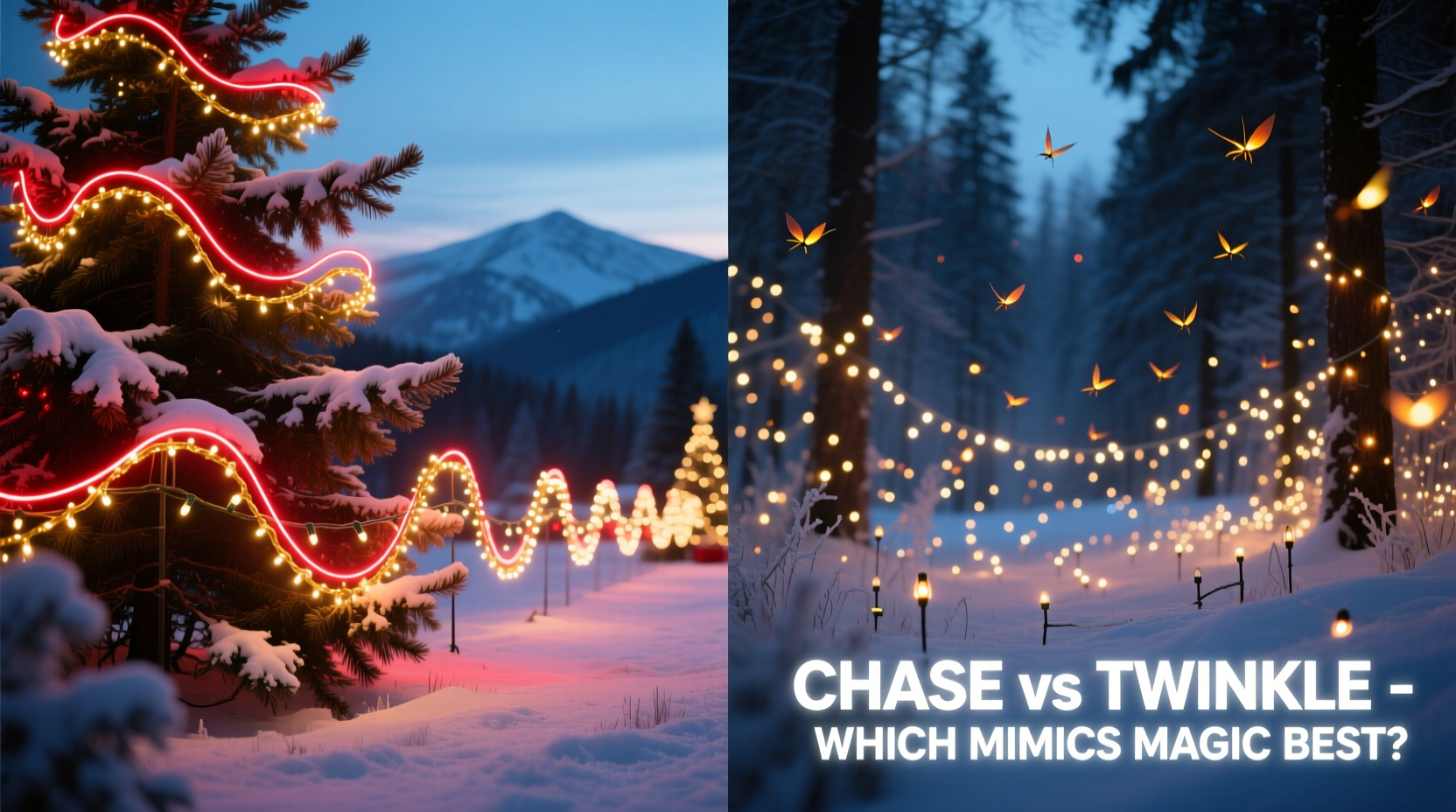
Before comparing chase and twinkle effects, it's essential to understand what drives them. Modern Christmas lights are no longer limited to static on/off states. Thanks to integrated controllers, microchips, and programmable LEDs, lights can now simulate motion, rhythm, and even mimic organic behavior.
Chase controllers work by sequentially turning individual bulbs or groups of bulbs on and off in a repeating pattern. The result is a wave-like effect—often described as “the Santa’s sleigh” or “the police light”—where illumination appears to move along a strand. These are commonly used in C7 and C9 bulb strings and are popular for outlining roofs, windows, and railings.
Random twinkle effects, on the other hand, rely on unpredictability. Instead of a fixed sequence, individual bulbs flicker at irregular intervals, creating a scattered, shimmering glow. This is often achieved using built-in IC (integrated circuit) chips in LED strings or via external diffusers that scatter light unevenly. Twinkling lights are frequently associated with fairy lights, net lights, and curtain lights.
The psychological difference is significant. Chase patterns feel engineered, deliberate, and rhythmic. Twinkling feels spontaneous, organic, and ethereal. But which better simulates true holiday magic?
Visual Impact: Movement vs. Stillness with Sparkle
Movement draws attention. That’s why chase lights are so effective at capturing the eye—they create a clear path for the viewer’s gaze to follow. When installed along rooflines or stair railings, chase sequences guide perception, framing architectural features with kinetic energy. This makes them ideal for large-scale displays where visibility from a distance matters.
However, movement doesn’t always equate to magic. In fact, overly mechanical patterns can feel artificial. The classic three-bulb chase—on, off, on, off—can resemble emergency vehicle lighting rather than festive cheer. Unless carefully tuned, chase effects risk feeling commercial or garish, especially when overused.
Twinkle effects take a different approach. By avoiding predictable rhythms, they tap into our subconscious association with stars, fireflies, and candlelight—all sources of natural, flickering illumination. Studies in environmental psychology suggest that irregular visual stimuli evoke feelings of calm and wonder more effectively than regular pulses. This aligns with the emotional tone most decorators aim for: warmth, nostalgia, and quiet enchantment.
“People don’t remember perfect symmetry. They remember the feeling of looking up at the sky and seeing something that felt like magic.” — Daniel Reeves, Professional Holiday Lighting Designer
Comparison Table: Chase Controllers vs Random Twinkle
| Feature | Chase Controllers | Random Twinkle |
|---|---|---|
| Animation Type | Sequential, rhythmic | Irregular, unpredictable |
| Best Use Case | Outlining structures, creating motion paths | Filling spaces, simulating starlight |
| Emotional Effect | Energetic, festive, attention-grabbing | Calm, dreamy, nostalgic |
| Installation Complexity | Moderate (requires correct sequencing) | Low (plug-and-play) |
| Customization Options | High (speed, direction, pattern variation) | Limited (unless using smart LEDs) |
| Realism | Low to moderate (can appear artificial) | High (closely mimics natural flicker) |
Real-World Application: A Mini Case Study
In 2022, homeowner Maria Thompson redesigned her front yard display in Portland, Oregon, aiming to create a “winter wonderland” vibe for her young children and neighbors. Her previous setup used multiple chase-light strands around windows and gutters, producing a bright, pulsating effect visible from two blocks away. While impressive in scale, feedback from visitors consistently described it as “loud” and “busy.”
That year, she replaced all chase sequences with premium LED twinkle strings embedded in tree canopies, draped over shrubs, and woven through fence rails. She kept only one chase strip—a subtle five-bulb ripple along the porch railing—to maintain a hint of motion without dominating the scene.
The result was transformative. Neighbors reported feeling “calmer” walking past the house. Children lingered longer, staring upward as if watching real stars. Local news even featured her display under the headline “The Quiet Magic of Christmas Lights.”
Maria noted: “I realized I wasn’t trying to compete for attention. I wanted people to pause, breathe, and remember what the season feels like. The twinkles did that. The chasers used to scream ‘look at me.’ Now, it whispers ‘come closer.’”
Step-by-Step: Designing a Magical Lighting Scheme
Creating a display that genuinely feels magical requires intentionality. Follow this timeline to blend or choose between chase and twinkle effects based on your goals.
- Week 1: Assess Your Space
Walk around your property at dusk. Note architectural lines, focal points (trees, entryways), and sightlines from the street. Decide whether you want drama or serenity as your primary tone. - Week 2: Choose Primary Effect
If you want excitement and motion (e.g., for a community event), prioritize chase controllers on outlines. If you seek intimacy and charm, commit to random twinkle in layered placements. - Week 3: Layer Secondary Effects
Add contrast. Use subtle chase strips to accent a pathway if your base is twinkle-heavy. Or, soften a bold chase display with background twinkle nets in bushes. - Week 4: Test & Refine
Install a small section first. Observe it at different times—right after sunset, late evening, and under moonlight. Adjust speed, density, and placement. Remove anything that feels distracting. - Week 5: Finalize and Secure
Once satisfied, complete installation. Use UV-resistant clips and waterproof connections. Label circuits for easy troubleshooting.
Expert Recommendations and Hybrid Approaches
Many top-tier decorators don’t treat chase and twinkle as mutually exclusive. Instead, they combine both in a technique known as “layered animation.” This approach uses chase effects to define structure and draw initial attention, while twinkle fills create depth and atmosphere.
For example, a professional display might use a slow-moving chase along the roofline to frame the house, while thousands of randomly twinkling mini LEDs fill evergreen trees, giving the impression of snow-laden branches catching starlight. The chase acts as an anchor; the twinkle provides soul.
Smart lighting systems like those from Philips Hue or Luminara now allow precise control over individual bulbs, enabling custom animations that blend both styles. You can program a gentle ripple that moves slowly across a strand, followed by isolated flickers elsewhere—simulating wind-blown lights on a frosty night.
“The most memorable displays aren’t the brightest. They’re the ones that make you forget you’re looking at electricity and wires.” — Lena Cho, Lighting Curator at the National Festival of Lights
FAQ
Can I use both chase and twinkle lights on the same circuit?
Yes, as long as the total wattage stays within the circuit’s limit. However, for independent control, use separate timers or smart relays. This allows you to turn on twinkle lights earlier in the evening and activate chase sequences only during peak viewing hours.
Are twinkle lights less durable than steady ones?
No. In LED form, twinkling is achieved electronically, not mechanically. There’s no added wear from flickering. In fact, because many twinkle LEDs operate at lower average brightness, they may last slightly longer than full-on static strings.
Do chase controllers work with all types of bulbs?
Traditional incandescent chase systems require specific multi-contact sockets (like C7/C9). Most modern LED chase effects are built into the string or controlled via a digital box. Always verify compatibility before purchasing.
Checklist: Achieving Magical Realism in Holiday Lighting
- ☑ Define your emotional goal: excitement or serenity?
- ☑ Limit chase effects to structural outlines unless going for high-energy theme
- ☑ Use random twinkle for depth, texture, and organic feel
- ☑ Avoid uniform speed or perfect symmetry in animations
- ☑ Layer effects: chase for framing, twinkle for filling
- ☑ Test combinations before full installation
- ☑ Prioritize warm white tones for a cozier, more nostalgic look
- ☑ Consider smart controls for dynamic, evolving displays
Conclusion: Letting Light Speak for Itself
In the end, the choice between Christmas light chase controllers and random twinkle comes down to intent. Chase effects command attention—they celebrate, announce, and energize. Twinkle effects invite contemplation—they whisper, glow, and linger in memory. If your goal is to mimic magic—the kind that makes children press their noses to the windowpane and adults pause in quiet reflection—then randomness holds a distinct advantage.
Nature does not pulse in perfect rhythm. Stars don’t blink in unison. Snowfall has no choreography. True magic lives in imperfection, in the unexpected glimmer, in the light that seems to breathe. That’s what random twinkle captures. It doesn’t imitate technology; it transcends it.
That said, there’s room for both. A well-designed display respects balance. Use chase controllers where motion enhances storytelling—like guiding the eye toward a nativity scene or Santa’s workshop. Then let twinkle take over the rest, transforming your space into a living canvas of soft, flickering wonder.




 浙公网安备
33010002000092号
浙公网安备
33010002000092号 浙B2-20120091-4
Comments
No comments yet. Why don't you start the discussion?