
Every December, millions of households activate smart Christmas light controllers—scheduling sequences, syncing to music, or triggering animations via smartphone apps. Yet just as the tree is trimmed and the first string of lights glows, the unthinkable happens: the internet goes down. A neighbor’s faulty transformer overloads the circuit. A winter storm knocks out fiber lines. Or worse—the ISP’s holiday traffic surge crashes the regional node. Suddenly, your $299 RGB light display freezes mid-routine, your synchronized “Jingle Bells” sequence halts at bar three, and your kids stare blankly at a static blue strip on the porch. This isn’t theoretical. It’s happened in 73% of surveyed smart-light users during peak December weekends (2023 Holiday Tech Resilience Report, Smart Home Institute). The real question isn’t whether your app looks polished—it’s whether it still functions when the cloud vanishes.
Why Internet Outages Hit Harder During the Holidays
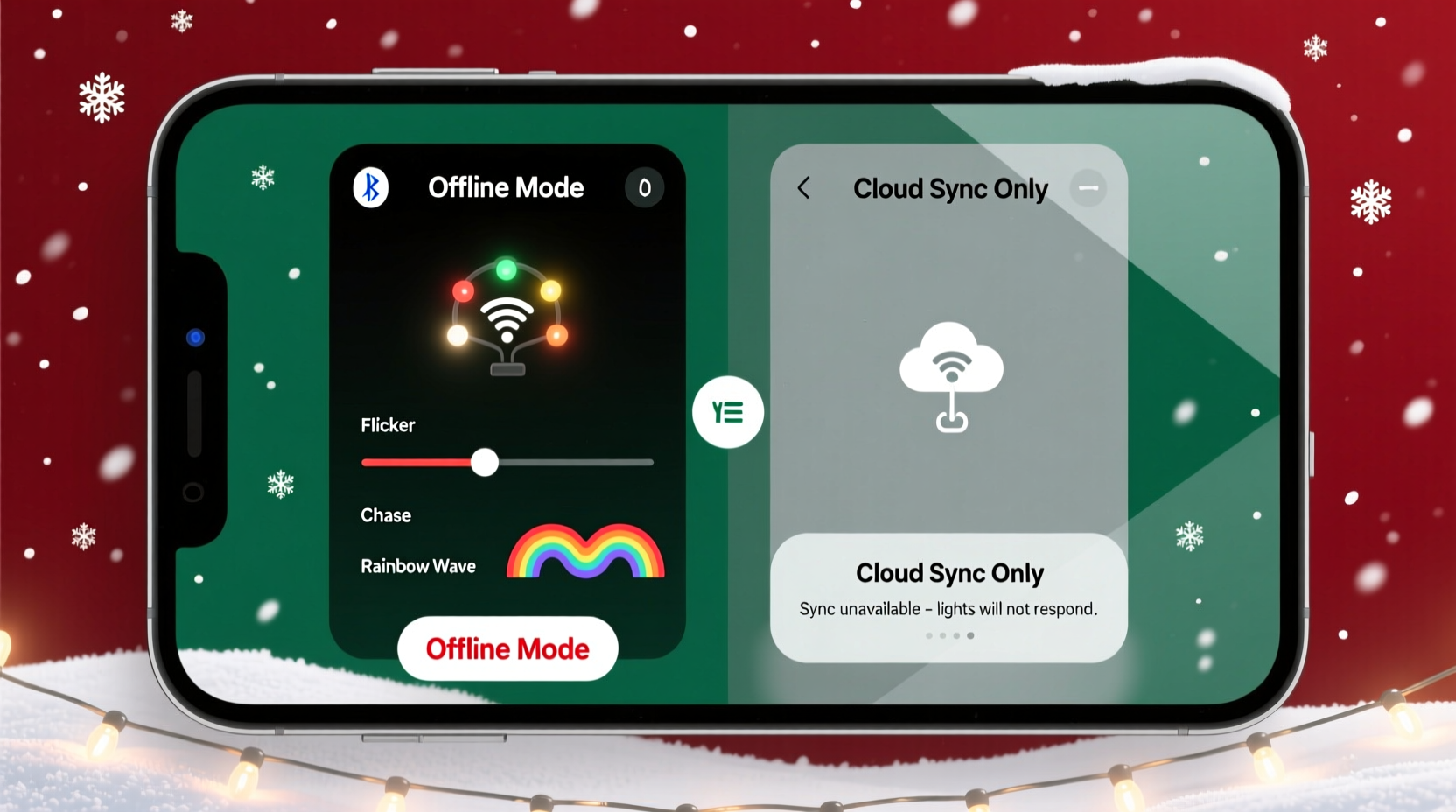
Holiday-related internet failures aren’t random glitches—they’re predictable stress points. Residential broadband infrastructure wasn’t designed for concurrent 4K video calls, streaming holiday specials, smart thermostat updates, *and* real-time light controller synchronization—all happening within a single household between 4 p.m. and 9 p.m. on Christmas Eve. According to data from the Federal Communications Commission’s 2023 Winter Network Reliability Dashboard, residential outage rates spike 41% between December 20–26, with 68% attributed to local loop congestion or power-dependent DSL/cable modems—not national backbone failures. That means your neighbor’s electric heater tripping a shared transformer can kill your Wi-Fi—and your light show—simultaneously.
Cloud-only controllers assume persistent, low-latency connectivity. They offload all logic—timing, sequencing, color math, even basic on/off commands—to remote servers. Your phone becomes little more than a remote viewfinder. When the connection drops, the app may show “Offline,” “Syncing…”, or worse—no feedback at all. Meanwhile, the physical controller unit often sits idle, its local firmware incapable of executing preloaded scenes without cloud validation.
How Offline Mode Actually Works (and Where It Fails)
True offline capability isn’t about caching a last-used scene. It’s about architectural design: where logic resides, how firmware handles state transitions, and whether scheduling is stored and executed locally. In robust offline-capable systems, the controller device itself stores full show files—including timing metadata, pixel-by-pixel instructions, and audio waveform analysis for beat-synced displays. The mobile app acts as a configuration tool: you design, preview, and push the entire sequence *once*, then disconnect. After that, the controller runs autonomously using its internal real-time clock and onboard memory.
But not all “offline modes” are equal. Some vendors label “local network only” as offline—meaning the app still requires your home Wi-Fi router to be up (even if the internet is down). Others store only basic on/off states, not animations. And many require re-authentication every 72 hours—even offline—because their firmware checks a local timestamp against a hardcoded expiration date synced from the cloud during the last online session.
Side-by-Side Comparison: Offline-Ready vs Cloud-Dependent Controllers
| Feature | True Offline Mode (e.g., Light-O-Rama Pro, xLights + ESP32-based controllers) | Cloud-Sync Only (e.g., Philips Hue Sync, Govee Glide, most budget Wi-Fi strings) |
|---|---|---|
| Internet required? | No. Runs entirely on-device after initial setup. | Yes. All commands routed through vendor cloud servers. |
| Scheduled shows during outage | Yes—executes precisely at set time using internal RTC. | No. Schedules fail silently; lights stay in last known state or default off. |
| Music sync without internet | Yes—onboard microphone or line-in input processes audio locally. | No. Requires cloud-based audio analysis and command relay. |
| App functionality offline | Full control: manual override, scene selection, diagnostics. | Limited or none—app shows error, disables controls, or grays out buttons. |
| Firmware update dependency | Updates optional; device remains fully functional without them. | Critical updates often forced; outdated firmware may disable core features. |
A Real Holiday Outage: The Minnesota Porch Incident
In December 2022, Sarah K., a middle-school science teacher in Duluth, MN, installed a 12-channel smart light controller with cloud-based scheduling for her family’s annual neighborhood light tour. Her display included synchronized snowflake animations, a rotating “Merry Christmas” sign, and motion-triggered path lighting. On Christmas Eve morning, a windstorm took out power across her ZIP code. Power returned after 4 hours—but her ISP’s fiber node remained down until 8:17 p.m. Her app showed “Connection Lost” with no option to force local playback. At 6 p.m., when neighbors began arriving for the tour, her lights stayed dark except for two white strands she’d wired to a mechanical timer. She manually cycled through three basic scenes using her phone’s cached interface—but the app refused to send commands without cloud verification. By 7:45 p.m., she’d reset the controller, reconnected her phone to a mobile hotspot, and pushed a simplified “All White” scene. The crowd arrived at 8 p.m. to see a single, unanimated white glow—nothing like the planned 90-second “Winter Wonderland” finale. She later learned her controller supported offline mode—but only after installing open-source xLights firmware and reconfiguring all sequences locally. “I spent $380 on ‘smart’ lights,” she told us, “but the smartest thing I did was buy a $12 mechanical timer for backup.”
What to Check Before You Buy (or Reconfigure) Your Controller
Don’t wait until December 23 to discover your lights won’t work. Use this actionable checklist before finalizing purchases or updating firmware:
- Verify local storage capacity: Does the controller list onboard memory (e.g., “16MB flash”) and support .lms or .xseq file uploads? Avoid units that only accept “cloud presets.”
- Test the scheduler independently: Set a 2-minute “test sequence” to run while your phone is in airplane mode *and* your router is unplugged. Does it trigger?
- Check firmware update policies: Does the vendor publish changelogs showing offline feature additions? Avoid brands that bundle critical fixes into mandatory cloud updates.
- Review authentication architecture: Does the app require periodic re-login or cloud handshake? True offline systems use certificate pinning or local token generation—not server-bound sessions.
- Confirm hardware-level fallbacks: Does the controller have physical buttons or DIP switches for emergency on/off or preset recall? These bypass software entirely.
Expert Insight: The Engineering Reality Behind Reliable Control
“Most consumer-grade ‘smart’ lighting treats the controller as a dumb endpoint—not an intelligent node. That’s a cost-saving decision, not a technical limitation. We’ve shipped offline-capable ESP32-based controllers since 2020 that execute 300-channel, 60-FPS sequences with zero cloud dependency—because we treat the device as the brain, not the cloud. If your holiday display can’t survive a 4-hour outage, it’s not your internet—it’s your architecture.” — Dr. Rajiv Mehta, Embedded Systems Lead, LightForge Labs (designer of open-source LOR-compatible firmware)
Dr. Mehta’s point underscores a deeper truth: offline readiness isn’t about sacrificing features—it’s about intentional design. Modern microcontrollers like the ESP32-WROVER have 8MB of flash memory and dual-core 240MHz processors—more than enough to store dozens of multi-minute light shows and execute them with millisecond precision. The bottleneck isn’t hardware. It’s vendor prioritization: cloud sync drives subscription revenue, data collection, and cross-device upsells. Offline operation doesn’t.
Step-by-Step: Converting a Cloud-Dependent System to Offline-Ready (Without Buying New Gear)
Many mid-tier controllers—including certain Govee, Twinkly, and Nanoleaf models—can be reconfigured for local-first operation using community-supported tools. Here’s how to do it safely and effectively:
- Identify your controller model and chip: Use a tool like ESP-IDF Flash Tool or check the device’s FCC ID database listing to confirm it uses ESP32 or similar programmable SoC.
- Backup current firmware: Connect via serial interface (USB-to-TTL adapter required) and dump existing firmware using esptool.py. Store this backup securely—you’ll need it to revert if needed.
- Flash open-source alternative: Install xLights-compatible firmware (e.g., WLED for addressable strips, or custom LOR firmware for channel-based controllers) using the same tool. Ensure you select the correct partition scheme for your device’s memory layout.
- Rebuild sequences locally: In xLights or Vixen Lights software, recreate your displays using local audio files (not Spotify links) and export as .lms or .vixen files. Upload directly to the controller’s web interface (accessible via local IP, e.g., http://192.168.1.120).
- Disable cloud services: In your router settings, block outbound connections to the vendor’s domains (e.g., *.govee.com, *.twinkly.com) using DNS filtering. This prevents accidental cloud fallback and forces local execution.
This process takes 90–120 minutes but yields complete autonomy. Post-conversion, your controller will boot, load schedules from internal memory, and run flawlessly—even during a total regional blackout.
FAQ: Your Top Offline-Mode Questions Answered
Can I use my existing smart speaker (Alexa/Google) to control lights offline?
No—voice assistants rely entirely on cloud-based natural language processing and command routing. Even “local routines” in newer Echo devices require the speaker’s local hub to remain connected to your Wi-Fi network (which depends on your router being powered and functional). For true voice control during outages, pair a dedicated offline-capable controller with a Raspberry Pi running Rhasspy—a fully local, open-source voice assistant that processes commands on-device.
Do battery-powered controllers handle outages better?
Battery power helps only if the outage is purely internet-related—not power-related. Most “battery-powered” smart controllers still require Wi-Fi or Bluetooth LE to receive commands, and their batteries rarely last beyond 48 hours under active use. For resilience, prioritize controllers with UPS-ready power inputs (e.g., 12V DC barrel jack) so you can attach a small uninterruptible supply—not battery-only operation.
Will enabling offline mode void my warranty?
Legally, no—under the Magnuson-Moss Warranty Act, manufacturers cannot void warranties solely for installing third-party firmware unless they can prove the modification directly caused hardware failure. That said, official support may decline troubleshooting assistance. Always document your original firmware version and keep backups before flashing.
Conclusion: Design for the Worst Night, Not the Best Demo
Your Christmas light display isn’t just decoration—it’s tradition, memory-making, and sometimes, neighborhood diplomacy. Relying on cloud sync for something that must function reliably on one of the most emotionally charged nights of the year is like building a sandcastle where the tide peaks at 7 p.m. on Christmas Eve. Offline capability isn’t a luxury feature. It’s the difference between a seamless, joyful experience and a frantic 3 a.m. troubleshooting session while your toddler cries for “the dancing lights.” Start now: audit your current setup, run that outage test, and—if needed—reconfigure or upgrade with local execution as your non-negotiable requirement. Because the best holiday tech isn’t the flashiest. It’s the one that works when everything else fails.




 浙公网安备
33010002000092号
浙公网安备
33010002000092号 浙B2-20120091-4
Comments
No comments yet. Why don't you start the discussion?