
Every holiday season brings the same frustrating ritual: untangling strings of Christmas lights, draping them across the roofline or tree, only to discover that half the strand won’t light up. For decades, troubleshooting meant manually testing each bulb with a multimeter or swapping them one by one. Now, smartphone apps claim to simplify this process—using your phone’s camera and AI to detect which bulb is out. But do they actually work? And more importantly, can they save time when you're racing against winter darkness and a growing list of seasonal to-dos?
This article dives deep into the world of Christmas light detection apps—how they function, what they promise, and whether they live up to expectations. We’ll compare app-based solutions with traditional methods, examine real user experiences, and offer practical guidance for anyone trying to restore their festive glow without losing their patience.
How Do Christmas Light Detection Apps Work?
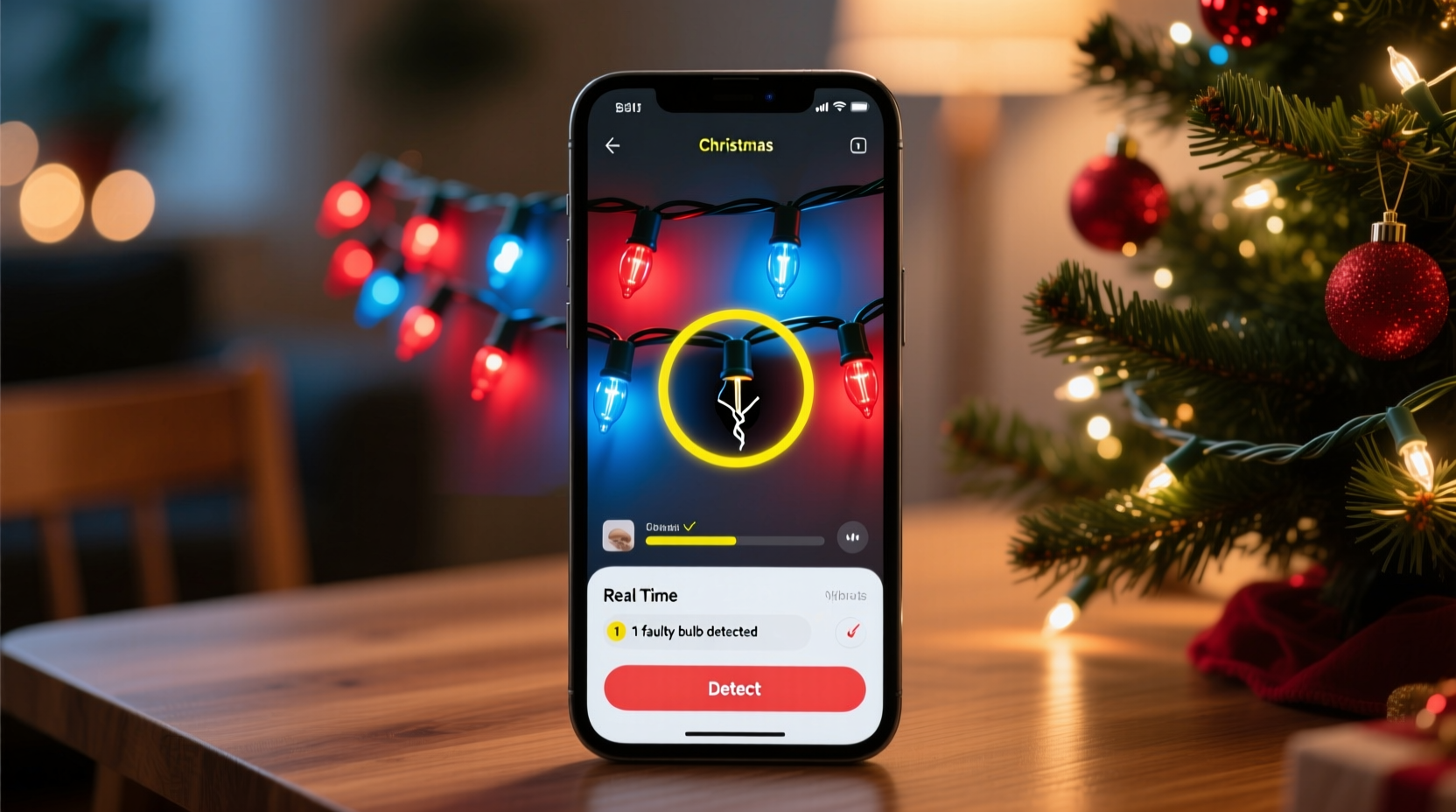
At first glance, the idea sounds like magic: point your phone at a darkened string of lights, tap an app, and it instantly identifies the faulty bulb. In reality, the technology relies on image processing and motion detection rather than direct electrical diagnostics.
These apps use your smartphone’s camera to record a video of the light strand while it’s powered on. The software analyzes frame-by-frame changes in brightness. Since most incandescent mini-lights flicker slightly due to AC current cycling (60 times per second in North America), even a bulb that appears “off” may still pulse faintly. By detecting micro-fluctuations in luminance, the app attempts to isolate non-flickering bulbs—indicating a complete failure or shunt malfunction.
Some advanced versions incorporate augmented reality overlays, highlighting suspect bulbs directly on your screen. Others allow slow-motion playback so users can visually scan for anomalies. However, performance depends heavily on lighting conditions, camera quality, and the type of lights being tested.
Limitations and Real-World Challenges
While the concept is promising, several technical and environmental factors limit the reliability of light detection apps.
- LED vs. Incandescent Compatibility: Most apps are designed for older incandescent strands, which produce visible flicker. Modern LED strings often use rectified power supplies and don’t flicker perceptibly, making them nearly invisible to these detection algorithms.
- Camera Frame Rate Limitations: Standard smartphone cameras capture 30 or 60 frames per second—matching the frequency of AC current. This makes it difficult to resolve rapid flicker patterns accurately.
- Distance and Angle Sensitivity: Bulbs must be clearly visible and occupy enough pixels in the frame. Dense clusters or distant rooftop installations reduce accuracy.
- No Electrical Diagnosis: These apps cannot determine if a bulb is loose, corroded, or has a failed shunt—they only observe light output.
“Apps can give you a starting point, but they’re not diagnostic tools. A dark bulb could mean a dead filament, a poor connection, or just a shadow.” — Mark Reynolds, Electrical Technician & Holiday Lighting Installer
Practical Alternatives to App-Based Detection
If apps fall short, what methods actually work for finding broken Christmas lights? Here are proven strategies used by professionals and experienced decorators.
Using a LightKeeper Pro Tool
The LightKeeper Pro remains one of the most effective handheld devices for diagnosing and repairing mini-light strands. It combines three functions:
- Pulse Testing: Sends a high-voltage pulse down the wire to clear common shunt failures in incandescent bulbs.
- Voltage Detection: Uses a built-in sensor to confirm whether power reaches specific points along the strand.
- Bulb Checker: Tests individual bulbs outside the socket.
Unlike apps, the LightKeeper Pro works regardless of visibility or camera quality. Users report restoring entire strands in under two minutes by simply inserting the probe into each socket until the circuit resets.
Manual Troubleshooting with a Known-Good Bulb
A low-tech but reliable method involves using a spare working bulb to test each position in a dark section. Start from one end and replace each bulb temporarily. If the rest of the strand lights up, you’ve found the culprit. This is time-consuming but foolproof for small sets.
Segment Isolation Technique
Many light strings are wired in series sections (e.g., 50-light strands divided into five groups of 10). When one bulb fails, only its segment goes dark. By identifying which segment is out, you can narrow your search to 10–20 bulbs instead of inspecting all 50.
Comparison: App vs. Traditional Methods
| Method | Speed | Accuracy | Cost | Best For |
|---|---|---|---|---|
| Christmas Light Detection App | Moderate | Low–Medium | Free–$5 | Incandescent strings, close-range indoor use |
| LightKeeper Pro | Fast | High | $20–$30 | Seasonal pros, large displays |
| Manual Bulb Swap | Slow | High | Free | Small sets, budget-conscious users |
| Multimeter Testing | Slow | Very High | $15+ | Electronics-savvy users, permanent repairs |
| Visual Inspection + Replacement | Fastest | Medium | Free | Newer LED strings with obvious damage |
Mini Case Study: Restoring a 300-Bulb Display
Janice M., a homeowner in Portland, Oregon, decorates her home annually with over 30 strands of 100-count mini-lights. Last year, she tried a popular free app called *LightScanner* to diagnose a dark section on her rooftop display. After recording multiple shaky videos in windy conditions, the app highlighted three different bulbs across separate attempts—with no consistent result.
Frustrated, she switched to her old LightKeeper Pro. Within four minutes, she identified and cleared a shunt failure in the third socket of the affected segment. The entire strand lit up. She later inspected the “faulty” bulbs flagged by the app and found they were functioning perfectly.
“The app was entertaining,” she said, “but it wasted more time than it saved. My $25 tool has paid for itself ten times over.”
Step-by-Step Guide to Finding a Broken Christmas Light
Follow this efficient, field-tested sequence to minimize downtime and avoid frustration:
- Unplug the Strand: Always start with safety. Never handle electrical components while powered.
- Inspect Visually: Look for obvious issues—bulbs that are missing, cracked, or browned. Check for loose connections or damaged wires.
- Identify the Dark Segment: On multi-segment strings, note which group of bulbs is out. This narrows your search area.
- Use a Known-Good Bulb: Remove a working bulb from a lit section and test it in the first socket of the dark segment. If the rest light up, the original bulb was faulty.
- Try a Pulse Tool: Insert a LightKeeper Pro or similar device into each socket in the dark section until the lights return.
- Test the Shunt (if applicable): For incandescent bulbs, some models allow you to bypass a failed shunt by gently wiggling the filament or using conductive grease.
- Replace if Necessary: If no repair works, replace the entire bulb or consider retiring old strands prone to repeated failures.
Expert Recommendations and Industry Insights
Professional installers overwhelmingly favor physical tools over apps. According to the National Christmas Tree Association, over 70% of commercial decorators use diagnostic devices like the LightKeeper Pro, citing consistency and speed as critical during tight installation windows.
“We don’t have time for guesswork. An app might be fun for a hobbyist, but when you’re on a lift 20 feet in the air in freezing weather, you need something that works the first time.” — Derek Langston, Owner of Evergreen Holiday Lighting Co.
Additionally, manufacturers are shifting toward parallel-wired LED systems, where a single bulb failure doesn’t affect the rest of the strand. While more expensive upfront, these designs drastically reduce maintenance needs and eliminate the hunt for dead bulbs altogether.
Frequently Asked Questions
Do Christmas light detection apps work with LED lights?
Generally, no. Most LED strings do not flicker in sync with AC current due to internal rectifiers and constant-current drivers. Without visible flicker, the apps cannot distinguish between working and non-working bulbs. Some newer apps claim partial success with PWM-driven LEDs, but results remain inconsistent.
Are there any free apps worth trying?
A few apps, such as *Christmas Light Detector* (Android) and *Twinkle Finder* (iOS), offer basic functionality at no cost. They can sometimes spot glaring outages in incandescent sets under ideal conditions. However, they lack calibration options, fail in bright environments, and often misidentify shadows as dead bulbs. Use them as a last resort—not a primary solution.
Can I fix a Christmas light without replacing the bulb?
Sometimes. Many incandescent mini-lights include a “shunt”—a backup conductor designed to activate when the filament breaks. If the shunt fails to engage, tools like the LightKeeper Pro can send a surge to melt away insulation and restore continuity. For LEDs, repairs are rarely feasible; replacement is usually the only option.
Checklist: Preparing for Efficient Light Maintenance
- ✅ Stock spare bulbs and fuses for each set
- ✅ Purchase a LightKeeper Pro or equivalent repair tool
- ✅ Store lights on cardboard reels or plastic spools to prevent tangling
- ✅ Test all strands before installation
- ✅ Use weatherproof connectors and timers for outdoor setups
- ✅ Label storage bins by location (e.g., “Front Porch – Red Mini-Lights”)
- ✅ Retire strands older than 5 years or with repeated failures
Conclusion: Apps Are a Gimmick—Smart Tools Win
Christmas light detection apps represent an interesting intersection of holiday tradition and modern tech—but they’re not yet a practical solution for most people. While they may occasionally help spot an obvious outage, their limitations in accuracy, compatibility, and usability make them unreliable compared to established tools and methods.
The real time-savers remain physical devices like the LightKeeper Pro, thoughtful storage habits, and upgrading to more resilient LED designs. Technology will likely improve, especially as computer vision and thermal imaging become more accessible on smartphones. Until then, the fastest way to find a broken bulb isn’t an app—it’s experience, the right tool, and a little holiday patience.




 浙公网安备
33010002000092号
浙公网安备
33010002000092号 浙B2-20120091-4
Comments
No comments yet. Why don't you start the discussion?