
As holiday lighting evolves from simple incandescent strings to sophisticated LED arrays, the way we control brightness has become just as important as the lights themselves. For homeowners, event designers, and lighting enthusiasts who value rich, natural-looking warm white tones during the holidays, choosing the right dimming method is critical. Traditional dimmers and modern pulse-width modulation (PWM) controllers offer different approaches to brightness control — but not all handle color fidelity equally. When warmth, ambiance, and visual authenticity matter, understanding the technical and aesthetic differences between these systems can make or break your seasonal display.
The Importance of Color Accuracy in Warm-Tone Christmas Lighting
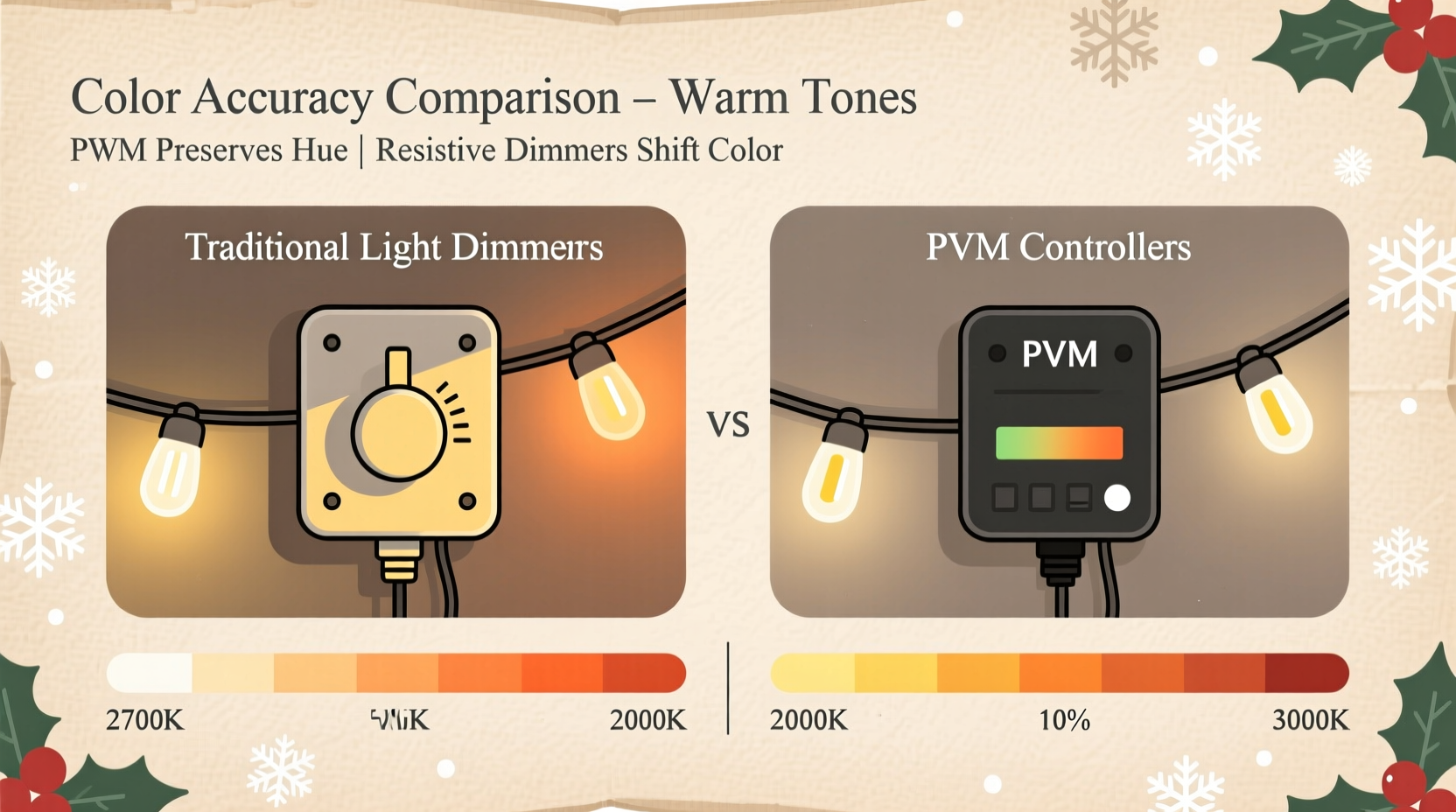
Warm white LEDs (typically 2700K–3000K) are favored for holiday decor because they mimic the soft glow of candlelight and traditional incandescent bulbs. This warmth evokes nostalgia, comfort, and elegance — qualities central to the holiday atmosphere. However, not all dimming methods preserve this delicate hue. Poor dimming can shift the color temperature toward cooler, harsher tones or create uneven flickering that disrupts the intended mood.
Color accuracy under dimming conditions depends on how consistently the LED’s current is regulated. When current drops unevenly or in abrupt pulses, the semiconductor materials in LEDs can emit slightly different wavelengths, altering perceived color. This effect is especially noticeable in warm whites, where subtle shifts toward pink, orange, or blue are more visible than in neutral or cool whites.
“Maintaining consistent chromaticity during dimming isn’t just a technical detail — it’s essential for emotional impact in ambient lighting.” — Dr. Lena Torres, Lighting Engineer at the Institute of Illuminating Engineers
How Traditional Dimmers Work — And Why They Struggle with Warm Tones
Traditional dimmers, often based on TRIAC (triode for alternating current) technology, were designed for incandescent bulbs. These bulbs work by heating a filament; reducing voltage simply makes the filament glow less brightly, naturally preserving color warmth even at low levels. The dimming curve is smooth and continuous.
However, LEDs operate differently. They require direct current and precise voltage regulation. When a TRIAC dimmer reduces AC voltage, it “chops” parts of the sine wave, leading to inconsistent power delivery. Many LED Christmas lights are not fully compatible with this method, especially inexpensive strings without proper driver circuitry.
Common issues with traditional dimmers on warm-tone LEDs include:
- Color shifting: As power fluctuates, the phosphor coating inside warm white LEDs may respond unevenly, causing a drift toward greenish or bluish tints at lower brightness.
- Flickering: Inconsistent waveform delivery leads to visible flicker, particularly at mid-to-low dim levels.
- Minimum brightness thresholds: Some LED strings won’t illuminate below a certain voltage cutoff, limiting dimming range.
- Incompatibility: Many plug-and-play Christmas light sets lack trailing-edge dimming support, resulting in erratic behavior.
PWM Controllers: Precision Dimming for Stable Color Performance
Pulse-width modulation (PWM) is a digital dimming technique that rapidly switches the LED current on and off — thousands of times per second. Instead of reducing voltage, PWM adjusts brightness by varying the ratio of “on” time to “off” time (duty cycle). At 100% duty cycle, the LED is fully on; at 25%, it’s on only a quarter of the time.
Because the full rated current flows during each “on” pulse, the LED operates at its designed electrical point, maintaining stable junction temperature and consistent photon emission. This results in minimal color shift, even at very low brightness levels.
PWM offers several advantages for warm-tone preservation:
- Stable color temperature: Since peak current remains constant, the phosphor excitation stays uniform across dimming levels.
- Wide dimming range: High-frequency PWM can achieve smooth dimming down to 1% or lower without flicker.
- Digital control: Enables integration with smart systems (Wi-Fi, Zigbee, DMX), allowing scheduling, scenes, and remote adjustments.
- Energy efficiency: No power is wasted as heat in resistors or linear regulators.
For professional installations and high-end residential displays, PWM-based controllers are increasingly the standard — especially when color consistency across multiple fixtures is required.
Comparing Technologies: A Practical Overview
| Feature | Traditional Dimmer (TRIAC) | PWM Controller |
|---|---|---|
| Color Accuracy (Warm Tones) | Poor to moderate – prone to green/blue shifts | Excellent – maintains original CCT |
| Flicker Risk | High at low dim levels | Low (with frequencies >1000 Hz) |
| Brightness Range | Limited – often cuts out below 20% | Full – down to 1% or lower |
| Compatibility with LED Strings | Variable – requires compatible drivers | High – especially with addressable or DC-powered LEDs |
| Installation Complexity | Simple – wall switch replacement | Moderate – may require external power supply and wiring |
| Smart Integration | Limited | Full support (via apps, voice, automation) |
| Cost (Entry-Level) | $10–$25 | $20–$60+ |
Real-World Example: A Holiday Display Restoration
A homeowner in Portland, Oregon, invested in premium warm white LED icicle lights to recreate the cozy porch lighting of her childhood. She used standard wall dimmers to adjust brightness in the evenings. While the lights looked inviting at full output, dimming them by more than 30% caused a noticeable shift — the once-golden glow turned slightly greenish, especially near the ends of the strands.
After consulting a local lighting technician, she replaced the TRIAC dimmers with a 24V PWM controller system designed for outdoor LED tape and rope lights. The new setup used high-frequency PWM (approximately 4,800 Hz) and maintained perfect color fidelity from 100% down to 5%. The difference was immediate: the softened evening lighting now retained its amber richness, enhancing curb appeal without sacrificing ambiance.
This case illustrates how technological choice directly impacts aesthetic outcome — especially in applications where emotional resonance depends on accurate color reproduction.
Step-by-Step Guide to Choosing the Right System
- Assess your light type: Determine whether your Christmas lights are AC-powered (standard plug-in) or DC/low-voltage (often used in addressable or landscape lighting).
- Check manufacturer specifications: Look for dimming compatibility notes. Does it mention TRIAC, ELV, or PWM? Is there a recommended dimmer?
- Evaluate your control needs: Do you want simple manual dimming, or would you benefit from scheduling, fading effects, or app-based control?
- Test for color stability: If possible, dim a sample string using both methods. Observe the light on a white surface in a dark room to detect subtle color shifts.
- Install and calibrate: For PWM systems, ensure correct voltage matching and use shielded cables if running long distances to avoid noise interference.
Action Checklist: Ensuring Warm Tone Fidelity
- ✅ Use only dimmers explicitly rated for LED loads
- ✅ Choose PWM controllers with frequency >1,000 Hz to eliminate perceptible flicker
- ✅ Verify that your LED string operates on DC or supports constant-current reduction (CCR)
- ✅ Avoid mixing different LED types or batches in the same circuit
- ✅ Perform a nighttime test at various dim levels before final installation
Frequently Asked Questions
Can I use a regular household dimmer with warm white LED Christmas lights?
You can, but with caution. Only do so if both the dimmer and the light string specify LED compatibility. Even then, many users report color instability and limited dimming range. For best results, especially with warm tones, opt for a dedicated PWM solution.
Does PWM dimming shorten LED lifespan?
No — in fact, it often extends it. Because PWM avoids thermal stress from operating at partial voltage (unlike analog dimming), junction temperatures remain stable. High-frequency PWM is considered one of the safest dimming methods for LED longevity.
Are there affordable PWM options for home users?
Yes. Entry-level PWM controllers like those based on the PCA9685 chip or ESP8266 modules are available for under $25. Smart platforms such as Shelly, Loxone, or Philips Hue also incorporate PWM-like techniques in their drivers and offer user-friendly interfaces.
Expert Recommendation: Prioritize Signal Quality Over Simplicity
“When preserving warm white integrity, the key metric isn’t just dimmability — it’s signal quality. PWM wins because it keeps the LED operating within its optimal electrical window. It’s not just about being dimmable; it’s about being dimmable *correctly*.” — Marcus Reed, Senior Applications Engineer at Lumivolt Dynamics
Conclusion: Make Your Lights Reflect the True Spirit of the Season
The warmth of holiday lighting goes beyond lumens and kelvins — it’s tied to memory, emotion, and atmosphere. Preserving the authentic golden hue of warm white Christmas lights requires more than just selecting the right bulb; it demands attention to how that light is controlled. While traditional dimmers offer simplicity, they often compromise the very quality they’re meant to enhance. PWM controllers, though slightly more complex, deliver superior performance in color stability, dimming range, and long-term reliability.
Whether you're illuminating a front porch, designing a commercial display, or crafting an intimate indoor vignette, investing in the right dimming technology ensures your lights don’t just shine — they resonate. Don’t let poor dimming dull the magic of your holiday glow. Choose precision. Choose consistency. Let your warm tones stay warm, no matter how softly they burn.




 浙公网安备
33010002000092号
浙公网安备
33010002000092号 浙B2-20120091-4
Comments
No comments yet. Why don't you start the discussion?