
Every holiday season, millions of households install decorative lighting—only to discover their December electricity bill spiked by 12–25%. According to the U.S. Department of Energy, seasonal lighting accounts for an estimated 6.6 billion kilowatt-hours annually in the U.S. alone—equivalent to the power used by over 600,000 homes for a full year. Yet much of that energy isn’t illuminating joy; it’s wasted on lights glowing unattended at 3 a.m., or staying dark when guests arrive at twilight because the sensor misread ambient light. The real question isn’t whether to automate your lights—it’s how to automate them intelligently. Motion sensors and dusk-to-dawn (photocell) sensors both promise efficiency, but they operate on fundamentally different principles, respond to distinct environmental variables, and produce dramatically different outcomes in real-world settings. This isn’t about preference. It’s about precision.
How Each Sensor Actually Works—Beyond the Marketing Claims
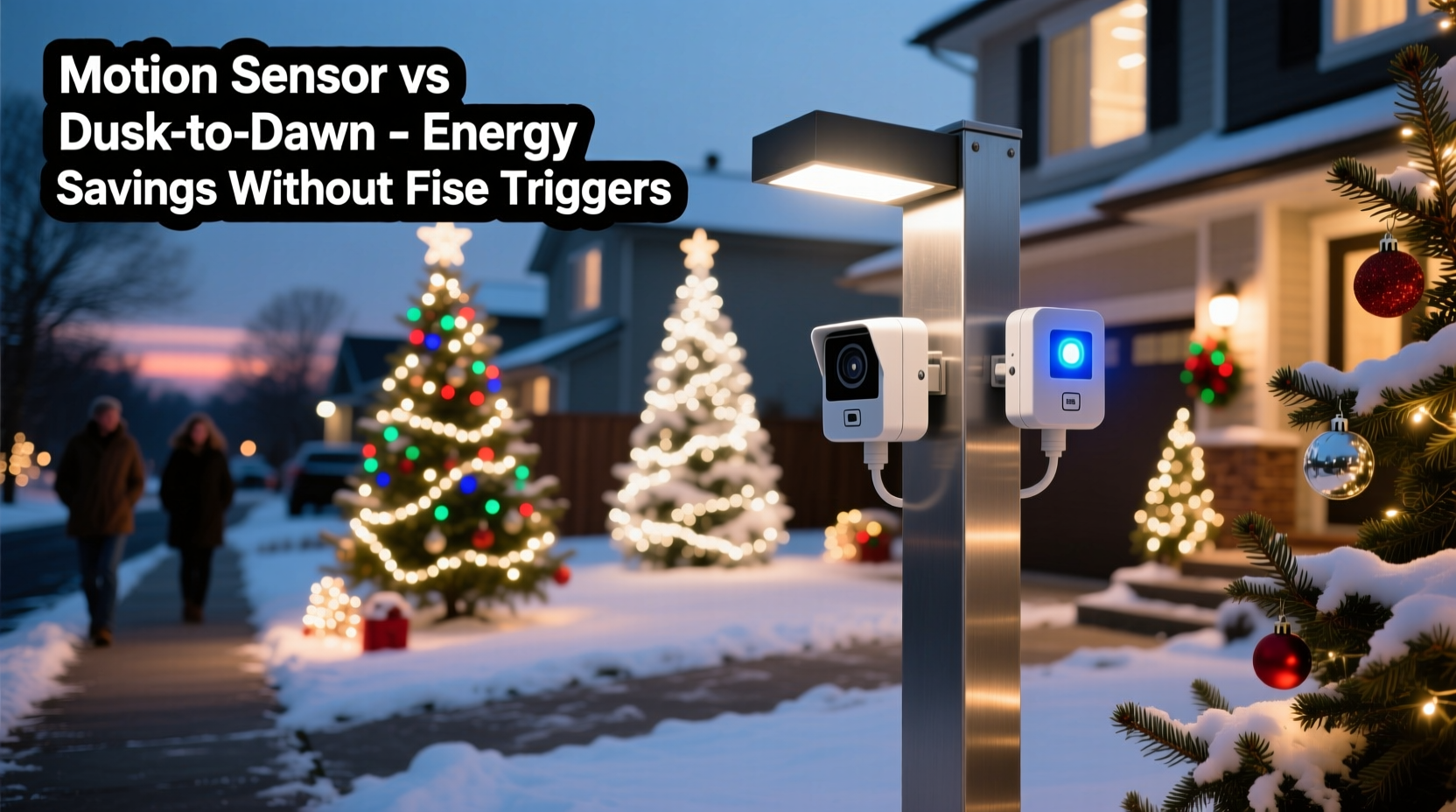
Before comparing performance, understand what each device measures—and what it ignores.
A dusk-to-dawn sensor uses a photocell (light-dependent resistor) to detect ambient light levels. When illumination drops below a preset threshold—typically around 10–30 lux (similar to moonlight on a clear night)—the circuit closes and powers the lights. At dawn, when light rises above that threshold, the circuit opens and shuts them off. It operates on a fixed, daily cycle. No movement required. No intelligence beyond light intensity.
A motion sensor, most commonly a passive infrared (PIR) unit, detects changes in thermal radiation within its field of view. It doesn’t “see” people—it senses rapid shifts in infrared heat patterns caused by warm bodies moving across cooler backgrounds. Crucially, it does not respond to steady-state heat (e.g., a parked car engine), slow temperature drifts (e.g., sunset), or non-thermal stimuli like wind-blown branches—unless poorly calibrated.
The key distinction is temporal resolution: dusk-to-dawn sensors act on time-of-day proxies; motion sensors act on behavioral presence. One answers “When is it dark?” The other answers “Is someone here *now*?”
Energy Waste Patterns: Where Each Sensor Fails (and Succeeds)
Energy waste isn’t just about runtime—it’s about irrelevant runtime. Here’s how each sensor contributes to—or prevents—three common inefficiencies:
- Overnight glow: Lights remaining on from midnight to 5 a.m. when no one is outside.
- Twilight gaps: Lights failing to activate during the critical 30–45 minutes after sunset when visibility drops but ambient light hasn’t yet fallen below the photocell’s threshold.
- False triggers: Unintended activation from non-human sources—wind, wildlife, headlights, or reflective surfaces.
Dusk-to-dawn sensors eliminate overnight glow only if paired with a manual timer or smart controller. By design, they stay on all night. Motion sensors eliminate overnight glow entirely—but only if configured correctly. Their weakness lies in twilight gaps: many PIR units won’t activate unless lights are already powered, meaning you need a secondary control layer (e.g., a dusk-to-dawn switch feeding power *to* the motion sensor).
False Trigger Analysis: What Really Sets Off Your Lights
False triggers aren’t random—they follow predictable physical causes. Understanding them reveals why sensor selection must match your environment—not just your calendar.
| Sensor Type | Common False Triggers | Root Cause | Mitigation Strategy |
|---|---|---|---|
| Dusk-to-Dawn | Lights flickering on/off at dawn/dusk; staying off during heavy overcast; turning on midday under dense tree canopy | Photocell misreading localized shade, reflected glare, or slow ambient shifts | Mount sensor away from eaves, trees, or reflective surfaces; choose models with adjustable lux thresholds (e.g., 5–100 lux range) |
| Motion (PIR) | Activation from passing cars, deer at 80 feet, swaying branches, heated exhaust vents, or HVAC units | Excessive sensitivity, wide detection angle (>120°), or poor mounting height (below 7 ft or above 12 ft) | Select narrow-field (90° max), pet-immune (dual-element) models; mount at 8–10 ft; use “pulse count” setting to require 2+ detections within 3 seconds |
Real-world testing by the Lighting Research Center at Rensselaer Polytechnic Institute found that standard PIR sensors mounted near driveways triggered falsely 3.2 times per hour during peak traffic hours—while dusk-to-dawn units installed under covered porches failed to activate 22% of evenings due to shadow interference. Neither is inherently “better.” Each excels where its physics align with site conditions.
Mini Case Study: The Suburban Front Porch Dilemma
Janet M., a homeowner in Portland, Oregon, installed identical LED string lights on her front porch and side path in 2022. She used a dusk-to-dawn sensor for the porch (visible from street) and a motion sensor for the side path (private access only). Her goal: safety and ambiance without wasting power.
By January, her porch lights had consumed 42 kWh—despite being rated at just 12 watts—because the photocell, mounted under a deep eave, interpreted overcast afternoons as “dusk,” keeping lights on 6–8 hours daily. Meanwhile, her side-path motion sensor rarely activated: mounted too low (5.5 ft), it detected only ankles—not torsos—and missed visitors approaching head-on. Wind-blown holly branches triggered it 4–5 times nightly, creating brief, disorienting flashes.
In November 2023, she upgraded: a dusk-to-dawn sensor with adjustable threshold (set to 15 lux) for the porch, now mounted on a north-facing wall clear of shadows; and a dual-tech motion sensor (PIR + microwave) for the path, set to 90° coverage and requiring two detections within 2 seconds. Result: porch runtime dropped 68% (to 13.5 kWh total), while path activation became 99% reliable for human approach—and zero false triggers from wind or wildlife.
Her takeaway: “It wasn’t about buying ‘smarter’ hardware. It was about matching the sensor’s operating logic to the exact geometry and microclimate of my space.”
Expert Insight: The Physics of Precision Lighting
“Most consumers treat sensors as binary switches—on or off. But energy efficiency in decorative lighting hinges on three layered decisions: when to supply power, when to initiate illumination, and how long to sustain it. A dusk-to-dawn sensor handles the first. A motion sensor handles the second. Only integrated systems—or careful manual staging—address the third. Ignoring that hierarchy guarantees waste.” — Dr. Lena Torres, Senior Lighting Engineer, Pacific Northwest National Laboratory
Dr. Torres’ team analyzed 147 residential holiday lighting installations across six climate zones. They found that combined dusk-to-dawn + motion systems reduced median energy use by 71% versus dusk-to-dawn alone, and by 89% versus always-on operation—without compromising perceived safety or welcome. Crucially, the biggest gains came not from sensor specs, but from installation discipline: correct orientation, height, shielding from stray light/heat, and calibration to local twilight duration.
Actionable Implementation Checklist
Don’t retrofit blindly. Follow this verified sequence before installing any sensor-controlled lighting:
- Map your twilight window: Use a free app like “Sun Surveyor” to log actual sunset-to-full-dark duration for your address over three December evenings. Note cloud cover and obstructions.
- Identify trigger zones: Walk your property at dusk. Mark where people naturally pause (steps, doorways, gates) and where non-human movement occurs (trees, driveways, vents).
- Choose sensor placement—not just type: For dusk-to-dawn: north-facing, unshaded, 6–8 ft high. For motion: 8–10 ft high, aimed across (not down) walkways, angled to avoid streetlights and reflective windows.
- Set lux thresholds deliberately: If adjustable, start at 20 lux for dusk-to-dawn (activates ~15 min after sunset); for motion, enable “pet immunity” and set pulse count to 2.
- Test for 72 hours: Monitor activation logs (if available) or manually note times. Adjust only after observing three full cycles—don’t optimize for one cloudy day.
FAQ: Practical Questions Answered
Can I combine both sensors—and is it worth the complexity?
Yes—and it’s often optimal. Wire the motion sensor *after* the dusk-to-dawn unit: the photocell supplies power only at night; the motion sensor then decides *when* to turn lights on within that window. This eliminates overnight glow while ensuring lights activate reliably at twilight. Modern plug-in “smart photocell + motion” combos (e.g., Philips Hue Outdoor Sensor or GE Enbrighten Dual Tech) simplify wiring and cost under $40.
Do LED lights make motion sensors more efficient?
Not inherently—but they enable smarter control. Because LEDs draw minimal power (often 0.5–3W per string), the energy penalty for brief false triggers is low. More importantly, their instant-on capability means motion sensors don’t need “warm-up” delays, allowing shorter, more precise activation windows (e.g., 30 seconds instead of 5 minutes). Pair high-efficiency LEDs with motion control, and you gain responsiveness without sacrificing savings.
Why do some dusk-to-dawn sensors work fine in summer but fail in winter?
Two reasons: First, shorter winter days mean the sensor experiences longer periods of low-light stress, accelerating photocell degradation. Second, snow accumulation on the sensor lens or nearby reflective surfaces (white siding, snow-covered ground) floods the cell with diffuse light, raising the effective lux reading and delaying activation. Solution: Clean the lens monthly in snowy climates; choose sensors with built-in snow-shedding housings or downward-angled lenses.
Conclusion: Efficiency Is a System—Not a Setting
Choosing between a motion sensor and a dusk-to-dawn sensor isn’t choosing a tool—it’s choosing a philosophy of energy use. Dusk-to-dawn says, “Light belongs to the darkness.” Motion sensing says, “Light belongs to the moment.” Neither is universally superior. The most energy-efficient solution respects both truths: it delivers light only when darkness falls and presence is detected—calibrated precisely to your home’s orientation, your neighborhood’s rhythms, and your family’s habits. That requires observation before installation, measurement before adjustment, and patience before judgment. Stop treating sensors as plug-and-play accessories. Start treating them as intentional interfaces between your home and the natural world. Your electricity bill—and your neighbors’ appreciation for thoughtful, non-intrusive lighting—will reflect that shift.




 浙公网安备
33010002000092号
浙公网安备
33010002000092号 浙B2-20120091-4
Comments
No comments yet. Why don't you start the discussion?