
When it comes to decorating outdoor shrubs and bushes for the holidays, one of the most common dilemmas homeowners face is choosing between Christmas light net lights and traditional string lights. Both options offer festive appeal, but they differ significantly in terms of installation speed, coverage efficiency, and long-term usability. For those aiming to streamline their holiday decorating without sacrificing visual impact, understanding the strengths and limitations of each type is essential.
The decision isn’t just about aesthetics—it’s also about time, effort, and durability. A single large bush can take anywhere from 20 minutes to over an hour to decorate, depending on the lighting method used. With many people balancing busy schedules during the holiday season, efficiency becomes a critical factor. This guide compares net lights and string lights head-to-head, focusing specifically on how quickly and easily each can cover bushes, while also addressing longevity, cost, storage, and real-world performance.
Understanding Net Lights and String Lights
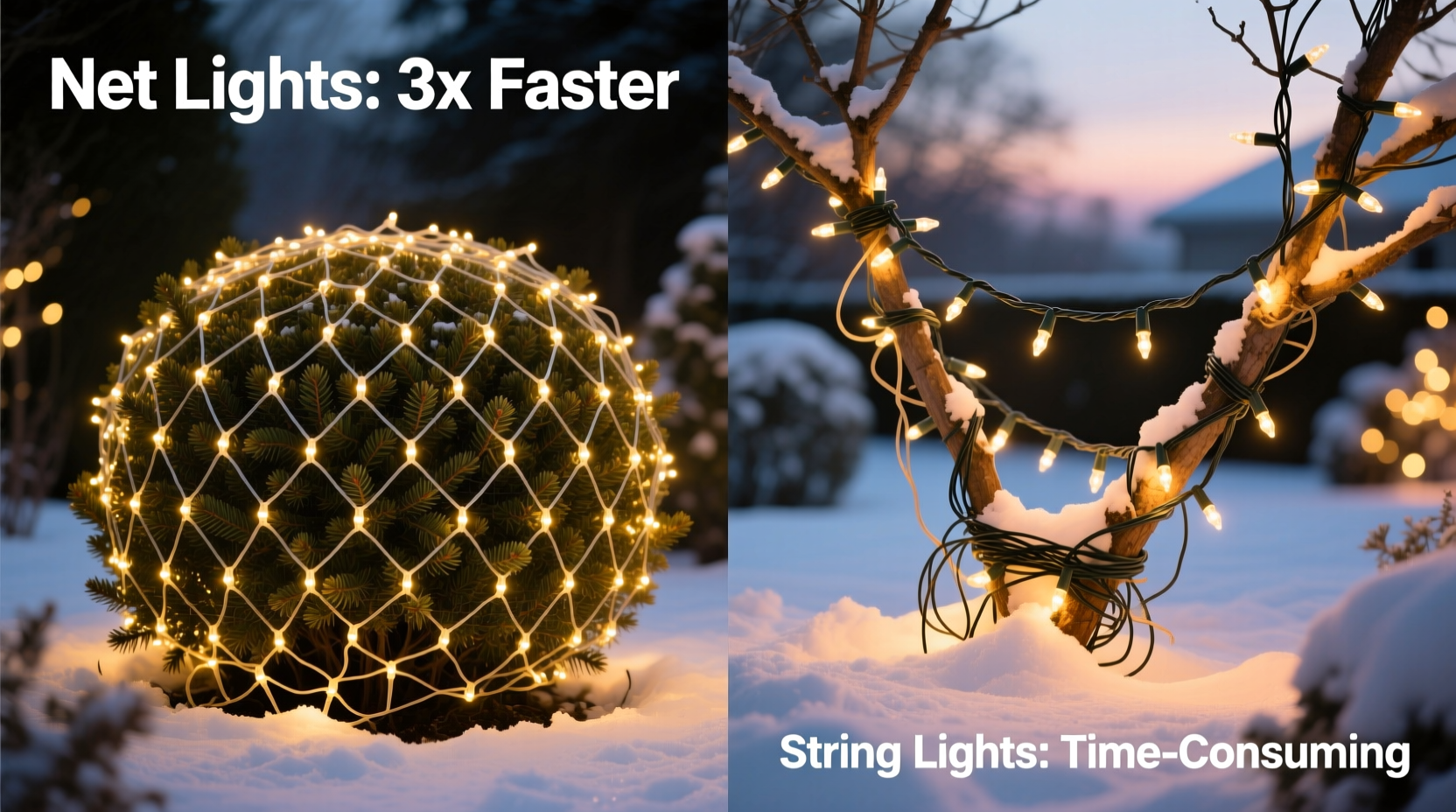
Before diving into performance comparisons, it's important to define what net lights and string lights are—and how they're constructed differently.
Net lights consist of strings of mini LED bulbs woven into a grid pattern that resembles a fishing net. The bulbs are evenly spaced, typically in 6-inch or 12-inch intervals, and the entire assembly forms a flat, rectangular or square sheet. These are designed to drape directly over bushes, hedges, or small trees, offering uniform illumination with minimal adjustment.
String lights, on the other hand, are linear strands—usually ranging from 25 to 100+ feet—that require manual wrapping, weaving, or draping around foliage. They come in various bulb sizes (C6, C7, C9, mini) and styles (warm white, multicolor, icicle), allowing for creative flexibility but demanding more labor during installation.
While both types use similar LED technology and can be energy-efficient and weather-resistant, their structural design leads to vastly different user experiences when applied to landscaping features like bushes.
Coverage Speed and Installation Ease
When the goal is to cover bushes quickly and efficiently, net lights have a clear advantage. Their ready-made structure allows users to simply unroll the net and lay it over the top and sides of a bush. Most models include corner loops or tie points, enabling quick anchoring with zip ties or garden wire. A medium-sized bush (approximately 3–4 feet tall) can be fully illuminated in under 10 minutes with a properly sized net light.
In contrast, using string lights on the same bush requires careful planning and physical effort. The user must weave the strand through branches, ensuring even spacing and avoiding dark spots. This process often involves stepping back frequently to assess coverage, adjusting tangled sections, and managing excess cord length. On average, wrapping a comparable bush with string lights takes 30 to 45 minutes—even for experienced decorators.
A side-by-side test conducted by a suburban homeowner in Minnesota revealed that covering three identical arborvitae bushes took 25 minutes with net lights versus 105 minutes using standard 100-light string sets. The time difference was largely attributed to the repetitive motion required to secure individual wraps and prevent slippage.
“Net lights are the fastest way to achieve full, even coverage on compact shrubs. If you're decorating multiple bushes and short on time, they’re hard to beat.” — Daniel Reeves, Landscape Lighting Designer
Comparison Table: Net Lights vs String Lights for Bush Coverage
| Feature | Net Lights | String Lights |
|---|---|---|
| Installation Time (per medium bush) | 5–10 minutes | 30–45 minutes |
| Coverage Uniformity | High – even bulb spacing | Variable – depends on skill |
| Bush Shape Flexibility | Moderate – best for rounded, symmetrical shapes | High – adaptable to irregular forms |
| Storage Size | Larger footprint when stored | Compact when coiled |
| Durability (Outdoor Use) | Good – but edges prone to snagging | Excellent – replaceable sections |
| Cost per Square Foot Covered | $0.80–$1.20 | $0.50–$0.90 |
| Reusability Over Years | Fair – damage to one bulb affects grid | High – modular replacement possible |
Real-World Example: A Front Yard Transformation
Sarah Thompson, a homeowner in Portland, Oregon, decided to upgrade her front yard holiday display two years ago. Her property includes six boxwood bushes flanking the walkway and two larger holly bushes near the porch. In her first attempt, she used traditional string lights—spending nearly three evenings after work to complete the job.
“I kept running out of lights or ending up with gaps,” she recalls. “One night, I dropped a strand into a wet bush and had to wait two days for it to dry before continuing. It was frustrating.”
The following year, she invested in four custom-sized green net lights designed for shrubbery. With help from her teenager, she covered all eight bushes in less than 40 minutes. “It felt like cheating,” she said. “We just laid them on top, tucked the edges slightly into the branches, and secured the corners. The look was instantly fuller and more professional.”
However, Sarah noted one limitation: the largest holly bush had an uneven, sprawling shape that didn’t align well with the rectangular net. Some areas were over-covered, while thin outer branches remained dim. For this reason, she now uses a hybrid approach—net lights for the boxwoods and string lights for the irregularly shaped hollies.
Step-by-Step Guide: How to Cover Bushes Efficiently
Whether you choose net lights or string lights, following a structured process ensures faster results and better-looking outcomes. Here’s a proven sequence:
- Assess bush size and shape – Measure height, width, and density. Round, compact bushes suit net lights; wide, irregular ones may need string lights.
- Select the right product – For net lights, ensure dimensions match or slightly exceed the bush. For string lights, calculate needed length (rule of thumb: 100 lights per cubic foot of bush volume).
- Test lights before installation – Plug in to check for dead bulbs or wiring issues. Fix or replace beforehand.
- Begin at the top (for net lights) – Drape the net over the highest point and gently pull down across sides. Tuck edges into outer foliage to prevent wind lift.
- Weave from inside out (for string lights) – Start near the trunk and spiral outward, maintaining consistent spacing. Use a ladder for even vertical distribution.
- Secure in place – Use UV-resistant zip ties, garden twist ties, or hook-and-loop straps. Avoid metal wire that can cut into cords.
- Connect to power source – Use outdoor-rated extension cords and GFCI outlets. Consider timers for automatic operation.
- Inspect and adjust – Walk around the bush at night to identify dark zones or glare spots. Make minor tweaks as needed.
This systematic method reduces rework and helps avoid common pitfalls like overloading circuits or creating hazardous trip wires along pathways.
Long-Term Considerations: Durability and Storage
While net lights win in initial setup speed, their long-term practicality depends heavily on care and storage. Because the entire grid is interconnected, damaging one section—such as a chewed wire from squirrels or a torn mesh corner—can render the whole unit unusable unless repaired. Repairs are possible with splice kits, but they often affect waterproofing and aesthetic neatness.
String lights, being modular, allow for easier maintenance. If a segment fails, it can be replaced individually in many cases (especially with shunt-wired LEDs). Additionally, string lights coil neatly and store in smaller containers, making them ideal for homes with limited seasonal storage space.
That said, high-quality net lights with reinforced corners and commercial-grade wiring can last five or more seasons with proper handling. Look for models labeled “heavy-duty” or “landscape-grade” if you plan to reuse them annually.
Checklist: Choosing the Right Option for Your Needs
- ✅ Do you have multiple similarly shaped bushes? → Choose net lights for speed
- ✅ Are your bushes large, tall, or irregularly shaped? → Lean toward string lights for control
- ✅ Is installation time a major constraint? → Net lights save significant labor
- ✅ Do you have limited storage space? → String lights are more compact
- ✅ Are you on a tight budget? → String lights generally cost less per foot
- ✅ Do you want maximum customization? → String lights allow layered, directional effects
- ✅ Are you decorating only one or two bushes? → Either option works—prioritize ease
Frequently Asked Questions
Can I use net lights on tall, narrow bushes?
Yes, but only if the net dimensions match the bush profile. Standard rectangular nets may leave gaps on very tall or slender bushes. Consider vertical-oriented net lights or supplement with string lights on upper sections.
Are net lights safe for live plants?
Yes, especially LED versions, which emit minimal heat. However, avoid pulling too tightly or restricting airflow around foliage. Remove lights after the season to prevent bark abrasion or moisture trapping.
Can I connect multiple net lights together?
Some models are linkable (check manufacturer specs), but many are not due to higher total wattage. Always verify maximum load limits to avoid circuit overload or fire risk. When in doubt, power each net separately using a multi-outlet timer.
Final Recommendation: Match the Tool to the Task
For speed and simplicity in covering bushes, **net lights are superior**—particularly for homeowners with several similarly shaped shrubs and limited weekend hours. Their plug-and-play nature delivers instant, full coverage with minimal learning curve. If your landscape features orderly rows of boxwoods, yews, or dwarf conifers, net lights will transform them into glowing holiday accents in minutes.
However, **string lights remain the more versatile and durable choice** for complex landscapes, larger installations, or those who enjoy hands-on decorating. They offer greater creative control, easier repairs, and better storage efficiency. Over time, they may also prove more economical, especially when replacing damaged sections instead of entire grids.
The smartest approach may be a hybrid strategy: use net lights for fast, broad coverage on easy-to-reach bushes, and reserve string lights for accent pieces, taller plants, or areas needing depth and dimension. This balances efficiency with visual richness, giving you the best of both worlds.




 浙公网安备
33010002000092号
浙公网安备
33010002000092号 浙B2-20120091-4
Comments
No comments yet. Why don't you start the discussion?