
When it comes to holiday decorating, few elements create instant festive charm like illuminated greenery. Shrubs and bushes, often positioned near entryways or along garden paths, become natural focal points during the Christmas season. But choosing between Christmas light nets and traditional string lights can significantly affect how quickly—and effectively—you cover those plants. While both options deliver sparkle, their design, application method, and efficiency vary greatly. Understanding these differences helps you make a smarter, faster decorating decision—especially when time is short and temperatures are dropping.
Design and Structure: What Sets Them Apart?
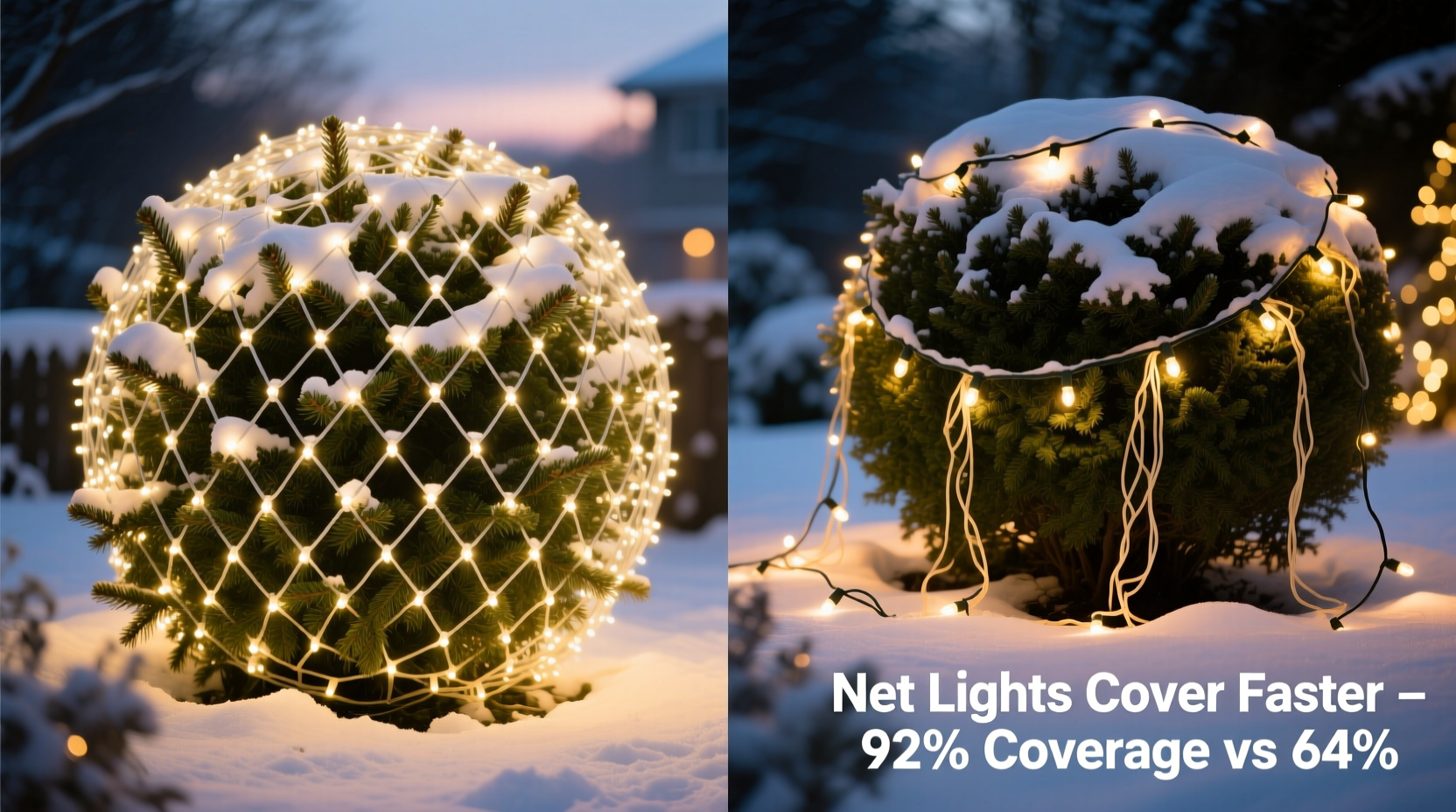
The fundamental difference between net lights and string lights lies in their physical construction and intended use. String lights are linear—individual bulbs spaced evenly along a single wire, meant to be draped, wrapped, or zig-zagged across surfaces. Net lights, on the other hand, consist of strings of bulbs woven into a grid pattern that resembles fishing netting, typically in rectangular or square layouts.
This structural distinction has direct implications for bush coverage. A standard string of 50–100 lights may require meticulous weaving through branches to achieve even illumination. In contrast, a single panel of net lights can drape over an entire shrub like a glowing blanket, instantly lighting up the surface with minimal effort.
Net lights are especially effective on dense, rounded bushes such as boxwoods, hollies, or junipers. Their flat, grid-like format conforms well to broad, outward-facing foliage. String lights offer more flexibility in shaping but demand significantly more time to wrap around individual limbs for full effect.
Coverage Speed: How Fast Can You Light a Bush?
Speed is often the deciding factor during holiday prep, particularly for homeowners managing multiple landscaping features. When covering bushes, net lights consistently outperform string lights in terms of installation time.
A typical medium-sized bush (approximately 3 feet wide and 2 feet deep) takes about 2–4 minutes to cover with a properly sized net light panel. Simply lay the net over the plant, tuck the edges slightly into the outer branches, and plug it in. The grid structure ensures bulbs are already distributed across the surface, eliminating the need for manual spacing.
In contrast, wrapping the same bush with string lights usually takes 10–20 minutes. Achieving uniform brightness requires careful back-and-forth draping to avoid dark spots. The process becomes even slower if the bush has irregular contours or thorny branches that resist manipulation.
“Time efficiency is one of the biggest advantages of net lights. For homeowners with multiple shrubs, switching from string to net lights can cut total decoration time by half.” — Laura Simmons, Landscape Lighting Designer & Holiday Decor Consultant
Comparison Table: Net Lights vs String Lights for Bush Coverage
| Feature | Net Lights | String Lights |
|---|---|---|
| Installation Time per Bush | 2–4 minutes | 10–20 minutes |
| Coverage Uniformity | High – consistent bulb spacing | Variable – depends on installer skill |
| Best For Bush Type | Dense, compact, low-profile shrubs | Tall, narrow, or sculpted bushes |
| Storage Size | Bulkier due to rigid grid | Compact when coiled |
| Reusability & Durability | Moderate – wires can snag | High – flexible, less prone to damage |
| Cost (Average per Panel/Strand) | $12–$20 | $8–$15 |
Step-by-Step: Installing Net Lights on a Bush
If you're considering net lights for the first time, follow this straightforward process to maximize speed and effectiveness:
- Measure the bush: Use a tape measure to determine width and depth. Choose a net light panel that matches or slightly exceeds these dimensions.
- Select the right bulb count: For a 3x2 foot bush, a 50-bulb net (typically 4x6 feet) provides ample coverage with room to adjust.
- Lay the net flat: Unroll the net on the ground first to check for damaged bulbs or tangled wires.
- Drape from the front: Starting at the top center, gently place the net over the bush, letting gravity pull it down evenly.
- Tuck the edges: Use gloved hands to tuck the sides slightly into the outer foliage to prevent sagging and improve 3D visibility.
- Secure if needed: For windy areas, use plastic-coated landscape staples or zip ties to anchor corners to nearby stakes or mulch rings.
- Test and adjust: Plug in the lights to confirm all bulbs work and reposition if shadows appear on one side.
This entire process rarely exceeds five minutes once you’re familiar with the technique—making net lights ideal for weekend decorators or last-minute holiday preparations.
Real-World Example: A Suburban Holiday Upgrade
The Peterson family in Portland, Oregon, maintains four large boxwood shrubs flanking their front walkway. For years, they used traditional string lights, spending nearly an hour each season draping 100-light strands in a crisscross pattern. Despite the effort, coverage was uneven, with some sections brighter than others.
Last year, they switched to 4x6-foot green-wire net lights with 50 warm-white LED bulbs each. With two people working, they covered all four bushes in under 15 minutes. “It was almost too easy,” said Mark Peterson. “We used to argue about who had to do the lights. Now we finish early and have time to test our new wreath display.”
The visual result was also more cohesive. Neighbors commented on the professional appearance, and the city included their home in its annual holiday walking tour. The Petersons now store the nets in labeled fabric bins, preserving them for reuse each December.
When String Lights Still Win
Despite the speed advantage of net lights, string lights remain the better choice in certain scenarios. Tall, columnar shrubs like arborvitae or Italian cypress benefit from vertical wrapping techniques that net panels cannot replicate. Similarly, multi-tiered or widely spaced bushes may leave gaps when covered with a single net, requiring additional strands anyway.
String lights also allow greater creative control. You can highlight specific branches, create spirals, or integrate ornaments directly onto the wire. For DIY enthusiasts or those aiming for a custom look, the extra time investment pays off in artistic expression.
Moreover, string lights are easier to repair. If one bulb fails on a net panel, the entire section may go dark due to series wiring. With many modern string lights using parallel circuits, a single dead bulb won’t disrupt the rest.
Checklist: Choosing the Right Option for Your Landscape
- ✅ Measure your largest bush—width, height, and depth
- ✅ Count how many shrubs you plan to illuminate
- ✅ Decide whether speed or customization is your priority
- ✅ Check if your outdoor outlets are GFCI-protected and within reach
- ✅ Choose LED bulbs for energy efficiency and cooler operation
- ✅ Opt for green or brown wires to blend with foliage
- ✅ Verify if lights are rated for outdoor use and connected-load compatible
- ✅ Plan storage—nets need flatter, wider containers than coiled strings
Frequently Asked Questions
Can I connect multiple net lights together?
Yes, but only if the product specifies “connectable” or “end-to-end” capability. Most net lights support linking 2–3 panels before overloading the circuit. Always check the manufacturer’s limit and total wattage against your outlet’s capacity.
Are net lights safe for evergreen bushes?
Yes. Modern LED net lights produce minimal heat, making them safe for direct contact with needles and bark. Avoid older incandescent models, which can dry out foliage over time. Also, ensure wires aren’t tied too tightly, which could restrict growth.
Can I cut net lights to fit a smaller bush?
No. Cutting the wires will break the circuit and disable the entire panel. Instead, drape excess netting behind the bush or let it fall naturally to the ground for a cascading effect. Trimming is only safe on non-electrical support strings, if present.
Final Recommendation: Prioritize Speed and Simplicity
For most homeowners looking to cover bushes quickly and effectively, net lights are the superior choice. Their ready-made layout eliminates guesswork, reduces installation time by up to 75%, and delivers a polished, uniform glow that enhances curb appeal with minimal effort. While string lights offer versatility and repairability, they demand significantly more labor—especially when decorating multiple plants.
The real value of net lights emerges during the hectic holiday season, when every saved minute counts. Whether you're preparing for guests, managing a tight schedule, or simply want to enjoy more time with family, choosing the faster option doesn’t mean sacrificing beauty—it means working smarter.
“The best holiday lighting isn’t the most complex—it’s the one that goes up fast, looks great, and comes down safely. Net lights hit that sweet spot for shrubbery.” — Derek Langston, Professional Holiday Lighting Installer, North Carolina
Take Action This Season
This year, evaluate your landscape with efficiency in mind. Identify which bushes would benefit most from rapid coverage and consider investing in a few high-quality net light panels. Test them on one shrub first, compare the results with your old method, and scale up based on what works. With the right tools, you can transform your yard’s nighttime presence in under an hour—leaving more time to savor the season.




 浙公网安备
33010002000092号
浙公网安备
33010002000092号 浙B2-20120091-4
Comments
No comments yet. Why don't you start the discussion?