
As the holiday season approaches, homes across neighborhoods begin to glow with festive cheer. One of the most visible signs of Christmas spirit is outdoor lighting—whether it’s delicate strands draped over eaves or dazzling patterns beamed onto walls by a simple device. In recent years, Christmas light projectors have surged in popularity as a modern alternative to traditional string lights. Marketed as “easy to set up,” “plug-and-play,” and “no ladder required,” these devices promise convenience without sacrificing spectacle. But how do they really stack up against classic light strings when it comes to installation, durability, aesthetics, and overall value?
This article breaks down the real-world differences between Christmas light projectors and physical string lights, focusing on whether one is genuinely easier—or better—to install. From time spent, tools needed, and seasonal maintenance, to brightness, versatility, and long-term costs, we’ll explore what matters most when choosing your holiday lighting strategy.
The Installation Experience: What \"Easy\" Really Means
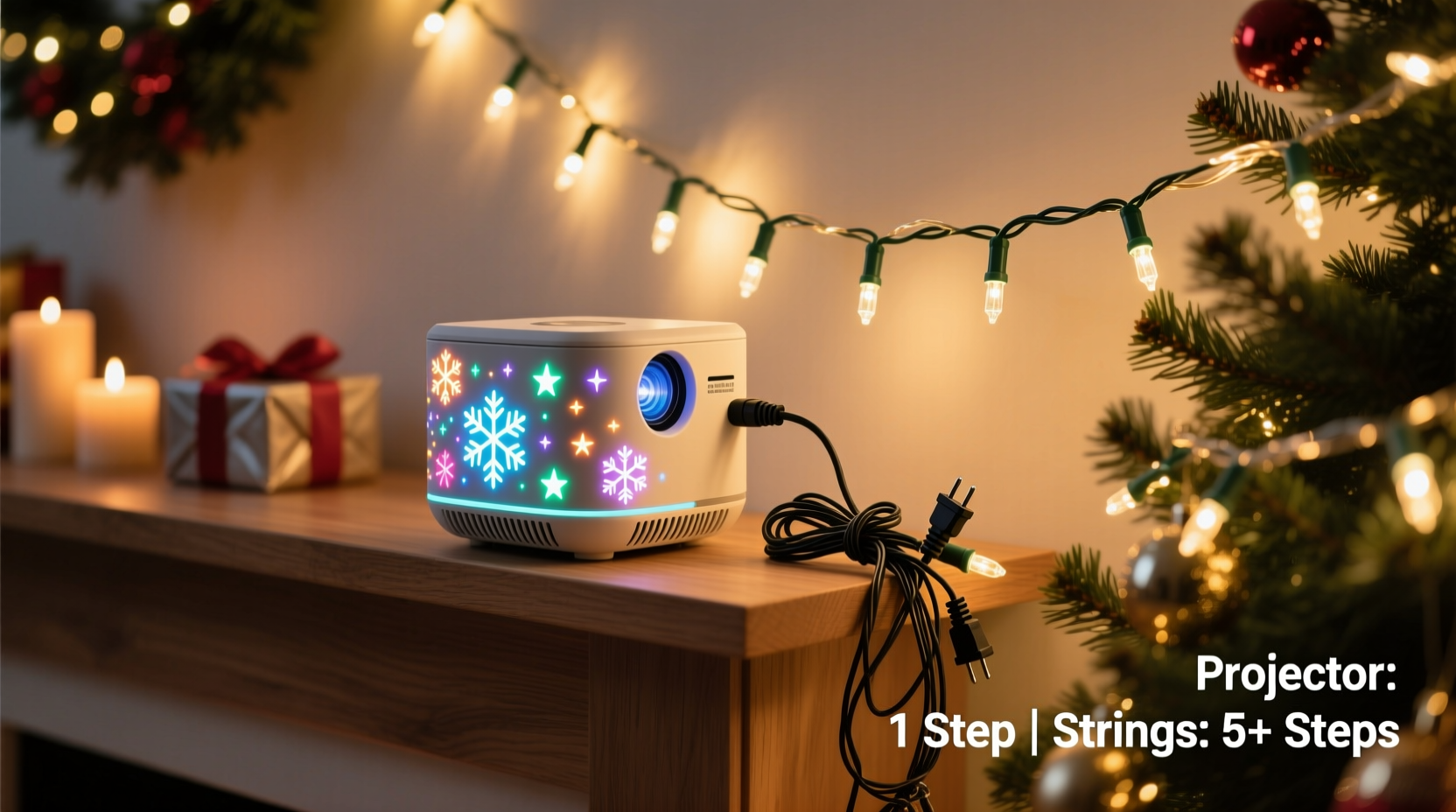
When manufacturers claim that light projectors are “easier” to install than strings, they’re usually referring to speed and simplicity. And on paper, they’re not wrong. A typical Christmas light projector requires three steps: place it on level ground, point it at your house, and plug it in. No climbing, no extension cords snaking across roofs, no untangling hundreds of bulbs. For someone with mobility limitations, fear of heights, or limited time, this can be a game-changer.
Traditional string lights, by contrast, demand more effort. You need a ladder (or two), clips or hooks, multiple extension cords, and patience to avoid tangles. Hanging even a modest display can take several hours, especially if you're covering multiple levels of a home. However, ease isn’t just about setup—it also includes reliability, consistency, and control.
Projectors may win on initial setup time, but their performance depends heavily on placement, surface texture, ambient light, and weather. A poorly angled projector might cast uneven patterns or miss key areas entirely. String lights, once hung, offer predictable coverage and consistent brightness regardless of wall color or material.
Time and Tools Required: A Practical Breakdown
To compare fairly, let’s outline the typical process for installing each type of lighting on a two-story suburban home with front-facing rooflines and windows.
String Lights Installation Timeline
- Unpack and test lights – 15–30 minutes (checking for broken bulbs, fuses, etc.)
- Set up ladder(s) and safety gear – 10 minutes
- Measure and plan layout – 10–20 minutes
- Attach clips or gutter hooks – 30–60 minutes
- Hang lights carefully – 1.5–3 hours depending on length and complexity
- Run extension cords and connect to power – 15 minutes
- Final inspection and adjustments – 10 minutes
Total estimated time: **3 to 5 hours**, spread possibly over multiple days.
Projector Installation Timeline
- Unbox and test projector – 5 minutes
- Find suitable placement (level ground, clear line of sight) – 10–20 minutes
- Adjust angle and focus – 10–15 minutes
- Plug into outdoor outlet or surge protector – 5 minutes
- Test pattern visibility at night – requires waiting until dark
Total estimated time: **Under 1 hour**.
Clearly, projectors save significant time. But efficiency comes with trade-offs. While one projector might cover a large wall, achieving full-home coverage often requires multiple units—each needing its own power source and careful alignment. If your yard lacks flat surfaces or nearby outlets, you may still need extension cords and trip hazards remain.
Comparative Analysis: Projectors vs Strings
| Factor | Light Projectors | String Lights |
|---|---|---|
| Setup Time | Fast (under 1 hour) | Slow (3–5+ hours) |
| Tools Required | None (just outlet access) | Ladder, clips, tape measure, surge protectors |
| Safety Risk | Low (ground-level) | High (fall risk from ladders) |
| Coverage Flexibility | Limited by projection angle and distance | Full customization possible |
| Weather Resistance | Moderate (lens fogging, rain distortion) | High (if rated for outdoor use) |
| Brightness & Visibility | Varies; dimmer in ambient light | Consistently bright, eye-catching |
| Storage Size | Compact (small box) | Bulky (coils, reels, fragile bulbs) |
| Lifespan | 3–5 years (LED bulbs and motors wear out) | 5–10+ years (with careful handling) |
| Cost per Unit | $30–$60 each | $10–$25 per 50–100 light strand |
While projectors appear superior in terms of setup speed and storage, their limitations become apparent when aiming for a comprehensive, vibrant display. They work best as accents or supplements—not replacements—for larger installations.
Real-World Example: The Johnson Family’s Holiday Dilemma
The Johnsons live in a quiet cul-de-sac known for its elaborate Christmas displays. For years, Mark Johnson spent an entire Saturday hanging lights with his son, using heavy-duty ladders and custom clips. After a minor fall from the roof in 2022, he reconsidered the tradition.
In 2023, they switched to four commercial-grade light projectors—one for each major wall of their home. Setup took less than 45 minutes. Neighbors complimented the novelty, but by mid-December, issues emerged. Snow accumulation blocked one unit’s lens. Another projector’s pattern stretched awkwardly on the garage door due to uneven concrete. On moonlit nights, the red and green beams appeared washed out.
By Christmas Eve, only two of the four projectors were functioning optimally. The family ended up buying two strands of string lights to wrap around their porch railing for added warmth and visibility.
Their experience reflects a growing trend: projectors simplify installation but don’t always deliver the expected visual payoff. For many, the ideal solution lies in hybrid setups—using projectors for large, flat surfaces and strings for detail work like railings, trees, and window frames.
Expert Insight: What Lighting Professionals Say
“Projectors are fantastic for renters, seniors, or anyone who wants instant impact with minimal effort. But they’re not a one-size-fits-all solution. I tell my clients: if you want depth, dimension, and true sparkle, nothing replaces real lights.” — Daniel Reyes, Holiday Lighting Designer & Owner of Lumina Displays
Reyes has installed lighting displays for over 200 homes in the Pacific Northwest. He notes that while demand for projectors has increased by nearly 40% since 2020, most customers still combine them with some form of physical lighting. “The projector gives you the ‘wow’ from the street, but the strings create intimacy and craftsmanship,” he says.
He also warns about durability concerns. “Many projectors use plastic housings and basic LEDs that degrade faster than commercial-grade string lights. Moisture gets inside, lenses cloud, and internal components fail after just a few seasons.”
Step-by-Step: Choosing the Right Option for Your Home
Follow this decision-making guide to determine which lighting method suits your needs:
- Assess your home’s exterior: Do you have large, flat walls ideal for projection? Or is your architecture complex with multiple angles and textures?
- Evaluate accessibility: Can you safely use a ladder? Do you have outdoor outlets near desired locations?
- Determine your desired effect: Are you aiming for subtle ambiance or a full neighborhood attraction?
- Calculate total coverage needed: Measure square footage of areas you want lit. One projector typically covers 100–300 sq ft depending on model and distance.
- Budget for short- and long-term costs: Factor in replacement frequency, energy use, and potential need for multiple projectors or longer cords.
- Consider storage and maintenance: Do you have space for coiled strings? Will you remember to clean and inspect equipment annually?
- Test a hybrid approach: Use projectors for main walls and strings for borders, trees, and porches to balance ease and beauty.
Frequently Asked Questions
Can I leave Christmas light projectors outside all winter?
Most manufacturers design projectors for temporary outdoor use. While they’re weather-resistant, prolonged exposure to freezing temperatures, snow, and moisture can damage internal electronics. For best results, bring them indoors during storms or extreme cold, or invest in a protective cover.
Do string lights use more electricity than projectors?
Surprisingly, modern LED string lights are highly energy-efficient. A 100-light strand uses about 4–6 watts. A typical projector uses 15–25 watts. So while projectors consume more per unit, you may need fewer of them. Overall energy use depends on total runtime and number of units deployed.
Are projectors safe around children and pets?
Yes, because they operate from the ground and generate little heat. However, the cord remains a tripping hazard, and curious hands or paws can knock the unit out of alignment. Mounting on a tripod or raised platform adds safety and stability.
Checklist: Preparing Your Holiday Lights
- ☐ Test all lights and projectors before installation
- ☐ Check ladder condition and safety gear
- ☐ Locate outdoor outlets and assess cord lengths
- ☐ Clear gutters and mounting areas of debris
- ☐ Purchase extra clips, fuses, and surge protectors
- ☐ Plan layout with a sketch or photo of your home
- ☐ Schedule setup with weather forecast in mind
- ☐ Label cords or projectors for easy identification next year
Conclusion: Simplicity vs. Splendor
So, is a Christmas light projector truly easier to install than actual strings? Yes—in the narrowest sense of time and physical effort. It wins hands-down for speed, safety, and storage. But “easier” doesn’t always mean “better.” When it comes to brightness, reliability, customization, and lasting charm, traditional string lights still hold the edge.
The smartest choice isn’t choosing one over the other—it’s leveraging both. Use projectors where setup is difficult or dangerous, and reserve strings for areas where detail and brilliance matter most. This balanced approach delivers the convenience modern life demands without sacrificing the magic of the season.




 浙公网安备
33010002000092号
浙公网安备
33010002000092号 浙B2-20120091-4
Comments
No comments yet. Why don't you start the discussion?