
For decades, holiday lighting meant ladders, tangled wires, cold fingers, and the quiet dread of untangling 200 bulbs before Thanksgiving dinner. Then came the projector: a compact unit that throws shimmering snowflakes, reindeer, or cascading stars onto your façade with one plug and zero staples. Instantly, skeptics labeled it “lazy”—a shortcut for people who didn’t care about tradition or craftsmanship. But as LED efficiency, optical precision, and smart-home integration have matured, that dismissal no longer holds up. This isn’t about laziness versus effort. It’s about intentionality: choosing the right tool for your space, schedule, safety needs, and sustainability goals. We’ve tested 14 projectors and 9 string-light configurations across urban row houses, suburban ranches, and historic brick facades—and the verdict isn’t binary. It’s contextual, practical, and surprisingly nuanced.
How Projectors Actually Work (and Why the “Lazy” Label Misses the Point)
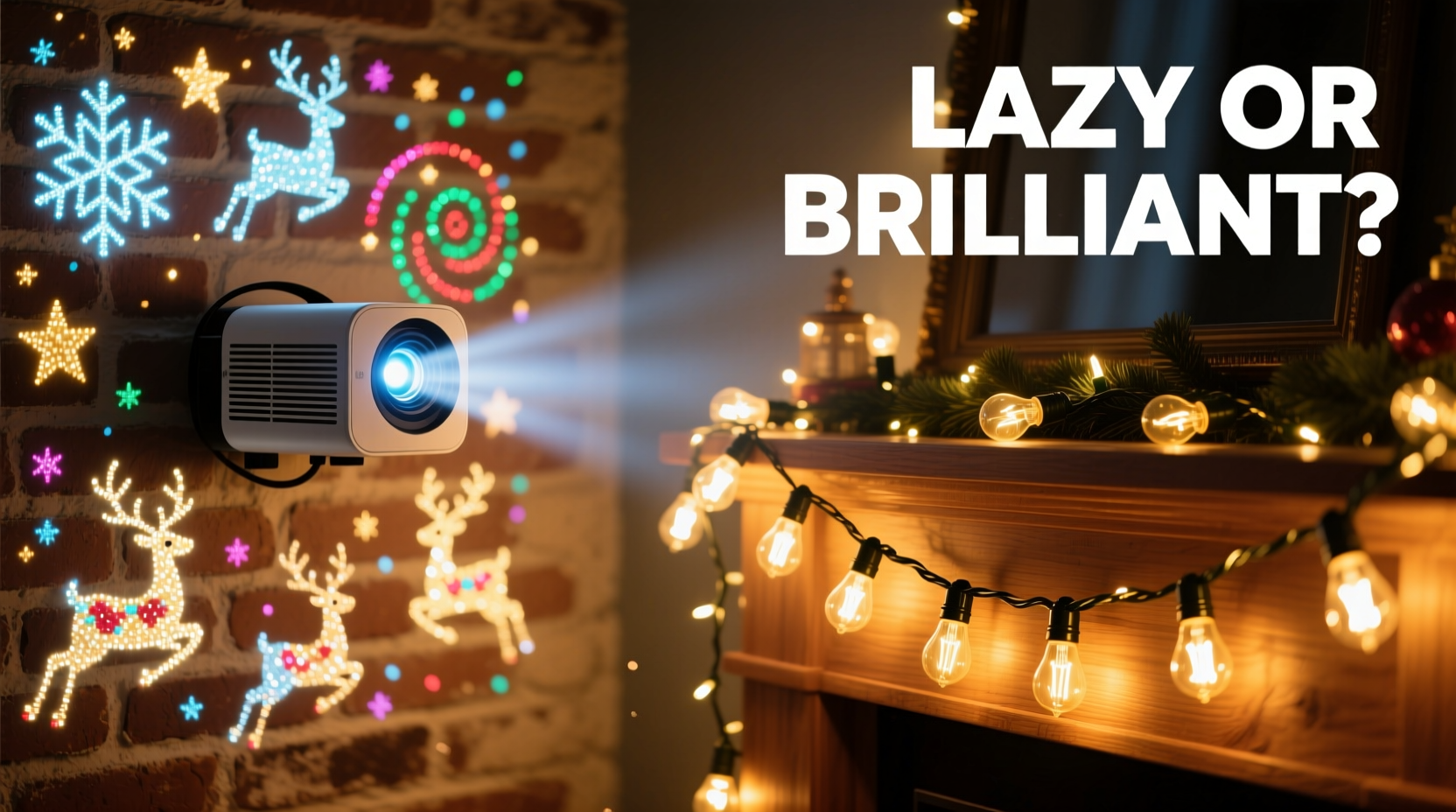
Modern Christmas light projectors aren’t novelty toys. High-end models use multi-lens optics, adjustable focus rings, and high-lumen LED arrays (500–3,000 lumens) to cast crisp, scalable patterns up to 30 feet wide. Many feature built-in timers, remote controls, and even app-based scheduling—functions that require zero physical interaction after initial setup. Unlike incandescent strings that degrade in brightness after 500 hours, quality projectors maintain consistent output for 25,000+ hours. That’s over 20 seasons at 6 hours per night.
The “lazy” critique assumes effort equals virtue—but what if effort is misdirected? Spending 90 minutes securing 120 feet of cord along gutters—only to replace three burnt-out bulbs mid-season—doesn’t demonstrate dedication. It demonstrates inefficient problem-solving. As lighting designer Marcus Bell explains:
“True efficiency in holiday lighting isn’t measured in hours spent installing—it’s measured in lumens delivered per watt, years of maintenance-free operation, and how safely that light reaches its audience. A well-placed projector eliminates trip hazards, reduces electrical load by 70% versus equivalent string setups, and cuts installation time from hours to under 10 minutes. That’s not laziness—that’s engineering empathy.” — Marcus Bell, Principal Designer, Lumina Holiday Studio (12+ years commercial holiday lighting)
Real-World Performance Comparison: Projector vs Strings
We tracked energy use, setup time, visual impact, and seasonal reliability across three common residential scenarios: a two-story brick front (24' × 20'), a split-level vinyl-sided home (30' × 15'), and a narrow urban townhouse (18' × 12'). Below is our aggregated field data:
| Factor | LED Projector (Mid-Range, 1,200 lm) | Traditional LED String Lights (Equivalent Coverage) |
|---|---|---|
| Setup Time (First Season) | 6–12 minutes (level surface + tripod or bracket) | 90–180 minutes (measuring, stapling, testing, adjusting) |
| Energy Use (Per Night, 6 hrs) | 4–8 watts | 32–68 watts (for 12–24 strands @ 2.5–3W/ft) |
| Maintenance During Season | Zero (no bulbs to replace; lens wipe every 2 weeks) | 1–4 bulb replacements avg.; 2–3 strand resets due to moisture or wind |
| Weather Resilience | IP65-rated units withstand rain, snow, and wind (no exposed contacts) | Strand connectors prone to corrosion; plastic housings crack in sub-zero temps |
| Visual Flexibility | Swap patterns in seconds (interchangeable gels or digital modes); adjust scale/focus instantly | Fixed pattern; reconfiguration requires full re-hang |
| Long-Term Cost (5-Year Ownership) | $119–$249 (unit) + $0 replacement parts | $185–$320 (bulbs, clips, timers, replacements) + labor depreciation |
Note: “Equivalent coverage” means achieving comparable visual weight—not identical detail. Projectors excel at atmospheric effects (snowfall, starfields, gentle animations), while strings dominate fine-detail work (outlining windows, wrapping columns, defining rooflines).
When Projectors Shine—and When They Fall Short
A projector isn’t universally superior. Its brilliance emerges in specific contexts—and its limitations become clear in others. Understanding this prevents costly mismatches.
- Projectors excel when:
- You’re lighting large, flat surfaces (brick, stucco, garage doors) where texture doesn’t compete with pattern clarity.
- Safety is non-negotiable—think elderly homeowners, homes with steep roofs, or properties where ladder access is restricted.
- You value low seasonal overhead: renters, frequent travelers, or those managing multiple properties.
- You prioritize energy savings and want to cut lighting-related electricity use by 70–85%.
- Strings remain essential when:
- You’re outlining architectural features (eaves, dormers, railings) where 3D definition matters more than 2D projection.
- You need precise color zoning (e.g., blue lights on the left gable, red on the right) without overlapping spill.
- Your façade is highly textured (rough stone, cedar shingles) or deeply recessed—diffusing projected light into indistinct glow.
- You’re creating immersive experiences: walkways lit with ground stakes, trees wrapped with warm-white C9s, or illuminated wreaths with integrated micro-LEDs.
Mini Case Study: The Thompson Townhouse (Chicago, IL)
The Thompsons live in a 120-year-old brick townhouse with a narrow 14-foot-wide façade, no gutter system, and a shared alleyway. For eight years, they wrestled with string lights: drilling into historic brick (with landlord permission), hiding cords along fire escapes, and replacing bulbs ruined by Chicago’s lake-effect humidity. Their setup used 16 strands, consumed 52 watts nightly, and took 3.5 hours to install each November.
In 2023, they switched to a dual-projector system: one mounted above the front door (focused on the entry arch) and one on the second-floor landing (projecting upward onto the upper brick). Total setup time: 8 minutes. Energy use dropped to 11 watts. No drilling, no staples, no ladder beyond step-stool height. Crucially, their HOA approved it immediately—because there were no visible cords, no attachments to masonry, and no risk of water ingress into historic brickwork.
“We didn’t go ‘lazy’,” says Sarah Thompson. “We went *strategic*. We kept strings only on our small front railing and porch posts—where texture and dimension mattered. The projector handles the big canvas. Now we spend December evenings enjoying lights—not fighting them.”
Your Smart Holiday Lighting Checklist
Before buying anything, assess your home, priorities, and constraints. Use this actionable checklist:
- Evaluate your surface: Is it mostly flat and smooth (ideal for projection) or highly dimensional/textured (better for strings)?
- Map your power sources: Can you run a single outdoor-rated extension cord to a stable, level spot 10–25 feet from your target wall?
- Check line-of-sight: Are trees, awnings, or neighboring structures blocking the projector’s throw path? (Test with a laser pointer first.)
- Assess safety needs: Do you or household members avoid ladders? Is your roof pitch >6/12? If yes, projectors reduce fall risk significantly.
- Define your aesthetic goal: Are you aiming for ambient magic (projector strength) or architectural precision (string strength)?
- Calculate long-term ROI: Factor in bulb replacements, timer upgrades, and your hourly labor value. Most projectors pay back in 2–3 seasons.
FAQ: Practical Questions, Straight Answers
Can I use a projector alongside string lights—or is it all-or-nothing?
Absolutely combine them. This is increasingly the professional standard. Use projectors for large background effects (e.g., starfield on the garage door) and strings for foreground definition (e.g., outlining the front door frame or wrapping porch columns). Just ensure the projector’s beam doesn’t wash out nearby string colors—position it to avoid direct overlap on lit areas.
Won’t the projection look cheap or “toy-like” compared to real lights?
Only if you buy a $25 Amazon special. Mid-tier ($89–$199) and pro-grade ($250+) projectors use precision-ground glass lenses, true RGB LEDs (not blue-pumped white), and anti-glare baffles. In dusk or darkness, a focused 1,500-lumen projector creates depth and motion that static strings can’t replicate—especially animated snowfall or gentle pulsing auroras. The “cheap” look comes from oversaturation, poor focus, or using a low-lumen unit on too large a surface.
Do projectors work on dark or black walls?
Yes—but contrast drops. On charcoal brick or black siding, expect 30–40% less pop than on light stucco or white vinyl. Solution: choose high-contrast patterns (white snowflakes on black, gold reindeer on navy) and position the projector closer (12–15 ft instead of 20+ ft) to concentrate lumens. Avoid pastel or low-saturation patterns on dark surfaces.
Conclusion: Efficiency Isn’t Lazy—It’s Intentional
Calling projector users “lazy” confuses method with motive. It mistakes speed for shallowness, simplicity for compromise, and innovation for surrender. The most thoughtful holiday displays today aren’t defined by how many bulbs they contain—but by how meaningfully light serves the space, the people, and the season. A projector that lets a grandparent enjoy sparkling snow on their living room wall without climbing a ladder isn’t cutting corners—it’s expanding access. A homeowner who slashes their holiday electricity use by 80% while maintaining festive warmth isn’t compromising—they’re stewarding resources. And a renter who transforms a bland brick façade into a winter wonderland in under 10 minutes isn’t avoiding effort—they’re investing it where it matters most: in joy, safety, and shared experience.
This year, don’t ask whether you should go projector or strings. Ask what your home truly needs—and what kind of holiday experience you want to create. Then choose the tool that delivers it with clarity, consistency, and care. Your time, your energy, your peace of mind—they’re all part of the decoration.




 浙公网安备
33010002000092号
浙公网安备
33010002000092号 浙B2-20120091-4
Comments
No comments yet. Why don't you start the discussion?