
As holiday seasons approach, homeowners face a recurring decision: traditional string lights or modern Christmas light projectors? Both promise festive cheer, but when weather turns harsh—especially with wind and rain—the real test begins. While string lights have decades of tradition behind them, projectors offer convenience and speed. But do they deliver when it matters most? This article dives deep into durability, performance, installation, and long-term reliability to help you make an informed choice.
Durability in Harsh Weather: Projector vs String Lights
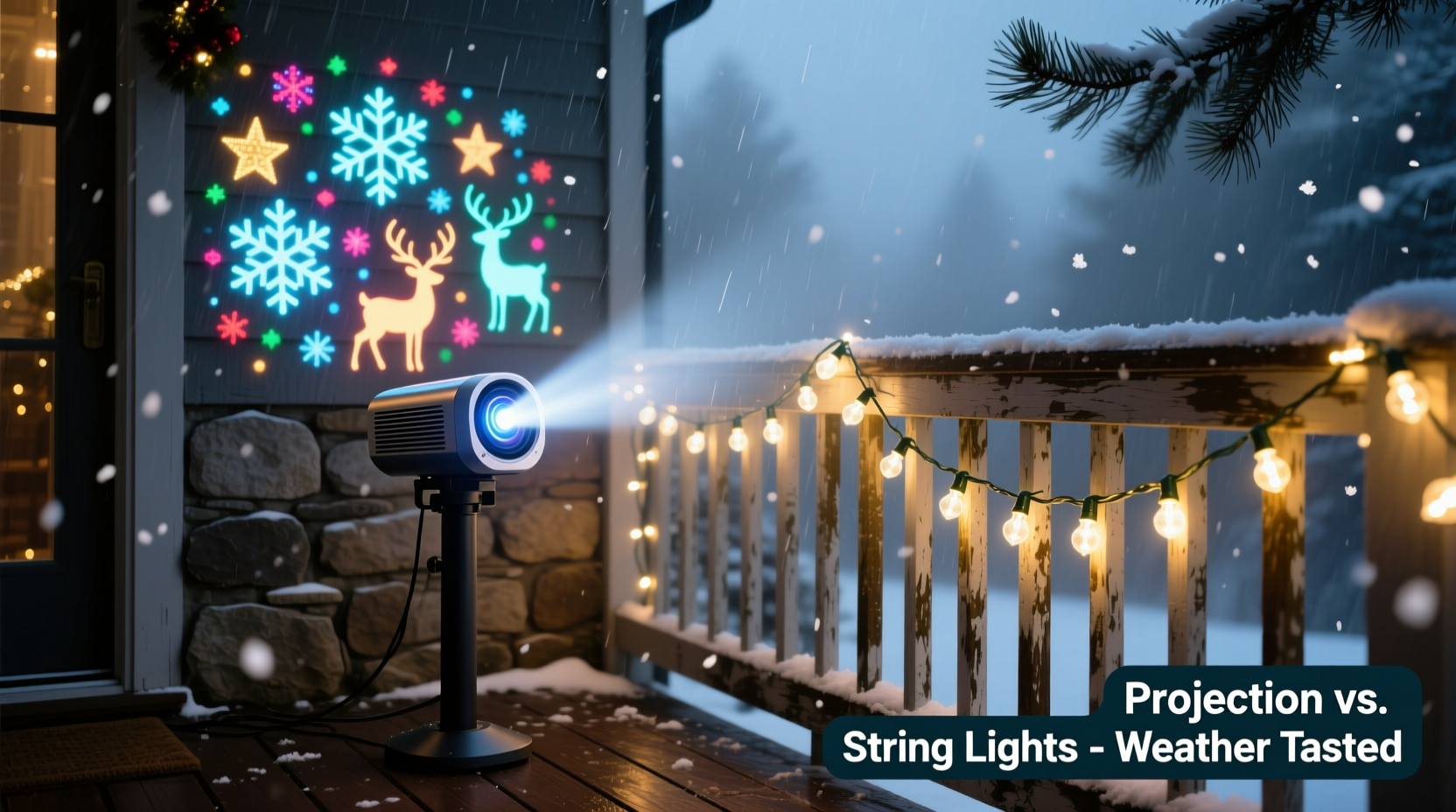
The core question isn’t just about brightness or coverage—it’s about resilience. Wind and moisture are the two biggest threats to outdoor holiday lighting. Traditional string lights, typically made with insulated wiring and weather-resistant bulbs (especially LED versions), are built for exposure. Many are rated IP44 or higher, meaning they can withstand splashing water and moderate wind without shorting or failing.
Christmas light projectors, on the other hand, rely on electronic components housed in plastic casings. Most models are designed for outdoor use and carry an IP65 rating—meaning they’re dust-tight and protected against low-pressure water jets from any direction. This makes them surprisingly resilient in rain. However, their vulnerability lies not in the housing, but in placement and stability.
A projector mounted on a wobbly surface or exposed to strong gusts may shift, tilt, or even fall. Unlike string lights that remain functional even if partially displaced, a misaligned projector can lose its entire light pattern. Rain pooling around the base or obstructing the lens can also reduce output or cause overheating if ventilation is blocked.
Installation and Setup: Speed vs Longevity
One of the biggest selling points of Christmas light projectors is ease of setup. Plug in, aim, and go. A single unit can cover an entire house facade with twinkling lights in under five minutes. No ladders, no tangled wires, no hours spent draping strands across gutters and trees.
String lights require significantly more time and effort. Installation involves untangling, testing individual strands, securing clips, and managing extension cords. However, this labor-intensive process comes with benefits: each section operates independently, so if one bulb fails or a wire gets damaged, the rest often stay lit. You can also customize layouts precisely—wrap trees, outline windows, or create patterns.
Projectors simplify setup but introduce dependency on a single point of failure. If the bulb burns out, the motor jams, or the power supply fails, the entire display goes dark. There’s no redundancy. And while many projectors come with backup bulbs or LEDs, replacing them isn’t always user-friendly.
“Projectors are excellent for renters or those with limited mobility, but they shouldn’t be seen as a permanent replacement for hardwired solutions.” — Mark Delaney, Outdoor Lighting Designer
Performance Comparison: Light Quality and Coverage
When conditions are ideal—dry, calm, and clear—both systems shine, but differently. String lights provide tangible, three-dimensional illumination. The glow emanates directly from bulbs spaced along a wire, creating depth and texture. Neighbors walking by can see individual points of light, reflections on windows, and subtle variations in color temperature.
Projectors cast a two-dimensional image using focused beams. They simulate the look of lights by projecting patterns onto surfaces. Some models rotate lenses to mimic twinkling, while others use static designs. The effect is impressive from a distance, especially on large, flat walls. But up close, the illusion fades—lights appear pixelated, lack depth, and can blur on uneven surfaces like brick or stucco.
Coverage is where projectors excel. One unit can illuminate up to 700 square feet, equivalent to dozens of string light strands. But this assumes optimal projection distance (usually 15–25 feet) and a clean, light-colored wall. Dark siding absorbs light; rough textures distort patterns. In contrast, string lights work equally well on red brick, wood, or stone.
| Feature | String Lights | Christmas Light Projector |
|---|---|---|
| Weather Resistance | High (IP44+ common) | Moderate to High (IP65 typical) |
| Wind Stability | High (secured with clips) | Low to Moderate (depends on mounting) |
| Rain Performance | Consistent if properly rated | Good unless lens is obstructed |
| Setup Time | 30–90 minutes | 2–5 minutes |
| Light Realism | High (physical sources) | Moderate (projected image) |
| Maintenance Needs | Moderate (check connections) | Low (clean lens, check alignment) |
| Lifespan (avg.) | 5–10 years | 3–7 years |
Real-World Example: A Midwest Winter Test
In December 2022, homeowner Lisa Tran in Indianapolis decided to replace her usual 500-bulb string light setup with two Christmas light projectors—one red/green, one white—to cover both sides of her two-story home. She wanted to avoid climbing icy gutters after a fall the previous year.
The first three weeks were flawless. The projections created a vibrant display visible from the street, drawing compliments from neighbors. But during a mid-January storm with 40 mph winds and freezing rain, issues emerged. One projector shifted on its wooden platform due to ice expansion, causing the beam to hit the roof instead of the wall. The second unit’s lens fogged over after snow melted and refroze, diffusing the light into a hazy glow.
Lisa had to manually reposition both units the next day. She later secured them with non-slip rubber mats and angled covers, which improved stability. Still, she noted that “they’re not hands-off like I thought.” By comparison, her old string lights—though harder to install—had survived similar storms without intervention.
This case highlights a key insight: projectors work well in mild winter climates or sheltered locations but demand attention in extreme conditions. Their convenience comes with trade-offs in autonomy.
Maintenance and Long-Term Care Tips
To get the most from either system, proactive care is essential. Here’s how to maintain both options through the season:
- Inspect Before Use: Check string lights for frayed wires, cracked sockets, or missing bulbs. For projectors, ensure the lens is clean and the base is intact.
- Secure Mounting: Use weatherproof anchors or weighted bases for projectors. Avoid placing them on loose gravel or snow-prone surfaces.
- Monitor After Storms: After heavy rain or wind, verify that projectors are still aligned and that no debris blocks the lens.
- Use GFCI Outlets: Protect both systems with ground-fault circuit interrupter outlets to prevent electrical hazards in wet conditions.
- Store Properly Off-Season: Keep string lights coiled on reels; store projectors in padded cases away from moisture and temperature extremes.
Step-by-Step: Choosing the Right Option for Your Home
Follow this decision-making timeline to determine which system suits your needs:
- Week 1: Assess Your Climate
Review local winter forecasts. If you experience frequent storms, high winds, or heavy snow, prioritize durability over convenience. - Week 2: Evaluate Your Home’s Exterior
Walk around your property. Are walls smooth and light-colored? Ideal for projectors. Are surfaces textured, dark, or multi-level? Better suited for string lights. - Week 3: Consider Physical Ability
If climbing ladders is risky or impossible, projectors offer a safer alternative despite lower resilience. - Week 4: Budget and Longevity Goals
String lights cost more upfront (especially commercial-grade) but last longer. Projectors range $30–$80 and may need replacement sooner. - Final Decision: Hybrid Approach?
Many homeowners now combine both: use projectors for large wall areas and string lights for porches, trees, and railings. This balances impact, realism, and ease.
Frequently Asked Questions
Can Christmas light projectors be left outside all winter?
Most manufacturers design outdoor-rated projectors to withstand seasonal exposure, but prolonged moisture and temperature swings shorten lifespan. For best results, bring them in during heavy storms or store them nightly if practical. Using a waterproof cover when not in use adds protection.
Do string lights stop working if one bulb burns out?
It depends on the wiring. In older series-wired sets, one dead bulb can blackout the whole strand. Modern mini-lights often use shunt wires or parallel circuits, so the rest stay lit. Always check product specs—look for “bulb stays lit if one fails” features.
Are projectors energy-efficient compared to string lights?
Yes, generally. A typical projector uses 7–15 watts, while a 100-light LED string uses 4–8 watts. However, projectors often run longer hours and cover larger areas, so total consumption varies. Overall, both are efficient compared to incandescent lights.
Expert Recommendations and Final Insights
According to landscape lighting specialist Elena Rodriguez, “Projectors are a great entry point for holiday lighting, but they’re not a one-size-fits-all solution. I recommend them for flat facades, rental properties, or temporary displays. For lasting curb appeal and weather resilience, nothing beats quality LED string lights.”
She also notes that advancements are closing the gap. Newer projectors feature automatic leveling, heated lenses to prevent frost buildup, and app-based controls for remote adjustment. As technology improves, their suitability for harsh climates will grow.
Still, the physical nature of string lights gives them inherent advantages. They don’t rely on line-of-sight, aren’t affected by ambient light pollution, and maintain consistent output regardless of surface condition. For neighborhoods with strict HOA rules or historic districts requiring authentic appearances, string lights remain the standard.
Conclusion: Make a Smart, Weather-Wise Choice
The choice between Christmas light projectors and string lights isn’t about which is universally better—it’s about matching the solution to your environment, priorities, and expectations. If you value speed, simplicity, and live in a mild climate, a projector can deliver stunning results with minimal effort. But if you face frequent wind, rain, or snow, and want a display that endures without constant monitoring, traditional string lights offer unmatched reliability.
Consider a hybrid strategy: use projectors to enhance large blank walls while framing doors, windows, and trees with real lights. This approach maximizes visual impact while ensuring your display survives whatever winter brings.




 浙公网安备
33010002000092号
浙公网安备
33010002000092号 浙B2-20120091-4
Comments
No comments yet. Why don't you start the discussion?