
For decades, hanging Christmas lights meant stepping onto ladders, untangling knots, testing bulbs, and wrestling with clips, staples, and extension cords. Then came the projector: plug it in, aim it at the house, and—poof—snowflakes, reindeer, and animated sleighs dance across your siding in under 60 seconds. It’s undeniably convenient. But convenience doesn’t always equal charm. As neighborhoods increasingly glow with synchronized projections while others shimmer with hand-strung vintage bulbs, a quiet question lingers: Is projection truly festive—or just a well-lit compromise?
This isn’t about declaring one “better” than the other. It’s about understanding what each delivers—not just in lumens or wattage, but in atmosphere, longevity, emotional resonance, and the quiet satisfaction of tradition versus the pragmatic appeal of modern efficiency. We’ll go beyond Amazon reviews and unboxing videos to examine how these lighting methods hold up under real winter conditions, family expectations, neighborhood dynamics, and even the subtle psychology of holiday warmth.
How They Actually Work—And Where the Magic (and Limits) Begin
String lights are analog storytelling. Each bulb is a discrete point source—warm white, cool white, multicolor—wired in series or parallel, draped over eaves, wrapped around railings, or woven through wreaths. Their charm lies in texture: the gentle sway of wind-blown strands, the soft halo around frosted glass bulbs, the way light catches on snow-dusted branches. Installation demands time and physical engagement—but that process itself becomes part of the ritual for many families.
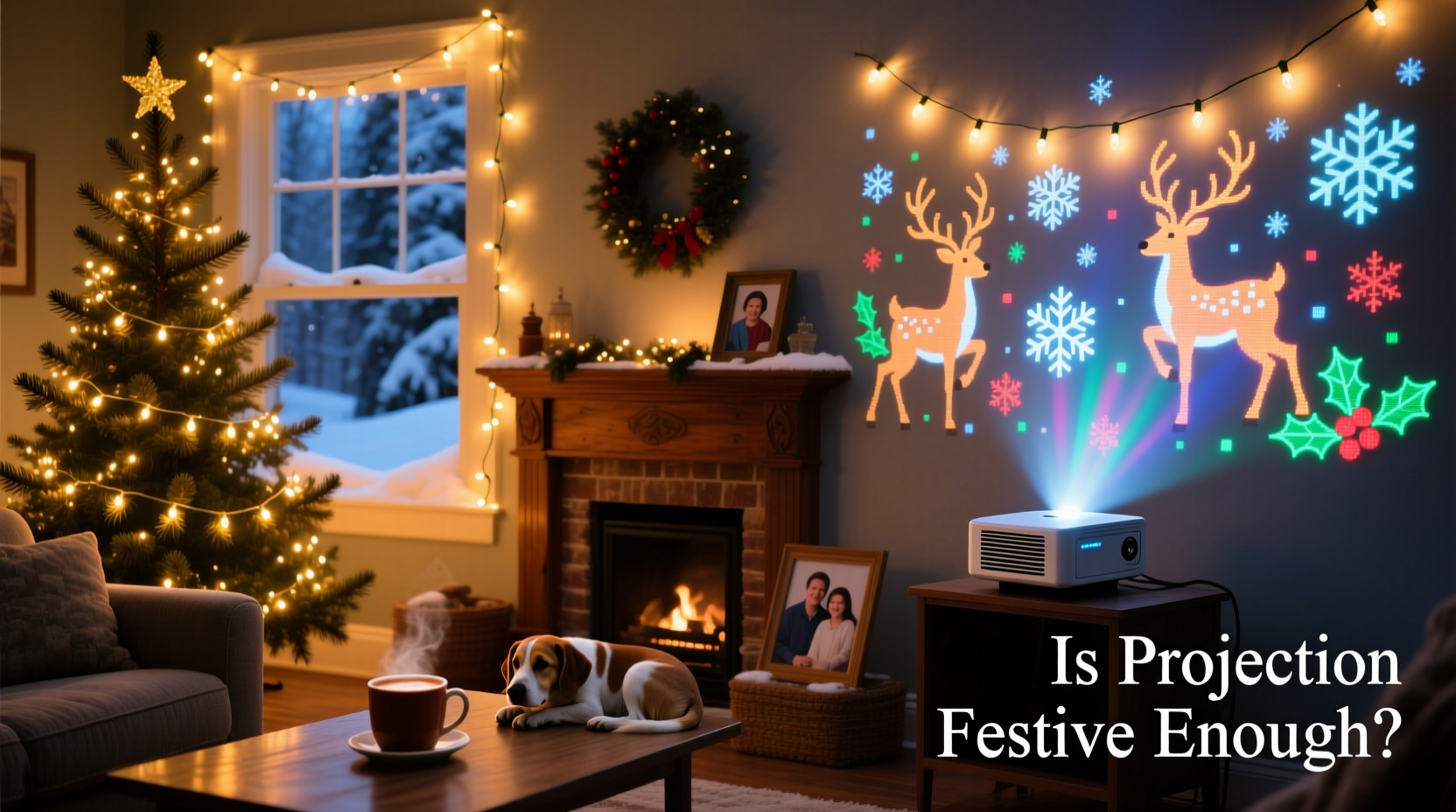
Projectors, by contrast, are digital emissaries. Most consumer-grade models use LED light engines paired with rotating gobo wheels or digital LCD/DLP chips to cast animated or static patterns—often with built-in timers, remote controls, and Bluetooth sync. They’re designed for flat, light-colored surfaces: white stucco, vinyl siding, garage doors. Their output isn’t ambient—it’s directional, high-contrast, and often sharply defined. A projected snowflake may cover six feet of wall, but it won’t wrap around a corner or twinkle in three dimensions like real lights do.
The physics matter. String lights emit diffuse, omnidirectional light; projectors emit focused, collimated beams. That difference shapes everything—from how shadows fall to how neighbors perceive your display from down the street.
Festivity Factor: Atmosphere, Authenticity, and Emotional Resonance
Festivity isn’t measured in lumens—it’s felt in memory. Psychologists studying seasonal affective patterns note that multi-sensory, tactile holiday rituals—like stringing lights together—trigger stronger neural encoding of positive emotion than passive visual consumption. When children help twist bulbs onto garlands, or grandparents recount which strand was used at their first home, the lights become vessels for narrative continuity.
Projection excels at spectacle: a 30-second animation loop of Santa flying across your roof can draw gasps from passing cars. But it rarely invites interaction. You don’t adjust a projector’s “mood” by swapping bulbs or adding a new color scheme mid-season. Its charm is cinematic—not communal.
“People don’t remember brightness—they remember presence. A flickering string of warm-white C9s on a porch railing feels like welcome. A high-definition reindeer projection feels like a commercial break.” — Dr. Lena Torres, Environmental Psychologist, Holiday Behavior Lab, University of Vermont
This isn’t nostalgia for its own sake. Studies tracking neighborhood cohesion during December show homes with visible, hands-on lighting displays report higher rates of spontaneous visitor interaction—neighbors stopping to chat, kids asking to help hang a strand—than homes relying solely on automated projection. Festivity, it turns out, is participatory.
Real-World Performance: Weather, Maintenance, and Longevity
Winter is unforgiving. Let’s compare how each holds up where it counts:
| Factor | String Lights | Christmas Light Projector |
|---|---|---|
| Lifespan (typical) | 3–7 years (LED), depending on storage & exposure | 1–3 years (LED engine degradation, motor wear on gobo wheels) |
| Cold tolerance | Rated to –25°F; flexible wiring handles freeze-thaw cycles | Most units rated only to 14°F; condensation inside optics causes fogging or failure |
| Wind resistance | Secure with clips/staples; may sway but rarely fails | Misalignment common—even 5 mph gusts shift projection; requires frequent re-aiming |
| Snow/rain impact | Water-resistant housings; occasional bulb replacement | Moisture ingress risk; lens fogging reduces brightness by up to 40% after overnight snow |
| Setup time (annual) | 2–6 hours (first year); 30–90 minutes thereafter | Under 10 minutes—unless surface is dirty, uneven, or shaded |
Here’s what manufacturers rarely highlight: projector performance plummets on textured surfaces. Brick, cedar shake, stucco with heavy aggregate, or even slightly weathered paint scatter light, turning crisp animations into blurry smudges. One homeowner in Portland, Oregon replaced his $199 projector three times over four seasons—not due to defects, but because rain-swollen cedar siding diffused the beam beyond recognition.
A Real Example: The Miller Family’s Two-Year Experiment
The Millers live in a 1938 Tudor-style home in Cincinnati—steep gables, half-timbering, and narrow, irregular windows. In 2022, they bought a premium projector promising “cinematic curb appeal.” They loved the ease: setup took eight minutes. But by night three, neighbors complained the red-and-green laser deer kept “jumping” onto their garage door. By week two, freezing drizzle coated the lens, and the “twinkling starfield” looked like static on an old TV.
In 2023, they invested in 1,200 warm-white LED mini-lights and spent a Saturday installing them with clip kits designed for architectural detail. It took 4.5 hours. The result? No complaints. Multiple neighbors asked where they bought the clips. Their 8-year-old started a “light patrol” each evening, checking for dark spots. When a bulb failed near the front door, he insisted on replacing it himself—with supervision. The lights didn’t “wow” passersby instantly. But people slowed down. They smiled. They said, “Your house looks like Christmas.”
They still own the projector. It now lives in the garage, illuminating their tool bench year-round.
What to Consider Before You Choose: A Practical Decision Checklist
- ✅ Your home’s architecture: Do you have large, smooth, light-colored walls—or complex textures, deep overhangs, or tall trees blocking line-of-sight?
- ✅ Your climate: Does your area see consistent sub-freezing temps, heavy snowfall, or frequent freeze-thaw cycles? (If yes, prioritize string lights’ reliability.)
- ✅ Your time budget: Are you willing to invest 2+ hours upfront for long-term ease—or do you need true plug-and-play, even if it means weekly adjustments?
- ✅ Your aesthetic goal: Do you want “cozy traditional,” “modern minimalist,” or “block-party spectacle”? Projection leans toward the latter; strings offer all three.
- ✅ Your audience: Are you lighting for family memories, neighborhood tradition, or social media shares? Projection wins for screenshots; strings win for shared moments.
Step-by-Step: Building a Hybrid Display That Delivers Both Charm and Convenience
The most satisfying solutions often reject false binaries. A thoughtful hybrid approach leverages the strengths of both—without doubling your workload.
- Anchor with strings: Install warm-white or amber LED mini-lights along rooflines, windows, and door frames—the structural bones of your display. Use commercial-grade clips for durability.
- Add depth with projection: Mount a projector low and angled upward to cast falling snow or gentle stars onto a clear section of garage door or fence—not the house itself. Keep animation subtle and slow-paced.
- Integrate smart control: Use a single smart plug or hub (e.g., Philips Hue or Lutron Caseta) to sync timing—so strings fade gently at 10 p.m. while the projector shuts off at 11 p.m.
- Layer textures: Place battery-operated twig lights or lanterns near the base of stairs or porch columns. This adds ground-level warmth that projection can’t replicate.
- Test before committing: Run your full setup for three consecutive nights—including one rainy and one windy evening—to assess real-world stability.
This method avoids the “all-or-nothing” trap. You get the authenticity of handmade light placement *and* the wow factor of motion—without sacrificing reliability.
FAQ: Straight Answers to Common Questions
Can I use a projector *with* string lights—or does it look cluttered?
Yes—and it often looks richer. Projection adds dynamic background interest (e.g., swirling snow behind a static string-wrapped tree), while strings provide foreground definition and dimension. Just ensure the projector’s color temperature matches your strings (2700K–3000K for warm white). Avoid clashing hues like cool-blue projection with warm-white strings.
Do projectors save money long-term compared to quality string lights?
Rarely. A durable set of commercial-grade LED strings costs $80–$150 and lasts 5+ years with proper storage. Mid-tier projectors ($120–$250) average 18 months of reliable outdoor use before optical drift or motor failure sets in. Factor in replacement bulbs (for older halogen models) or repair costs, and the ROI flips decisively toward strings.
Are there any projectors that genuinely hold up to real winters?
A few do—but they’re niche and expensive. Commercial units like the Light-O-Rama PicoPro or Color Kinetics iColor Flex (used by municipalities) operate reliably down to –40°F, feature heated lenses, and cost $800–$2,500. For residential use, treat consumer projectors as seasonal accessories—not permanent fixtures.
Conclusion: Festivity Isn’t About the Tool—It’s About the Intention Behind It
There’s no shame in choosing convenience. Life is busy. Not every household has the time, ladder access, or physical ability to hang thousands of lights. A projector can bring genuine joy—especially for seniors, renters, or those managing chronic fatigue. But let’s stop pretending it’s equivalent to the layered, dimensional, deeply human experience of string lights. One is a broadcast; the other is a conversation.
The most memorable holiday displays don’t shout the loudest. They invite pause. They carry weight—of care, of repetition, of small acts done with attention. A single strand of lights, carefully hung, tells a story of presence. A projector, however dazzling, tells a story of efficiency.
You don’t need to choose forever. Try a projector this year—then next December, spend an afternoon with a spool of warm-white LEDs and a pair of gloves. Notice how the light catches differently on your windowpane. How your neighbor waves instead of just slowing down. How your child points not at the animation, but at the way the real bulbs reflect in the frost on the glass.




 浙公网安备
33010002000092号
浙公网安备
33010002000092号 浙B2-20120091-4
Comments
No comments yet. Why don't you start the discussion?