
When decorating exterior brick walls for the holidays, achieving crisp, well-defined lighting patterns is essential to creating a professional-looking display. Brick surfaces are textured and uneven, making them both an ideal canvas for dramatic lighting effects and a challenge for maintaining sharpness. Two popular options—Christmas light projectors and traditional string lights—offer very different results in this context. Understanding how each performs on masonry will help you choose the right method for maximum visual impact.
Projectors cast light from a distance, relying on optics and lens quality, while string lights are placed directly on or near the surface, producing illumination through proximity. The question isn’t just about brightness or ease of installation—it’s about precision. For homeowners aiming for clean lines, distinct shapes, and high-definition holiday motifs like snowflakes, reindeer, or stars, pattern sharpness becomes the deciding factor.
How Surface Texture Affects Light Clarity
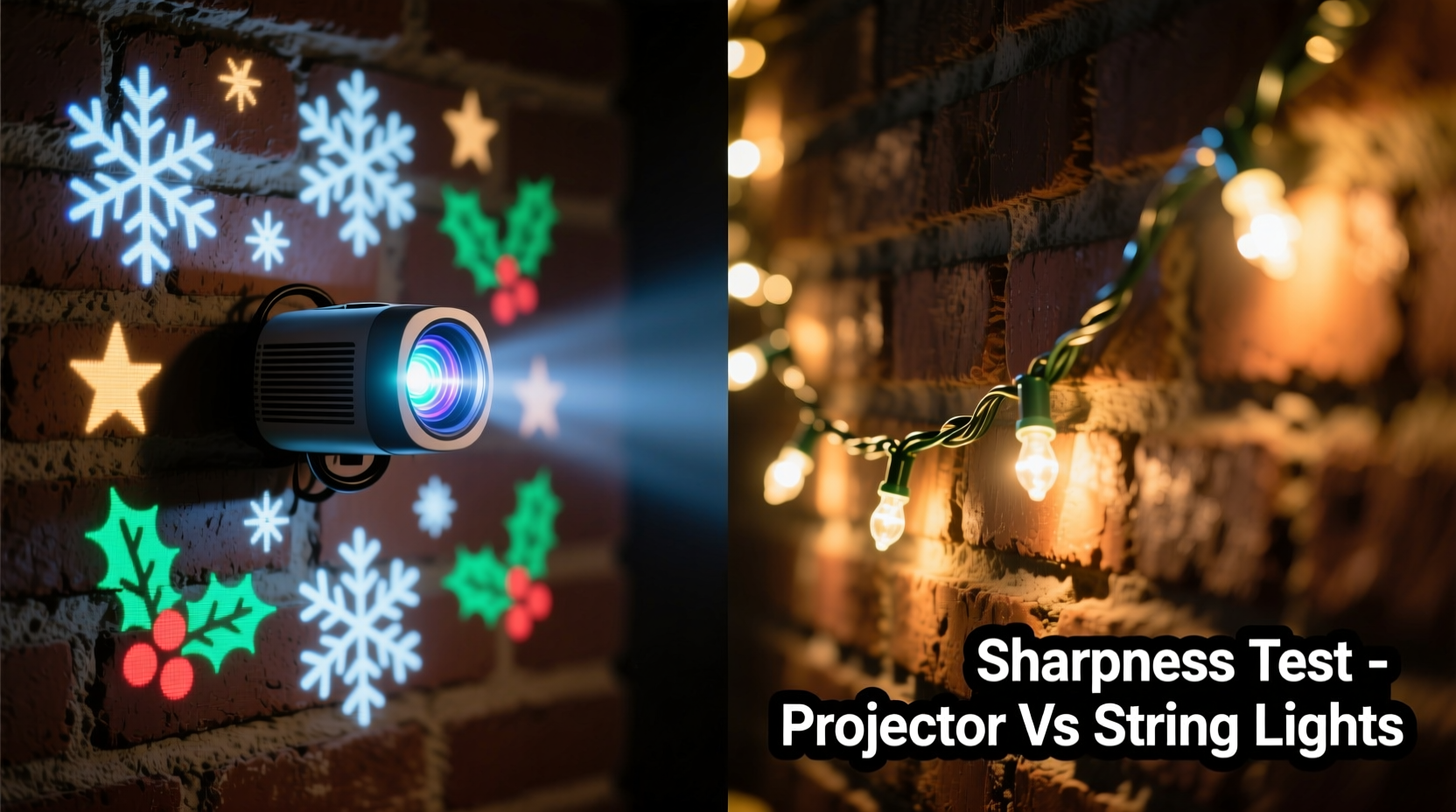
Brick walls present unique challenges due to their depth, grooves, and irregular mortar lines. These textures can scatter light, blur edges, and create shadows that distort patterns. The way light interacts with these surfaces depends heavily on the source type and placement.
String lights, when draped or stapled along a wall, follow the contours of the bricks. This means the bulbs sit at varying depths, causing inconsistent projection angles and diffused glows around each point. While charming up close, the overall pattern may appear soft or fragmented when viewed from a distance—especially if spacing between bulbs is wide.
In contrast, Christmas light projectors emit a focused beam from a single source, typically several feet away from the wall. High-quality lenses can maintain edge definition across textured surfaces by projecting uniformly, minimizing distortion caused by individual brick relief. However, if the projector is misaligned or too close, even slight wall imperfections can magnify blurring.
Pattern Precision: Projector Technology Breakdown
Modern Christmas light projectors use LED arrays combined with transparent stencils (gobos) or digital micro-mirrors (DLP-based systems) to generate patterns. The sharpness of the resulting image hinges on three key factors: lens quality, gobo resolution, and throw distance.
- Lens Quality: Multi-element glass lenses reduce chromatic aberration and focus light more precisely than plastic alternatives.
- Gobo Resolution: Metal or high-density polymer templates with fine etching produce cleaner outlines. Lower-end models often have thicker borders and less detail.
- Throw Distance: Most projectors perform best between 15 and 30 feet from the target. Too close, and the image appears compressed and blurry; too far, and intensity drops, reducing contrast.
Top-tier projectors, such as those used in commercial displays, can achieve near-laser sharpness with crisp transitions between lit and unlit areas. Consumer-grade units vary widely—some deliver surprisingly clear snowflake silhouettes on brick, while others smear details across mortar joints.
“With proper alignment and a quality gobo, a projector can render intricate patterns on brick with better edge definition than manually placed strings.” — Daniel Reeves, Outdoor Lighting Designer & Seasonal Display Consultant
String Lights: Control Through Placement and Density
Unlike projectors, string lights offer physical control over every illuminated point. Their ability to form sharp patterns depends entirely on design intent and execution. If the goal is a literal outline—such as a star made from connected bulbs—the clarity improves dramatically with higher bulb density and strategic mounting.
For example, using mini LED strings with 100 bulbs per 25 feet allows tighter curves and straighter lines than older C7/C9 strands spaced every 6 inches. When secured flush against the wall with clips or staples, these dense strings minimize shadowing and maintain consistent elevation, reducing depth-related blur.
However, limitations arise when attempting complex shapes. A projector can display a detailed nativity scene instantly; replicating that with string lights would require hundreds of connection points, custom framing, and extensive wiring. Even then, the result would be a series of dots rather than a continuous image.
| Feature | Light Projector | String Lights |
|---|---|---|
| Edge Sharpness (on brick) | High (with quality lens/gobo) | Moderate (depends on bulb spacing) |
| Setup Time | 5–10 minutes | 30 mins – 2+ hours |
| Pattern Complexity | High (snowflakes, animations, scenes) | Low to Moderate (outlines only) |
| Viewing Distance Ideal | 15–40 ft | 10–30 ft |
| Maintenance Needs | Minimal (clean lens, secure base) | Regular (check connections, reattach clips) |
| Weather Resistance | Varies (check IP rating) | Generally high (outdoor-rated) |
Real-World Example: Suburban Home Display Comparison
A homeowner in Portland, Maine, tested both methods on their red brick garage façade during the 2023 holiday season. They used a Luminara ProJet 3000 (a mid-range projector with interchangeable gobos) and a 50-foot string of 200-count warm white mini LEDs.
The projector was placed 22 feet from the wall, angled upward at 35 degrees, displaying a rotating sequence of snowflakes and icicles. From the street, the patterns appeared sharply defined, with clean six-fold symmetry in each snowflake. Mortar lines caused minor texture interference, but no significant distortion.
The string lights were arranged into a large star shape using adhesive clips. Despite careful alignment, the corners showed slight wavering due to brick protrusions forcing some bulbs forward. At night, the star was recognizable but lacked the crispness of the projected images. Neighbors consistently commented that the projector looked “more professional” and “like something from a store display.”
The homeowner noted that while the string lights required nearly two hours to install perfectly, the projector was operational in under ten minutes. However, they did need to adjust its angle twice during windy nights to prevent image drift.
Step-by-Step Guide to Maximizing Pattern Sharpness
Whether you choose a projector or string lights, follow these steps to enhance clarity on brick walls:
- Clean the Wall Surface: Remove dirt, cobwebs, and debris that could scatter light or create unwanted shadows.
- Choose the Right Equipment: For projectors, select models with glass lenses and high-resolution gobos. For strings, opt for high-density LED sets (100+ bulbs per 25 ft).
- Determine Optimal Positioning: Place projectors 15–30 feet back at a stable elevation. For strings, plan layouts on paper first to minimize guesswork.
- Test at Night: Evaluate patterns under real viewing conditions. Adjust projector focus or reposition string segments as needed.
- Secure All Components: Use stakes for projector bases; use UV-resistant clips for strings to prevent sagging.
- Limit Ambient Interference: Turn off nearby outdoor lights to increase contrast and perceived sharpness.
- Use Multiple Angles (Optional): For string lights, consider backlighting techniques using behind-wall fixtures to reduce depth variance.
Tips for Choosing Based on Your Goals
- Choose a projector if: You value quick setup, dynamic visuals, and gallery-level pattern detail. Ideal for renters or those who change themes annually.
- Choose string lights if: You prefer hands-on customization, long-term installations, or wish to highlight specific architectural features like columns or archways.
- Combine both: Some decorators use projectors for background effects (e.g., falling snow) and string lights for foreground outlines (roofline, door frames), creating layered depth.
Frequently Asked Questions
Can I use multiple projectors for larger brick walls?
Yes, but ensure patterns don’t overlap unless designed to do so. Misaligned projections can create moiré effects or blurred zones. Use projectors with adjustable focus and stagger their positions for seamless coverage.
Do string lights look better on smooth versus brick walls?
Absolutely. On flat surfaces, string lights produce uniform, sharp lines. On brick, depth variation causes subtle inconsistencies. For best results on masonry, use flexible wire forms behind the strings to maintain plane alignment.
Why does my projector image look fuzzy on brick?
Fuzziness often stems from incorrect focus, low gobo resolution, or placing the unit too close. Clean the lens, verify the throw distance matches manufacturer specs, and ensure the wall isn’t reflecting moisture or frost, which scatters light.
Checklist: Achieving Sharper Holiday Lighting on Brick
- ☐ Select high-lumen projector with glass lens (if using projection)
- ☐ Choose mini LED strings with tight bulb spacing (if using strings)
- ☐ Measure throw distance and test positioning before final setup
- ☐ Clean brick surface to reduce light diffusion
- ☐ Secure all equipment against wind or vibration
- ☐ Evaluate clarity from typical viewing angles (street, sidewalk)
- ☐ Increase contrast by minimizing competing light sources
- ☐ Consider hybrid approach: projector for patterns, strings for accents
Final Recommendation: When Sharpness Matters Most
If your primary objective is sharp, well-defined patterns on a brick wall—particularly intricate designs like snowflakes, stars, or holiday figures—a high-quality Christmas light projector will almost always outperform string lights. Its ability to project uniform, focused images across textured surfaces gives it a technical edge in clarity and consistency.
That said, string lights remain unmatched for structural outlining and tactile presence. They glow with warmth and craftsmanship that projectors can’t replicate. But for pure optical precision, especially in complex or animated displays, projectors lead the field.
The best decision often comes down to balance. For maximum impact, combine a sharp-projected background effect with strategically placed string lights that frame doors, windows, or rooflines. This hybrid strategy leverages the strengths of both technologies, delivering both definition and dimension.
“The future of holiday lighting isn’t one or the other—it’s intelligent layering. Projectors handle the art; strings define the architecture.” — Lena Torres, Landscape Lighting Innovator, IllumiNation Design Group
Take Action This Season
This holiday season, don’t settle for blurred edges or uneven spreads on your brick walls. Test both methods on a small section before committing. Invest in a reputable projector with a proven track record on textured exteriors, or meticulously install dense string lights with attention to alignment. Share your results, compare night-time photos, and refine your approach year after year. With the right tools and insights, your home can become the sharpest, most memorable display on the block.




 浙公网安备
33010002000092号
浙公网安备
33010002000092号 浙B2-20120091-4
Comments
No comments yet. Why don't you start the discussion?