
As the holiday season approaches, homeowners face a familiar decision: how to decorate their homes with festive lights. For decades, string lights have been the go-to option—delicate strands of bulbs wrapped around trees, railings, and rooftops. But in recent years, Christmas light projectors have emerged as a modern alternative, promising dazzling displays with minimal effort. The real question isn’t just about brightness or style—it’s about ease. Is a Christmas light projector truly easier than traditional strings? The answer depends on what you value most: speed, control, longevity, or visual richness.
The Setup Experience: Speed vs. Precision
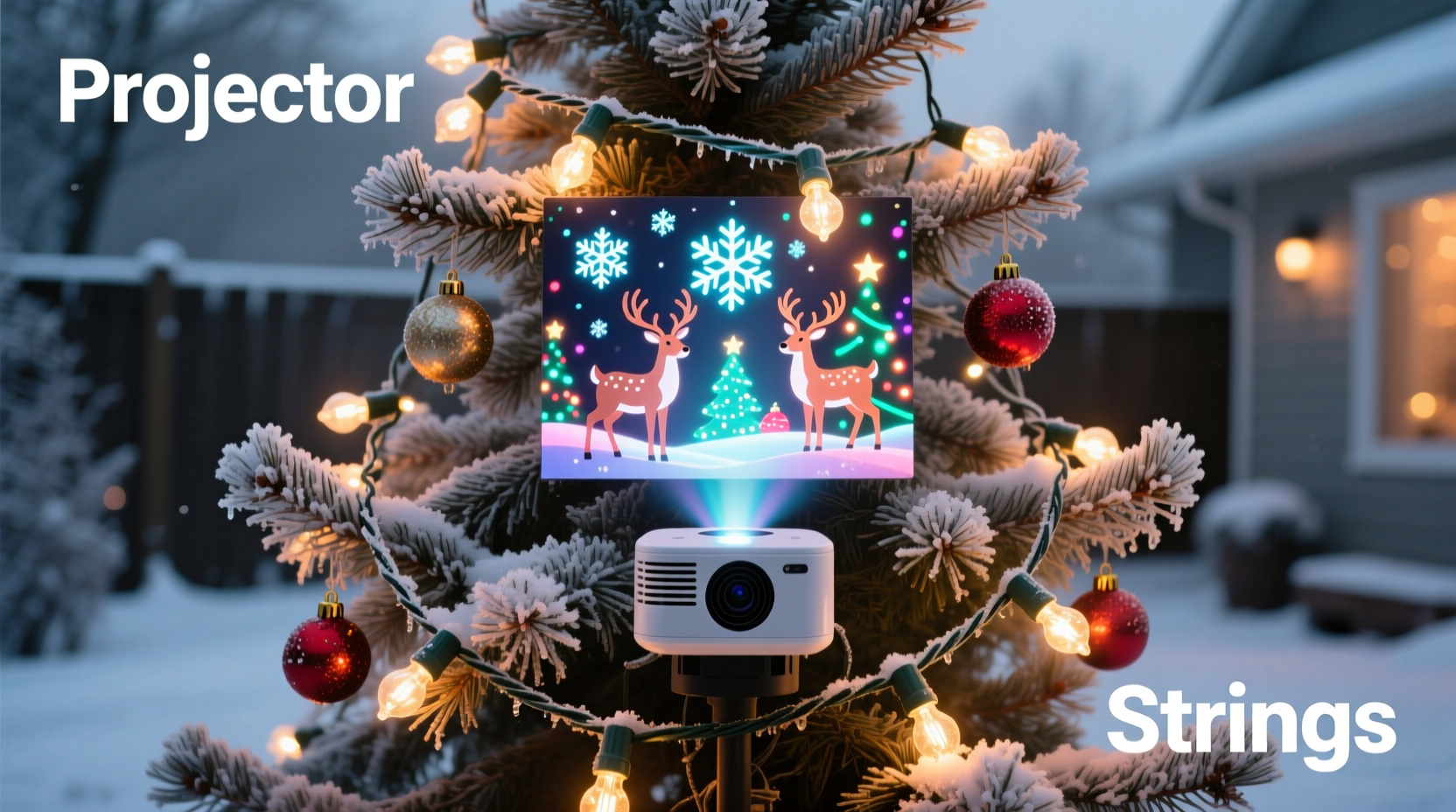
One of the biggest selling points of Christmas light projectors is their rapid setup. Unlike traditional strings, which require untangling, testing, draping, and securing, a projector can be ready in minutes. Simply place it on a stable surface or mount it on a tripod, plug it in, and aim it at your house. Most models offer 360-degree rotation and adjustable focus, allowing coverage across multiple walls or large facades with a single unit.
In contrast, traditional string lights demand time, patience, and often a ladder. You must test each strand for burnt-out bulbs, secure clips or hooks along gutters or siding, and ensure even spacing. For a two-story home, this could take several hours—or an entire weekend if done meticulously. However, that hands-on process allows for precision. With strings, you can highlight architectural details, outline windows, or create custom patterns that projectors simply can’t replicate.
Maintenance and Durability Over Time
Once installed, both options require some upkeep—but the nature of that maintenance differs significantly. Projectors are largely “set and forget.” There are no individual bulbs to replace, no wires to reattach after wind damage. However, they rely on internal components like lenses, fans, and LED arrays. If the cooling system fails or moisture seeps into the housing, the entire unit may stop working. Most projectors last 3–5 seasons under normal conditions, but exposure to harsh weather can shorten that lifespan.
Traditional string lights, while more labor-intensive, offer modularity. If one bulb burns out, you can replace it or bypass it without affecting the whole strand. Many modern sets come with shunt-wired technology that keeps the rest lit even when a bulb fails. With proper storage—using reels or organizers and keeping them in climate-controlled spaces—quality string lights can last a decade or more. They’re also easier to repair incrementally.
“Projectors are great for quick impact, but long-term decorators still prefer strings because they’re more resilient and customizable over time.” — Marcus Tran, Holiday Lighting Designer & Installer
Visual Impact and Customization
When it comes to aesthetics, traditional string lights provide a classic, warm glow that many associate with nostalgia and craftsmanship. You can mix colors, densities, and bulb types (C7, C9, mini LEDs) to achieve different moods. Want icicle effects along the eaves? Doable. Looking to outline every window in gold? No problem. The flexibility is unmatched.
Projectors, on the other hand, excel at covering large areas quickly. A single unit can simulate thousands of twinkling lights across a broad wall or lawn. Some advanced models even cycle through animations—falling snow, shooting stars, or pulsing color waves. But they lack depth. Because the light is projected from a distance, shadows and textures on your home’s surface can distort the pattern. Bricks, siding seams, or protruding vents might break up the image, making it look uneven.
Moreover, projectors are limited by their built-in designs. You can’t change the pattern unless the model includes interchangeable lenses or digital modes. Even then, you’re confined to manufacturer presets. Strings let you design freely—curving around trees, spelling out words, or creating layered effects that feel immersive rather than flat.
Cost Comparison Over Multiple Seasons
Upfront, projectors often appear cheaper. A basic model starts around $30–$50, while high-end versions with multiple patterns and remote controls range from $80 to $150. In contrast, fully decorating a medium-sized home with quality LED string lights can cost $200–$400 depending on length and features.
But long-term costs tell a different story. Consider this breakdown:
| Factor | Light Projector | Traditional String Lights |
|---|---|---|
| Initial Cost (per unit) | $40–$150 | $15–$30 per 100-light strand |
| Lifespan | 3–5 years (average) | 8–12 years (with care) |
| Replacement Cost | Full unit replacement | Individual strands or bulbs |
| Energy Use (avg. nightly) | 15–25 watts | 5–10 watts per 100 lights |
| Storage Space | Compact (one unit) | Bulky (multiple reels/bins) |
While projectors save space and initial labor, their shorter lifespan means replacing them more frequently. Over ten years, buying two or three projectors could equal or exceed the cost of a durable string light setup. Plus, if you want multiple projection angles, you’ll need additional units—quickly increasing both price and power consumption.
Installation Step-by-Step: Real-World Timelines
To understand the true difference in ease, consider how long each method takes from start to finish in a typical suburban home.
Christmas Light Projectors: 30–60 Minutes
- Unbox the projector and check all parts (lens caps, power cord, mounting hardware).
- Choose a location with clear line-of-sight to the target wall (driveway, porch step, garden stake).
- Mount or place securely; adjust tilt and rotation for full coverage.
- Plug into an outdoor-rated extension cord and GFCI outlet.
- Turn on and fine-tune focus and pattern alignment.
- Set timer or remote function if available.
Traditional String Lights: 4–8 Hours
- Unpack and test all strands for functionality.
- Measure key areas (eaves, windows, trees) and plan layout.
- Install clips or gutter hooks every 6–12 inches.
- Drape and secure lights evenly, avoiding sagging or gaps.
- Connect strands in series, ensuring not to exceed circuit load.
- Run extension cords safely, using rodent guards and elevated paths.
- Test final display and make adjustments.
The time gap is undeniable. For someone with limited mobility, a busy schedule, or no interest in DIY work, projectors are clearly easier. But for those who enjoy the ritual of decorating or want a tailored look, strings offer a rewarding experience—even if it’s slower.
Mini Case Study: The Nguyen Family’s Two-Year Experiment
The Nguyen family in Denver, Colorado, decided to test both methods over two consecutive holidays. In Year One, they used a dual-lens red-and-green projector aimed at their front facade. Setup took 45 minutes. Neighbors complimented the brightness, but by mid-December, snow accumulation blocked part of the beam, and the fan inside began making a grinding noise. By January, the unit failed completely.
The following year, they invested $275 in commercial-grade LED string lights, including icicle strands, net lights for bushes, and rope lighting for railings. Setup took two weekends with help from their teenagers. But the result was transformative—a layered, dimensional display that wrapped around porches and trees. They stored the lights carefully in labeled bins. Three years later, they’re still using the same set with only two bulb replacements.
“We thought the projector would be our forever solution,” said Lisa Nguyen. “But it felt temporary. The strings take more work, but they feel like part of our tradition now.”
Tips for Getting the Best Results from Either Option
- For projectors: Clean the lens regularly with a microfiber cloth to maintain brightness.
- For strings: Use a light tester to quickly identify dead sections before installation.
- Label cords and store by area (e.g., “Front Eaves,” “Tree Wrap”) to simplify next year’s setup.
- Aim projectors slightly upward to reduce glare and improve vertical coverage.
- Overlap string light strands slightly at connection points to hide dark gaps.
Frequently Asked Questions
Can I use a Christmas light projector indoors?
Yes, but most are designed for outdoor use and may be too bright for small rooms. Indoor-specific models exist with softer outputs and decorative patterns suitable for ceilings or walls.
Do string lights use more electricity than projectors?
It depends on scale. A single projector uses about 20 watts. But 1,000 mini LED lights consume roughly 100 watts total—still energy-efficient by modern standards. Overall, projectors use less power per unit, but large string displays may use more due to coverage needs.
Are light projectors safe in the rain?
Most are rated for outdoor use (IP44 or higher), meaning they resist splashing water. However, prolonged exposure to heavy rain or submersion can damage internal components. Always place under an overhang or use a weatherproof cover if possible.
Checklist: Choosing the Right Option for Your Home
- ✅ Assess your available time for setup and takedown.
- ✅ Measure your home’s exterior to determine coverage needs.
- ✅ Decide whether you prefer customization or convenience.
- ✅ Check for nearby power outlets and GFCI compliance.
- ✅ Evaluate storage space for off-season.
- ✅ Consider long-term budget versus upfront savings.
- ✅ Read reviews for reliability, especially in your climate.
Conclusion: Ease Is Personal—Choose Based on Your Priorities
So, is a Christmas light projector truly easier than traditional strings? In terms of speed and simplicity, yes—by a wide margin. It’s the ideal choice for renters, seniors, or anyone who wants festive ambiance without the hassle. But “easier” doesn’t always mean “better.” Traditional string lights offer unmatched control, durability, and emotional resonance. They become heirlooms, passed down and refined over years.
The truth is, ease is subjective. If your priority is minimizing effort, go with a projector. If you value craftsmanship, longevity, and personal expression, invest in quality strings. Or consider a hybrid approach: use projectors for large background effects and strings for detailed accents. That way, you get both speed and sparkle.




 浙公网安备
33010002000092号
浙公网安备
33010002000092号 浙B2-20120091-4
Comments
No comments yet. Why don't you start the discussion?