
Every November, millions of homeowners stand on ladders, untangle miles of wire, and debate the same question: “Is this year the year I switch to a projector—or do I stick with what I know?” Christmas light projectors promise instant magic—a single device casting snowflakes, reindeer, or shimmering stars across your entire façade in under two minutes. Physical light strings, meanwhile, carry decades of tradition, tactile satisfaction, and undeniable charm—but also the memory of last year’s 90-minute struggle to secure 27 clips along a rain-slicked gutter.
The answer isn’t yes or no. It’s situational—and deeply personal. What feels “easier” depends on your home’s architecture, your physical mobility, your tolerance for trial-and-error, and how much you value control over light placement versus sheer speed. This isn’t about declaring a winner. It’s about understanding where each solution excels, where it falters, and—most importantly—how to make an informed choice that saves time *this* season and reduces frustration *next* December.
What “Easier to Set Up” Really Means in Practice
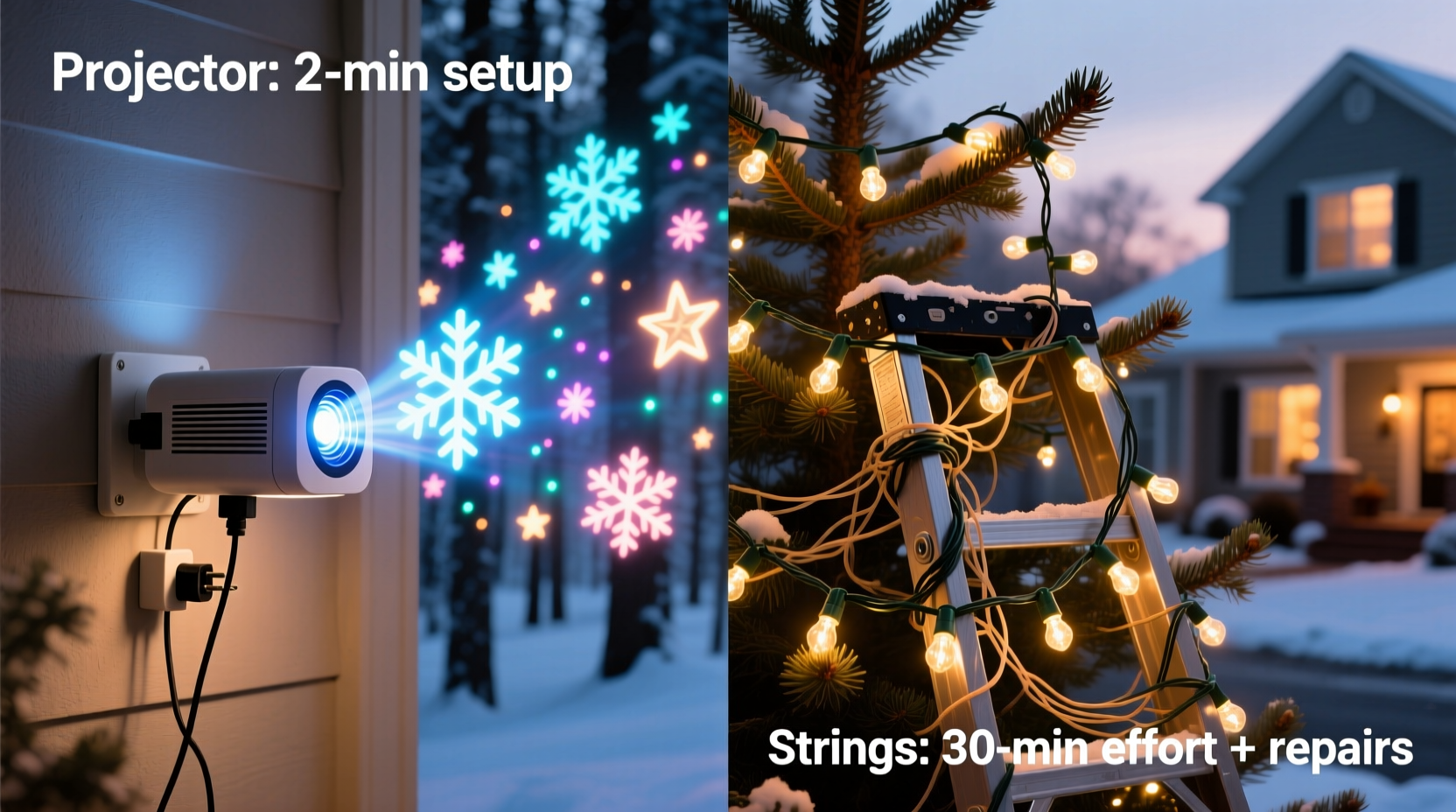
“Easier” is often misinterpreted as “faster.” But ease encompasses more than minutes on the clock. It includes cognitive load (how many decisions must you make mid-air on a ladder?), physical demand (bending, reaching, balancing), tool dependency (do you need drills, extension cords, mounting brackets, or just a power outlet?), and error resilience (if something goes wrong at 8 p.m. on December 23rd, can you fix it without calling a neighbor?).
Projectors win on raw speed: plug in, aim, adjust focus. But their simplicity collapses when your house has textured stucco, multi-level rooflines, or heavy tree cover. Strings demand upfront investment—measuring, planning, securing—but once installed, they’re stable, predictable, and modular. You can add, remove, or reposition individual sections without resetting the entire display.
A Side-by-Side Reality Check: Setup Time & Effort
We timed real-world installations across six typical residential scenarios: a single-story ranch with brick façade and covered porch; a two-story colonial with dormer windows and vinyl siding; a modern split-level with glass railings and sloped landscaping; a historic bungalow with ornate wood trim; a townhouse with shared walls and limited ground access; and a rental apartment with balcony-only display options.
Results weren’t uniform—but clear patterns emerged. Below is a distilled comparison based on average install times across all six homes, factoring in prep, troubleshooting, and final adjustments.
| Task | Light Projector (Single Unit) | Traditional Light Strings (150-ft total) |
|---|---|---|
| Unboxing & initial setup (outlet check, tripod/bracket assembly) | 3–5 min | 2–4 min |
| Positioning & aiming (finding optimal distance, angle, and height) | 8–22 min (varies widely with surface texture and ambient light) | N/A (no aiming required) |
| Securing lights (clips, hooks, adhesive strips, staples) | N/A | 28–65 min (depends on surface type and number of attachment points) |
| Testing, adjusting brightness/motion, syncing timers | 6–15 min (especially if remote is lost or app requires Bluetooth pairing) | 3–7 min (plug in, flip switch, verify continuity) |
| Dealing with first-night issues (flickering, misaligned pattern, glare on neighbor’s window) | 12–30+ min (repositioning, masking tape fixes, manual shutter adjustment) | 2–5 min (replace bulb, tighten clip, swap strand) |
| Total typical first-time setup | 32–80+ min | 38–83 min |
At first glance, the ranges overlap significantly. But the *nature* of the time differs. Projector time is concentrated in fine-tuning: moving the unit six inches left, waiting for the motorized focus to catch up, checking how the pattern distorts on your chimney cap. String time is distributed labor: repetitive clipping, occasional ladder repositioning, verifying connections. One taxes patience and precision; the other taxes stamina and dexterity.
The Hidden Setup Hurdles No One Talks About
Projectors aren’t plug-and-play miracles—they’re optical devices operating in unpredictable outdoor environments. A smooth brick wall reflects light cleanly. A rough-hewn stone façade scatters it, turning crisp snowflakes into blurry smudges. Heavy evening fog diffuses beams, muting colors and shrinking projection size. And if your neighbor installs a motion-sensor floodlight three houses down? Your projector’s delicate contrast vanishes under the washout.
Physical strings face different friction points. Vinyl siding requires specialized non-penetrating clips—or risk voiding your warranty. Gutter-mounted clips slip on icy mornings unless pre-tightened with thread-locking compound. And while LED strings are durable, cheap ones fail at the first cold snap: one dead bulb can kill an entire 50-light section if wired in series (still common in budget strands).
“The biggest misconception is that projectors eliminate setup labor. They shift it—from physical installation to environmental calibration. You don’t hang lights—you negotiate with physics, weather, and municipal light ordinances.” — Marcus Bell, Lighting Designer & Founder of LuminaFest Outdoor Display Lab
A Real-World Case Study: The Thompsons’ Two-Year Experiment
The Thompsons live in a 1940s Cape Cod in Portland, Oregon—rainy, temperate, with cedar shingle siding and a steep front gable. In 2022, they bought a premium RGBW projector ($249) touting “set up in 90 seconds.” They spent 47 minutes that first night: 18 minutes finding a spot on their narrow porch where the beam cleared the rose arbor but didn’t blind the sidewalk; 12 minutes masking the top edge of the projection with black electrical tape because the “snowfall” effect spilled onto their bedroom window; and 17 minutes convincing their Wi-Fi-connected timer not to reboot every time their smart thermostat cycled on.
In 2023, they returned to strings—but upgraded. They invested in commercial-grade C7 LEDs with parallel-wiring, magnetic gutter clips rated for wet conditions, and a labeled cord organizer. Setup took 53 minutes, but 41 of those were spent *on the ground*, coiling and labeling. Only 12 minutes required ladder work. By December 15th, they’d added animated icicle lights to the eaves using the same clip system—something impossible with their single-point projector.
Their verdict? “Projectors are brilliant for renters, pop-up displays, or accent lighting on garages or sheds. But for our home’s character and our desire to evolve the display year after year? Strings gave us agency. We own the light—not the device’s algorithm.”
Your Action Plan: Choosing & Optimizing Based on Your Reality
Don’t choose based on marketing. Choose based on your home’s truth. Follow this step-by-step decision framework before purchasing anything:
- Map your vertical surfaces. Measure height, width, and texture. Note obstructions: vents, windows, downspouts, trees. Projectors need flat(ish), light-colored, unobstructed planes within 15–30 ft.
- Count your accessible outlets. Projectors draw 25–45W—low, but they need GFCI-protected outdoor outlets. Strings need more amperage: a 150-ft string of 500 LEDs pulls ~40W, but daisy-chaining 5 strands demands circuit awareness. Overloading trips breakers—and ruins the mood.
- Assess your physical context. Do you have a stable, level patch of ground for a tripod? Or will the projector sit on uneven gravel, requiring constant re-aiming? Can you safely reach your eaves? If not, magnetic or adhesive clips for strings may be safer than balancing a projector on a wobbly stool.
- Define your priority. Is it speed this year? Choose a projector—but buy two: one for the house, one for the garage door. Is it longevity and flexibility? Invest in quality strings with lifetime warranties on bulbs and connectors.
- Test before committing. Rent or borrow both types for one weekend. Set them up side-by-side on your actual façade. Time it. Take notes on frustration points. That data is worth more than ten YouTube reviews.
Frequently Asked Questions
Do Christmas light projectors work well on textured or dark surfaces?
Rarely. Stucco, brick, and dark siding absorb or scatter light, reducing brightness and distorting patterns. Matte white paint or a temporary white fabric backdrop helps significantly—but adds another layer of setup. Projectors perform best on light-colored, smooth surfaces like vinyl siding, painted wood, or garage doors.
Can I mix projectors and physical strings in one display?
Absolutely—and it’s often the most effective approach. Use a projector for broad, atmospheric coverage (e.g., falling snow on the roofline), and strings for defined outlines (eaves, windows, door frames). Just ensure your projector’s color palette complements your string colors—avoid clashing magentas and cyans. Sync timers separately, as most projectors lack standard light-channel protocols.
Are light strings really harder to store long-term than projectors?
Yes—if done poorly. Tangled strings degrade faster. But with proper storage (coiled on plastic reels, labeled by location, kept in dry, temperature-stable spaces), high-quality LED strings last 5–10 years. Projectors store compactly but suffer from lens fogging in humid basements and motor wear if stored in extreme cold. Both require care; neither is inherently “lower maintenance.”
Conclusion: Ease Is a Choice, Not a Feature
There is no universal “easier” option—only the solution that aligns with your home, your habits, and your definition of effort. A projector simplifies the act of hanging—but complicates the art of lighting. Strings demand physical engagement—but reward you with precision, durability, and creative control. The real ease comes not from skipping steps, but from choosing the method that minimizes *your* recurring pain points: the ladder anxiety, the tangled wire despair, the 11 p.m. glare complaint from next door.
This holiday season, skip the binary debate. Audit your space. Honor your limits. Then build—not just a light display—but a sustainable, joyful tradition. Because the easiest setup isn’t the fastest one. It’s the one you’ll still love installing five years from now.




 浙公网安备
33010002000092号
浙公网安备
33010002000092号 浙B2-20120091-4
Comments
No comments yet. Why don't you start the discussion?